
SoFi Technologies announces expanded partnership with Mastercard, positioning its full reserve US dollar stablecoin SoFiUSD as a settlement currency within the global payment network. Under the agreement, both parties will explore how issuing and acquiring banks can use SoFiUSD to settle credit and debit card transactions, with SoFiUSD expected to receive technical support from Mastercard’s multi-token network.
SoFiUSD Integration with Mastercard’s Technical Architecture and Core Goals
SoFiUSD was issued by SoFi Bank last December. The bank is a federally chartered depository institution regulated by the Office of the Comptroller of the Currency (OCC) and insured by the Federal Deposit Insurance Corporation (FDIC), with the token deployed on Ethereum. Fully backed 1:1 by cash reserves, SoFiUSD is positioned as the first stablecoin issued by a nationally chartered bank on a public blockchain.
This partnership integrates SoFiUSD into traditional financial settlement infrastructure, focusing on: issuing and acquiring banks exploring replacing fiat currency with SoFiUSD for transaction settlement; connecting traditional payment channels and digital asset ecosystems via Mastercard’s multi-token network; and Galileo platform providing SoFiUSD settlement options to payment card customers and issuing banks.
SoFi CEO Anthony Noto stated, “SoFiUSD is at the core of our strategy, aiming to enable faster, cheaper, and more secure money transfers worldwide. With SoFiUSD as the settlement currency on the Mastercard network, issuing and acquiring banks can more easily help millions of businesses globally achieve real-time, 24/7 settlement.”
Key Elements of SoFiUSD Integration with Mastercard’s Global Network
Unique Background: The first stablecoin issued by a nationally chartered bank regulated by OCC on the Ethereum public blockchain
Technical Integration: Connecting to Mastercard’s multi-token network to explore interoperability between fiat, stablecoins, and tokenized deposits
Use Cases: Cross-border remittances, inter-business transfers, 24/7 real-time transaction settlement
Platform Role: Galileo as an early adopter providing SoFiUSD settlement options to issuing banks
Programmable Payments: Both parties will explore programmable fund management and new payment transfer solutions (subject to regulatory approval)
Market Context and Industry Significance of Stablecoin Settlement
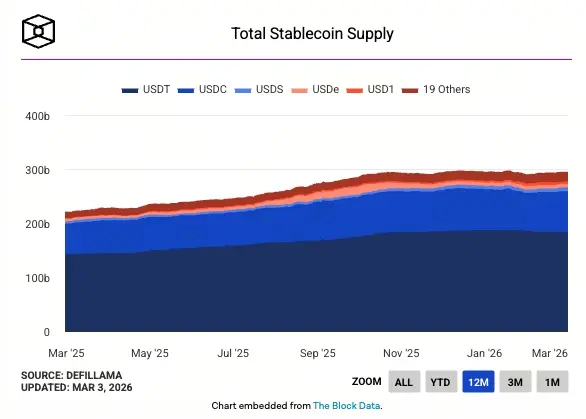 (Source: The Block)
This partnership exemplifies the rapid growth of the global stablecoin market. According to McKinsey, daily stablecoin trading volume is approximately $30 billion, with issuance doubling by 2025 compared to the previous year. A global study by BVNK in collaboration with Coinbase and Artemis shows over half of crypto holders have held stablecoins in the past 12 months, and more than 75% of respondents would open a stablecoin wallet if offered by their bank.
Sherri Haymond, Mastercard’s Head of Global Digital Commerce, said this collaboration will expand the operational capabilities of regulated stablecoins in the real world, making regulated digital currencies more reliable, secure, and widely accessible for consumers, businesses, and financial institutions.
Frequently Asked Questions
What is SoFiUSD, and what makes it special?
SoFiUSD is a full reserve US dollar stablecoin issued by SoFi Bank, fully backed 1:1 by cash reserves, deployed on Ethereum. Its uniqueness lies in being the first stablecoin issued by a federally regulated, FDIC-insured national bank on a public blockchain, combining traditional banking compliance with blockchain transparency.
What does the integration of SoFiUSD with Mastercard mean for global payments?
This integration allows SoFiUSD to serve as a settlement currency within Mastercard’s global payment network, enabling issuing and acquiring banks to explore replacing traditional fiat with stablecoins for settlement, unlocking faster, 24/7 settlement capabilities for cross-border remittances and inter-business transfers.
What is Mastercard’s Multi-Token Network (MTN)?
Mastercard’s Multi-Token Network is a digital asset platform designed to connect traditional payment channels with the digital asset ecosystem, enhancing interoperability between fiat, stablecoins, and tokenized deposits to provide more settlement options across the payment ecosystem.
Disclaimer: The information on this page may come from third parties and does not represent the views or opinions of Gate. The content displayed on this page is for reference only and does not constitute any financial, investment, or legal advice. Gate does not guarantee the accuracy or completeness of the information and shall not be liable for any losses arising from the use of this information. Virtual asset investments carry high risks and are subject to significant price volatility. You may lose all of your invested principal. Please fully understand the relevant risks and make prudent decisions based on your own financial situation and risk tolerance. For details, please refer to
Disclaimer.
Related Articles
ETH drops 0.69% in 15 minutes: large on-chain transfer outflows trigger a rebound of spot sell pressure
During the period from 2026-04-19 22:00 to 2026-04-19 22:15(UTC), the ETH price fell from 2275.98 USDT to 2252.72 USDT. The return over 15 minutes was -0.69%, and the amplitude reached 1.02%. During this round of unusual price movement, short-term market volatility increased, attention on major coins rose, trading activity improved, and volatility was clearly tilted bearish.
The main driver behind this unusual move is the frequent occurrence of on-chain ETH large transfers with both high frequency and notable volume concentrated in a short period. Using a certain well-known hot wallet as a hub, more than 20,000 ETH were transferred out in a short time, and some of it has been traced on-chain and confirmed to have flowed to other exchanges’ receiving addresses. After funds briefly flowed into trading platforms, the number of sell orders in the spot market increased significantly, bringing about a phase of liquidity pressure and further intensifying the downward move in price. In addition, the futures market is linked to spot volatility; during the decline, highly leveraged long positions were liquidated passively, pushing short-term prices to release more downside pressure.
At the same time, the pace of ETF capital inflows has slowed since mid-April. Within the latest range, continuous net inflows have been trending steadily, and coupled with some funds making small redemptions, this weakens the market’s institutional support. Global risk sentiment is also facing synchronized pressure—repeated swings in macro-level expectations for the Federal Reserve’s policy and heightened geopolitical tensions have driven inflows into safe-haven assets. The U.S. Dollar Index strengthened in the short term, global equity markets came under pressure, and this further reinforced ETH’s ongoing downside pressure. In addition, the 24-hour trading volumes for spot and futures were 21.75 billion USD and 42.76 billion USD, respectively; futures open interest was 30.93 billion USD. The liquidation size showed no abnormality, indicating a structural adjustment under multi-dimensional market convergence.
Going forward, it is necessary to stay alert to risks such as continued large outflows on-chain and ETF capital movements shifting from inflows to outflows. If the macro environment deteriorates further, ETH may further intensify volatility. For short-term support, watch the 2250 USDT area; resistance is at 2275 USDT. The ETF trend, the direction of on-chain transfers, and macro news remain the key indicators to monitor for the next stage. Please closely follow subsequent market developments and the flow of large on-chain funds, and promptly capture relevant trading information.
GateNews2h ago
ETH drops 0.56% in 15 minutes: Institutions’ ETF in-and-out flows and tightened on-chain liquidity dominate the market
From 17:45 to 18:00 (UTC) on 2026-04-19, the ETH price recorded a return of -0.56% within 15 minutes, closing in the 2294.03 - 2311.0 USDT range, with an amplitude of 0.73%. Heightened market volatility triggered increased short-term trading activity and boosted attention, while overall liquidity performance tightened.
The main driving force behind this unusual move is institutions’ short-term in-and-out flows of ETF funds and a lull in on-chain stablecoin activity. In early April, after the ETH spot ETF recorded a net inflow of $120.24 million over a short period, it quickly reversed to a net outflow of $64.61 million, indicating that institutional capital became more short-term and there was no signal of sustained accumulation. Meanwhile, on-chain USDT and USDC activity fell in tandem to an annual low; ETH’s short-term buying power was clearly insufficient, putting pressure on liquidity.
In addition, high-win-rate whales have been frequently shorting ETH and BTC since April 14, with related position sizes exceeding $25 million, further intensifying downward pressure in the short term. On the macro front, the Federal Reserve maintains high interest rates, the U.S. dollar remains strong, risk appetite has shifted to cautious, and some funds have flowed into traditional assets such as U.S. stocks. On-chain data shows that exchange reserves for ETH have fallen to the lowest level in nearly a decade, suggesting that long-term holders are actively shifting away from self-custody, further reducing market liquidity supply and amplifying price anomalies. Network conditions are stable; gas fees are operating at low levels, and on-chain transactions have not shown extreme spikes.
The risk of near-term fluctuations remains high. ETF fund flows, large on-chain transfers, stablecoin activity, and changes in whale positions will be key indicators to watch. If institutions step up selling or stablecoin outflows expand further, ETH price volatility may intensify. Please continue to monitor macro developments and on-chain liquidity changes, stay alert to the risk of sharp short-term volatility, and get more real-time updates.
GateNews7h ago
ETH breaks below 2300 USDT
Gate News bot message, Gate market shows that ETH breaks below 2300 USDT, current price 2299.54 USDT.
CryptoRadar8h ago
A judge ruled that the JENNER meme coin issued by socialite Jenners from the Kardashian family is not a security, dismissing the lawsuit.
The U.S. District Court for the Central District of California ruled that the $JENNER meme coin issued by socialite Jenna, of the Kardashian family, does not meet the definition of a security, dismissing investors’ lawsuit. The judge said the plaintiffs failed to prove the features of a common enterprise and can bring other claims in state court.
ChainNewsAbmedia9h ago
ETH breaks through 2350 USDT
Gate News bot message, Gate quotes show that ETH has broken through 2350 USDT, with the current price at 2350 USDT.
CryptoRadar11h ago
KelpDAO Exploiter Borrows $195M ETH from Aave, TVL Drops $6.28B as Whales Withdraw
Gate News message, the KelpDAO exploiter borrowed over 82,600 ETH ($195M) from Aave using RSETH as collateral, resulting in bad debt appearing on Aave. Following this incident, numerous whales withdrew funds from Aave, causing its TVL to decline from $26.396B to $20.114B, a decrease of $6.28B.
GateNews13h ago


