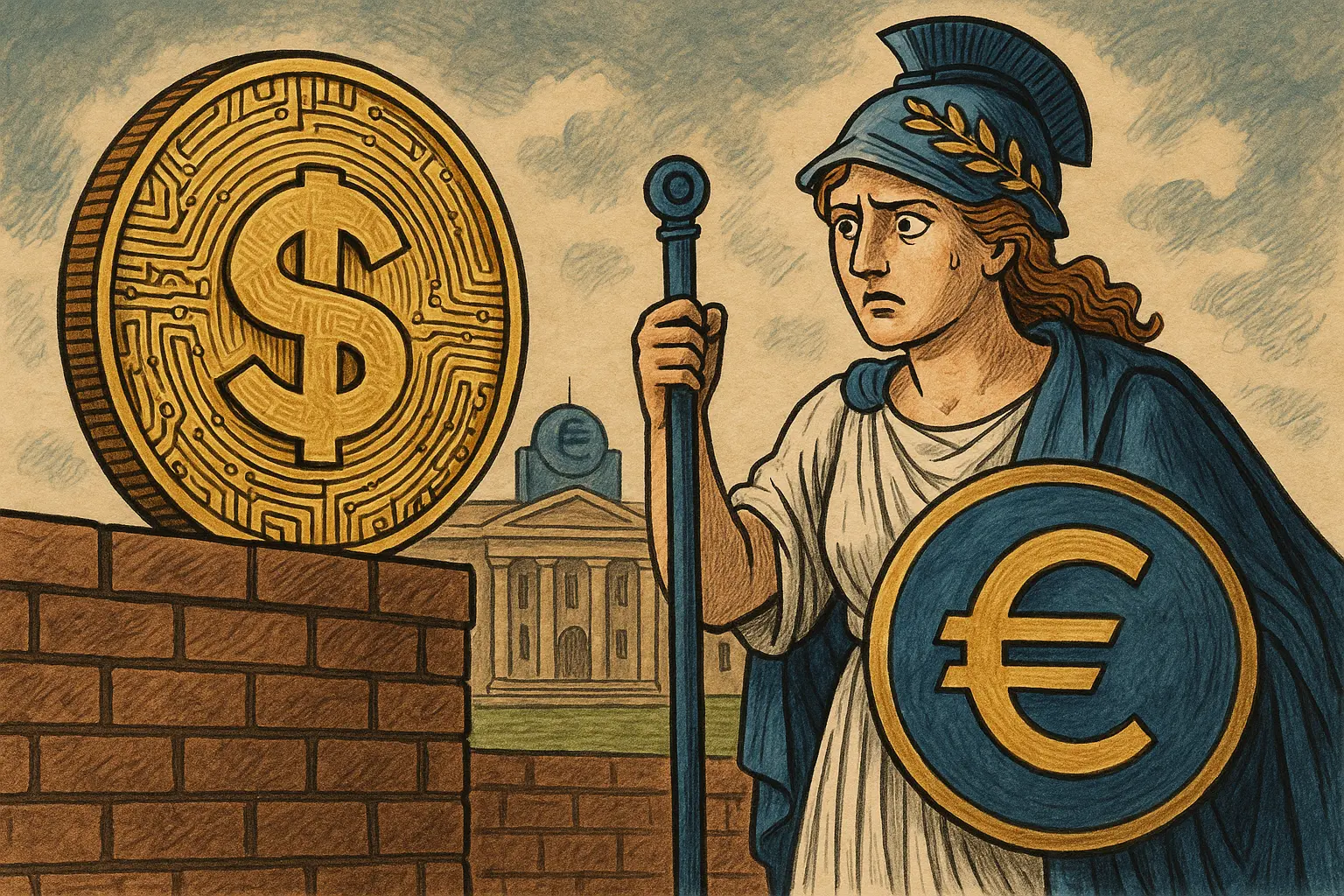
Researchers at the European Central Bank (ECB) have published a working paper warning that widespread adoption of stablecoins could pose significant risks to the euro area banking system and the ECB’s monetary sovereignty, especially in a context where foreign currency-denominated instruments such as the US dollar dominate. This could introduce external currency conditions into the eurozone and increase uncertainty in the transmission of monetary policy.
Core Risk Identification Framework of the Working Paper
This jointly authored working paper by multiple ECB researchers identifies three main transmission channels through which the widespread adoption of stablecoins could impact the euro area’s monetary system.
First, rapid expansion could trigger large-scale reallocation of funds from retail bank deposits into digital assets, weakening the stability of banks’ funding sources; second, impaired banking intermediation could reduce the effectiveness of ECB policy rate transmission to actual lending volumes; third, if the stablecoin market is dominated by non-euro-denominated instruments, the impact could be significantly amplified—fluctuations in demand for foreign currency-denominated stablecoins may directly transmit external currency and financial shocks into the euro area.
The document states: “Demand fluctuations for foreign currency-pegged stablecoins could transmit external currency and financial shocks directly into the euro area, effectively introducing external liquidity conditions that may be orthogonal to domestic policy stances.”
Policy Context: Trump’s Crypto Policies Trigger European Regulatory Vigilance
The release of this ECB working paper coincides with the Trump administration actively promoting mainstream adoption of cryptocurrencies, raising broad concerns about the potential expansion of US dollar-backed stablecoins in European markets. ECB Executive Board member Piero Cipollone previously stated in January that such tools could “threaten financial stability”; meanwhile, German Bundesbank President Joachim Nagel has expressed a more positive view, emphasizing the potential benefits of euro-pegged stablecoins in payment scenarios.
Currently, major European banks such as Citigroup, ING, UniCredit, and DekaBank are collaborating on developing regulated euro stablecoins, seen as an active European response to counter the expansion of dollar-denominated stablecoins.
Key Risk Points Identified in the ECB Working Paper
Deposit Reallocation: Rapid expansion may lead to large-scale transfer of retail deposits into digital assets, weakening banks’ funding base.
Impaired Intermediation: Unstable bank funding sources reduce credit provisioning capacity, impacting real economy financing.
Reduced Policy Transmission Effectiveness: ECB rate adjustments face obstacles in transmission to the loan market, weakening monetary policy effectiveness.
Amplification by Foreign Currency Stablecoins: When dollar and other foreign currency stablecoins dominate the market, external currency shocks can enter the euro area directly without ECB control.
Wholesale Financing Risks: Banks may increase reliance on foreign currency wholesale funding, further diminishing sensitivity to ECB policy stance.
Frequently Asked Questions
What exactly does the ECB mean by the “monetary sovereignty” risk?
The ECB’s monetary sovereignty refers to its ability to effectively influence borrowing costs and credit flows in the euro area through policy rate adjustments. When large funds shift from ECB-regulated bank deposits to foreign currency-denominated stablecoins, the ECB’s policy tools have significantly less influence over these funds, weakening the transmission of interest rate decisions.
Why are US dollar stablecoins more threatening to European monetary policy than euro stablecoins?
Euro stablecoins’ reserves and operations are still under ECB regulation, maintaining relatively complete monetary policy transmission channels. In contrast, the liquidity and value of US dollar-denominated stablecoins are determined by the Federal Reserve’s policies. Once widely circulated in the euro area, they effectively introduce US monetary conditions directly into European markets, bypassing ECB tools and creating a direct channel for external currency shocks.
Can the joint development of euro stablecoins by European banks effectively address ECB’s risk concerns?
The euro stablecoin plans led by institutions like Citigroup, ING, UniCredit, and DekaBank align somewhat with the ECB’s stance—German Bundesbank President Nagel has expressed a positive attitude toward euro stablecoins in payment applications. If euro stablecoins can compete with dollar stablecoins in scale and usability, they may reduce users’ motivation to switch to foreign currency tools. However, specific regulatory frameworks and launch timelines remain unclear.
Disclaimer: The information on this page may come from third parties and does not represent the views or opinions of Gate. The content displayed on this page is for reference only and does not constitute any financial, investment, or legal advice. Gate does not guarantee the accuracy or completeness of the information and shall not be liable for any losses arising from the use of this information. Virtual asset investments carry high risks and are subject to significant price volatility. You may lose all of your invested principal. Please fully understand the relevant risks and make prudent decisions based on your own financial situation and risk tolerance. For details, please refer to
Disclaimer.
Related Articles
Trump Says U.S. Should Always Maintain Lowest Global Interest Rates
Gate News message, April 21 — U.S. President Donald Trump stated that "the United States should always maintain the lowest global interest rates." Trump noted that interest rate adjustments have played a role in addressing inflation concerns.
GateNews49m ago
Trump Says He Has Always Supported Rate Hikes to Combat Inflation
Trump reiterates support for rate hikes to curb inflation, claiming the policy has effectively restrained price pressures.
GateNews50m ago
Bank of Japan Likely to Hold Rates at April 28 Meeting, But Maintains Hawkish Stance
Summary: BoJ is likely to hold at 0.75% on April 28 while signaling future rate hikes if conditions permit; June action remains possible, with some officials leaning toward a near-term move amid inflation risks from geopolitical shocks and a higher forecast.
Abstract: The Bank of Japan is expected to keep its policy rate at 0.75% at the April 28 meeting, signaling eventual hikes as conditions permit; discussion centers on timing and a potential June move, in light of geopolitical tensions and an updated inflation outlook.
GateNews6h ago
Bank for International Settlements Warns: Stablecoins Are More Like Securities, Redemption Flaws Could Trigger a Bank Run
International Settlements Bank (BIS) Managing Director Pablo Hernández de Cos warned on Monday at a Bank of Japan conference in Japan that the global stablecoin market has surpassed $315.9 billion, but its operating mechanism is closer to investment products such as ETFs rather than true money. The BIS said that if large-scale redemptions occur, it would trigger a chain-reaction effect similar to the run on Silicon Valley Bank in 2023.
MarketWhisper7h ago
Bank of Korea Governor Outlines CBDC, Deposit Token Expansion and Won Internationalization Strategy
South Korea's central bank Governor Shin Hyun-song aims to promote CBDCs and deposit tokens through Project Hangang Phase 2, emphasizing digital payment innovation and financial stability while signaling a softening stance on stablecoins.
GateNews11h ago
Kevin Warsh 成首位「Tech Bro」Fed 主席提名人:AI 樂觀派、持 SpaceX 與 Polymarket 股份
Kevin Warsh, nominated by Trump, becomes the first “Tech Bro” Fed chair, closely connected with Silicon Valley giants, and argues that AI can reduce inflation and supports an accommodative monetary policy. His Silicon Valley background could influence the Fed’s interest-rate decisions; expectations for the crypto market are positive, but the risk of conflicts of interest also needs to be considered. His appointment process and future policy direction will affect the U.S. Dollar Index and valuations of Taiwan stocks.
ChainNewsAbmedia23h ago


