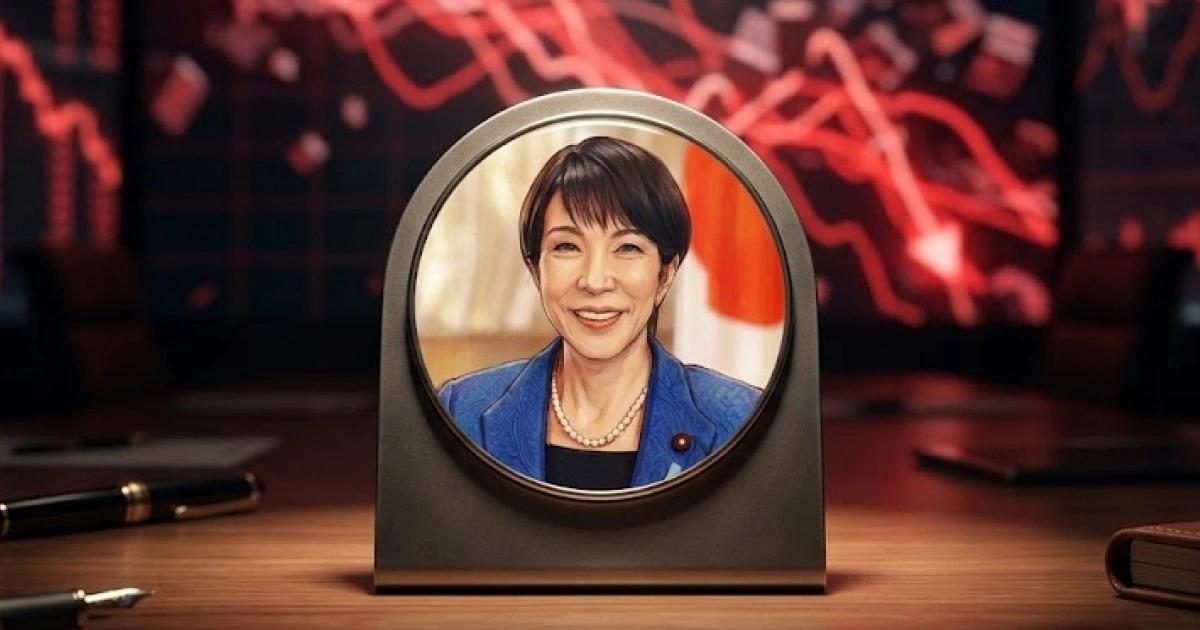
Japanese Prime Minister Sanae Takaichi firmly denies involvement in the issuance of the cryptocurrency called SANAE TOKEN. The coin was promoted with political slogans, and after the Prime Minister issued a statement clarifying that she was not involved, the price plummeted immediately, sparking outrage from the community and investors who labeled it a typical scam.
Sanae Takaichi Issues Statement Denying Involvement in SANAE TOKEN
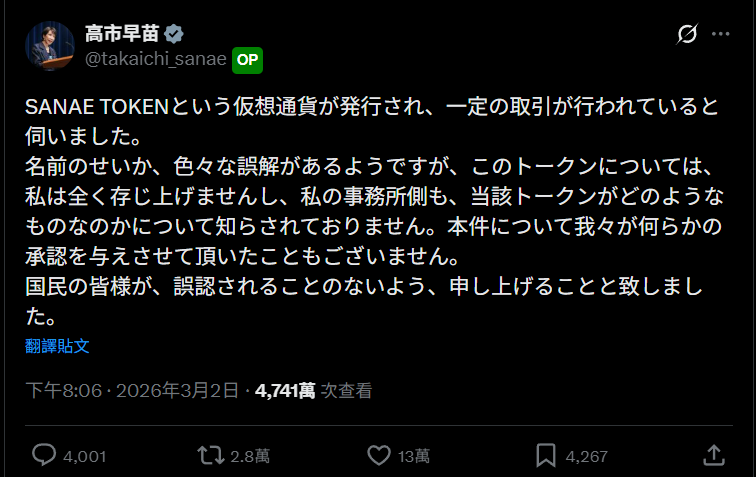
Recently, a cryptocurrency called SANAE TOKEN has been heavily promoted within Japanese communities and on YouTube. Last night (3/2), Japanese Prime Minister Sanae Takaichi publicly responded, strongly denying any participation or endorsement of SANAE TOKEN. Following her statement, the coin’s value crashed, and Japanese citizens criticized the issuer harshly.
Takaichi pointed out that SANAE TOKEN has some trading volume, but due to its name, it has caused many misunderstandings. She emphasized she was completely unaware of it, and her office had never been informed of any details regarding this token.
She clarified that the Japanese government has never approved or endorsed this project in any form. To prevent public misunderstanding among Japanese citizens, she decided to make this statement publicly.
SANAE TOKEN Uses Political Branding, Promotion Methods Spark Controversy
According to CoinPost, SANAE TOKEN is a meme coin launched on the Solana blockchain on February 25, with a total supply of about 1 billion tokens. The issuer is NoBorder DAO, a Web3 community run by serial entrepreneur Yuji Mizoguchi. The operational team holds a large proportion of tokens and has not locked liquidity.
However, the issuer claims that SANAE TOKEN is not just a meme coin but a reward token related to the “Japan is Back” ideology, aimed at encouraging political participation among the public.
During promotion, Mizoguchi revealed on his YouTube show that they had communicated with Sanae Takaichi’s camp, and even Takafumi Horie, former CEO of Livedoor, Japan’s popular portal site, expressed anticipation. These statements led the public to mistakenly believe that the project had official approval.

Subsequently, a community account claiming to be the official support group for Sanae Takaichi posted support for SANAE TOKEN, causing the coin’s price to surge temporarily.
Because these tactics can easily mislead the public into thinking government officials are involved, industry experts questioned the legality and ethics of such actions. Ultimately, the Prime Minister had to step forward to clarify.
SANAE TOKEN Price Collapses, Community Labels It a Typical Investment Scam
According to data from DEX Screener, after Takaichi’s statement, SANAE TOKEN’s price dropped over 50%, accompanied by a panic sell-off.
Some netizens captured clips from Mizoguchi’s online show, sharply criticizing those promoting the token on the program, saying they deserve punishment. Others criticized that if the Prime Minister was truly unaware and unendorsed, this is a classic community-based investment scam.
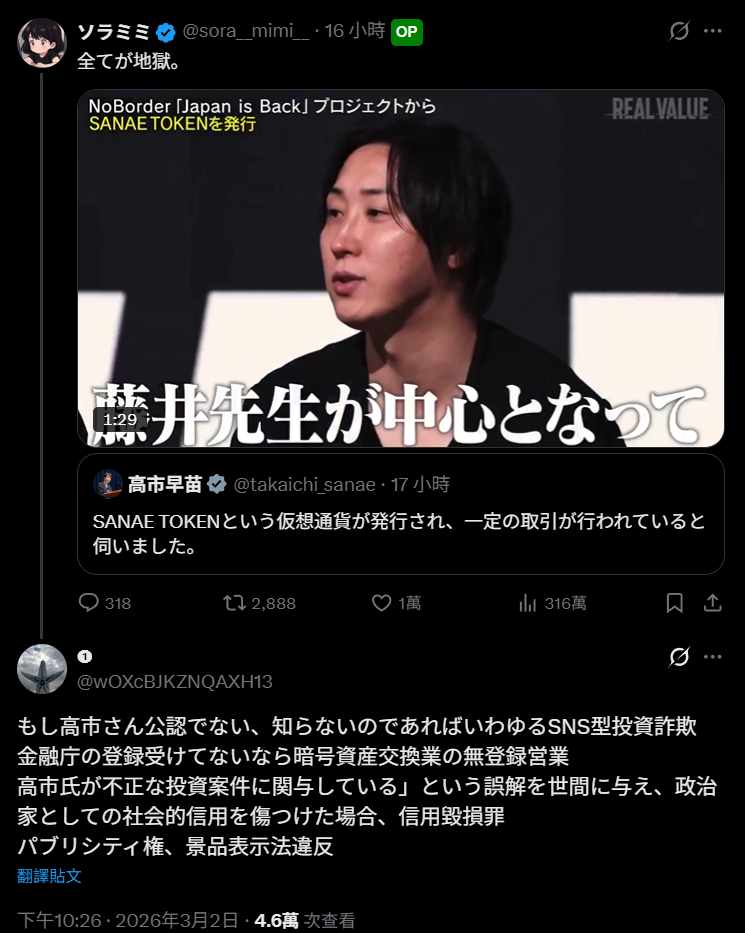
Additionally, Mizoguchi is suspected of transferring large amounts of tokens from internal wallets, further fueling community suspicion that this is a malicious Ponzi scheme. The controversy continues to escalate within Japanese online communities.
Start-up company neu Takes Responsibility, but Questions Remain
Mizoguchi later posted that he is seeking expert advice, and the token issuing company, “Kabushiki Kaisha neu,” has come forward to take full responsibility.
CEO Ken Matsui stated that he is responsible for the design and issuance of the tokens, and NoBorder was merely a委託 (commissioned party). He promised to further explain the events so far and future policies.
However, some netizens pointed out that Ken Matsui’s X (formerly Twitter) account was only created in March this year and has only posted this one message.
Additionally, Japanese media personality Kazuyoshi Shimoyasu noted that after searching for the company registration number 2010401171131 of neu, he found no records in the Ministry of Health, Labour and Welfare’s employee pension data, raising doubts about the company’s existence. Some also found that the business scope submitted at registration did not mention Web3, blockchain, or cryptocurrencies, yet the official website claims to offer Web3 services.
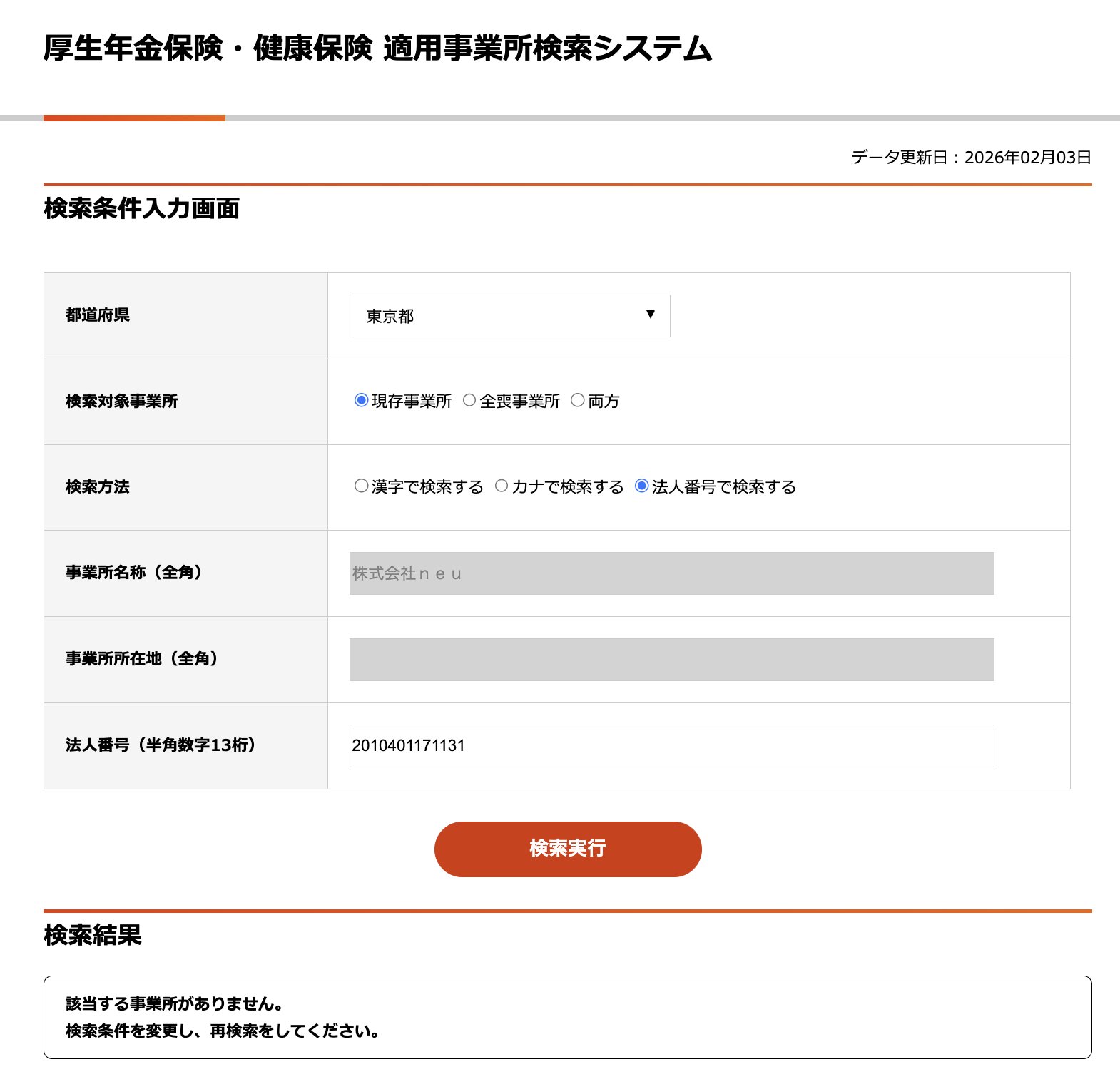
Image source: Kazuyoshi Shimoyasu
When personally checking the registered address of Kabushiki Kaisha neu, Google Street View currently shows a rentable apartment in M.A Roppongi BLD, Minato Ward. It is said that their office is located on the third floor of this building.
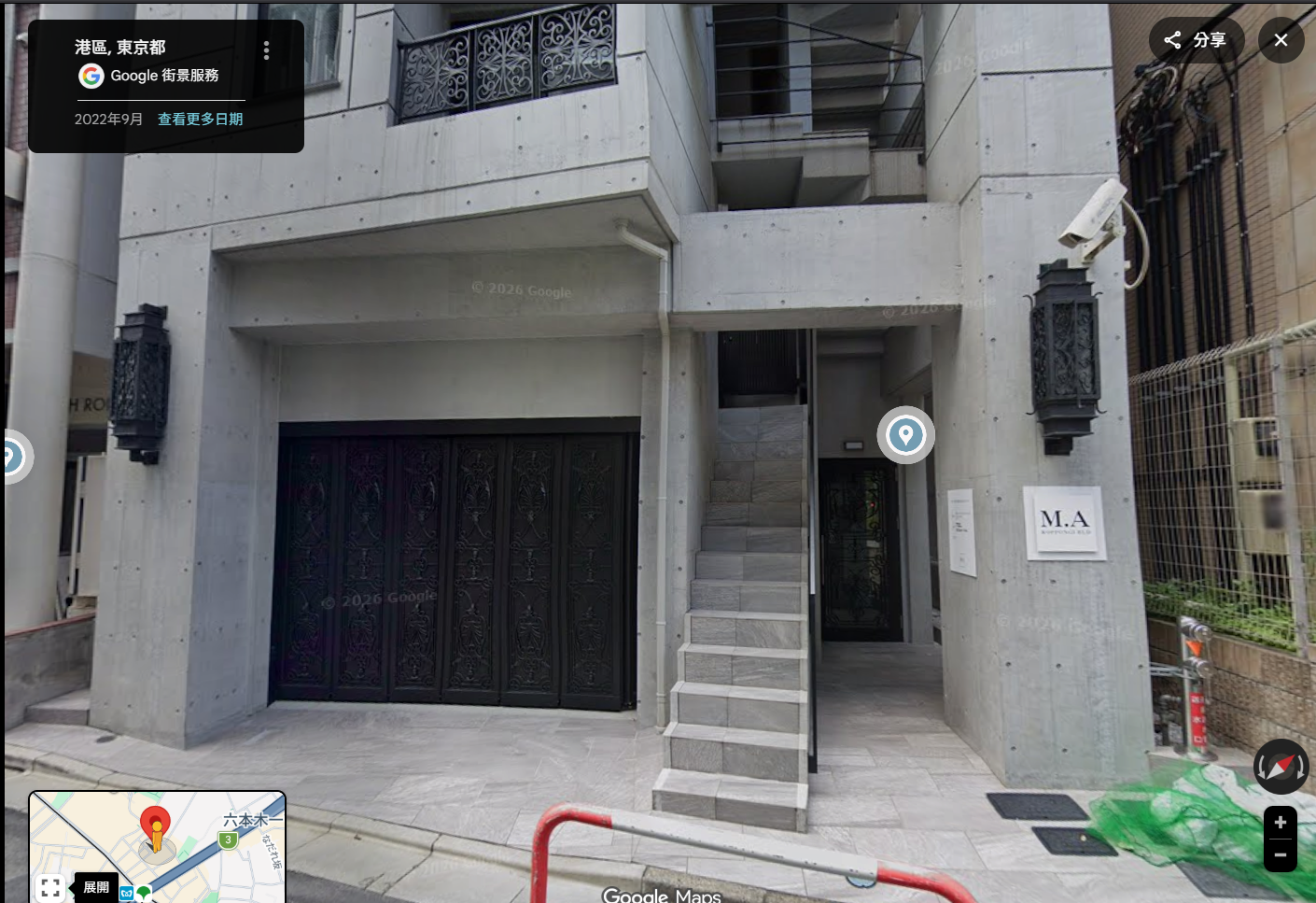
Image source: Google Street View
Using Celebrity Names Faces Legal Risks; Investors Should Be Cautious
This SANAE TOKEN incident raises serious ethical and legal issues. Unauthorized use of political figures’ names and images for commercial profit may infringe on publicity rights and could lead to significant civil liabilities in the future.
Although the SANAE TOKEN official website states that the project was not directly approved or collaborated with Sanae Takaichi, the overall design heavily uses her name and illustrations, which critics see as a mere formality.
Legally, netizens have pointed out several potential violations:
- If SANAE TOKEN’s issuer has not obtained proper licensing from the Financial Services Agency, it may be operating illegally in the crypto asset exchange business.
- If the project misleads the public and damages the reputation of the political figure, it could violate Japan’s defamation laws and the Act against Unjustifiable Premiums and Misleading Representations, which regulate exaggerated advertising and over-giving.
This incident serves as a reminder for the public to be highly vigilant when encountering cryptocurrencies that use the names of politicians or celebrities. Always conduct thorough research, as such tokens often carry high investment risks and legal controversies. Investors should carefully evaluate and avoid falling into financial traps.
Disclaimer: The information on this page may come from third parties and does not represent the views or opinions of Gate. The content displayed on this page is for reference only and does not constitute any financial, investment, or legal advice. Gate does not guarantee the accuracy or completeness of the information and shall not be liable for any losses arising from the use of this information. Virtual asset investments carry high risks and are subject to significant price volatility. You may lose all of your invested principal. Please fully understand the relevant risks and make prudent decisions based on your own financial situation and risk tolerance. For details, please refer to
Disclaimer.
Related Articles
Gate Daily Report (April 23): The U.S. government runs Bitcoin nodes; Tesla’s BTC holdings remain unchanged
Bitcoin (BTC) continues the rebound trend from the beginning of the week, trading at around $78,230 as of April 23. U.S. Pacific Command Commander Samuel Paparo said in a congressional hearing that the U.S. government operates Bitcoin nodes to conduct cybersecurity tests, but does not participate in mining. Tesla’s first-quarter Bitcoin holdings remain unchanged, and its digital-asset impairment loss is $173 million.
MarketWhisper7h ago
Ethereum Breaks Through $2,400 as Daily Decline Holds at 0.15%
Gate News message, April 22 — Ethereum broke through the $2,400 mark today, though the cryptocurrency recorded a 0.15% decline over the 24-hour period.
GateNews15h ago
OpenSea Launches Mobile Perpetuals Trading for Beta Users, Kicks Off 5-Day Trading Contest
Gate News message, April 22 — OpenSea has rolled out mobile perpetuals (Perps) trading functionality to select beta users and will launch a five-day trading contest beginning April 23 at 5 a.m. UTC+8. The competition is restricted to mobile beta testers, with all participants receiving an initial
GateNews17h ago
Gate Daily Report (April 22): A U.S. PACE bill is set to allow the Federal Reserve to pay for access; Kalshi plans to launch sustainability futures
Bitcoin (BTC) sees a short-term rebound, temporarily trading at around $76,230 as of April 22. A bipartisan PACE bill in the U.S. would seek to allow the Federal Reserve’s payment system to be connected, with support from the crypto industry. According to The Information, Kalshi is considering launching sustainable futures to expand its cryptocurrency business.
MarketWhisper04-22 01:38
Major CEX Launches Spot Trading for OpenGradient (OPG) Token on April 21
A major exchange launches OPG spot trading with the OPG-USD pair starting April 21, 2026. Trading will roll out gradually to ensure liquidity and stability, with access limited by regional regulatory requirements.
OpenGradient (OPG) is being listed for spot trading on a major centralized exchange, issuing the OPG-USD pair on April 21, 2026. The rollout will be phased and regionally restricted to manage liquidity and regulatory constraints.
GateNews04-21 16:52
Gate Daily Report (April 21): Lido discloses the EarnETH exposure protection mechanism; DeFi losses exceed $600 million over the past three weeks
Bitcoin (BTC) sees a V-shaped rebound. As of April 21, it is temporarily around $76,028. U.S. President Trump says he is willing to hold direct talks with Iran’s top leadership. Lido said that the EarnETH treasury holds an exposure of about $21.6 million in rsETH, and the loss-protection mechanism is ready. DeFi has lost more than $600 million over the past three weeks, and the Kelp DAO incident has dragged DeFi TVL down to a one-year low.
MarketWhisper04-21 02:05


