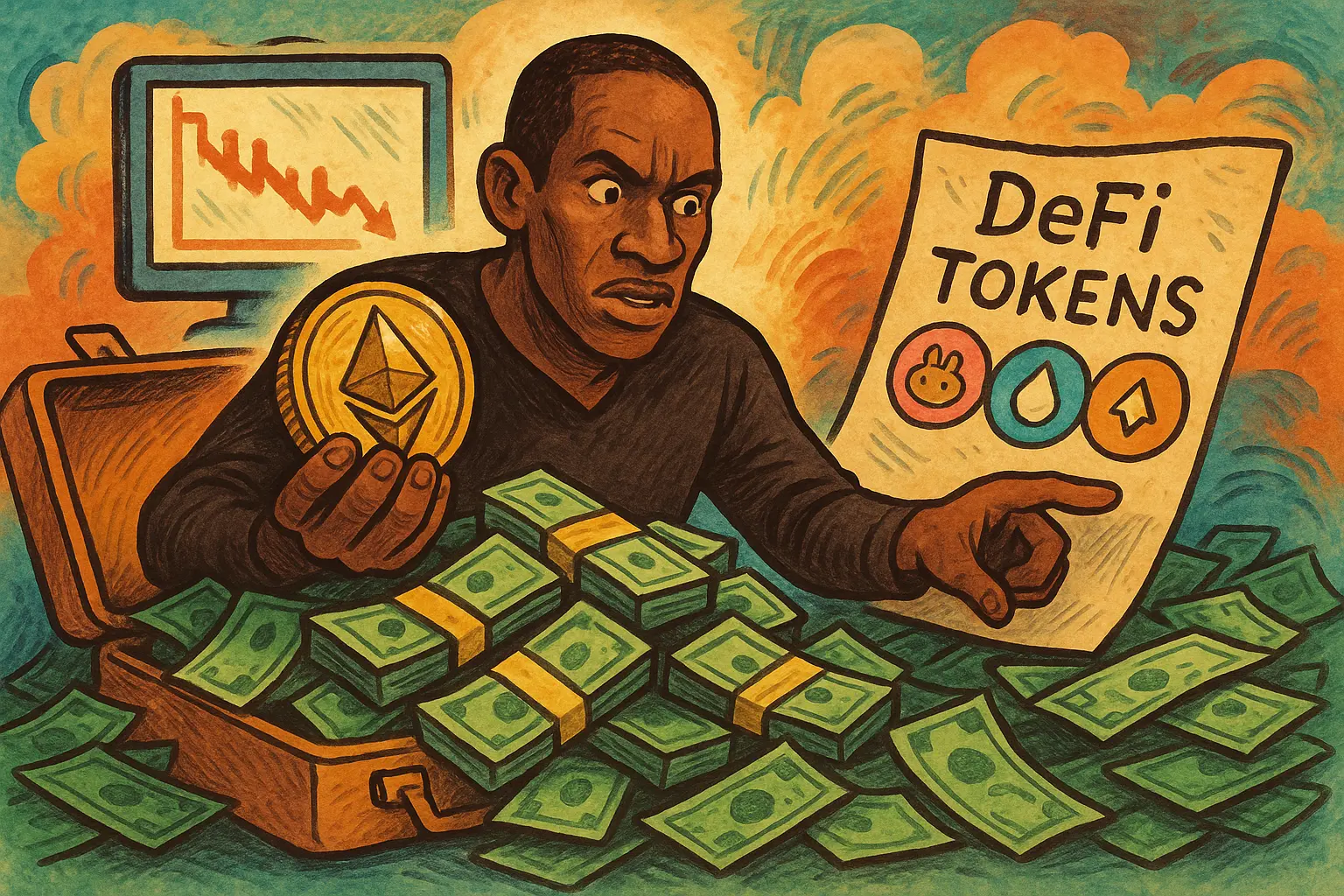
Legendary trader Arthur Hayes sold 1,871 ETH (worth $5.53 million) within two weeks, reallocating funds into DeFi tokens such as PENDLE, LDO, ENA, and ETHFI. PENDLE accounts for 48.9% of his portfolio. Hayes believes that the crypto market liquidity has bottomed out in November, and improvements in fiat liquidity will benefit DeFi tokens beyond ETH.
Liquidity Bottoming Theory Drives Strategic Shift
In a statement released on December 31, Arthur Hayes explicitly pointed out that liquidity in the crypto market may have bottomed in November and is gradually recovering. This judgment is the core logic behind his large-scale portfolio adjustment. He believes that when liquidity recovers from its trough, market capital flows tend to follow the “risk ladder” principle: first into stablecoins and Bitcoin, then spilling over into Ethereum, and finally igniting the DeFi and altcoin markets.
However, Hayes’s move bypassed the traditional capital flow path. He chose to shift directly from ETH to DeFi tokens at the moment liquidity just bottomed out. This contrarian operation hints at his unique assessment of the DeFi space: current DeFi token valuations are excessively undervalued by the market, and the improvement in fiat liquidity will first benefit these mispriced assets.
From a timing perspective, Hayes’s actions began in mid-December, coinciding with the Federal Reserve’s third rate cut and significant redemptions from Bitcoin ETFs. The market generally expects the Fed to pause rate hikes in 2026, which would further tighten liquidity expectations. But Hayes’s judgment is the opposite: he believes the worst is over, and the liquidity environment will gradually improve.
This contrarian approach is not his first. In March 2020, during the COVID-19 crash, Hayes made large Bitcoin purchases; in May 2021, during the market frenzy, he reduced his holdings early. These actions demonstrate his precise grasp of macro liquidity cycles. His recent shift from ETH to DeFi tokens may be another bold bet based on the same logic.
In-Depth Analysis of PENDLE-led Portfolio
According to on-chain data disclosed by Lookonchain, Arthur Hayes completed a thorough portfolio restructuring within two weeks. He sold 1,871 ETH worth $5.53 million and allocated funds into four DeFi tokens: 961,113 PENDLE (worth $1.75 million), 2.3 million LDO (worth $1.29 million), 6.05 million ENA (worth $1.24 million), and 491,401 ETHFI (worth $343,000).
PENDLE emerged as the biggest winner in this adjustment, receiving the highest capital allocation and accounting for 48.9% of Hayes’s overall portfolio. This highly concentrated holding indicates Hayes’s strong confidence in PENDLE compared to other DeFi protocols. PENDLE is a yield tokenization protocol that allows users to monetize future yields or trade yield derivatives. In 2024, PENDLE has gained widespread attention for its unique yield splitting mechanism.
LDO is the governance token of Lido Finance, the largest Ethereum staking protocol, controlling over 30% of the ETH staked market share. Hayes allocated $1.29 million to LDO, indicating his bullish outlook on the long-term development of Ethereum staking economics, despite reducing his ETH holdings.
ENA and ETHFI represent innovations in stablecoin issuance and liquidity re-staking tracks, respectively. ENA is the governance token of Ethena, which issues the synthetic dollar USDe. ETHFI is the token of Ether.fi, focusing on liquidity re-staking services. These allocations show Hayes’s optimism for financial innovation within the Ethereum ecosystem rather than the underlying assets themselves.
Arthur Hayes DeFi Portfolio Structure
Core Holdings (PENDLE 48.9%)
· Leading yield tokenization protocol
· 961,113 tokens, valued at $1.75 million
· Bullish on yield derivatives market explosion
Staking Economy (LDO)
· Ethereum staking leader
· 2.3 million tokens, valued at $1.29 million
· Controls over 30% of ETH staking market
Stablecoin Innovation (ENA)
· Issuer of synthetic dollar USDe
· 6.05 million tokens, valued at $1.24 million
· Hedging against fiat liquidity volatility
Re-staking Track (ETHFI)
· Liquidity re-staking service provider
· 491,401 tokens, valued at $343,000
· Capturing ETH staking yield stacking
Fiat Liquidity Improvement Amplifies DeFi
Hayes’s core bullish thesis on DeFi tokens hinges on a macro judgment: that improvements in fiat liquidity will benefit DeFi tokens more than ETH. This logic can be broken down into three layers. The first is the lag effect of liquidity transmission: when central banks release liquidity, capital first flows into traditional financial markets, then into cryptocurrencies, and finally spills over into DeFi. This lag creates a value trough, and current DeFi token valuations have not yet reflected the upcoming liquidity improvements.
The second layer is leverage amplification: DeFi protocols’ revenue and user growth are highly sensitive to liquidity conditions. When markets are flush with capital, total value locked (TVL) and trading volumes in DeFi protocols grow exponentially, directly impacting governance token values. In contrast, ETH’s growth as an underlying asset tends to be more linear and stable.
The third layer is valuation repair potential: DeFi tokens like PENDLE and LDO experienced severe declines in 2024, with many retracing over 60% from their highs. Hayes believes these declines have overly priced in pessimism, and as liquidity improves, valuation recovery potential will far exceed that of ETH.
However, this logic also carries risks. If liquidity does not improve as expected, or if capital continues to chase Bitcoin and meme coins instead of DeFi, Hayes’s bets could result in losses. Additionally, smart contract risks, regulatory uncertainties, and increasing competition in DeFi could weaken investment returns.
Hedging ETH Weakness with DeFi Opportunities
Hayes’s decision to sell ETH has sparked debate in the market. ETH price currently hovers below $3,000, down 38% from its peak of $4,878 in 2021. This is not Hayes’s first ETH sale; CoinGape previously reported that he transferred 682 ETH worth $2 million to Binance and exchanged for PENDLE.
His bearish stance on ETH may be based on several considerations. First, Ethereum is gradually losing its edge in the competition with high-performance chains like Solana. Solana’s low fees and high throughput have attracted many DeFi and NFT projects, while Ethereum’s Layer 2 scaling solutions, though addressing some issues, have also dispersed ETH’s value capture.
Second, after transitioning from proof-of-work to proof-of-stake, ETH’s narrative shifted from “digital oil” to “bond-like asset.” While this reduces energy consumption, it also weakens ETH’s scarcity narrative. When market capital chases high-risk, high-reward assets, ETH’s bond-like properties become a disadvantage.
Third, Hayes may believe that ETH’s valuation already fully reflects its role as the base asset of DeFi, while DeFi protocol tokens are severely undervalued. By selling ETH to buy PENDLE and other tokens, he is essentially engaging in a relative value trade: selling a reasonably valued underlying asset and buying undervalued application-layer assets.
Related Articles
ETH Whale with $44.61M Profits in 2 Months Opens 4,000 ETH Long on Hyperliquid at 15x Leverage
An Ethereum whale, after making $44.61 million in profits, opened a 4,000 ETH long position with 15x leverage at $2,264.1 per ETH, post closing a short position for $123,000 profits, indicating a significant market stance change.
GateNews14m ago
eth.limo domain hijacked; EasyDNS admits first social engineering attack in 28 years
The eth.limo domain was subject to DNS hijacking on April 17. The attacker, posing as a team member, successfully tricked the domain registrar EasyDNS into executing account recovery for the domain. Although this incident did not affect users, because the attacker did not obtain the DNSSEC key material, they were unable to bypass the trust chain. This incident highlighted the risks of social engineering in the crypto space and prompted eth.limo to switch to the Domainsure service, which does not support account recovery, to enhance security.
MarketWhisper4h ago
Vitalik confirms a talk in Hong Kong, with Ethereum AI and ZK ecosystem applications as the core focus
Vitalik Buterin and Aya Miyaguchi, Chair of the Ethereum Foundation, will attend the opening event of the Hong Kong Ethereum Community Hub (ETH HK Hub) on April 21. This will be the first in-person community space in Asia supported by the Foundation, with a focus on topics such as ZK technology, privacy computing, and the integration of AI and blockchain. Vitalik proposed an Ethereum AI integration framework that emphasizes defensive acceleration, safeguards human agency in the age of AI, and promotes coordinated development between blockchain and AI.
MarketWhisper4h ago
Whale Linked to Matrixport Opens $100M ETH Long Position with 44,000 ETH
A whale linked to Matrixport has opened a 44,000 ETH long position, valued at about $100 million, indicating strong bullish sentiment toward Ethereum, as reported by Lookonchain.
GateNews5h ago
ETH drops 0.69% in 15 minutes: large on-chain transfer outflows trigger a rebound of spot sell pressure
During the period from 2026-04-19 22:00 to 2026-04-19 22:15(UTC), the ETH price fell from 2275.98 USDT to 2252.72 USDT. The return over 15 minutes was -0.69%, and the amplitude reached 1.02%. During this round of unusual price movement, short-term market volatility increased, attention on major coins rose, trading activity improved, and volatility was clearly tilted bearish.
The main driver behind this unusual move is the frequent occurrence of on-chain ETH large transfers with both high frequency and notable volume concentrated in a short period. Using a certain well-known hot wallet as a hub, more than 20,000 ETH were transferred out in a short time, and some of it has been traced on-chain and confirmed to have flowed to other exchanges’ receiving addresses. After funds briefly flowed into trading platforms, the number of sell orders in the spot market increased significantly, bringing about a phase of liquidity pressure and further intensifying the downward move in price. In addition, the futures market is linked to spot volatility; during the decline, highly leveraged long positions were liquidated passively, pushing short-term prices to release more downside pressure.
At the same time, the pace of ETF capital inflows has slowed since mid-April. Within the latest range, continuous net inflows have been trending steadily, and coupled with some funds making small redemptions, this weakens the market’s institutional support. Global risk sentiment is also facing synchronized pressure—repeated swings in macro-level expectations for the Federal Reserve’s policy and heightened geopolitical tensions have driven inflows into safe-haven assets. The U.S. Dollar Index strengthened in the short term, global equity markets came under pressure, and this further reinforced ETH’s ongoing downside pressure. In addition, the 24-hour trading volumes for spot and futures were 21.75 billion USD and 42.76 billion USD, respectively; futures open interest was 30.93 billion USD. The liquidation size showed no abnormality, indicating a structural adjustment under multi-dimensional market convergence.
Going forward, it is necessary to stay alert to risks such as continued large outflows on-chain and ETF capital movements shifting from inflows to outflows. If the macro environment deteriorates further, ETH may further intensify volatility. For short-term support, watch the 2250 USDT area; resistance is at 2275 USDT. The ETF trend, the direction of on-chain transfers, and macro news remain the key indicators to monitor for the next stage. Please closely follow subsequent market developments and the flow of large on-chain funds, and promptly capture relevant trading information.
GateNews8h ago
ETH drops 0.56% in 15 minutes: Institutions’ ETF in-and-out flows and tightened on-chain liquidity dominate the market
From 17:45 to 18:00 (UTC) on 2026-04-19, the ETH price recorded a return of -0.56% within 15 minutes, closing in the 2294.03 - 2311.0 USDT range, with an amplitude of 0.73%. Heightened market volatility triggered increased short-term trading activity and boosted attention, while overall liquidity performance tightened.
The main driving force behind this unusual move is institutions’ short-term in-and-out flows of ETF funds and a lull in on-chain stablecoin activity. In early April, after the ETH spot ETF recorded a net inflow of $120.24 million over a short period, it quickly reversed to a net outflow of $64.61 million, indicating that institutional capital became more short-term and there was no signal of sustained accumulation. Meanwhile, on-chain USDT and USDC activity fell in tandem to an annual low; ETH’s short-term buying power was clearly insufficient, putting pressure on liquidity.
In addition, high-win-rate whales have been frequently shorting ETH and BTC since April 14, with related position sizes exceeding $25 million, further intensifying downward pressure in the short term. On the macro front, the Federal Reserve maintains high interest rates, the U.S. dollar remains strong, risk appetite has shifted to cautious, and some funds have flowed into traditional assets such as U.S. stocks. On-chain data shows that exchange reserves for ETH have fallen to the lowest level in nearly a decade, suggesting that long-term holders are actively shifting away from self-custody, further reducing market liquidity supply and amplifying price anomalies. Network conditions are stable; gas fees are operating at low levels, and on-chain transactions have not shown extreme spikes.
The risk of near-term fluctuations remains high. ETF fund flows, large on-chain transfers, stablecoin activity, and changes in whale positions will be key indicators to watch. If institutions step up selling or stablecoin outflows expand further, ETH price volatility may intensify. Please continue to monitor macro developments and on-chain liquidity changes, stay alert to the risk of sharp short-term volatility, and get more real-time updates.
GateNews12h ago


