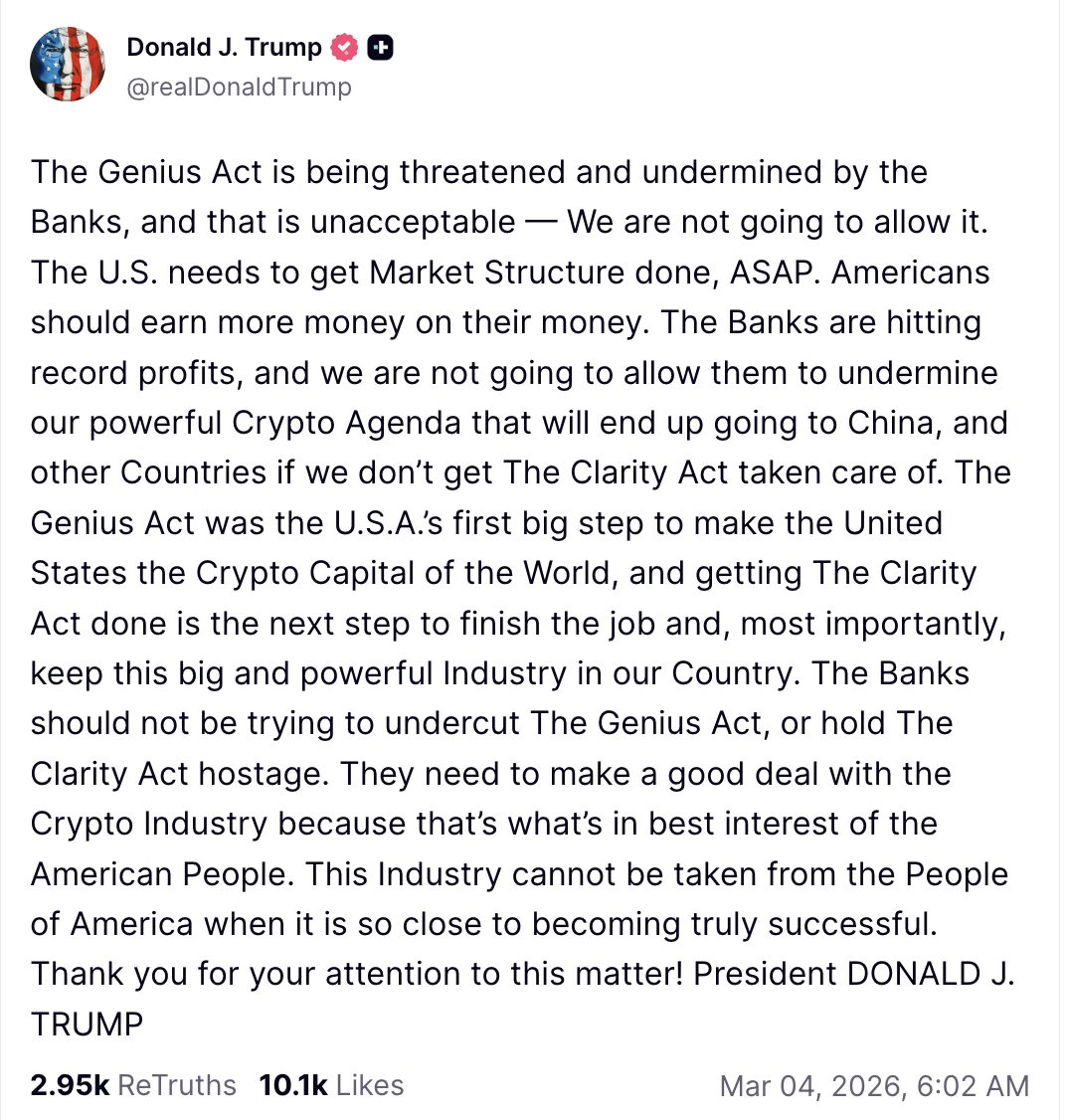
President Donald Trump of the United States posted on Truth Social on Tuesday, criticizing traditional banks for attempting to “threaten and undermine” the first U.S. regulation for stablecoin issuers—the GENIUS Act—and calling on Congress to quickly pass a more comprehensive cryptocurrency market framework bill, the CLARITY Act.
Trump’s strong stance comes amid escalating tensions between Wall Street banks and the cryptocurrency industry, with debates over the regulation of “stablecoin yields” (the interest or rewards users earn from holding stablecoins). In his post, Trump warned banks not to use the CLARITY Act as a “hostage” and emphasized that this legislation is a necessary tool to keep the cryptocurrency industry rooted in the U.S.
The U.S. must quickly complete market structure legislation! Americans deserve to let their money grow.
While banks are reporting record profits, we will not allow them to block our ambitious crypto agenda. If the CLARITY Act isn’t passed swiftly, these industry advantages will ultimately be handed over to China or other countries.
The Digital Asset Market Clarity Act (CLARITY Act), currently under review in Congress, aims to clarify the division of regulatory authority between the U.S. Securities and Exchange Commission (SEC) and the Commodity Futures Trading Commission (CFTC) in the cryptocurrency industry. The bill was bipartisanly approved by the House last year but faced obstacles when transferred to the Senate— the Senate Banking Committee indefinitely delayed the bill’s review in January, causing legislative progress to stall.
Disputes over the CLARITY Act remain unresolved, with the biggest disagreement centered on the fierce battle between banks and the crypto industry over “whether third-party institutions can offer interest on stablecoin deposits”.
The origin of this dispute traces back to the GENIUS Act, which successfully passed last year. To gain banking support, it explicitly banned “interest-bearing stablecoins,” prohibiting issuers from paying interest to users, but did not ban third-party platforms like DeFi protocols and exchanges from offering yield rewards. This angered banks, who are now trying to overturn this in the CLARITY Act legislation by demanding all potential profit pathways be blocked.
Sources say bank representatives have submitted revised proposals on how to handle stablecoin yields, but before Trump’s Tuesday post, the White House and the crypto industry had remained silent.
In response, Trump sharply criticized: “Banks shouldn’t be undermining the GENIUS Act behind the scenes, nor should they use the CLARITY Act as a bargaining chip. They must negotiate in good faith with the crypto industry— that’s the best way to serve the American people.”
Earlier, Trump issued an ultimatum, demanding all parties reach an agreement by the end of February. Over the past month, the White House has repeatedly acted as a mediator, holding multiple closed-door meetings between banks and the crypto industry, but negotiations remain deadlocked. Although the Senate still has time to advance the bill, the approaching summer recess and the upcoming 2026 midterm elections are shrinking the legislative window.
On Monday, JPMorgan Chase CEO Jamie Dimon publicly stated that stablecoin yield products should be regulated as strictly as banks and called for the establishment of “fair competition rules.”
Representative French Hill proposed a solution, suggesting the Senate adopt the House version of the bill directly to save time and avoid lengthy debates, so the bill can pass quickly.
The CLARITY Act is expected to pass by mid-year! JPMorgan: “8 Major Bullish Factors” Ignite the Crypto Market in the Second Half of the Year
Disclaimer: The information on this page may come from third parties and does not represent the views or opinions of Gate. The content displayed on this page is for reference only and does not constitute any financial, investment, or legal advice. Gate does not guarantee the accuracy or completeness of the information and shall not be liable for any losses arising from the use of this information. Virtual asset investments carry high risks and are subject to significant price volatility. You may lose all of your invested principal. Please fully understand the relevant risks and make prudent decisions based on your own financial situation and risk tolerance. For details, please refer to
Disclaimer.
Related Articles
CICC: Gold investment demand and prices may both have upside room for upward revision
A research report from China International Capital Corporation (CICC) notes that the Iran–U.S. conflict has pushed up oil prices, increasing inflation risks, affecting expectations for Fed rate cuts, and driving selling of gold ETFs. Geopolitical developments put oil prices at a crossroads, while the gold market is focused on how an economic downturn could affect it; in the future, it may reassess expectations for rate hikes. Demand for gold investment and prices may have room to rise.
GateNews5h ago
Carson Group strategist: The latest nonfarm payroll data puts the Federal Reserve in a difficult situation, and last year’s rate cut was a mistake
Gate News update, April 3, Carson Group’s Chief Macroeconomic Strategist Sonu Varghese said that the latest labor data show that the economy’s new job growth is sufficient to keep pace with population growth. He noted that this will put the Federal Reserve in a more complicated position, making rate cuts pointless—especially given the size of the inflation shock that’s coming. He added that the inflation problem already existed before the Middle East crisis that sent energy prices soaring, and in the end, it appears that the rate cuts implemented last year were a mistake.
GateNews17h ago
U.S. March jobs smash expectations, with 178,000 added
The U.S. job market saw significant improvement in March, adding 178,000 jobs and lowering the unemployment rate to 4.3%. This rebound follows February's losses, with potential implications for future interest rate hikes amid ongoing oil price concerns.
CoinDesk18h ago
Market pricing shows expectations for Federal Reserve rate cuts in 2026 have fallen
Gate News message, on April 3, market pricing shows that bets on the Federal Reserve cutting rates in 2026 have eased.
GateNews18h ago
CME Data: The probability that the Federal Reserve will keep interest rates unchanged in April is 99.5%
Gate News update: On April 3, according to CME's “FedWatch” data, ahead of the nonfarm payrolls release, the probability that the Federal Reserve will raise rates by 25 basis points in April is 0.5%, while the probability of keeping rates unchanged is 99.5%. The probability that the Federal Reserve will cut rates by a cumulative 25 basis points by June is 7.8%, the probability of keeping rates unchanged is 91.7%, and the probability of raising rates by a cumulative 25 basis points is 0.5%.
GateNews18h ago
Gold Plunges 12% in March—The Real Story Behind the Drop: Leverage Collapse and Central Bank Moves Spark Market Turmoil
In March 2026, gold prices saw a sharp 12% pullback, prompting the market to reassess its structural risks. Goldman Sachs analysts said that trading was driven by margin imbalances and intensifying geopolitical conflicts, leading traders to close positions and sell off gold. Despite increased short-term volatility, institutions remain optimistic about gold’s medium- to long-term outlook, forecasting that the price could reach $5,400 by year-end. Future trends will be influenced by the strength of the U.S. dollar and the state of the global economy.
GateNews23h ago


