Author: Jonah Burian, Investor at Blockchain Capital
Translation: Felix, PANews
Summary: Under a three-party game, users may actually be the ultimate beneficiaries of this competition and ultimately receive the majority of the profits.
In recent years, behind the massive profits earned annually by stablecoin issuers, the struggle for interests among issuers, application layers, and users has become increasingly intense. An investor at Blockchain Capital has written to reveal the profit distribution mechanism of stablecoins and the evolution of their business logic. Below are the details.
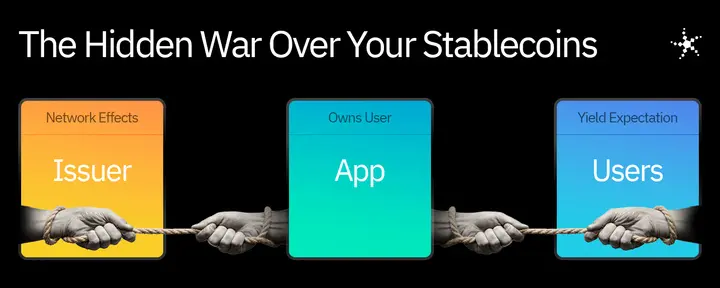
Stablecoin issuers have one of the most profitable business models on Earth, and this huge profit has made them targets for various parties vying for control. At Blockchain Capital, we have closely observed a tug-of-war among issuers, application layers, and users competing for profits.
We have invested in some major issuers (such as Tether, Circle, Paxos) and also in several applications trying to get a piece of the pie (such as Aave, Phantom, Polymarket, RedotPay, etc.). Here are our observations.
Issuers Are Highly Profitable
Users send fiat currency to issuers, who then mint digital dollars on the blockchain. Behind the scenes, issuers invest these fiat funds into cash or cash equivalents, earning risk-free interest. That’s the entire business. In comparison, banks take your deposits, lend them out, manage credit risk, and maintain branch networks; insurance companies collect premiums but ultimately must pay claims. Stablecoin issuers, on the other hand, mostly hold government bonds, earning cash flow without bearing complex risks or operational burdens.
Issuer revenue grows with the scale of assets under management, while operating costs remain roughly constant: this is essentially a pure, unrestricted cash flow machine. Tether reports its team size at about 300 people, projecting profits reaching $10 billion by 2025. This can be considered one of the best business models in history.
But such huge profits inevitably attract envy.
Applications Also Want a Share
Most users never deal directly with issuers; they interact with stablecoins through applications like Phantom, which control user relationships.
Large exchanges, DeFi protocols, and well-known wallets have significant bargaining power over issuers. They can specify default stablecoins and decide to integrate or deprecate stablecoins through single product decisions, exerting some control over fund flows. If billions of dollars in stablecoins remain within an application, that app can demand a share of the floating interest income (float) from the issuer. The logic is simple: we are distributing your assets and anchoring user behavior, so you must share the profits, or else direct users to competitors’ stablecoins.
This scenario has already occurred. The most typical example is the relationship between Coinbase and Circle. Early on, Coinbase was the main distributor of USDC and negotiated profit sharing. Reports indicate Coinbase received 100% of the interest income generated by USDC on its platform, and 50% of the interest income from USDC outside the platform. Whether within or outside the portfolio, applications are gradually adopting this strategy, actively seeking their share.
Creating Own-Brand Stablecoins: Bypassing Issuers
Applications can also attempt to launch their own branded stablecoins or “wrappers,” completely bypassing issuers. They do not directly direct users to USDC or USDT but instead offer a dollar balance supported by a combination of stablecoins and short-term notes. At this point, distributors are partially involved in issuance. Aave’s GHO stablecoin is an example.
However, applications often lack the resources or licenses to establish full issuance infrastructure. Therefore, they opt for “Issuer-as-a-Service” white-label solutions. Paxos is currently a leading white-label provider, supporting PayPal’s PYUSD. This allows PayPal to profit from floating interest without negotiating with major issuers.
Issuers’ Leverage
Applications cannot fully control issuers. Mature stablecoins like USDC and USDT benefit from strong network effects. They are reserve assets across the entire DeFi space and form the basis for most trading pairs. Brand stablecoins may be less attractive to users due to lower liquidity and integration levels.
Moreover, white-label stablecoins are not pursuing “neutrality” like USDT. A company competing with PayPal at the application layer might be reluctant to accept PYUSD, as doing so could fund a competitor. The same situation may have influenced Circle’s early development; exchanges like Binance might have been hesitant to fully promote USDC early on because of its close ties to Coinbase, which is why Binance defaulted to supporting USDT. Today, USDT’s trading volume on Binance is about five times that of USDC.
User Demand for Floating Returns
In developed markets, user expectations for returns put pressure on issuers and applications. When risk-free rates hover around 4%, US users naturally ask why their digital dollars generate no yield. When a wallet offers returns while competitors do not, users tend to flock to the one that does.
If this expectation becomes normal, application providers will face a dilemma. To stay competitive, they may have to share some of the returns with users, forcing them to negotiate more aggressively with issuers. If an app cannot secure a share, it will be difficult to pay interest to users without incurring losses. As more products promote “stablecoin balance yields,” the model where all profits stay with the underlying issuer will become unsustainable.
However, this pressure is not universal. In many overseas markets, the core value of dollar stablecoins lies in combating local inflation and foreign exchange controls, rather than seeking yields. Users trying to prevent their assets from halving in value each year may not care much about earning 4% interest. For global issuers with high penetration in these regions, user demand for yields is less urgent than in the US market. We believe this dynamic could benefit Tether, which has the largest overseas user base.
Conclusion
In summary, user expectations and issuer profits place application layers in a dilemma. They are caught between users who expect returns and issuers who want to retain profits. The distribution of profits within stablecoin architecture is rapidly evolving, and the game for profit sharing is ongoing. My guess is that users may ultimately be the final winners in this game and will receive the majority of the benefits.
Related reading: Stablecoin Yield Guide: Which of the 8 Types Is Best?
Disclaimer: The information on this page may come from third parties and does not represent the views or opinions of Gate. The content displayed on this page is for reference only and does not constitute any financial, investment, or legal advice. Gate does not guarantee the accuracy or completeness of the information and shall not be liable for any losses arising from the use of this information. Virtual asset investments carry high risks and are subject to significant price volatility. You may lose all of your invested principal. Please fully understand the relevant risks and make prudent decisions based on your own financial situation and risk tolerance. For details, please refer to
Disclaimer.


