
The US Marshals Office reportedly liquidated 57 Bitcoins on November 3, which may have violated President Trump’s Strategic Reserve Order. The BTC confiscated from Samourai Wallet was processed through Coinbase Prime. On-chain data shows funds moving to Coinbase, but foreign media point out that it cannot be confirmed whether they have been sold. Trump advisors have launched an investigation into this matter.
The Destination of 57 Bitcoins Remains a Mystery
(Source: Bitcoin Magazine)
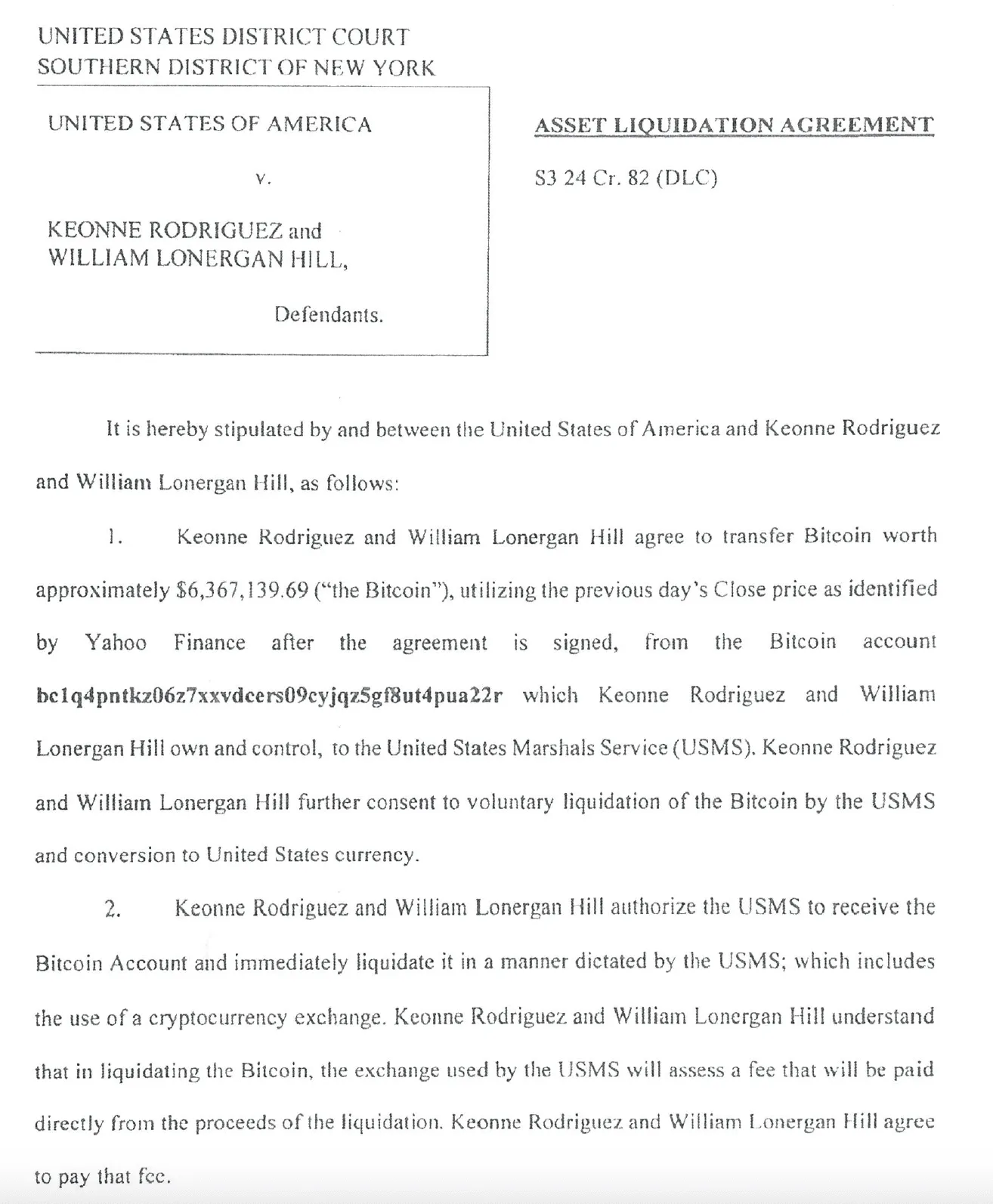
Foreign media Bitcoin Magazine reported on January 5 that the US Marshals Service (USMS), allegedly under the instructions of the Department of Justice, liquidated about 57 Bitcoins on November 3, 2025, and may have violated Executive Order No. 14233 issued by Trump, which requires seized Bitcoins to be kept in the US Strategic Bitcoin Reserve.
An asset liquidation agreement document obtained exclusively shows that the Marshals Service liquidated Bitcoins from Samourai Wallet developer Keonne Rodriguez and William Lonergan Hill, who were confiscated under a guilty plea agreement. The defendants agreed to transfer approximately $6,367,139 and about 57.55 Bitcoins at that time to the US government.
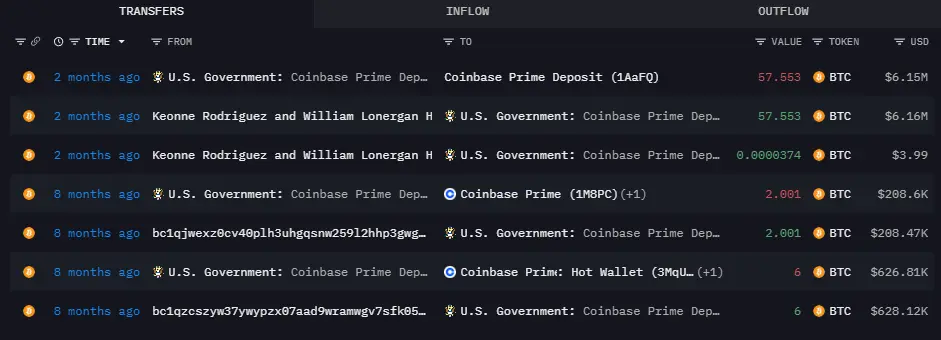
The media pointed out that after the funds were sent from the relevant address, they seemingly did not go through direct custody by the Marshals Office but flowed directly into a deposit address marked as Coinbase Prime. Since the current balance of that Coinbase Prime address shows zero, external speculation suggests that this batch of Bitcoins may have already been sold. This “zero balance” status is highly suspicious in the eyes of blockchain detectives, usually indicating that the funds have been transferred or sold.
Regarding the allegation that the Bitcoins have been sold, another foreign media BeInCrypto analyzed on-chain data, confirming that the US Department of Justice controlled this batch of Bitcoins, which was indeed transferred to a Coinbase Prime deposit wallet on November 3, then moved to another internal wallet. However, current data is insufficient to confirm that these Bitcoins have been sold.
On-Chain Data Cannot Confirm Sale: The Technical Blind Spot
(Source: Arkham)
Ultimately, these Bitcoins were integrated into Coinbase Prime’s extensive custodial group of thousands of addresses. Such fund transfers and consolidations are typically standard custodial procedures within Coinbase Prime’s infrastructure. So far, no outflow of funds from Coinbase-controlled infrastructure has been observed, nor are there signs of typical transaction splitting or movement toward exchange settlement wallets.
This technical blind spot highlights the limitations of blockchain transparency. While all transfers are publicly accessible, key information such as internal fund management within Coinbase Prime, whether the assets were actually sold, at what price, and who benefits, cannot be discerned from on-chain data. Coinbase Prime, as an institutional custody service, has a highly complex internal account system, and fund movements between internal wallets are common.
Three Key Evidence Points to Determine Violations
Court Seizure or Disposition Orders: Whether explicitly requiring sale or retention in the strategic reserve
Internal Asset Management Records of the Marshals Office: Approval processes and decision documents for asset disposition
Actual Transaction Settlement Documents of Coinbase Prime: Whether fiat currency exchange transactions were executed
Currently, the controversy over whether the Department of Justice violated Executive Order No. 14233 hinges on the status of these assets, defined as “government Bitcoins.” However, this is difficult to clarify solely through on-chain data. To confirm whether the DOJ violated regulations, one must examine court-issued seizure or disposition orders, internal asset management records of the Marshals Service, or actual transaction settlement documents of Coinbase Prime. These key pieces of information are not publicly available at this time.
Political Signal of Trump Advisors’ Investigation
In response, Trump advisors have publicly stated that they are investigating whether the Department of Justice violated the Strategic Reserve Executive Order. This high-profile statement itself is a political signal, indicating that Trump’s team considers this matter serious. If the investigation confirms that the DOJ violated regulations by selling, it could lead to officials being dismissed or held accountable, thereby strengthening Trump’s control over federal agencies.
From the timeline perspective, November 3 coincides with Trump’s victory in the election but before his inauguration. During this transition period, Biden’s officials still held power, but the administration was in a “lame duck” state. If DOJ officials violated policies at this time, it might reflect disagreement with the incoming administration’s policies or an attempt to create facts before the handover.
Executive Order No. 14233 mandates that seized Bitcoins be retained in the strategic reserve, which is central to Trump’s “Making the US the Crypto Capital” strategy. If the DOJ openly violated this order, it would be a direct challenge to the executive order and Trump’s crypto policies. Such internal conflicts, if unpunished, could weaken Trump’s policy authority.
From Trump’s perspective, this case also presents an opportunity to reorganize federal agencies. Since taking office, Trump has sought to purge officials he perceives as disloyal “deep state” actors. If the DOJ’s violation is confirmed, it would provide a legitimate reason for large-scale personnel adjustments.
Overall, the fate of these 57 Bitcoins remains a mystery. On-chain data shows funds entering Coinbase Prime but cannot confirm they have been sold. Trump advisors’ investigation will reveal the truth, and if violations are confirmed, it could trigger a shake-up in the DOJ’s leadership. Regardless of the outcome, this case highlights the complexity of executing strategic reserve policies.
Disclaimer: The information on this page may come from third parties and does not represent the views or opinions of Gate. The content displayed on this page is for reference only and does not constitute any financial, investment, or legal advice. Gate does not guarantee the accuracy or completeness of the information and shall not be liable for any losses arising from the use of this information. Virtual asset investments carry high risks and are subject to significant price volatility. You may lose all of your invested principal. Please fully understand the relevant risks and make prudent decisions based on your own financial situation and risk tolerance. For details, please refer to
Disclaimer.
Related Articles
Bitcoin mining difficulty dips 7.7% as miners endure pressure
Bitcoin’s mining difficulty shifted lower once more, declining by about 7.7% in the latest retarget to 133.79 trillion at block 941,472, according to CoinWarz data. The move follows a mid-March dip that pulled the metric from roughly 148 trillion to the current level, marking the sharpest drop
CryptoBreaking5m ago
Analyst Says XRP To $10 Is “Inevitable”; It Might Even Rival Bitcoin
Various analysts continue to drop price predictions across the crypto market, and XRP often finds itself at the center of those conversations. Some projections sound like wishful numbers, yet others attempt to tie their outlook to market structure, adoption, and long-term utility. We at
CaptainAltcoin15m ago
Bitcoin Market Update: BTC Stuck in Tight Range as Volatility Drops and Breakout Looms
Bitcoin traded at $70,646 on Saturday morning at 8:30 a.m., holding within a narrow intraday range as technical indicators reflected a broadly neutral stance across key timeframes. Market participants continue to monitor consolidation near the $70,000 level as momentum signals diverge and
Coinpedia32m ago
CFTC Allows Bitcoin and Ethereum as Margin Collateral
CFTC permits Bitcoin, Ethereum, and stablecoins as margin collateral with strict valuation haircuts and risk controls applied.
Stablecoins receive lower capital charges than BTC and ETH, reflecting reduced volatility in margin calculations.
Firms must meet reporting, cybersecurity, and
CryptoFrontNews34m ago
Bitcoin Taproot Upgrade: Key Improvements in Performance and Privacy
The Taproot upgrade serves as one of the top technological improvements for the Bitcoin ecosystem. Activated on the 14th of November 2021, the upgrade aims to boost functionality, efficiency, and privacy without disrupting Bitcoin’s core principles. By merging multiple innovations, such as Schnorr s
BlockChainReporter45m ago
Bitcoin mining difficulty down 7.76% to 133.79 T, marking the largest decline since the end of 2025
Gate News reports that on March 21st, Bitcoin mining difficulty was adjusted downward to 133.79 T at block height 941472, with a decrease of 7.76%. During this adjustment period, the average hashrate was 760.10 EH/s, and the average block time was 12 minutes and 36 seconds. This downward adjustment represents the largest decline since the end of 2025.
GateNews47m ago


