Bitcoin reclaims $94,000 and breaks through October’s downtrend line. The US conducts a military raid on Venezuela, but no risk-off panic occurs. US stocks, the Dow Jones Industrial Average, rebound by 800 points, with energy stocks leading a 9% surge. Gold futures hit $4,456, as funds allocate between risk and safe-haven assets. Bitcoin tests the critical resistance zone of $93,347–$94,236, with this Friday’s non-farm payroll report being a decisive variable.
Market Logic of Rapidly Digesting Geopolitical Shocks
From a macro perspective, the US raid on Venezuela and the arrest of Maduro should have triggered sharp oil price volatility and rapidly heightened global risk aversion, but market reactions have been relatively restrained. Limited crude oil price fluctuations led investors to quickly shift focus from geopolitical risks to US economic data and monetary policy expectations. Institutions generally believe that although Venezuela holds the world’s largest proven oil reserves, its current capacity and infrastructure have been sluggish for a long time, limiting short-term impacts on global oil supply, and thus unlikely to trigger systemic energy price increases.
This calm response reflects the market’s precise judgment of the event’s nature. On Sunday, Trump threatened military action against Colombia and Mexico, which, while increasing future uncertainty, is currently viewed by markets as a “manageable risk,” not causing systemic shocks in forex or commodities markets. The US dollar index briefly hit a nearly four-week high of 98.86 intraday on Monday, then retraced some gains, currently trading around 98.35, indicating that safe-haven demand has not continued to ferment.
Rising geopolitical uncertainty has instead reinforced the logic of holding Bitcoin as a non-sovereign asset. Unlike traditional financial assets, Bitcoin is not controlled by a single country or institution, and during escalating geopolitical conflicts, it often gains additional demand. More importantly, institutional investors are adopting a “risk-on plus gold defensive plus Bitcoin hedge” portfolio strategy to cope with the volatility caused by overlapping political and macro variables. This complex allocation shows that the market has not fully “dropped the risk alert,” but is instead maintaining defensive positions while risk appetite recovers.
Contradictory Signals of US Stocks and Gold Rising Simultaneously
US stocks on Monday showed a clear return of risk appetite, with the Dow rising over 800 points, up 1.7%, hitting a new all-time high intraday. Sector-wise, energy stocks led the rally, not because of bets on rising oil prices, but because of expectations that Venezuela’s political changes could trigger energy infrastructure rebuilding, leading to increased orders and capital expenditure in the future. Chevron’s stock rose about 4%, ExxonMobil about 2%, and oil service giants Halliburton and SLB surged around 9%. The Energy ETF XLE rose nearly 2%, highlighting the “reconstruction expectation” as a structural opportunity.
However, despite the strong stock rally, gold futures also rose nearly 3% on Monday, with spot gold reaching $4,456.02, indicating that markets have not completely ignored the tail risks posed by geopolitical tensions. Besides gold, other precious metals performed impressively: spot silver up 6.3%, platinum up 7.7%, and palladium up over 7%. This rare simultaneous rise of stocks and gold reflects investor uncertainty about future developments and a cautious stance on the Federal Reserve’s policy and the dollar’s long-term trend.
Analysts believe that Bitcoin currently exhibits a dual nature as both a “risk asset” and a “hedge asset.” The rise in US stocks boosts risk appetite, capital flows into high-volatility assets, and Bitcoin, as a high-beta asset, benefits first. On the other hand, increased geopolitical uncertainty also strengthens Bitcoin’s logic as a non-sovereign asset. This trend, moving in tandem with gold, indicates that the market is not solely betting on “risk off,” but is instead engaging in structured asset allocation amid a complex environment.
Technical Breakthrough and This Week’s Non-Farm Payroll Showdown
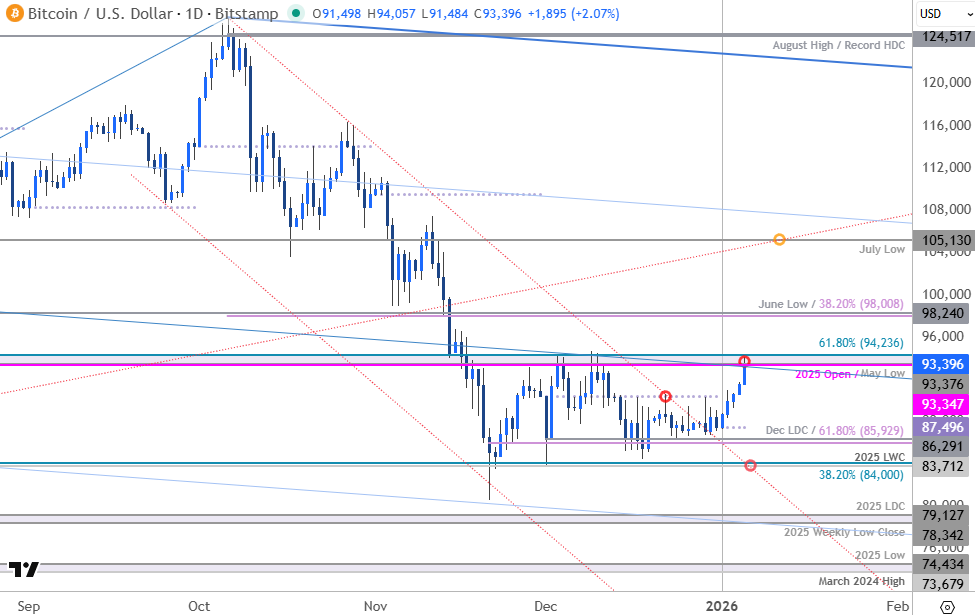
(Source: Trading View)
Bitcoin has broken through October’s downtrend line, with BTC/USD up nearly 11.5% from the December lows. This rebound is testing the resistance zone of $93,347–$94,236, formed by the 2025 open price, May lows, and the 61.8% retracement of the 2025 price range. Notably, the December opening range remains intact, and the next few weeks’ movement will depend mainly on whether this resistance is broken. A breakout upward would target the 38.2% retracement at $98,008–$98,240 and the July low of $105,130.
From a trading perspective, if the price breaks above $94,236 and closes above this key pivot zone, with losses limited within the year’s open at $87,496, it suggests a more significant bottom may be forming, and a larger trend reversal could be underway. However, the current breakout is testing the upper limit of the December range, with risks of price weakness or a reversal at this zone.
Three Key Variables to Determine the Short-Term Direction
This Friday’s Non-Farm Payrolls: This data will directly influence the market’s re-pricing of the Fed’s 2026 rate cut expectations. Market participants note that from Friday’s non-farm data to next week’s CPI, industrial production, and retail sales reports, the US economy’s resilience will be further confirmed. If employment data shows continued cooling, it will reinforce rate cut expectations, potentially weakening the dollar and providing upward momentum for Bitcoin.
Fed Chair Nomination Uncertainty: Trump has stated he will nominate a Fed chair “who strongly believes in needing to significantly lower interest rates,” as Powell’s term ends in May. This statement complicates market expectations for future monetary policy and could become an important source of medium-term dollar volatility. According to LSEG’s calculations based on interest rate futures, traders currently still expect the Fed to cut rates twice by 2026.
Persistent Weakness in Manufacturing: Monday’s US December manufacturing PMI continued in contraction for the 10th consecutive month, reflecting ongoing cost pressures from Trump’s import tariffs. Market participants believe that sustained manufacturing weakness will remain an important variable in Fed policy discussions, but short-term, attention remains on whether employment and inflation data show more obvious signs of cooling.
Overall, the clear answer for why Bitcoin is rising today is: risk appetite in US stocks is returning, geopolitical uncertainties are strengthening hedge demand, and the dollar’s rebound is driven by rate cut re-pricing. These three factors jointly push BTC above $94,000. However, the technicals are testing a key resistance zone, and this week’s non-farm payroll data will be the critical node to determine whether the breakout succeeds.
Disclaimer: The information on this page may come from third parties and does not represent the views or opinions of Gate. The content displayed on this page is for reference only and does not constitute any financial, investment, or legal advice. Gate does not guarantee the accuracy or completeness of the information and shall not be liable for any losses arising from the use of this information. Virtual asset investments carry high risks and are subject to significant price volatility. You may lose all of your invested principal. Please fully understand the relevant risks and make prudent decisions based on your own financial situation and risk tolerance. For details, please refer to
Disclaimer.


