Author: 0xTodd; Source: X, @0xTodd
Let’s talk about Visa supporting stablecoin settlement.
First of all, many people might not fully understand how Visa (or Mastercard) actually operates.
Visa itself does not issue cards nor does it lend money to merchants; it is purely an intermediary, mainly responsible for information processing and rule setting.
Taking the US as an example, the Visa operation process mainly consists of three stages:
Stage 1: Authorization (Can I spend the money?)
When a cardholder swipes at a merchant, the merchant’s acquiring bank sends the transaction information to VisaNet. VisaNet recognizes the card number and routes the request to the issuing bank. The issuing bank checks the account balance or credit limit and responds with “approved” or “declined.” Visa then transmits the result back to the acquiring bank, and then to the merchant.
Stage 2: Clearing
Usually at the end of each day or transaction batch. The acquiring bank packages all the transaction data for that day and sends it to VisaNet. VisaNet performs netting calculations.
It calculates each bank’s net position. For example, if the issuer A’s customer spent a total of 100 million USD today, and the merchant (if it is also an acquirer) for issuer A is owed 20 million USD today, then issuer A’s net obligation is to pay 80 million USD.
Stage 3: Settlement (Transferring money)
Based on the net amount calculated during clearing, Visa instructs the settlement banks to transfer funds between the accounts of the issuing and acquiring banks. Previously, this was done via wire transfers or similar channels.
—Divider—
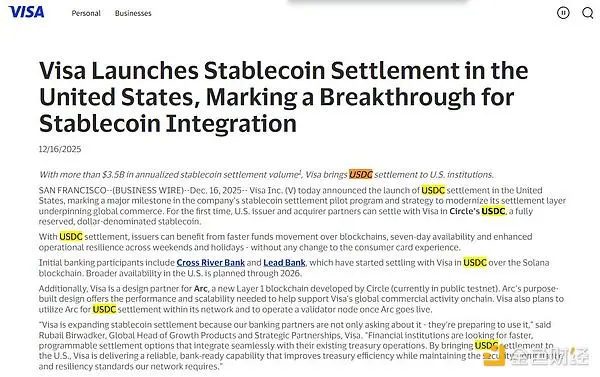
And this time, Visa announced support for $USDC , not to say that retail users can now spend stablecoins via Visa, but that issuing banks and merchants can settle using stablecoins during the third stage.
To translate, it means: Previously, the banks owing money to Visa merchants could only settle through traditional bank transfers (USD fiat). But now, they can directly transfer USDC from their crypto wallets to Visa to settle the account.
Coincidentally, Mastercard also announced yesterday that it supports stablecoin settlement in the Middle East. And Visa is doing this in the US, which shows that, as I predicted earlier, after the US stablecoin legislation passes, the entire industry is accelerating rapidly.

However, one point to clarify is that Visa is talking about “Select partners.” Implicitly, this feature is not open to all US banks; it’s probably mainly targeted at crypto-related financial institutions or enterprises.
In summary, this is pretty impressive, meaning the idea that stablecoins = real money is being further cemented. The more people accept “stablecoins = real money,” the more stablecoins become truly equivalent to real money, and the peg becomes tighter.
Disclaimer: The information on this page may come from third parties and does not represent the views or opinions of Gate. The content displayed on this page is for reference only and does not constitute any financial, investment, or legal advice. Gate does not guarantee the accuracy or completeness of the information and shall not be liable for any losses arising from the use of this information. Virtual asset investments carry high risks and are subject to significant price volatility. You may lose all of your invested principal. Please fully understand the relevant risks and make prudent decisions based on your own financial situation and risk tolerance. For details, please refer to
Disclaimer.
Related Articles
Circle ускорила чеканку 3.25B USDC, побивши Solana тижневий рекорд
In early April, Circle minted $3.25 billion USDC on the Solana blockchain, setting the largest single-week issuance record since 2026, indicating rising DeFi activity and demand for institutional capital inflows. As a liquidity medium, USDC supports trading and lending across the Solana ecosystem, and its huge coin-minting volume also underscores Solana’s important role in stablecoin settlement. Analysis suggests that the flow of funds will affect market impact strength.
MarketWhisper25m ago
Several Korean financial institutions are piloting stablecoin payments through foreign users, laying the groundwork for infrastructure in advance
Due to delays in the legislation of the Digital Asset Basic Act, several financial institutions in South Korea have launched stablecoin payment services for foreign users, building infrastructure. Industry analysis says that such services are like a “regulatory sandbox,” helping companies validate their business models.
GateNews50m ago
Circle Redeems $550M USDC on Solana in 12 Hours, Issues $10.19B in Past Month
Gate News message, Circle redeemed $550 million USDC on Solana within a 12-hour period. Over the past 30 days, Circle has issued $10.19 billion in USDC on the Solana blockchain.
GateNews1h ago
Polymarket Major Upgrade: Phasing Out USDC.e, Launching Native Collateral Tokens
The prediction market platform Polymarket will undergo a full rebuild, launching a new collateral token, “Polymarket USD,” to replace the existing USDC.e, in order to enhance its control over the settlement layer and comply with regulatory requirements. The upgrade will affect users’ trading workflows: ordinary users can complete the conversion automatically, while advanced users must do it manually. This move is intended to strengthen management of market manipulation and to promote a shift toward compliance.
MarketWhisper2h ago
Polymarket will upgrade its trading system and launch its native stablecoin, Polymarket USD
Polymarket’s prediction market platform will undergo a major upgrade in the coming weeks, including the launch of the V2 trading system, the native stablecoin Polymarket USD, and an optimized order book structure. The new system will improve matching efficiency, reduce Gas costs, and support smart contract wallets to participate in trading.
GateNews2h ago


