The figure of $13.5 billion in overnight repo on December 1st may not seem particularly notable at first glance, but for those who monitor the Fed’s “liquidity pipeline,” it’s a subtle uptick worth watching.
These operations rarely make headlines, yet they steer the flow of liquidity that governs everything—from bond spreads and risk appetite in equities to Bitcoin price action on a quiet weekend.
When overnight repo spikes, it signals a change in the smoothness of USD flows within the financial system. And Bitcoin, now tightly tethered to global risk flows, often reacts swiftly.
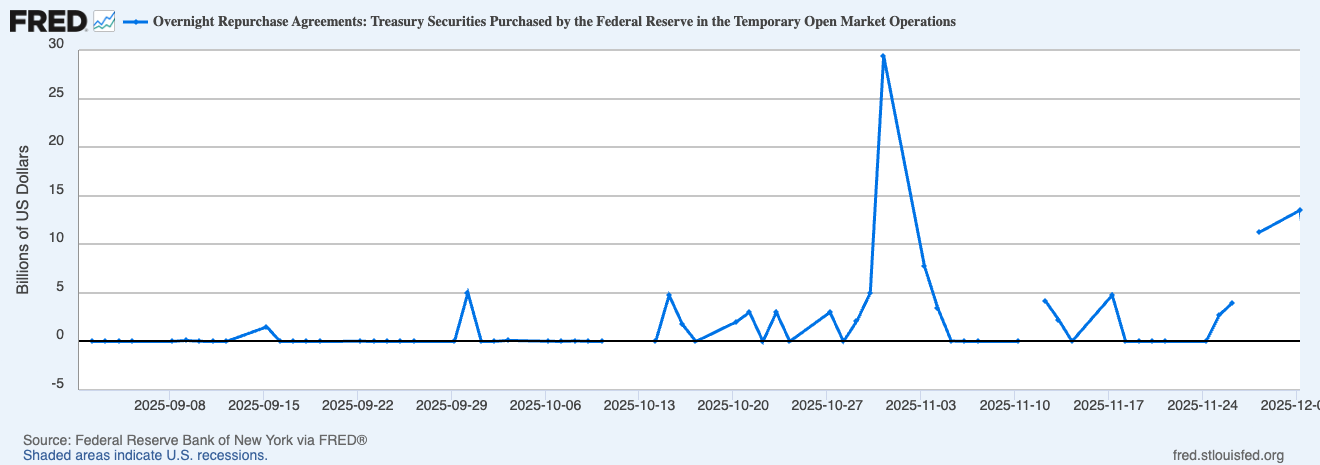 Chart showing overnight repo transactions from September 1 to December 1, 2025 (Source: FRED)## What is repo, and why does it occasionally spike?
Repo, or repurchase agreement, is a short-term borrowing/lending transaction in which institutions bring Treasuries to the Fed in exchange for USD, with repayment completed the next day. Since Treasuries are the “cleanest” form of collateral, this is the safest channel for short-term funding needs.
Repo spikes typically stem from two causes:
1. Caution:
Banks, dealers, or leveraged funds want to secure USD from the safest counterparty—the Fed. When private credit tightens, even slightly, the Fed’s repo window absorbs this demand.
2. Technical demand:
Payment schedules, auctions, or month-end adjustments can create temporary USD demand unrelated to market stress.
Therefore, a number like $13.5 billion only makes sense in context. Recent weeks have shown some mixed signals: SOFR has ticked up, collateral demand is stronger, and the Standing Repo Facility has been more active. It’s not panic, but it’s not entirely calm either.
For traditional markets, this is a fast indicator of how “breathable” the system is. When overnight USD becomes expensive or harder to borrow, leverage weakens, hedging costs rise, and investors will reduce exposure to risky assets first.
Why does this matter for Bitcoin?
Although promoted as an asset outside the USD system, Bitcoin’s price behavior shows it is closely tied to the same factors driving stocks, credit, and risk assets.
When liquidity is abundant:
USD is easier to borrow, markets are more relaxed, and risk becomes “cheaper.” Bitcoin—a high-beta asset—tends to benefit.
When liquidity tightens:
Repo rises, SOFR jumps, and institutions’ balance sheets become more cautious. Bitcoin is vulnerable to sell-offs even if its fundamentals remain unchanged, simply because investors cut volatility during short-term funding stress.
Repo doesn’t directly make BTC rise or fall instantly; it shapes the sentiment and liquidity “floor” in which traders operate. A smooth system usually supports BTC; a parched system makes BTC fragile.
This $13.5 billion repo sits between those two extremes—not large enough to sound the alarm, but enough to show the system needed extra USD before the weekend. It reveals mild strain the Fed must soothe—something Bitcoin should note, as liquidity injections often help risk markets hold up better.
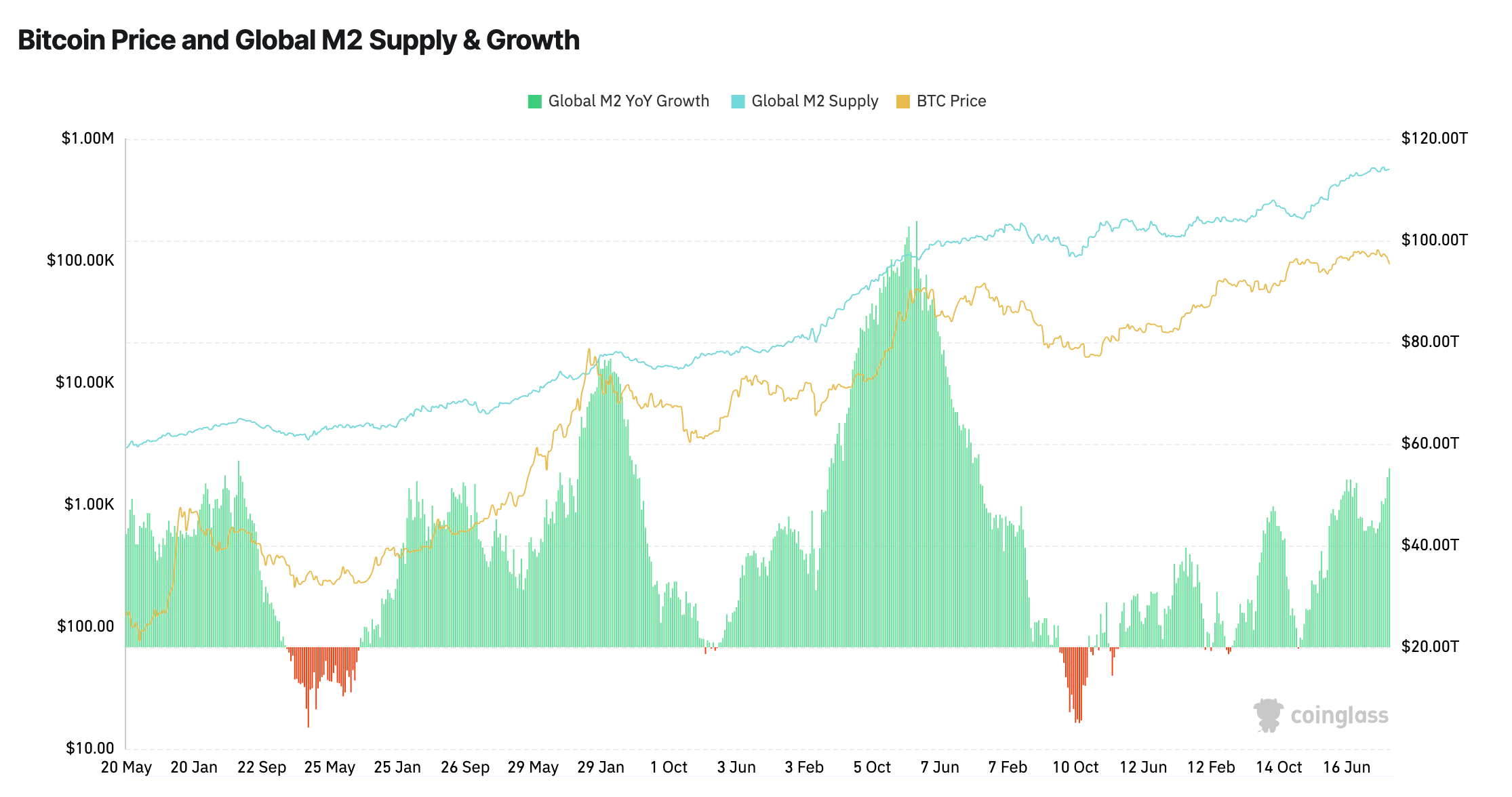 Chart comparing Bitcoin price with global M2 supply and growth from May 20, 2013, to December 3, 2025 (Source: CoinGlass)## Bitcoin now trades in the same liquidity ecosystem as TradFi
The emergence of spot ETFs, market-making desks, systematic funds, and derivatives products has brought Bitcoin fully into the macro market liquidity cycle. QT, Treasury supply, money market flows, and Fed balance sheet tools—including repo—all impact large institutional holders.
Thus, small repo signals can explain why Bitcoin sometimes rallies on a newsless day, or drops when everything in crypto seems normal.
If this repo volume quickly subsides, it’s likely just technical demand. If it repeats, SOFR stays high, or the Standing Repo Facility becomes more active, the signal tilts toward liquidity tightening—a context in which Bitcoin behaves very differently.
Currently, the market is in a fragile equilibrium: ETF flows have slowed, yields are stable, and year-end liquidity is unevenly distributed. The $13.5 billion repo doesn’t change the big picture, but fits perfectly into it: not tense enough to sound the alarm, but not comfortable enough to ignore.
In an environment where the “breathability” of USD determines the risk boundary, Bitcoin moves precisely at that edge—and it’s that edge that sets BTC’s direction.
Thach Sanh
Disclaimer: The information on this page may come from third parties and does not represent the views or opinions of Gate. The content displayed on this page is for reference only and does not constitute any financial, investment, or legal advice. Gate does not guarantee the accuracy or completeness of the information and shall not be liable for any losses arising from the use of this information. Virtual asset investments carry high risks and are subject to significant price volatility. You may lose all of your invested principal. Please fully understand the relevant risks and make prudent decisions based on your own financial situation and risk tolerance. For details, please refer to
Disclaimer.
Related Articles
The crypto market is widely declining, with BTC breaking below $68,000, while AI and Meme sectors rally against the trend with gains exceeding 3%
On March 23, the crypto market experienced widespread declines, with Bitcoin and Ethereum falling 1.42% and 1.78% respectively. The RWA sector suffered a significant drop of 4.85%, while AI and Meme sectors bucked the trend with gains of 10.36% and 3.66% respectively. Other sectors showed mixed performance, with overall market sentiment remaining weak.
GateNews34m ago
Michael Saylor Signals Continued Bitcoin Accumulation as Funding Strategy Shifts Toward STRC Preferred Stock
Strategy Executive Chairman Michael Saylor posted on March 22, 2026, that "The Orange March Continues," signaling the company's ongoing Bitcoin accumulation as total holdings reached 761,068 BTC valued at approximately $52.36 billion with an average acquisition cost of $75,696 per coin.
CryptopulseElite38m ago
BTC rises 0.61% in 15 minutes: Whale fund inflows superimposed with futures premium resonance driving
Between 2026-03-23 02:15 and 2026-03-23 02:30 (UTC), BTC yield recorded +0.61%, with prices fluctuating between 67807.1 and 68304.9 USDT, representing a volatility of 0.73%. During this short-term volatility period, market trading activity was robust, with enhanced linkage between spot and futures markets, and sustained volume increase in core trading zones, attracting market attention.
The primary driver of this volatility was significant capital inflow from on-chain whale wallets to exchanges during the window period, with approximately 17,184 BTC flowing in within a short timeframe, marking a new monthly high. M
GateNews43m ago
Bitcoin Falls Below $69,000, Derivatives Market Shifts to Defense, Downside Risks Intensify
10x Research analysis points out that Bitcoin has broken below $69,000, marking a shift in market structure. Traders have significantly adjusted positions, with increased futures liquidations and negative funding rates. Options capital flows are moving toward downside protection, signaling hedging demand against downside risks. Meanwhile, market expectations regarding rate increases are diverging from the Federal Reserve's rate-cutting guidance, which could impact risk asset performance.
GateNews44m ago
NYSE Lifts Crypto Options Cap Across 11 BTC and ETH ETFs
Two NYSE-affiliated venues have scrapped the 25,000-contract cap on options tied to 11 crypto ETF options, a move the exchanges filed with the Federal Register on March 10. The Securities and Exchange Commission acknowledged the rule alterations on Sunday by waiving the standard 30-day waiting
CryptoBreaking1h ago
NYSE Exchanges Remove 25,000-Contract Options Cap on 11 Bitcoin and Ether ETFs
NYSE Arca and NYSE American have removed the 25,000-contract position and exercise limits on options tied to 11 spot Bitcoin and Ether exchange-traded funds (ETFs), with the rule changes filed on March 10, 2026, becoming immediately effective after the Securities and Exchange Commission (SEC) waived the standard 30-day waiting period.
CryptopulseElite1h ago


