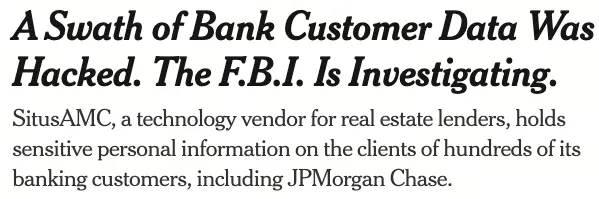
The New York Times was the first to report on recent customer data breaches involving major American banks such as JPMorgan Chase, Citigroup, and Morgan Stanley. Vitalik remarked, “Privacy is not a feature, but a hygiene habit,” coinciding with the Ethereum Foundation's launch of the Kohaku privacy toolkit. Technically, Ethereum has formed a bullish head and shoulders pattern, with a final target price of $10,000.
Traditional banking leak crisis sparks Vitalik's privacy revolution declaration
(Source: The New York Times)
The cause of this controversy was that The New York Times first reported on recent data breaches involving major American banks such as JPMorgan Chase, Citigroup, and Morgan Stanley. The scale and impact of this leak are unprecedented, involving sensitive financial information of millions of customers, including account balances, transaction records, and personal identification information. After the incident was exposed, the vulnerability of data security in the traditional financial system once again became a focus of public concern.
Vitalik's recent comment that “privacy is not a feature, but a hygiene habit” has reignited interest, and this time, Ethereum has become the focus of discussion. The deeper meaning of this statement is that privacy should not be seen as an optional add-on, but rather a fundamental requirement of any financial system, just like handwashing is a basic hygiene habit. Vitalik's comment has resonated widely within the crypto community, as it not only responds to bank leak incidents but also fundamentally questions the nature of the entire Web2 data architecture.
In this institution-led market cycle, privacy issues have taken on new significance: institutional use cases require mechanisms that provide privacy protection, while also adhering to selective disclosure requirements. This dual demand creates unique market opportunities for Ethereum. One of the biggest obstacles faced by traditional financial institutions when exploring blockchain technology is the transparency of public blockchains. Banks cannot publicly disclose all of their customers' transaction records on the chain, while still needing the immutability and settlement efficiency of blockchain. If Ethereum can provide solutions that protect privacy while meeting regulatory compliance, it will become the preferred platform for institutional adoption.
Before the broader market panic spreads, the story of privacy coins is gaining attention, and it is set to become the next major touchpoint for real-world applications through tokens like Zcash. As a pioneer in privacy coins, Zcash utilizes zero-knowledge proof technology to achieve transaction privacy, but its ecosystem scale and developer resources are far inferior to Ethereum. If Ethereum can integrate similar privacy technology, it will open up a new market for privacy applications while maintaining its existing ecological advantages.
Ethereum Foundation Launches Kohaku Privacy Toolkit
In October, the Ethereum Foundation launched a new privacy-centric cluster and released preliminary details about Kohaku, a privacy-focused browser wallet and software development kit. The name Kohaku comes from the Japanese word for “amber,” symbolizing something precious that needs protection, just like users' private data. The core function of this toolkit is to enable developers to easily build decentralized applications (dApps) with privacy protection features.
Kohaku's technical architecture includes advanced cryptographic technologies such as Zero-Knowledge Proofs (ZK-Proofs), Trusted Execution Environments (TEE), and Multi-Party Computation (MPC). Developers can add transaction privacy, identity privacy, and data privacy features to their dApps through simple API calls without needing to deeply understand the underlying complex cryptographic principles. This developer-friendly design significantly lowers the development barrier for privacy applications and is expected to give rise to a new wave of dApps centered around privacy as a core selling point.
This is a step towards the article written by Vitalik in April, which outlined the approach for Ethereum to address the structural data exposure issues arising in TradFi and public blockchains. In that article, Vitalik proposed the concept of a “privacy pool,” allowing users to prove the legitimacy of their funding sources to regulators while protecting transaction privacy. This design cleverly balances the needs for privacy protection and regulatory compliance, clearing the way for Ethereum's application in the institutional market.
Three Core Functions of the Kohaku Toolkit
Privacy Transaction Layer: Utilizes ZK-Rollups technology to conceal transaction amounts and participant identities while maintaining transaction verifiability.
Selective Disclosure Mechanism: Allows users to selectively disclose transaction information to specific parties (such as regulatory authorities or auditing firms) when needed.
Developer SDK: Provides standardized APIs and pre-built modules, allowing developers to build privacy dApps within weeks.
The Ethereum Foundation's investment in Kohaku demonstrates that it views privacy features as a strategic priority equally important as scalability and security. This strategic adjustment directly responds to the market demand exposed by the banking leak incident and opens up a potential multi-billion dollar market for Ethereum.
Technical Analysis: Head and Shoulders Pattern Points to $10,000

(Source: Trading View)
As a native blockchain serving as a potential privacy solution connecting Web 2 to Web 3, the new demand will help Ethereum complete the final shoulder of a potential bullish head and shoulders pattern. With favorable momentum indicators and a decisive rebound from the historical demand zone around $2750, it may have just hit the bottom.
The head and shoulders pattern is one of the most reliable reversal patterns in technical analysis. The current pattern of Ethereum shows that the left shoulder formed in early 2024, the head reached a peak in mid-year, and the right shoulder is currently forming. The key is the position of the neckline, which is around $4,000. If the price can break through this neckline and hold, it will confirm the validity of the pattern and initiate a new bullish cycle.
After months of continuous decline, the RSI indicator has significantly rebounded from the oversold threshold of 30, and the MACD indicator is also approaching a golden cross. Historically, these readings have marked local bottoms in Ethereum prices. The rebound of the RSI from the oversold zone indicates that the selling pressure has been fully released, and buying interest is starting to enter. The MACD golden cross (the fast line crossing above the slow line) is a classic buy signal and usually indicates a reversal of the medium-term trend.
If the pattern completely breaks out, the neckline may stabilize around $5,500, breaking the historical high and entering a new price discovery phase within a 90% pump. $5,500 is the previous historical high for Ethereum, and breaking this level will eliminate all technical resistance, entering a price discovery phase purely driven by supply and demand. A 90% pump means that based on the current price (around $2,900), the short-term target will reach approximately $5,500.
However, as the bullish market matures, if Ethereum plays a larger role in the transition from Web2 to Web3, its price could pump by 250%, reaching $10,000. This long-term goal is based on the assumption that Ethereum becomes the dominant platform for privacy applications. If Kohaku successfully attracts a large number of developers to build privacy dApps, if institutions accelerate the adoption of blockchain privacy solutions due to bank leak incidents, and if regulatory agencies recognize Ethereum's selective disclosure mechanism, then the $10,000 target is not impossible.
How Privacy Narratives Reshape Ethereum's Value Proposition
The banking leak incident has provided Ethereum with an opportunity for repositioning. In the past, Ethereum was primarily seen as an infrastructure platform for DeFi and NFTs, but the penetration rate of these application scenarios in the institutional market has been limited. Privacy applications are different; they directly address the pain points of the traditional financial system, opening the door for Ethereum to enter mainstream markets such as banking, payments, and corporate data management.
Vitalik's argument that “privacy is a hygiene habit” distinguishes Ethereum from dedicated privacy coins like Zcash. The privacy of Zcash is its only selling point, but it lacks a rich application ecosystem. Ethereum, on the other hand, integrates privacy as a dimension of its multifunctional platform, allowing developers to choose whether to enable privacy features based on specific needs. This flexibility enables Ethereum to serve both public applications that require complete transparency (such as charitable donations) and enterprise applications that require strict privacy (such as payroll payments).
Three Potential Markets for Ethereum Privacy Applications
Enterprise Data Management: After the bank leak incident, the demand for data security among enterprises surged. Ethereum can provide immutable and privacy-protecting data storage solutions.
Cross-border Payment: The traditional SWIFT system has excessive transparency and low efficiency, while Ethereum privacy payments can achieve instant settlement and protect transaction privacy.
Medical Health Records: Patient medical data needs to allow authorized medical institutions to access it while protecting privacy, and Ethereum's selective disclosure mechanism fits perfectly.
If these application scenarios can be implemented, it will bring Ethereum a market scale far exceeding the current DeFi and NFT. The global enterprise data management market is over 100 billion dollars, the cross-border payment market exceeds 150 trillion dollars, and the healthcare IT market is over 200 billion dollars. If Ethereum can capture even a small part of these markets, a price target of 10,000 dollars will just be the beginning.


