Article Author: Thejaswini M A
Article compiled by: Block unicorn
Foreword
Sandeep Nailwal's father often doesn't come home for days.
By the time he returned, the monthly salary of 80 dollars was gone, squandered on alcohol and gambling debts.
This family lives in a settlement along the banks of the Yamuna River, which locals contemptuously refer to as “Jamna-Paar,” roughly meaning “the other side of the river.” But this is not a compliment.
Sandeep always stood outside the classroom when he was a child because his parents couldn't pay the tuition, so he couldn't enter the classroom. When he was ten, his brother suffered a serious accident, and his childhood came to an end. His father's drug addiction meant that someone had to step up. That person was Sandeep.
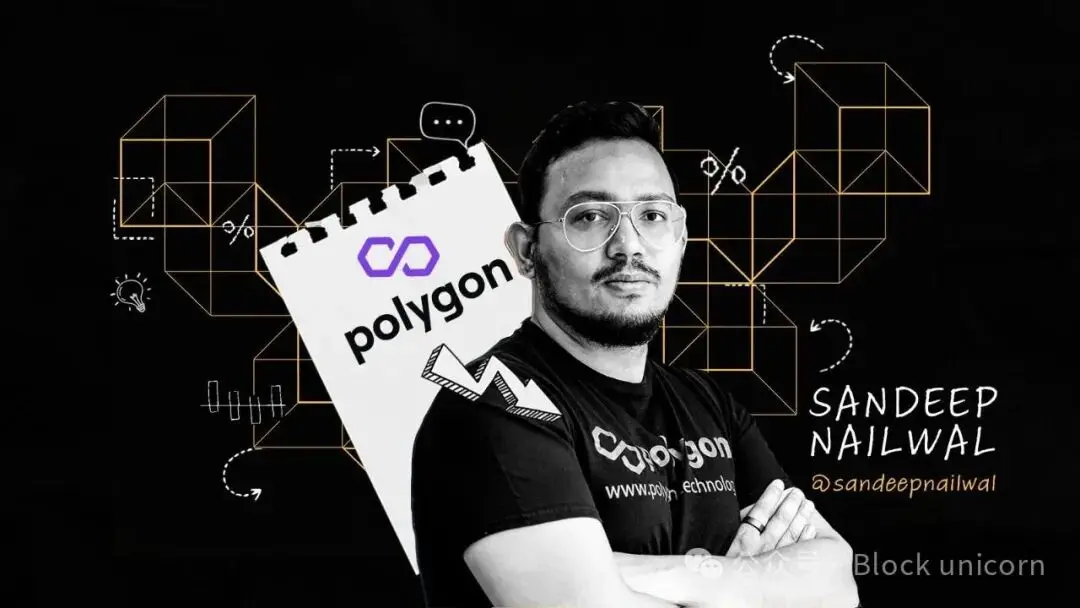
Today, Nairwal operates Polygon, a blockchain infrastructure company that processes millions of transactions daily, collaborating with companies like JPMorgan, Stripe, and Disney. This journey took just thirty years, from the slums of Delhi to developing technology used by Fortune 500 companies.
But this road was not smooth sailing; the scars from his early years influenced every decision he made.
Sandeep Nailwal was born in 1987 in Ramnagar, a rural village at the foot of the Himalayas, which had no electricity. His parents were illiterate when they got married, and when he was four years old, they moved to Delhi in search of opportunities that were unavailable in their village.
As a result, what they found was a slum.
The settlements on the east bank of the Yamuna River are crowded, dirty, and rife with violence. Illegal firearms and knives are the preferred tools for resolving disputes. His family squeezes into any accommodation they can afford and moves constantly as the situation changes.
His parents do not understand education. They do not know that children can start school at the age of three or four. Sandip did not start school until he was five, simply because no one told his parents. Starting school so late meant that he was always the oldest child in the class, two years older than the other children, which constantly reminded him that he was falling behind.
The trauma brought about by poverty is not just the shame of not having food to eat or being in rags. It also includes the shame of watching your father lose all the tuition fees while you stand outside the classroom. It also includes watching your mother struggle to keep the family fed while battling with an alcoholic husband.
It is at a young age that one understands that no one will come to save you.
Sixth Grade Entrepreneur
Sandeep's way of dealing with poverty is through work. In sixth grade, he started tutoring younger students, earning 300 rupees a month. He also found a friend who owned a stationery store and began purchasing pens at cost price, then reselling them to his classmates at a markup.
Although the amount is not large, the lesson he learned is very important: you can create value, obtain a part of it, and use that money to change your situation.
He dreams of being admitted to the Indian Institute of Technology (IIT), a prestigious engineering college that offers a way out of poverty for ambitious students. However, the IIT requires expensive tutoring fees to compete for 5,000 spots among millions of applicants. His family cannot afford it.
Thus, Nairval entered the second-rate Maharaja Agrasen Technical Institute, paying tuition fees with student loans. Sometimes, he had to use the loans to pay off his father's gambling debts instead of buying textbooks or a computer.
The decision to study computer science stemmed from seeing Mark Zuckerberg on Indian television. At that time, Facebook was a global sensation, and the young Sandeep thought to himself, “I want to create my own Facebook.”
He now admits that he was very naive at that time. But the combination of naivety and despair created a special kind of determination.
After obtaining his engineering degree, Narwhal pursued an MBA at the National Institute of Industrial Engineering in Mumbai. There, he met Harshita Singh, who later became his wife. After graduation, he worked as a consultant at Deloitte and quickly paid off his student loans and his father's debts.
Nairval has held positions at multiple companies: as a software developer at a computer science firm, as a consultant at Deloitte, and as the Chief Technology Officer in the e-commerce division of the Welspun Group. He performed excellently, received promotions, and earned a considerable income.
But he could never shake off the urge to start a business.
In Indian culture, buying a house before marriage is a kind of pressure. A man without property has no future. Nairwal feels this pressure deeply. He has a good job, can get a loan to buy a house, and can settle down.
The Hash Tower said to him one thing that changed everything: “You will never be happy like this. I don't care about my house, we can rent a place to live.”
In early 2016, Nairval resigned from his job. He borrowed $15,000 (money he originally planned to use for a wedding in the future) to start Scope Weaver, an online platform that provides professional services. His idea was to standardize India's fragmented service industry and create a platform similar to Alibaba, but aimed at Indian service providers rather than Chinese manufacturers.
The company is doing pretty well and has generated some income. But Narwhal realizes that he is becoming a bottleneck. What clients want is a face, someone to be accountable when problems arise. He is turning into just an ordinary service provider, only now he has to pay his employees' salaries.
This business cannot be scaled. A year later, he began to look for the next opportunity.
a $800 Bitcoin bet
Narwhal first heard about Bitcoin in 2010. A friend suggested mining together, but Narwhal didn't have a laptop, and the topic ended there.
In 2013, he came into contact with Bitcoin again while pursuing his MBA. He tried to set up a mining rig, but his laptop's performance was too poor. He attempted to understand Bitcoin and after reading a couple of paragraphs, he saw “no backing whatsoever” and thought it was a scam, so he chose to give up.
In 2016, Bitcoin once again came into his view. Naval, realizing that Scope Weaver could not become the company he envisioned, began to explore opportunities in “deep tech.” He considered artificial intelligence but found that the mathematics exceeded his capabilities.
Then, he actually read the Bitcoin white paper.
“Oh, this is so important,” he thought, “this is the next revolution for humanity.”
Whether it's faith or recklessness, it depends on your perspective. Narwhal took out the $15,000 he borrowed for the wedding and invested it all in Bitcoin, with each Bitcoin priced at $800.
He admitted, “My FOMO (fear of missing out) was very strong at that time. Even if I were a year late, I would have done the same thing at $20,000 and would have lost all my money.”
But he did not lose. The price of Bitcoin has risen. More importantly, Naval discovered Ethereum and its programmable smart contracts. This is a new computing platform that can run applications without centralized control.
He is completely fascinated.
In 2017, Narwhal met Janti Kanani through the online Ethereum community. Kanani proposed a solution to the scalability issue of Ethereum. At that time, the Ethereum network was experiencing congestion due to its own success. CryptoKitties caused transaction fees to soar by 600%.
Kaanani and Nairval, along with co-founders Anurag Arjun and Mihailo Bjelic, began developing the Matic Network in early 2018. They raised $30,000 in seed funding with the plan to first create a runnable product before financing through an ICO.
This principled approach almost led to their failure. By the time they had a usable testnet, the crypto market had already collapsed. No one was willing to invest, especially in Indian projects. At that time, two Indian crypto projects were exposed as scams.
“No one believed that the Indian founder could develop the protocol,” Nairwal recalled.
The team only managed to operate on $165,000 in the first two years. The founders only took a few thousand dollars in salary each month. Several times, their funds were only enough to last three months. Narwhal remembers begging other cryptocurrency founders for $50,000 just to last another quarter.
In 2018, just before his wedding, his life hit rock bottom. A Chinese fund promised to invest $500,000. Two days before the wedding, Bitcoin dropped from $6,000 to $3,000. The Chinese fund called and said, “We were planning to invest in 100 bitcoins. Now that it has depreciated by half, we won't invest anymore.” Worse still, all of Matic's funds were in Bitcoin. Its value was also halved.
His wedding went ahead as usual. Friends celebrated for him. But Nairval knew that in three months they might not have a company anymore.
At the beginning of 2019, Binance approved Matic to raise $5.6 million through its Launchpad project. Due diligence took eight months. This funding also gave Matic a chance to breathe. However, final approval has still not been achieved. The team attended countless hackathons, visiting developers one by one to explain their technology.
Initially, growth was slow, but in 2021, due to high gas fees on Ethereum making it nearly impossible to conduct small transactions, the growth began to accelerate. Developers began migrating to Matic.
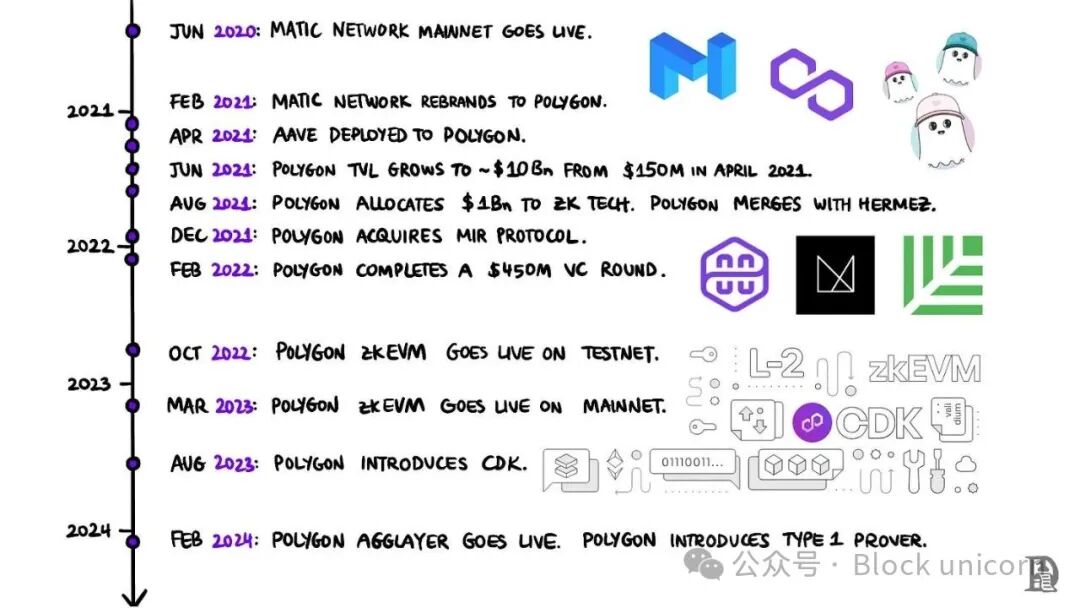
Originally launched under the name Matic Network, it is a single-chain scaling solution that operates in the form of a sidechain and combines Plasma and Proof of Stake (PoS) mechanisms. In 2021, Matic Network underwent a significant rebranding and was renamed Polygon, reflecting its transition from a single chain to a broader multi-chain ecosystem, aimed at providing diverse scaling solutions for Ethereum-compatible blockchains.
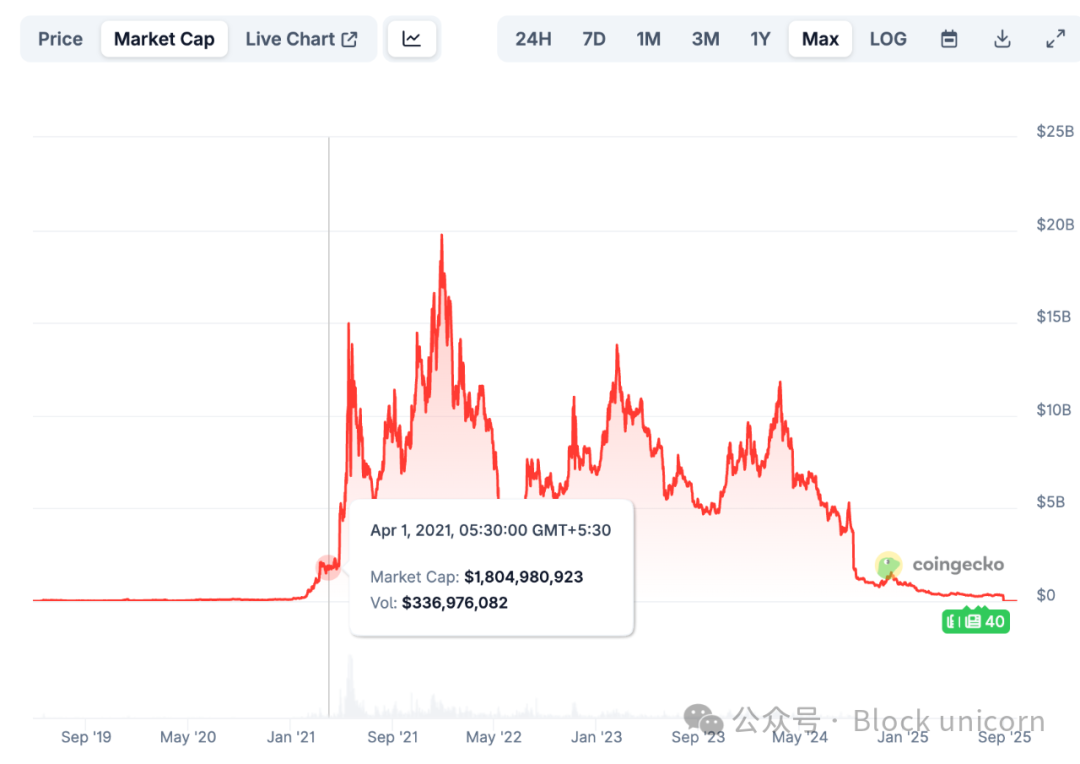
The market has responded positively to this brand revitalization. Polygon's market capitalization soared from $87 million at the beginning of 2021 to nearly $19 billion in December.
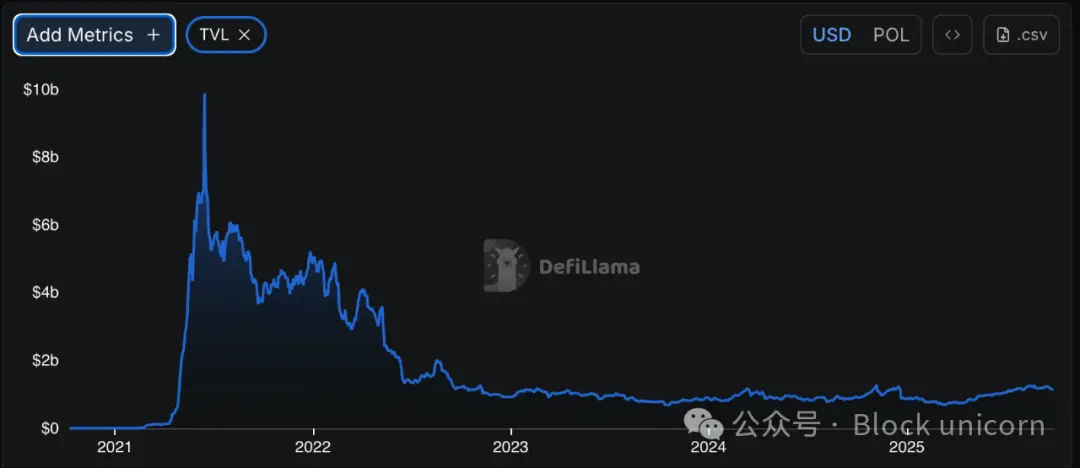
Developers are flocking to Matic, with the total value locked in the network reaching a peak of 10 billion dollars.
In addition, the native token has transitioned from $MATIC (used to secure the original Polygon PoS chain) to $POL (aimed at supporting the entire Polygon ecosystem), especially under the upcoming upgraded version (such as Staking Hub), which aims to solidify and enhance cross-chain security and governance. This token migration is crucial, although it has brought some temporary uncertainty to holders during the transition period, leading to a dispersion of liquidity.
Polygon Labs has boldly shifted its strategic focus to zero-knowledge (ZK) Rollup and has acquired a team focused on ZK to develop zkEVM, a virtual machine capable of achieving execution power comparable to Ethereum while also benefiting from the scalability advantages of ZK proofs. Although optimistic Rollup (OR) initially garnered attention due to its simpler design and earlier release, Polygon's emphasis on ZK Rollup reflects its long-term bet on Ethereum's ultimate Layer-2 scaling solution. The zkEVM technology aims to combine high security, scalability, and full compatibility with existing Ethereum tools, potentially allowing Polygon to take a leading position in future multi-chain architectures.
Turning point of the COVID-19 pandemic
In April 2021, the second wave of the COVID-19 pandemic hit India hard. Hospitals were overcrowded, and there was a shortage of oxygen supply. Nehru's family contracted COVID-19 in India, while he was helpless far away in Dubai.
“At that time, it was clear that our family couldn't all make it through 100%,” he said, “not everyone can survive.”
He stated on Twitter that he could not stand by and watch this crisis unfold. He created a crypto multi-signature wallet to receive donations, expecting to raise a total of 5 million dollars. Within a few days, donations reached 10 million dollars. Subsequently, Ethereum founder Vitalik Buterin donated 1 billion dollars worth of Shiba Inu coins.
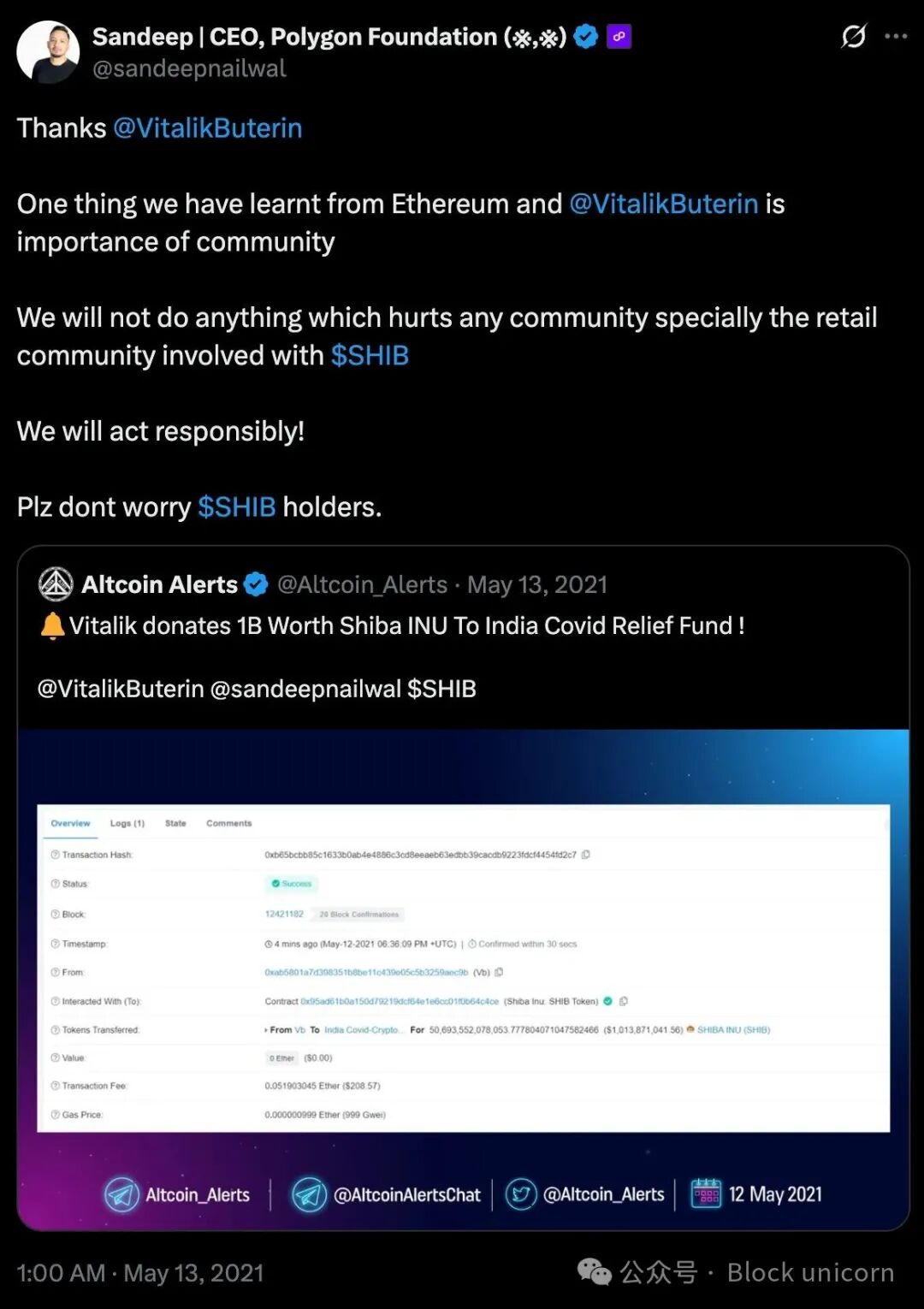
The real challenge is: how to liquidate $1 billion worth of meme coins without causing a market crash?
Nerwal collaborated with market makers to slowly sell off over several months. The Shiba Inu coin community initially panicked over concerns of a large-scale sell-off, but calmed down after Nerwal promised to execute it cautiously. In the end, he netted $474 million, far exceeding Buterin's expectations.
The Crypto COVID Relief Fund deployed $74 million to India in an emergency. Narwal returned $200 million to Buterin, who donated it to U.S. biomedical research. The remaining $200 million is reserved for the long-term project “Blockchain Impact.”
shapes character in adversity
By mid-2025, Polygon will face new challenges. The price of $POL has dropped more than 80% from its peak. Competitive Layer 2 solutions from Arbitrum and Optimism are capturing market share. The company expanded to 600 employees during the boom, leading to cultural issues and organizational bloating.
Nerval made a difficult decision. Two rounds of layoffs have streamlined the team to a more cohesive size. Several projects that consumed months of engineering time were canceled as they no longer aligned with the strategy.
In June 2025, Neval was appointed the first CEO of the Polygon Foundation, consolidating the leadership that had previously been dispersed among the co-founders and board members. Three of the four co-founders have exited active roles, and he is the last one remaining.
“When the crucial moment arrives, most founders are unable to make tough decisions,” he said in an interview, “executing market strategies the hard way, firing those who do not fit the current strategy, and abandoning projects that have consumed a lot of time and emotional resources.”
The feeling of these decisions will be different when you cut support for the projects you personally believe in or fire those who believed in your vision during difficult times.
Under the full leadership of Narwhal, Polygon refocuses on AggLayer, an interoperability protocol aimed at unifying blockchain networks. Its technical vision is to create infrastructure that allows thousands of independent blockchains to appear to end users as a single, seamless network.
“By 2030, there could be 100,000 to 1,000,000 chains,” said Nailwal, “and all activities will shift to these application chains.”
This is a bold claim. Whether it can be realized depends on the execution in the coming years.
long-term game
Naval thinks in decades rather than quarters. When discussing the competition of Polygon or the future of DePIN, he continually references timelines of 10 years and 50 years.
“If you give me 10 years, I can tell you 100% that this is the ultimate framework for cryptocurrency to go mainstream,” he said when talking about AggLayer. “But whether it's Polygon's version or others joining in to build something similar, no one can predict.”
He is firmly convinced of the vision for blockchain infrastructure. Whether realized by Polygon or others, it is far less important than seeing it come to fruition.
Through the “Blockchain Influence” project, he is shifting from emergency relief to “incentive-based” philanthropy. He is planning an award similar to the Indian Nobel Prize to encourage the next generation of scientists and engineers.
“I hope to get $2 trillion in output from this $200 million BFI,” he explained, the leverage he described sounded absurd until you remember he turned $30,000 in seed capital into a company that briefly reached a market value of $30 billion.
However, Polygon is facing headwinds. Competitors like Arbitrum and Base have already captured more market share, offering simpler user experiences and stronger support. Polygon's bridging technology remains complex, and the transition from MATIC to POL has also brought uncertainty. The company's developer-centric marketing has not yet translated into large-scale retail applications like its competitors. Whether Narwal's long-term infrastructure investments will pay off depends on execution in an increasingly crowded market.
What is certain is that the distance Sandip Nailwal has traveled from the starting point exceeds most people's imagination. However, whether the infrastructure built can help others like cryptocurrency helped him remains to be seen.
From a village without electricity to building a value internet, the destination is still uncertain, and the journey continues.
This is the story about the Polygon guy. See you in the next article.
Before this… Stay calm and do your own research (DYOR).


