
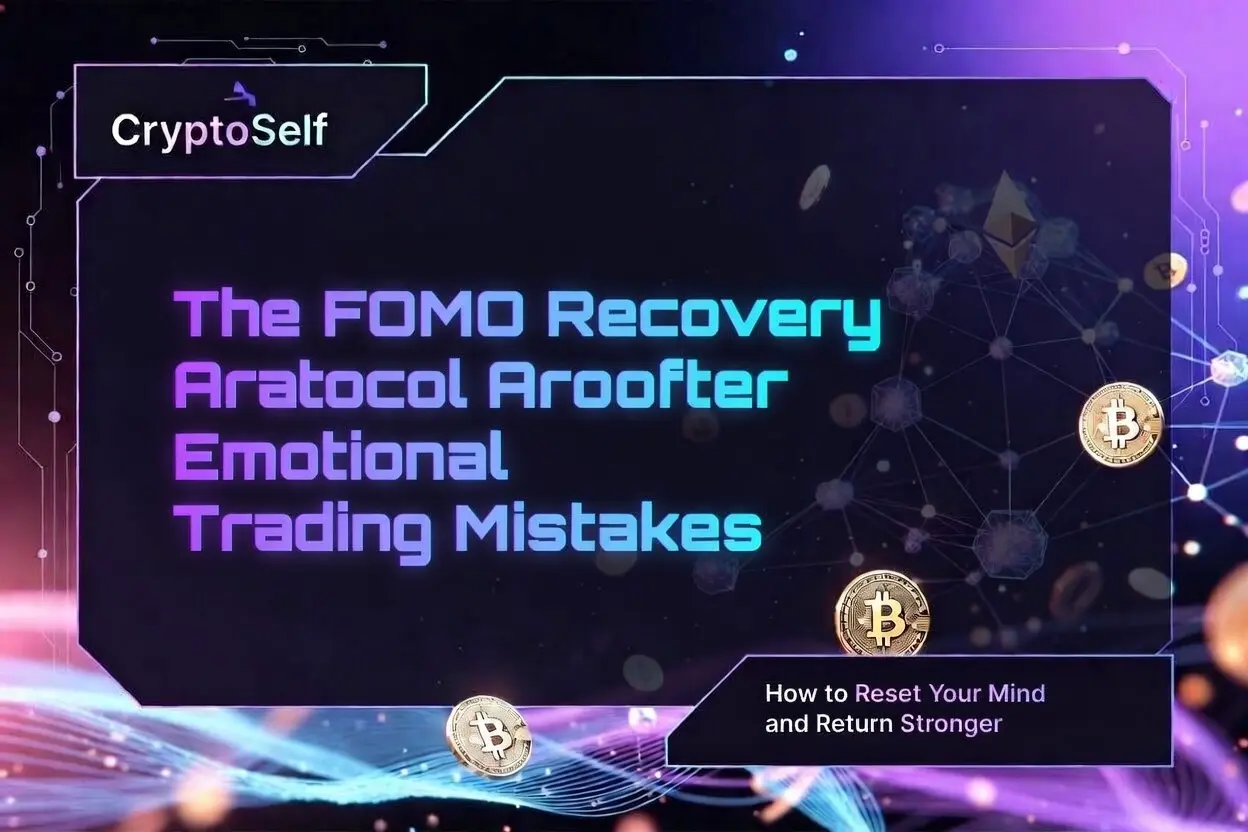
Overcoming FOMO: Emotional Discipline and Practical Strategies in Crypto
FOMO, or “fear of missing out,” is not just an emotion in crypto markets. It is a subtle psychological state that quietly takes control of decision-making. When prices rise rapidly, this feeling does not simply reflect greed or excitement—it reveals something deeper: the human discomfort of watching opportunity move without participation.
In fast-moving markets like crypto, the real danger of FOMO is not speed itself, but the way it compresses thinking. It replaces analysis with urgency and turns observation into reaction. At that point, the trader is no longer following the market—they are following emotion disguised as opportunity.
---
The philosophical root of FOMO: competing with time
At its core, FOMO is a distortion of time perception. A rising chart is not interpreted as a sequence of movements, but as a disappearing chance.
Instead of seeing “what is happening,” the mind begins to think in terms of “what I am losing right now.” This shift is subtle but powerful. Because once time becomes an enemy, decisions stop being rational and become defensive.
And decisions made to avoid regret often create the very regret they are trying to escape.
---
Why crypto markets amplify FOMO
FOMO is not created by individuals alone. It is amplified by the structure of the market itself:
Price movements are non-linear and explosive
Information spreads unevenly and with delay
Social media highlights wins, not failures
Visibility creates illusion of constant success
In such an environment, the mind learns a dangerous pattern:
“If I am not entering now, I am always late.”
But this belief is not reality—it is perception shaped by selective visibility.
---
Emotional discipline: not elimination, but awareness
Overcoming FOMO does not mean removing emotion. That is impossible. Instead, it means preventing emotion from becoming execution.
Emotional discipline is not suppression—it is separation.
It is the ability to feel urgency without obeying it.
---
Practical strategies to control FOMO
1. The waiting rule
After strong price movements, impose a waiting period before entering a trade. Even 15–30 minutes is enough to reduce emotional intensity. FOMO is strongest at the beginning of impulse; it weakens with time.
---
2. Removing the question “Am I too late?”
This question is emotional, not analytical. Replace it with a structured one: “Does this setup still offer a valid risk–reward ratio?”
---
3. Pre-defined entry planning
FOMO thrives in absence of structure. When entries are planned in advance, market movement becomes a trigger—not a decision. This shifts control from emotion to system.
---
4. Reducing position size
If emotional control is weak, risk exposure should be reduced. Smaller positions decrease psychological pressure and allow clearer thinking.
---
5. Accepting that missing is also a position
One of the hardest truths in trading is that not participating is also a decision. Missing an opportunity is not always a mistake—it can be protection from unnecessary risk.
---
The real nature of FOMO
FOMO is often misunderstood as greed, but it is more accurately a fear of exclusion. It is not just “price is moving,” but “I am not part of it.”
This transforms trading into emotional participation rather than strategic decision-making.
Markets move regardless of participation. But the human mind struggles to accept that it does not need to be part of every move.
---
Conclusion
Overcoming FOMO is not about controlling the market. It is about understanding oneself within it.
Because in crypto, the hardest battles are not fought on charts, but in the silent moments before a decision is made.
And in those moments, discipline is not about action—it is about restraint.
The most consistent traders are not those who act the most, but those who can wait without emotional collapse.
#GateLaunchesPreIPOS #GateSpotDerivativesBothTop3 #OilEdgesHigher #USIranCeasefireTalksFaceSetbacks #GateSquareAprilPostingChallenge
FOMO, or “fear of missing out,” is not just an emotion in crypto markets. It is a subtle psychological state that quietly takes control of decision-making. When prices rise rapidly, this feeling does not simply reflect greed or excitement—it reveals something deeper: the human discomfort of watching opportunity move without participation.
In fast-moving markets like crypto, the real danger of FOMO is not speed itself, but the way it compresses thinking. It replaces analysis with urgency and turns observation into reaction. At that point, the trader is no longer following the market—they are following emotion disguised as opportunity.
---
The philosophical root of FOMO: competing with time
At its core, FOMO is a distortion of time perception. A rising chart is not interpreted as a sequence of movements, but as a disappearing chance.
Instead of seeing “what is happening,” the mind begins to think in terms of “what I am losing right now.” This shift is subtle but powerful. Because once time becomes an enemy, decisions stop being rational and become defensive.
And decisions made to avoid regret often create the very regret they are trying to escape.
---
Why crypto markets amplify FOMO
FOMO is not created by individuals alone. It is amplified by the structure of the market itself:
Price movements are non-linear and explosive
Information spreads unevenly and with delay
Social media highlights wins, not failures
Visibility creates illusion of constant success
In such an environment, the mind learns a dangerous pattern:
“If I am not entering now, I am always late.”
But this belief is not reality—it is perception shaped by selective visibility.
---
Emotional discipline: not elimination, but awareness
Overcoming FOMO does not mean removing emotion. That is impossible. Instead, it means preventing emotion from becoming execution.
Emotional discipline is not suppression—it is separation.
It is the ability to feel urgency without obeying it.
---
Practical strategies to control FOMO
1. The waiting rule
After strong price movements, impose a waiting period before entering a trade. Even 15–30 minutes is enough to reduce emotional intensity. FOMO is strongest at the beginning of impulse; it weakens with time.
---
2. Removing the question “Am I too late?”
This question is emotional, not analytical. Replace it with a structured one: “Does this setup still offer a valid risk–reward ratio?”
---
3. Pre-defined entry planning
FOMO thrives in absence of structure. When entries are planned in advance, market movement becomes a trigger—not a decision. This shifts control from emotion to system.
---
4. Reducing position size
If emotional control is weak, risk exposure should be reduced. Smaller positions decrease psychological pressure and allow clearer thinking.
---
5. Accepting that missing is also a position
One of the hardest truths in trading is that not participating is also a decision. Missing an opportunity is not always a mistake—it can be protection from unnecessary risk.
---
The real nature of FOMO
FOMO is often misunderstood as greed, but it is more accurately a fear of exclusion. It is not just “price is moving,” but “I am not part of it.”
This transforms trading into emotional participation rather than strategic decision-making.
Markets move regardless of participation. But the human mind struggles to accept that it does not need to be part of every move.
---
Conclusion
Overcoming FOMO is not about controlling the market. It is about understanding oneself within it.
Because in crypto, the hardest battles are not fought on charts, but in the silent moments before a decision is made.
And in those moments, discipline is not about action—it is about restraint.
The most consistent traders are not those who act the most, but those who can wait without emotional collapse.
#GateLaunchesPreIPOS #GateSpotDerivativesBothTop3 #OilEdgesHigher #USIranCeasefireTalksFaceSetbacks #GateSquareAprilPostingChallenge