
BlackRiderCryptoLord

vip
Age 0.6 Yıl
Peak Tier 0
No content yet
#BitcoinWeakens
Bitcoin is currently trading around $66,818 — and for those thinking, “just wait a little, it will recover,” there’s an important reality to understand:
Over the past 7 days, it has dropped by -5.76%, and over the last 90 days, it is down -24.49%. This is not just a minor dip — it reflects sustained weakness.
From a technical perspective, both the 4-hour and daily timeframes tell a similar story. Key moving averages — MA7, MA30, and MA120 — are all aligned downward, forming what is known as a bearish alignment. Additionally, the PDI is significantly below the MDI, while the AD
BTC-0,61%
ADX-1,54%
post-image
  • Reward
  • 4
  • Repost
  • Share
Yusfirahvip:
2026 GOGOGO 👊
View More
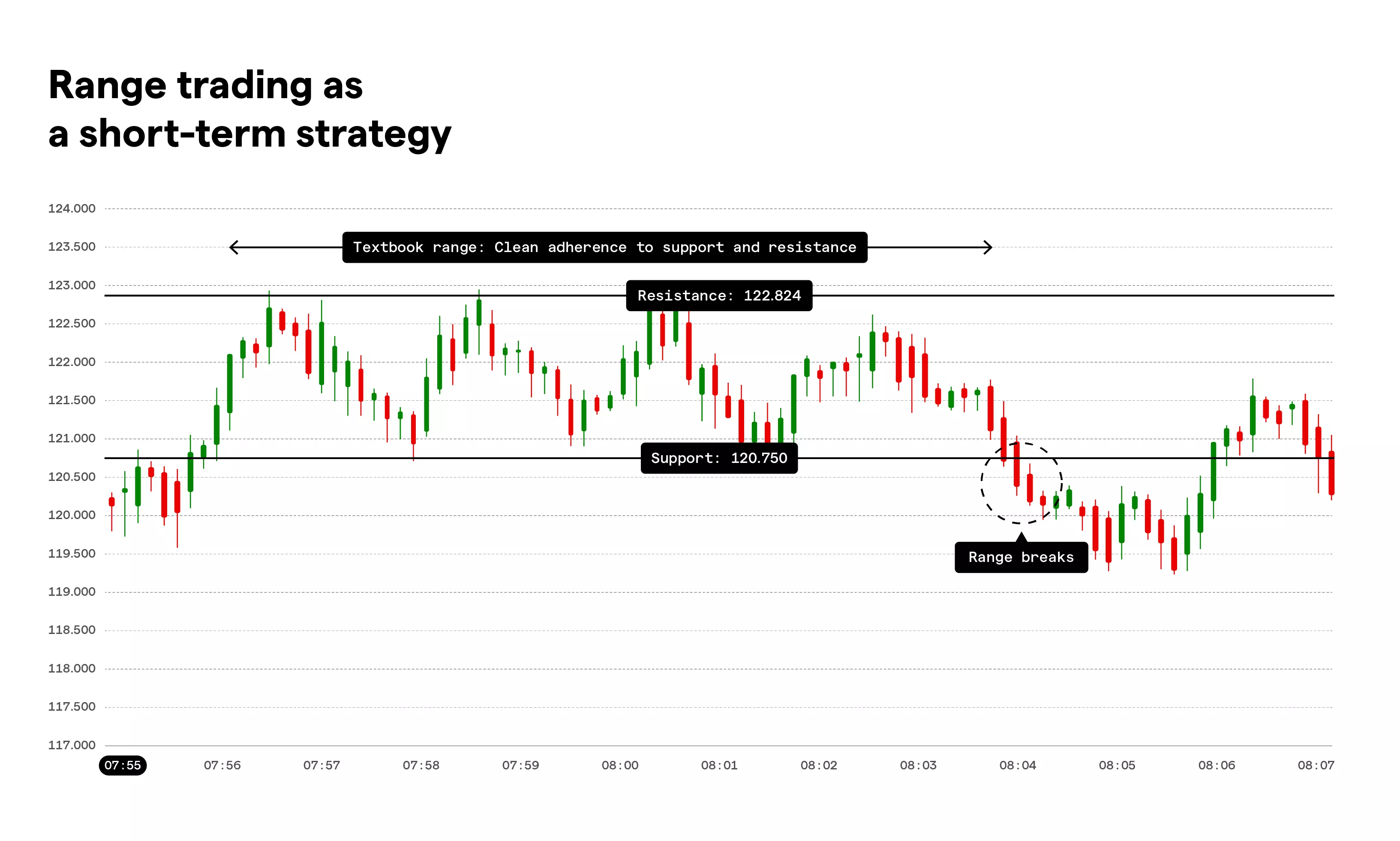
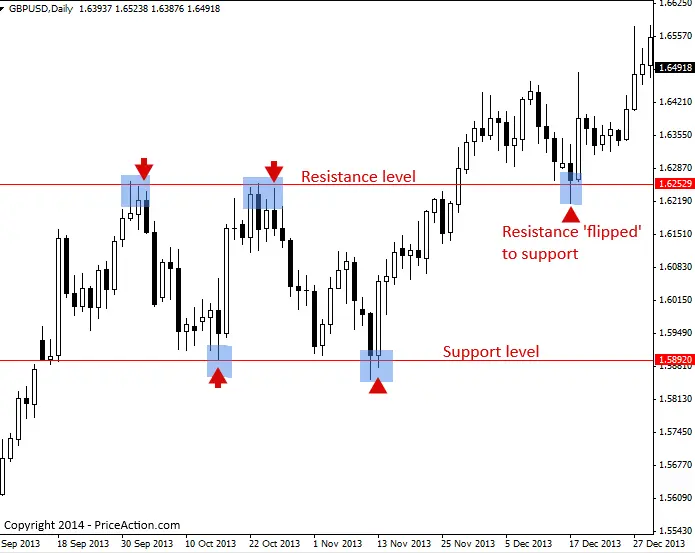
#RangeTradingStrategy
Institutional Perspective 📊
Retail traders chase breakouts.
Smart money accumulates inside ranges.
📊 Market Reality (Data-Backed Insight):
• ~65–75% of market time is range-bound
• Only 25–35% is trending
• Most breakout attempts = fakeouts/liquidity grabs
👉 This is why breakout traders often lose…
👉 And range traders build consistency.
🔍 Core Concept: Liquidity Engineering
Markets don’t move randomly.
Price moves between liquidity zones:
⬇️ Support = Buy-side interest
⬆️ Resistance = Sell-side pressure
Smart money:
• Buys when retail panic sells (support)
• Sells w
post-image
post-image
  • Reward
  • 1
  • Repost
  • Share
dragon_fly2vip:
To The Moon 🌕
#PredictToWin1000GT
🎯 Prediction
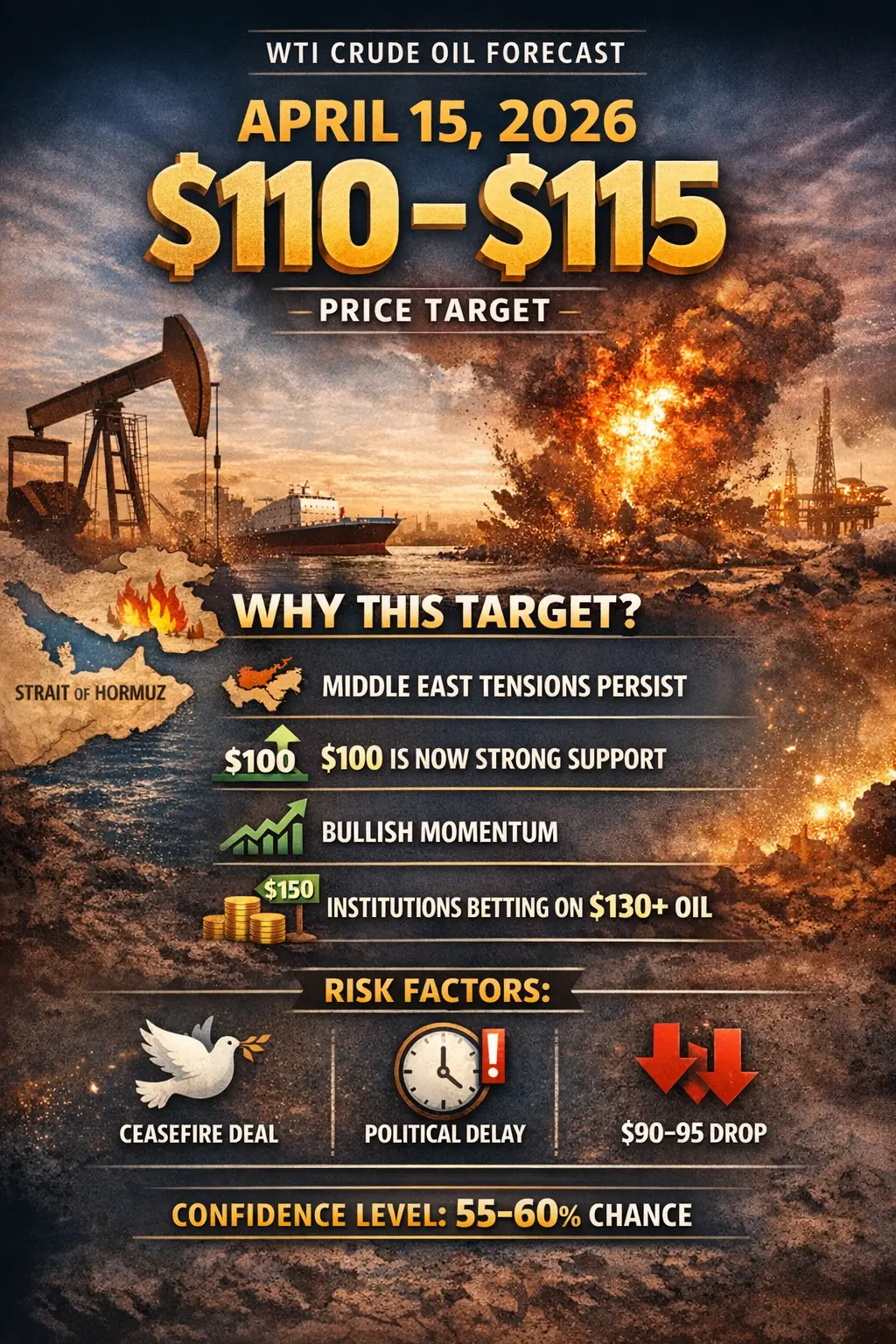
🔥 WTI (XTI) Price on April 15, 2026: $110 – $115
📊 Why This Target Makes Sense
1. Geopolitical Pressure Remains Strong
Middle East tensions are still unresolved
Disruptions in the Strait of Hormuz → tight global supply
👉 This keeps a persistent risk premium in oil prices
2. $100 Has Turned Into Support
WTI has tested the $100 level multiple times
It is now acting as a support zone, not resistance
👉 Once sustained above $100:
→ the next natural move is toward $110+
3. Bullish Momentum Is Intact
Recent sharp rallies show:
Strong buyer activity
Fear-driven
post-image
  • Reward
  • 1
  • Repost
  • Share
ybaservip:
To The Moon 🌕
#PredictToWin1000GT
U.S. Crypto Regulation Milestone
Event:
Will the United States pass a comprehensive Crypto Market Structure Bill before December 31, 2026?
Options:
Yes
No
My Answer: YES
📊 Clear, Strategic Prediction Logic
For years, crypto has operated under regulatory uncertainty in the United States.
👉 That phase is now ending
👉 The system is transitioning from unclear rules → defined structure
This shift is not theoretical — it is already in motion.
🔼 Core Catalysts Driving a “YES” Outcome
1. Regulatory Framework Has Already Started
Securities and Exchange Commission and Commodit
HighAmbitionvip
#PredictToWin1000GT
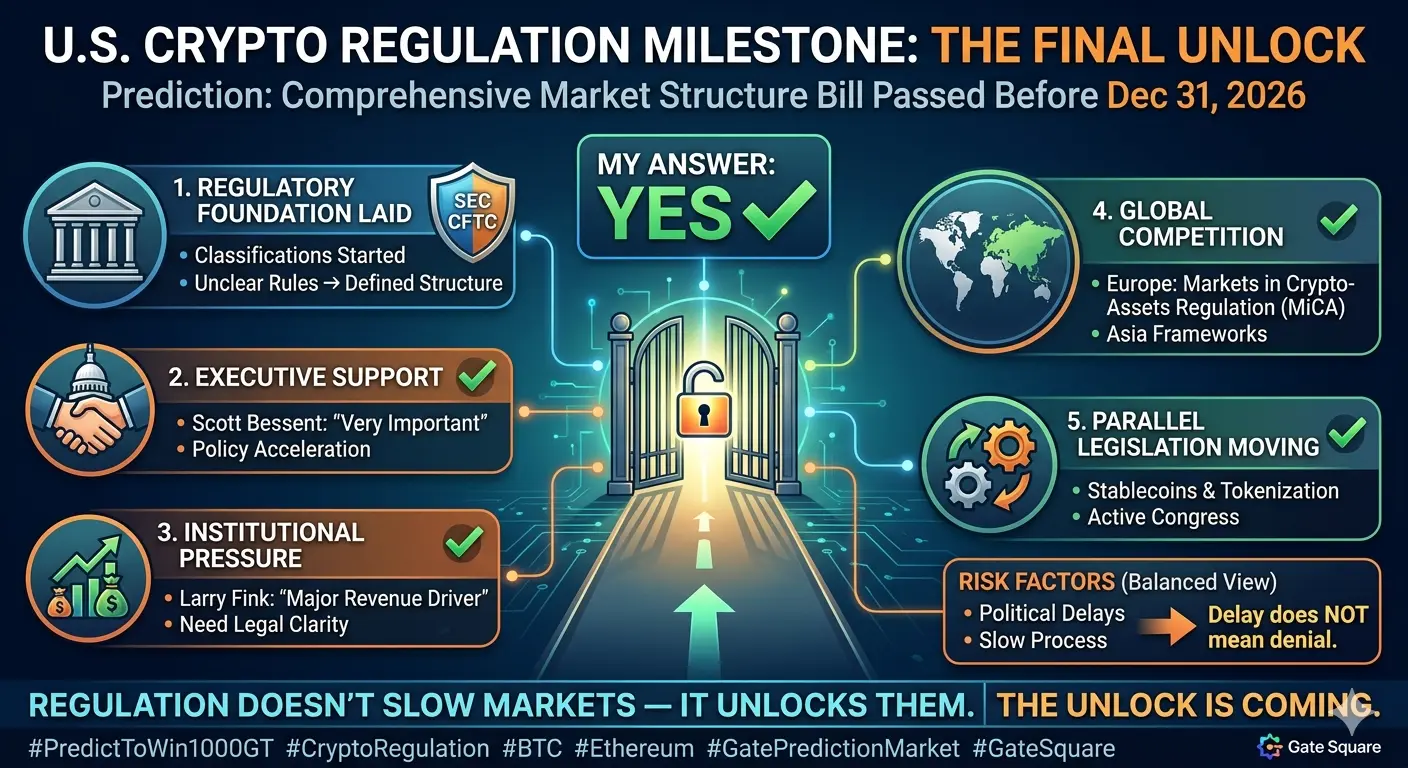
U.S. Crypto Regulation Milestone
Event:
Will the United States pass a comprehensive Crypto Market Structure Bill before December 31, 2026?
Options:
Yes
No
My Answer: YES
📊 Clear, Strategic Prediction Logic
For years, crypto has operated under regulatory uncertainty in the United States.
👉 That phase is now ending
👉 The system is transitioning from unclear rules → defined structure
This shift is not theoretical — it is already in motion.
🔼 Core Catalysts Driving a “YES” Outcome
1. Regulatory Framework Has Already Started
Securities and Exchange Commission and Commodity Futures Trading Commission have introduced a formal classification structure
👉 Major assets are now being clearly categorized
👉 This is the foundation of full legislation
2. Executive-Level Support Is Now Visible
Scott Bessent has publicly emphasized that passing a crypto market structure bill is “very important”
👉 When the Treasury signals urgency, policy acceleration usually follows
👉 This is not speculation — this is direction from the top
3. Institutional Pressure Is Increasing
Larry Fink has projected crypto to become a major revenue driver in coming years
👉 Large institutions are already positioned
👉 Now they need legal clarity to scale further
4. Global Competition Is Forcing Action
Europe already has regulatory clarity via Markets in Crypto-Assets Regulation
Asia is rapidly advancing crypto frameworks
👉 The U.S. cannot afford to fall behind
👉 Regulation is now a strategic priority, not a debate
5. Parallel Legislation Is Moving
Stablecoin regulation progressing
Tokenization frameworks expanding
👉 This shows Congress is already in active crypto legislation mode
📉 Risk Factors (Balanced View)
Political delays or election cycles
Disagreements between regulatory bodies
Slower-than-expected legislative process
👉 But important point: delay does not mean denial
🎯 Final Insight
All critical layers are aligned:
Regulatory groundwork ✔️
Political support ✔️
Institutional demand ✔️
Global pressure ✔️
👉 This is no longer a question of if
👉 It is a question of when
🟣 Gate Square Post (Final — Powerful & Clear)
My fourth prediction — and this one matters more than any single coin.
Will the U.S. pass a Crypto Market Structure Bill before December 31, 2026?
My answer: YES.
Here’s the reality.
For years, crypto has been stuck in uncertainty.
Now, that phase is ending.
Securities and Exchange Commission + Commodity Futures Trading Commission have already started defining the rules
Scott Bessent is openly supporting crypto legislation
Larry Fink sees massive financial upside in crypto
At the same time:
Europe has already moved ahead with Markets in Crypto-Assets Regulation
Global competition is rising
Institutional money is waiting for clarity
👉 The pressure is building from every direction
This is no longer a debate.
This is a transition.
Prediction: U.S. passes Crypto Market Structure Bill before Dec 31, 2026
My vote: YES
🔥 Final Line
Regulation doesn’t slow markets — it unlocks them.
repost-content-media
  • Reward
  • Comment
  • Repost
  • Share
#BTCMarketAnalysis
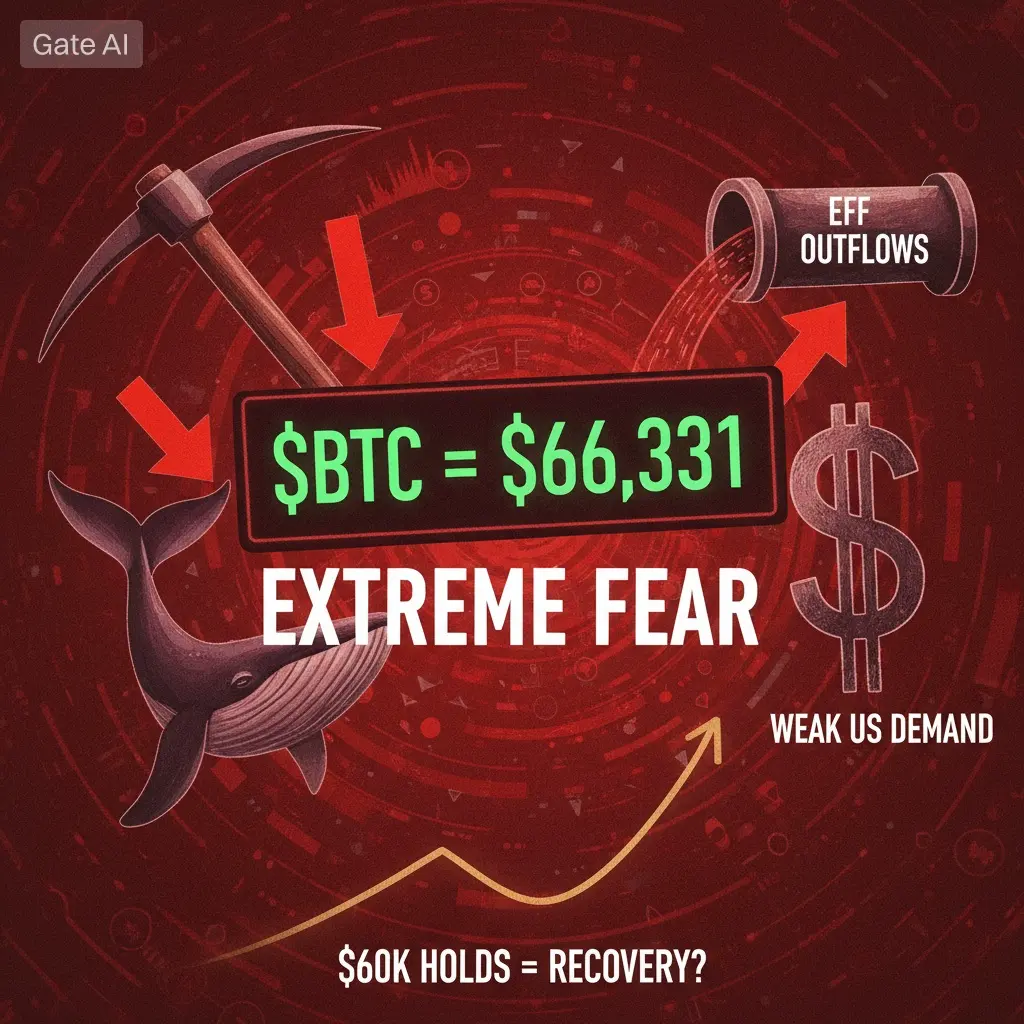
Current Price: $66,331
24h Range: $65,932 – $67,290 | 7-Day Drop: -6.44% | 90-Day Drop: -25%
Bitcoin is currently trading around $66K in a highly sensitive zone where price is attempting to stabilize after a sharp decline, yet the underlying structure still reflects sustained weakness, as momentum remains suppressed and liquidity conditions continue to tighten, preventing any strong or sustained upward movement despite multiple short-term recovery attempts.
At this stage, the market is not crashing aggressively, but it is also not recovering convincingly, which creates a sl
BTC-0,61%
HighAmbitionvip
#BTCMarketAnalysis
Current Price: $66,331
24h Range: $65,932 – $67,290 | 7-Day Drop: -6.44% | 90-Day Drop: -25%
Bitcoin is currently trading around $66K in a highly sensitive zone where price is attempting to stabilize after a sharp decline, yet the underlying structure still reflects sustained weakness, as momentum remains suppressed and liquidity conditions continue to tighten, preventing any strong or sustained upward movement despite multiple short-term recovery attempts.
At this stage, the market is not crashing aggressively, but it is also not recovering convincingly, which creates a slow, grinding environment where both bulls and bears are actively engaged, resulting in choppy price action and increasing uncertainty among participants.
Why the Market Dropped — The Real Reason
This decline is the result of a multi-factor pressure system, where supply expansion, demand contraction, and external macro forces have aligned simultaneously, creating a situation where the market is unable to absorb selling pressure efficiently.
1. Miner Capitulation Pressure
Mining companies are facing extreme operational pressure as production costs have surged toward $80,000 per BTC, while the market price remains significantly lower near $66K–$70K, forcing miners into a position where selling becomes a necessity rather than a choice.
This type of forced selling introduces a consistent stream of supply into the market, and with more than 15,000+ BTC already offloaded, it creates a structural imbalance where supply continues to increase even in the absence of strong demand, making it difficult for price to establish a sustainable base.
2. Heavy Whale Distribution
Whales are actively distributing large quantities of Bitcoin, and this behavior typically reflects a transition phase in the market cycle where large holders begin reducing exposure at higher levels, creating strong overhead resistance.
The impact of these large-scale transactions extends beyond immediate price movement, as they influence sentiment, liquidity depth, and order book structure, making it increasingly difficult for smaller participants to push price upward against such heavy sell-side pressure.
3. US Spot ETF Outflows
The shift from inflows to $225.5M in outflows marks a critical change in institutional behavior, as ETFs previously acted as a stabilizing force that absorbed selling pressure and supported upward trends.
Now, with that demand weakening, the market is losing one of its strongest support mechanisms, which results in slower recoveries, weaker rebounds, and increased vulnerability to downside moves whenever selling pressure intensifies.
4. Weak US Investor Sentiment
The decline from $74K down to $66K has been heavily influenced by US-based investors reducing exposure, as indicated by the persistent negative premium on major exchanges, reflecting a clear shift toward risk-off behavior.
This kind of sentiment-driven selling often accelerates trends because it is not purely technical — it is psychological, driven by fear of further losses and uncertainty about short-term direction, which leads to continuous distribution rather than accumulation.
5. Tight Macro + Geopolitical Pressure
The global macro environment remains restrictive, with high interest rates limiting liquidity and reducing risk appetite, while ongoing geopolitical tensions are adding another layer of uncertainty that discourages aggressive investment in volatile assets like Bitcoin.
In such an environment, capital naturally flows toward safer instruments, and even when Bitcoin reaches attractive price levels, hesitation dominates decision-making, which slows down recovery and keeps overall market participation low.
Market Sentiment — Extreme Fear Zone
Fear & Greed Index: 9 / 100
This level represents a deep fear phase where most participants are reacting emotionally rather than strategically, often leading to panic selling at lower levels while more experienced investors begin quietly accumulating positions in anticipation of future recovery.
However, extreme fear alone is not a guaranteed bottom signal — it simply indicates that the market is under stress, and confirmation through volume and structure is still required before a sustained reversal can occur.
Technical Analysis — What the Charts Are Saying
Bearish Structure
The current technical structure remains weak, with price struggling to reclaim resistance levels near $67K–$68.5K, while overall momentum indicators continue to reflect seller dominance.
Each attempt to move higher is met with resistance, suggesting that supply remains active above current levels, and until these zones are convincingly broken, the market remains vulnerable to further downside pressure.
Bullish Signals (Early Signs)
Despite the weakness, early signs of potential stabilization are emerging, as momentum indicators show slowing downside pressure, and oversold conditions suggest that sellers may be approaching exhaustion.
Holding above the $64K region is particularly important, as it indicates that buyers are still present and willing to defend key levels, creating the possibility of a base formation if selling pressure begins to decline.
Price Forecast — Bull vs Bear Scenario
🐻 Bearish Case
If Bitcoin fails to hold the critical $60,000 support, the market could experience a sharp increase in selling pressure, leading to a deeper correction toward the $45K–$40K range, which would represent a more significant structural reset.
Such a move would likely delay recovery, extending the timeline into 2027, as rebuilding confidence after a major breakdown typically requires prolonged consolidation and renewed liquidity inflows.
🐂 Bullish Case
On the upside, reclaiming control above $67K–$68.5K would be the first sign of strength, while a confirmed breakout above $72,000 would indicate a shift in market structure.
A move beyond $74,000 would act as strong confirmation of recovery, opening the door for a continuation toward the $78K–$82K range, supported by renewed confidence and improving liquidity conditions.
Short-Term Outlook (1–4 Weeks)
In the near term, Bitcoin is likely to remain within the $64K–$70K range, characterized by high volatility and low conviction moves, as both buyers and sellers test control without a clear directional breakout.
This type of environment often precedes larger moves, as the market builds energy during consolidation before eventually breaking out once sufficient volume returns.
Trading Strategy — Smart Positioning
A disciplined approach is essential in the current market conditions, where uncertainty remains high and false signals are common.
Gradual accumulation through DCA within the $62K–$64K range allows controlled exposure, while waiting for confirmation above $72K reduces the risk of entering premature trades.
Risk management below $60K is critical, as a breakdown could significantly change market structure and invalidate bullish setups.
Final Summary — One-Line Reality
Bitcoin at $66,331 is currently in a high-pressure zone where fear, liquidity constraints, whale distribution, and macro uncertainty are all weighing on price, yet beneath this surface weakness, early signs of accumulation are beginning to emerge, making this phase where the defense or loss of the $60K level will ultimately determine whether the market transitions into recovery or extends into a deeper correction cycle. 🚨
repost-content-media
  • Reward
  • Comment
  • Repost
  • Share
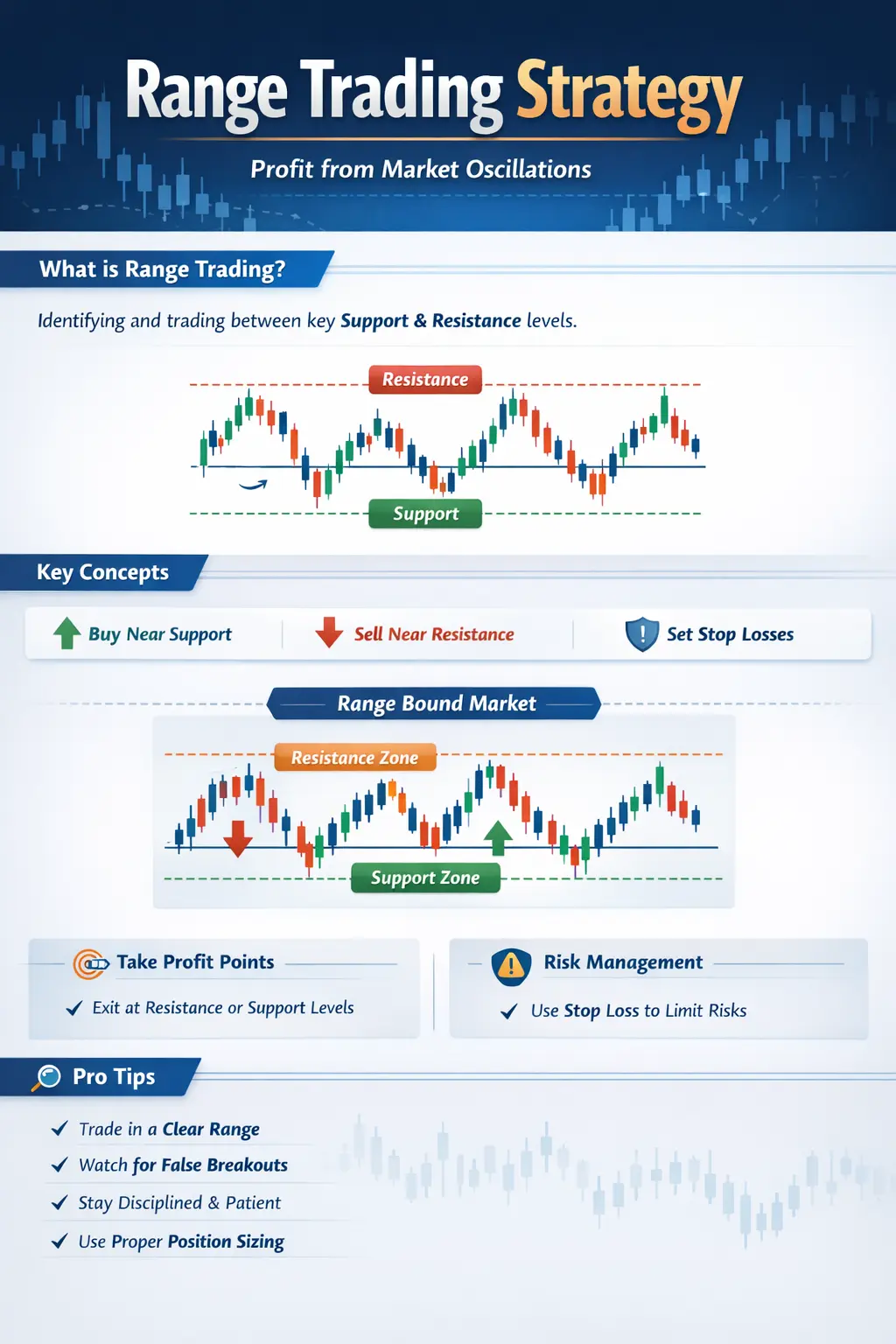
#RangeTradingStrategy
Introduction: Why Range Trading Works in BTC Markets
Range trading is one of the most structured and repeatable strategies in cryptocurrency markets, particularly during periods when Bitcoin (BTC) does not exhibit strong trending behavior either upward or downward. In sideways markets, price oscillates between predictable boundaries, allowing traders to repeatedly capture liquidity-driven moves. Unlike trend-following strategies, range trading focuses purely on market structure, volume, and repeated behavior, turning short-term price swings into actionable opportunities.
BTC-0,61%
HighAmbitionvip
#RangeTradingStrategy
Introduction: Why Range Trading Works in BTC Markets
Range trading is one of the most structured and repeatable strategies in cryptocurrency markets, particularly during periods when Bitcoin (BTC) does not exhibit strong trending behavior either upward or downward. In sideways markets, price oscillates between predictable boundaries, allowing traders to repeatedly capture liquidity-driven moves. Unlike trend-following strategies, range trading focuses purely on market structure, volume, and repeated behavior, turning short-term price swings into actionable opportunities. Currently, BTC is trading at $66,458, reflecting a 6.3% decline over the past seven days. Macro-level analysis identifies a range between $85,000 and $94,000, while intraday traders focus on $63,000–$68,500. Liquidity and volume trends indicate moderate absorption, confirming the market is neither strongly bullish nor bearish, reinforcing the viability of range-bound trading.
Step 1 — Understanding the Two Pillars: Support and Resistance
Support represents the price zone where buyers consistently absorb selling pressure, creating a natural barrier against decline. Every approach to support results in repeated upward bounces, making it the primary buy area. Resistance is the zone where sellers cap upward movement, as profit-taking, short entries, and liquidity concentration create price reversals. For example, BTC oscillating between $63,000 (support) and $68,500 (resistance) over multiple weeks allows traders to profit from repeated buy-low, sell-high cycles by entering near support and exiting near resistance.
Step 2 — How to Confirm a Valid Range
Not all sideways price action is tradable. A valid range requires multiple touches on both support and resistance, sufficient width for profit, and alignment with broader market trends. The range should be wide enough to cover trading fees, stop-loss buffers, and still deliver meaningful profits. For BTC, a 5–15% range is typically ideal. Additionally, the range must align with the higher timeframe; trading a range against a strong daily or weekly trend increases the risk of breakouts.
Step 3 — Indicators to Identify Entry and Exit Points
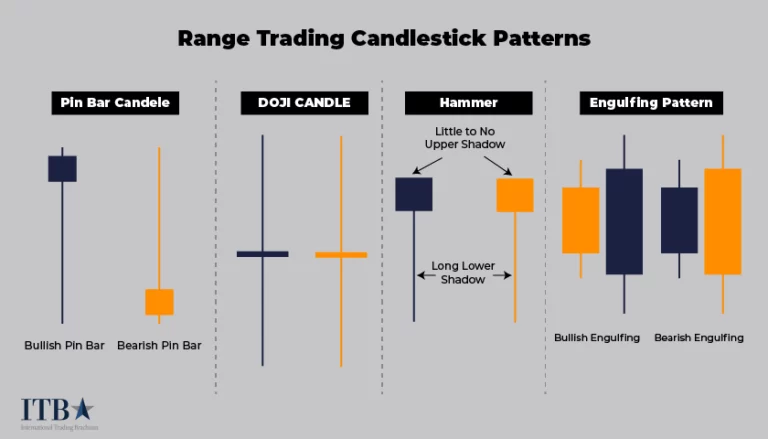
Effective range trading requires RSI, Bollinger Bands, volume analysis, and candlestick confirmation. RSI readings below 30 near support suggest oversold conditions and buying opportunities, while readings above 70 near resistance suggest overbought conditions and selling opportunities. Bollinger Bands dynamically reflect volatility: touches on the lower band near support indicate potential buy signals, while touches on the upper band near resistance indicate sell signals. Declining volume on sell candles at support confirms weakening selling pressure, while rising volume can indicate a potential range break. Candlestick patterns such as Hammer or Bullish Engulfing at support and Shooting Star or Bearish Engulfing at resistance provide additional confirmation.
Step 4 — Entry and Exit Strategy
When BTC approaches support, traders look for RSI near 35, declining sell volume, and reversal candlestick confirmation before entering a buy. Stop-loss is set 2–3% below support, and take-profit is near resistance but slightly below to avoid ceiling hesitation. When approaching resistance, RSI above 65–70, declining buy-side volume, and bearish reversal patterns signal optimal exit points or short entries. Position sizing follows the 1–2% risk rule: for a $10,000 portfolio, risking 2% per trade with a 3% stop-loss requires a position size of $6,667.
Step 5 — Risk Management: Protecting Your Capital
Risk management is essential. Never average down into losing trades; respect stop-losses. Maintain a minimum 1:2 risk-to-reward ratio to ensure profitable outcomes. Real breakouts with strong volume require immediate exit, while fake breakouts (brief moves beyond support/resistance that close back inside the range on low volume) do not invalidate trades. After breakouts, previous resistance may act as new support in upside scenarios, and previous support may be invalidated in downside scenarios.
Step 6 — Selecting the Right Timeframe
Timeframe selection impacts trade reliability. 15-minute or 1-hour charts are suitable for day traders but contain high noise. 4-hour charts provide swing traders with clear setups while filtering minor fluctuations, making them ideal for beginners. Daily charts suit position traders holding multi-week ranges.
Step 7 — Sample BTC Trade Walkthrough
For a range between $63,000 and $68,500 on a 4-hour chart: BTC drops to $63,200, RSI hits 32, a hammer candle forms, and sell-side volume declines. A buy entry is executed with stop-loss at $61,300 and take-profit at $67,800. When BTC reaches $67,800, RSI at 68 with bearish engulfing candle, the trade closes, yielding $4,600 per BTC with $1,900 risk. As BTC approaches support again, the setup repeats until a breakout occurs.
Step 8 — Common Mistakes to Avoid
Trading ranges against strong trends
Entering mid-range instead of at support/resistance
Ignoring stop-loss discipline
Overtrading
Ignoring macro events like Fed decisions, BTC ETF news, or regulations
Traders must remain patient, disciplined, and focused on price, percentage changes, liquidity, and volume to consistently profit.
Step 9 — Summary of the Range Trading Framework
Identify a valid range with multiple touches on both boundaries, confirm entries using RSI, volume, and candlestick patterns, execute trades with strict stop-losses and take-profits, risk no more than 2% of capital per trade, maintain a minimum 1:2 risk-to-reward ratio, exit immediately on real breakouts, and repeat until the range breaks. Range trading provides consistent, repeatable profits during consolidation phases without guessing long-term trends. Traders can automate limit orders on Gate to capture predictable swings while maintaining discipline.
repost-content-media
  • Reward
  • Comment
  • Repost
  • Share
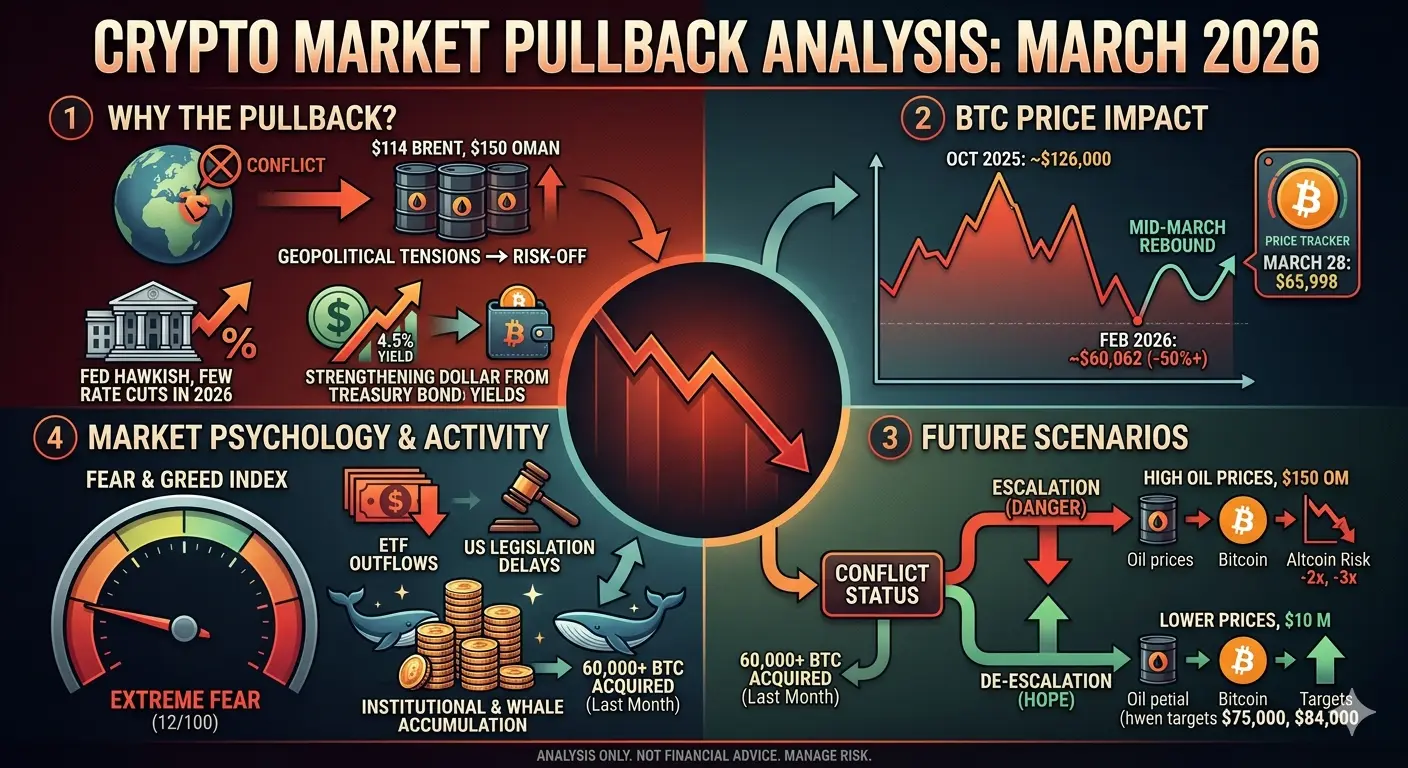
#BitcoinWeakens
As of now, Bitcoin (BTC) is trading around $66,000–$66,314, reflecting continued weakness in the markets. This recent downward pressure on price follows a series of events that have pushed BTC below key psychological and technical thresholds. BTC’s current price levels show not just a simple pullback, but a complex interplay of geopolitical risk, macroeconomic uncertainty, liquidity rotation, and changing investor behavior across global financial markets.
Why Bitcoin Fell — The Chain Reaction of Price Weakness
Bitcoin’s retreat from recent higher levels, including the mid‑$70
BTC-0,61%
HighAmbitionvip
#BitcoinWeakens
As of now, Bitcoin (BTC) is trading around $66,000–$66,314, reflecting continued weakness in the markets. This recent downward pressure on price follows a series of events that have pushed BTC below key psychological and technical thresholds. BTC’s current price levels show not just a simple pullback, but a complex interplay of geopolitical risk, macroeconomic uncertainty, liquidity rotation, and changing investor behavior across global financial markets.
Why Bitcoin Fell — The Chain Reaction of Price Weakness
Bitcoin’s retreat from recent higher levels, including the mid‑$70,000 range earlier this month, is driven by several overlapping forces:
1. Geopolitical Tension and Risk‑Off Sentiment
The ongoing military tension involving the United States, Israel, and Iran has had a significant impact on global risk sentiment. As headlines about conflict escalation spread, investors reacted by reducing exposure to volatile assets — including Bitcoin — causing abrupt selling and downward price pressure. Geopolitical shocks tend to increase risk aversion, meaning traders prefer cash or perceived safe havens over speculative assets.
2. Macro Market Behavior & Liquidity Flows
Bitcoin is no longer an isolated asset — it now behaves more like a macro risk asset, moving in correlation with traditional markets and liquidity conditions. Rising Treasury yields, stronger U.S. dollar dynamics, and muted institutional demand have made BTC less attractive in the short term, especially when geopolitical events exacerbate uncertainty. Institutions have shown caution rather than aggressive buying, keeping BTC under pressure.
3. Bond Market, Interest Rates, and “Safe Haven” Shifts
When geopolitical risk rises, many investors flock to bonds or yield‑producing instruments rather than Bitcoin, which does not pay yield. Rising bond yields often create headwinds for BTC, reinforcing selling pressure as capital rotates toward safer or yield‑bearing assets. This is part of the broader “risk‑off” environment that can drive BTC price down.
4. Panic Selling and Derivative Liquidations
Sharp sell‑offs triggered massive liquidations, particularly of leveraged long positions. In one recent session, roughly $240–$299 million in long positions were wiped out as price dipped below key levels, amplifying short‑term bearish momentum. Such forced liquidations add to downward pressure and can make price moves more abrupt.
Has Geopolitical Risk Already Been Priced In?
Markets are incredibly fast at adjusting prices to reflect evolving expectations. For Bitcoin:
Initial sell‑offs often occur when conflict news breaks, pushing price down.
But after the initial shock, markets may stabilize as headlines are digested and traders start evaluating the probability of escalation versus de‑escalation.
In some cases, BTC has shown resilience and even recovered from dips as lessons from previous geopolitical shocks (like the Ukraine conflict) have taught markets to price these events more efficiently.
This suggests that while BTC can react strongly in the short term to news, some moves are already reflected in market pricing, especially when conflict continues without sudden surprises.
Can Bitcoin Fall Further? Probability and Scenarios
1. Escalation Scenario — More Pressure Ahead
If geopolitical tension escalates further — especially if energy infrastructure or global supply lines are threatened — market risk appetite could decline further, leading to additional downside. In some analytical scenarios, continued conflict could push BTC below major support zones (e.g., $60,000 or even lower toward $53,000) if panic selling returns and liquidity dries up.
2. Continued Choppy Consolidation
In a more common scenario, BTC could hover in the $60K–$70K range for weeks, driven by alternating waves of fear and relief. This would mean repeated tests of support near current levels and resistance near prior highs, with sharp intraday volatility but no strong breakout until more clarity emerges in macro and geopolitical fronts.
3. De‑escalation & Recovery Scenario
If conflict tensions ease — even partially — global markets could rotate back into risk‑on mode, potentially lifting BTC back toward higher ranges. As seen in recent sentiment swings, news of peace negotiations or delayed conflict actions led to temporary rebounds and improved risk appetite.
Reddit
Geopolitical Impact on Bitcoin — Discussion and
As geopolitical headlines unfold daily, BTC’s relationship with global events becomes clearer:
War escalation → risk‑off response → BTC down initially
Peace signals or de‑escalation → risk‑on rotation → BTC stabilizes or rebounds
Conflicting signals in headlines → volatile price swings
This underscores how sensitive BTC is to macro geopolitical behavior, even though it remains a decentralized digital asset with broad adoption globally.
It’s important to note that Bitcoin does not mechanically act as a “safe haven” like gold traditionally does in all cases. Instead, it behaves more like a risk asset during acute shock phases and a potential hedge in longer‑term inflationary or systemic uncertainty environments.
Market Forecast & Trader Sentiment — What Investors Are Thinking
Short‑Term Traders
Many short‑term traders are watching whether BTC can hold current support levels around $65K–$66K. A breakdown below these levels could increase technical selling, while recovery above key moving averages could shift short‑term sentiment back to neutral or bullish.
Institutional Investors
Institutional demand remains cautious, with muted flows and limited aggressive buying even as price dips, indicating hesitation amidst macro uncertainty.
Long‑Term Investors
Longer‑term traders see current weakness as a potential accumulation zone, especially because BTC has previously recovered from geopolitical dips and continued broader adoption. Many view current price levels as discounted relative to recent all‑time highs.
Conclusion: Where Bitcoin Stands Now and Next Moves
Bitcoin’s current weakness isn’t driven by a single factor but rather a combination of geopolitical tension, macro liquidity conditions, risk‑off market sentiment, and complex trader behavior. BTC’s reaction to conflict news shows that markets price geopolitical risk quickly, and future price direction will likely remain volatile as headlines change.
Short‑term downside risk exists if conflict intensifies or liquidity dries up.
Sideways consolidation with volatility remains very possible.
De‑escalation or positive macro shifts could spark recovery moves.
Ultimately, BTC’s price now reflects both economic reality and shifting investor psychology, and understanding this dual nature is essential for traders navigating this period.
repost-content-media
  • Reward
  • Comment
  • Repost
  • Share
#FedRateHikeExpectationsResurface
Fed Rate Hike Expectations Resurface
Step 1 — What Triggered This Topic Right Now?
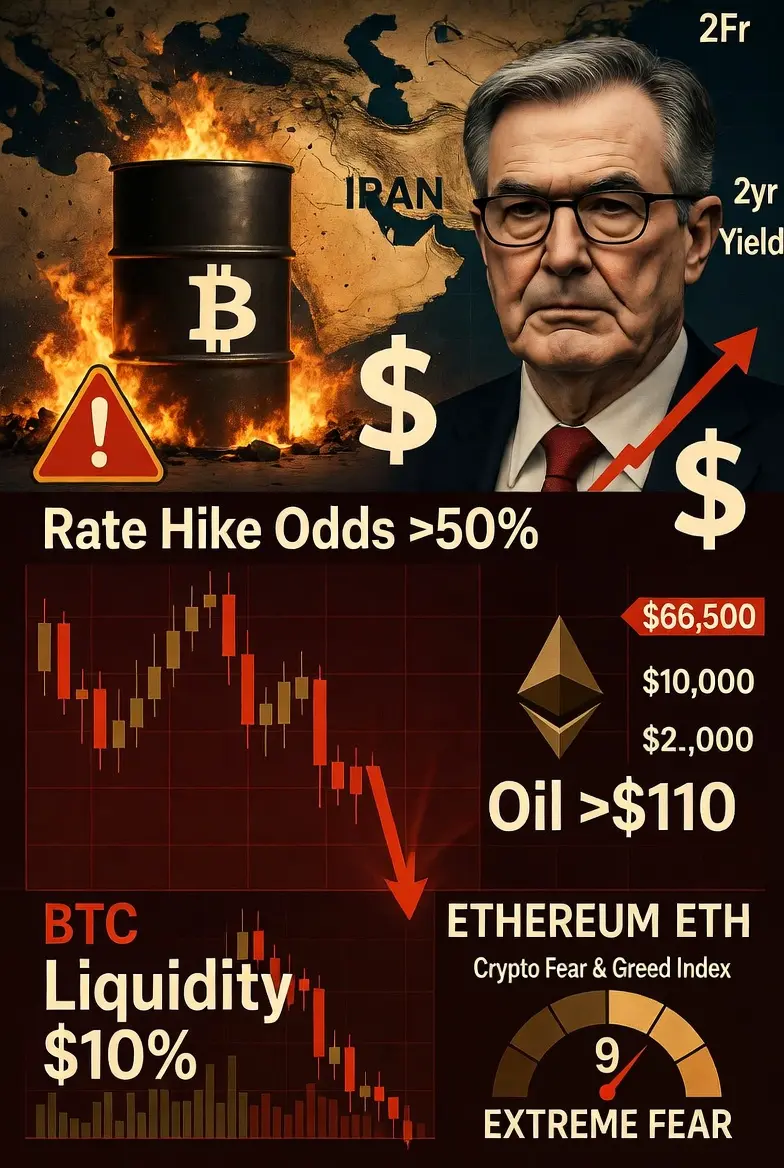
The narrative flipped dramatically in the last two weeks due to a significant geopolitical shock: the Iran conflict. In early March 2026, tensions between the U.S. and Iran escalated, sending crude oil prices soaring above $110 per barrel — almost a 50% surge in just a few weeks. Gasoline prices in the U.S. followed sharply higher, while import costs rose further due to ongoing tariffs. This sudden inflation spike collided with a U.S. market that was already expecting rate cut
BTC-0,61%
ETH-1,29%
HighAmbitionvip
#FedRateHikeExpectationsResurface
Fed Rate Hike Expectations Resurface
Step 1 — What Triggered This Topic Right Now?
The narrative flipped dramatically in the last two weeks due to a significant geopolitical shock: the Iran conflict. In early March 2026, tensions between the U.S. and Iran escalated, sending crude oil prices soaring above $110 per barrel — almost a 50% surge in just a few weeks. Gasoline prices in the U.S. followed sharply higher, while import costs rose further due to ongoing tariffs. This sudden inflation spike collided with a U.S. market that was already expecting rate cuts, creating a stagflation-like environment where prices rise while growth slows. Investors and traders suddenly began to reconsider the likelihood of the Fed raising interest rates instead of cutting them, as previously anticipated. This geopolitical event has become the main driver behind renewed rate hike expectations.
Step 2 — The Fed's Actual Position in March 2026
At the March 19 Federal Open Market Committee meeting, the Fed decided to hold rates steady at 3.5%–3.75%. Fed Chair Jerome Powell emphasized that the majority of officials did not plan a hike at the moment and that it was too early to fully assess the inflationary impact of the Iran conflict. The March dot plot still projected one rate cut in 2026, but Chicago Fed President Austan Goolsbee suggested that circumstances could justify a rate hike if inflation accelerated further. Essentially, while the Fed remains hawkish in stance, it has not acted yet, and the market has already begun pricing in the possibility of hikes ahead of any official moves.
Step 3 — Rate Hike Probability
Just four weeks ago, the probability of a rate hike was below 10%, while the market had been pricing in cuts. By March 19, Polymarket futures indicated negative probability, effectively pricing in rate reductions. However, by March 27, the probability crossed 50% for the first time, reaching 52%, and today it remains above 50%. This shows a dramatic market shift: the chance of rate cuts in 2026 has dropped from 62% a month ago to near zero, while the likelihood of at least one rate hike has surpassed 50%. Correspondingly, the 2-year U.S. Treasury yield, often the best real-time proxy for rate expectations, has risen, signaling increasing conviction that rates could tighten this year.
Step 4 — How Rate Hike Expectations Impact Crypto
The effects on crypto markets are clear and direct. First, higher rates drain liquidity because borrowing becomes more expensive and speculative capital retreats, hitting crypto disproportionately. Second, a stronger U.S. dollar, which typically follows rate hikes, historically correlates with lower BTC and altcoin prices since crypto is primarily USD-denominated. Third, opportunity cost rises: if U.S. Treasuries yield 4%–5%, holding non-yielding assets like BTC becomes less attractive. Lastly, risk-off sentiment spreads quickly as algorithms adjust portfolios automatically; the mere mention of rate hikes triggers rapid reallocation from risk assets, affecting crypto almost instantly.
Step 5 — BTC Price Action, Support, Resistance, and Liquidity
Bitcoin currently trades around $66,591, consolidating between $65,000 and $72,000. The $67K–$72K range is a key resistance zone; any confirmed hawkish news could push BTC down toward $60K. Large holders recently sold over 1,650 BTC worth $117 million after the Fed’s March statements, signaling distribution pressure at these levels. Critical support exists at $65,000, representing heavy institutional bids, while resistance is concentrated near $70,000–$72,000. Bullish scenarios require renewed rate cut expectations or significant ETF inflows, which could send BTC toward $100K–$120K. Volume indicators suggest moderate activity, with 5,446 BTC traded over 24 hours and $362.8 million in USDT exchanged, showing the market is balancing accumulation and distribution under macro pressure.
Step 6 — ETH Price Action
Ethereum trades around $2,004.86, holding near the $2,000 psychological level but showing extreme fragility. Spot ETH ETFs have experienced eight consecutive days of net outflows totaling over $200 million. Staking now represents roughly 32% of all ETH supply, which somewhat reduces sell pressure, but macroeconomic headwinds outweigh this support. ETH price movement is now primarily reactionary, responding to liquidity shifts, market sentiment, and geopolitical developments.
Step 7 — Market Sentiment
The Crypto Fear & Greed Index currently sits at 9, indicating extreme fear and near-panic conditions. Historically, such fear can signal medium-to-long-term accumulation opportunities, but in a rising rate environment, attempting to catch the bottom carries high risk because macro floors remain uncertain. Social sentiment shows a slight bullish tilt with 74 bullish authors versus 54 bearish, and bullish tweets outnumber bearish tweets 150 to 90. Retail investors often act on panic dips, while institutional players are reducing exposure, creating a delicate balance in the market.
Step 8 — Bank of America Conditions for a Rate Hike
Bank of America has outlined three conditions that could trigger a Fed hike: if Powell remains Fed Chair longer than expected, if unemployment stays below 4.5%, and if energy price shocks feed into core inflation. Sustained crude oil prices above $80–$100 per barrel create the perfect storm for a potential hike. With oil currently at $110, the market may already be beyond this threshold, making a tail-risk hike realistic, even if rate cuts remain the base scenario.
Step 9 — Institutional Research Consensus
Grayscale views rate hike fears as currently overpriced, maintaining that actual hikes are unlikely in the near term. CoinShares emphasizes that while risk assets, including crypto, could face short-term pressure if hikes occur, these remain tail risks, not base-case scenarios. Overall, institutions see the market’s pricing of hikes as precautionary rather than inevitable, creating a volatile but structured environment for BTC and ETH.
Step 10 — Forward BTC Scenarios
If the Fed cuts once in 2026 due to easing Iran tensions or oil falling below $80, BTC could rally toward $85K–$100K. If the Fed holds all year with no hike or cut, BTC may remain range-bound between $60K and $75K, constrained by macro uncertainty. A single rate hike while oil remains above $100 could push BTC down to $50K–$55K. Two hikes in combination with persistent inflation and low unemployment could trigger a severe bear market, highlighting the risk of sharp downside moves. Traders must monitor macro data closely to adjust positions in response to rapid developments.
Key Takeaway
Fed rate hike expectations are resurfacing due to the intersection of geopolitical shocks, energy price surges, and markets previously priced for cuts. BTC is currently at $66,591, liquidity is under pressure, the Fear & Greed Index is at 9, and short-term price action is highly sensitive to macro triggers. Investors and traders should watch upcoming CPI data, Iran conflict developments, oil price movements, CME FedWatch readings, and ETF inflows/outflows closely to anticipate the next major move in crypto markets.
repost-content-media
  • Reward
  • Comment
  • Repost
  • Share
#TrumpExtendsStrikeDelay10Days
This headline refers to a decision by former U.S. President Donald Trump (in narratives, campaigns, or policy influence scenarios) to extend a strike delay by 10 days — typically meaning the postponement of a military or punitive action that was expected to happen immediately. In geopolitical terms, a delayed strike equals delayed escalation.
This seemingly short delay can send shockwaves through financial markets, especially when investors are already pricing in geopolitical risk, inflationary pressure, and monetary policy uncertainty.
Step 1 — What Exactly Hap
BTC-0,61%
HighAmbitionvip
#TrumpExtendsStrikeDelay10Days
This headline refers to a decision by former U.S. President Donald Trump (in narratives, campaigns, or policy influence scenarios) to extend a strike delay by 10 days — typically meaning the postponement of a military or punitive action that was expected to happen immediately. In geopolitical terms, a delayed strike equals delayed escalation.
This seemingly short delay can send shockwaves through financial markets, especially when investors are already pricing in geopolitical risk, inflationary pressure, and monetary policy uncertainty.
Step 1 — What Exactly Happened?
A military or strategic strike that was anticipated to occur immediately has been delayed by 10 days by Trump’s administration or influence — effectively giving markets additional time before a conflict expands.
This delay changes the geopolitical narrative:
It suggests tempestuous negotiations behind the scenes
It increases uncertainty about the timing and outcome of military action
It gives markets more time to digest the implications of conflict
In essence, rather than an immediate escalation event, we now have a window of ambiguity lasting 10 days.
Ambiguity = volatility.
Step 2 — Why This Matters to Financial Markets
Markets respond to both risk and uncertainty.
When a strike is imminent, markets tend to:
Price in risk quickly and sharply
Move decisively toward safe havens (like gold)
Rotate out of risk assets (stocks & crypto)
When a strike is delayed, markets interpret:
A postponement of immediate conflict
A potential for negotiation
A period of unresolved tension
Ongoing headline risk for the next 10 days
This situation is very different from either full escalation or full de‑escalation. Instead, it creates:
📌 Uncertainty premium — markets increase pricing for risk while lacking clear direction
📌 Volatility compression/explosion cycles — quiet then sudden spikes
Step 3 — How Crypto Reacts to Geopolitical News
Cryptocurrencies, especially Bitcoin, behave differently than traditional assets in geopolitical scenarios:
Risk Asset Response
In most sharp conflict scenarios, BTC behaves like a risk asset — meaning:
Conflict fear rises → liquidity drains → BTC price falls
Safe havens like gold outperform BTC
Crypto flows get muted as traders seek stability
Crypto as “Hedge” Narrative
Some investors view BTC as a hedge against systemic risk, inflation, and monetary instability — but this has not yet fully materialized consistently in live markets.
In ambiguity like a delayed strike:
Some capital stays in crypto expecting long-term upside
Others exit temporarily until clarity returns
The net result often becomes range‑bound trading instead of directional trending
Step 4 — Immediate Market Reaction to the 10‑Day Delay
When news of the strike delay hit:
Equities: Fall slightly or trade sideways as investors wait for clarity.
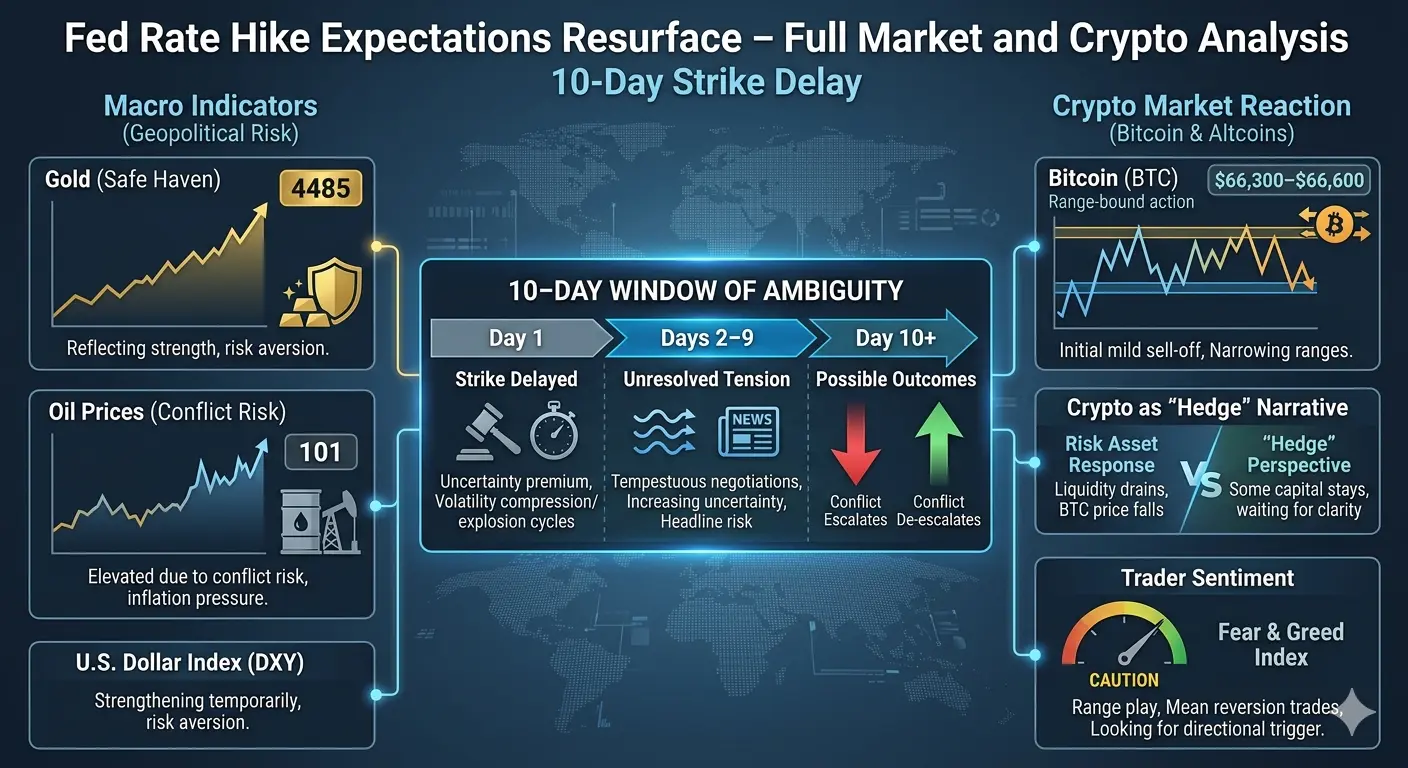
Gold: 4485 — reflecting strength as a safe haven asset. Gold’s price has tracked upward due to risk aversion and inflation expectations.
Oil Prices: 101 — elevated due to conflict risk. Crude oil (WTI/Brent) remains elevated near $100–$105+ per barrel, keeping inflation pressure alive.
U.S. Dollar Index (DXY): May strengthen as risk aversion rises, pushing capital into USD — at least temporarily.
Bitcoin & Crypto: BTC (around $66,300–$66,600) and altcoins reacted with:
Initial mild sell‑off as uncertainty spiked
Range‑bound action rather than clear downtrend
Liquidity rotating in and out quickly in short timeframes
BTC’s volatility increased, but sustained downward momentum was limited
This behavior reflects that markets are unsure if this delay means de‑escalation OR a reset to a later escalation.
Step 5 — Price Impact and Sentiment — Crypto View
Right now, traders are watching:
🔹 BTC support levels
🔹 Resistance ranges
🔹 Volume patterns
🔹 Fear & Greed readings
🔹 Macro sentiment shifts
Instead of strong directional signals, crypto markets are showing narrowing ranges and volatility expansion on news.
This typically happens when:
Major news stories have uncertain futures
Traders are unsure whether to hold, sell, or buy
Liquidity providers widen bid/ask spreads
In simple terms: BTC is not trending strongly up or down — it is consolidating with risk bias still toward the downside because of ongoing uncertainty.
Step 6 — Geopolitical Uncertainty and Crypto Volatility
A delayed strike widens the range of possible outcomes:
Scenario A — Conflict Escalates After 10 Days
Markets would likely price in immediate risk, pushing asset prices down again — potentially more sharply than before, because the delay raises expectation of worse‑than‑anticipated conflict outcomes.
Scenario B — Conflict De‑escalates or Is Defused
If tensions ease:
Equities rebound
Safe‑havens like gold stabilize
BTC may rally as risk assets get repriced with positive sentiment
Scenario C — Prolonged Ambiguity
Markets remain nervous, shifting between fear and hope, resulting in:
Range‑bound trading
Short squeezes
Sudden volatility spikes and retracements
Crypto tends to exaggerate these swings due to:
High leverage use in derivatives
Retail trader reactions amplified on social feeds
Lower institutional hedge presence in crypto vs equities
Step 7 — Longer Term Outlook for BTC & Crypto
When geopolitical uncertainty persists:
🟡 BTC price often remains sideways until macro clarity arrives
🟡 Liquidity retreats may keep prices range‑bound
🟡 Volume becomes choppy — big spikes then dry patches
🟡 Risk assets remain weak until safe‑havens stabilize
In this 10‑day window:
Crypto traders will be watching every CPI print, oil price move, and policy speech
Momentum indicators will likely whipsaw
BTC could bounce between support and resistance as fear and hope alternate
Short‑term traders may profit from volatility swings, while “long‑term holders” may remain inactive until macro drivers become clearer.
Step 8 — What Traders Are Thinking Right Now
Short-Term Traders: Expect short squeezes, range play, mean reversion trades, and quick volume surges as news breaks.
Swing Traders: Looking for clean support break or confirmation of trend — likely waiting for a directional trigger (conflict escalation OR de‑escalation).
Long-Term Investors: Largely hanging tight, seeing dips as accumulation opportunities but staying cautious.
The overall psychology is not panic, but caution.
Step 9 — What This Means for Price Direction
In geopolitically uncertain environments:
Downside risk stays elevated
Upside momentum is limited until clarity emerges
Consolidation is the default state
This means Bitcoin is more likely to trade inside well‑defined ranges than break out until either:
✔ Confidence in peace rises
OR
✔ A decisive escalation event forces a new trend
For now, BTC could oscillate around volatility, with key psychological levels acting as magnets — such as support at mid‑$60K and resistance near high‑$60K to low‑$70K levels.
Step 10 — Core Takeaway
A 10‑day delay in military strike timing may seem short, but for markets it means a period of unresolved tension and heightened uncertainty. Crypto reacts strongest to uncertainty, not just conflict, because traders are left guessing direction.
This creates:
🔸 Range‑bound trading
🔸 Volatility spikes on news
🔸 Liquidity ebb and flow
🔸 Sentiment oscillations between fear and hope
Until macro clarity returns, crypto’s short‑term trend will hover between caution and opportunistic swings rather than a clear uptrend or downtrend.
Watch These Catalysts Over Next 10 Days
☑ Geopolitical headlines (conflict escalation or negotiation progress)
☑ Oil price movement (currently ~$100–$105+)
☑ Gold price direction (currently 4485)
☑ U.S. macro data (jobs, CPI, policy speeches)
☑ Safe‑haven asset behavior (gold, bonds)
☑ Crypto volume and funding rate spikes
repost-content-media
  • Reward
  • Comment
  • Repost
  • Share
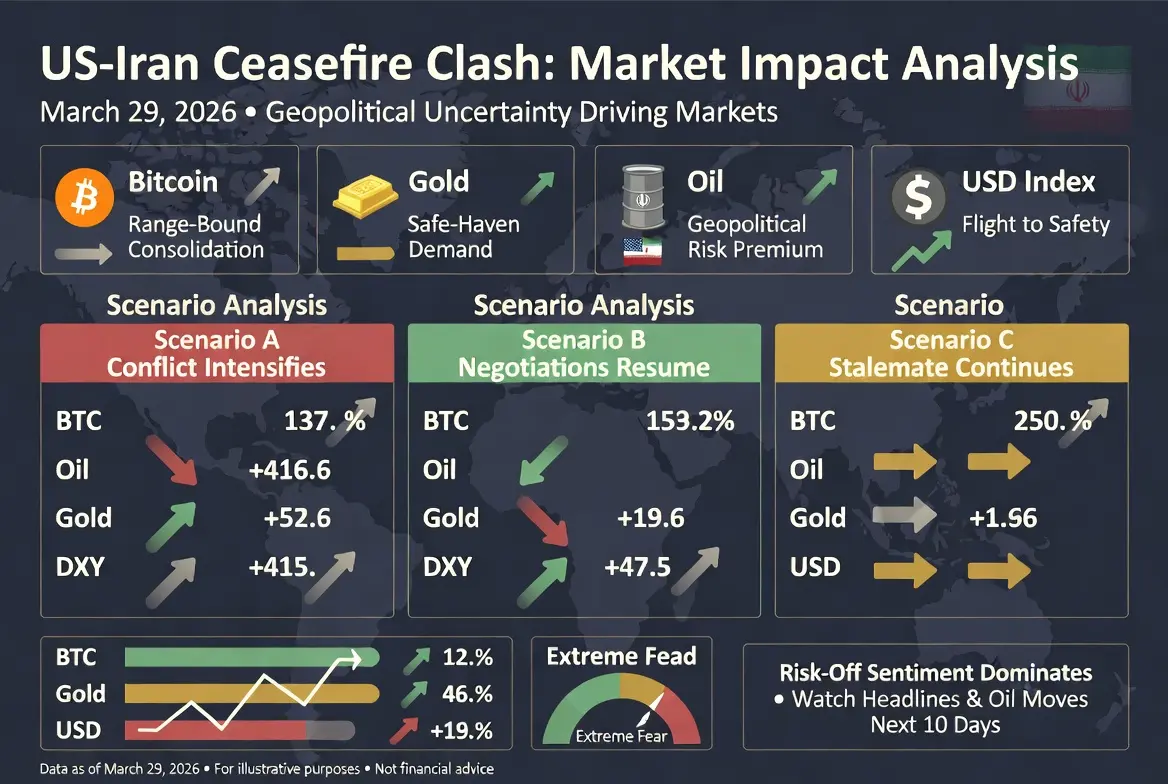
#USIranClashOverCeasefireTalks
#USIranClashOverCeasefireTalks .
US-Iran Clash Over Ceasefire Talks
Tensions between the United States and Iran over ceasefire negotiations have escalated significantly. The stalemate in talks is creating geopolitical uncertainty, which has become a dominant force influencing global financial markets. Unlike simple political headlines, these disputes impact energy markets, fiat currencies, risk assets, and crypto simultaneously.
Current Prices (March 29, 2026):
Bitcoin (BTC): $66,310
Gold: $4,485 per ounce (stable)
Oil (WTI/Brent): $101.13 per barrel
US Dollar
BTC-0,61%
HighAmbitionvip
#USIranClashOverCeasefireTalks
#USIranClashOverCeasefireTalks .
US-Iran Clash Over Ceasefire Talks
Tensions between the United States and Iran over ceasefire negotiations have escalated significantly. The stalemate in talks is creating geopolitical uncertainty, which has become a dominant force influencing global financial markets. Unlike simple political headlines, these disputes impact energy markets, fiat currencies, risk assets, and crypto simultaneously.
Current Prices (March 29, 2026):
Bitcoin (BTC): $66,310
Gold: $4,485 per ounce (stable)
Oil (WTI/Brent): $101.13 per barrel
US Dollar Index (DXY): Showing strength near 103.2
This context is critical: markets are reacting not only to immediate events but also to the uncertainty premium embedded in a potential escalation scenario.
Step 1 — What Exactly Happened?
The ceasefire negotiations between the U.S. and Iran have stalled. Both sides are accusing each other of delays and violations, which has created:
Heightened tension: Markets now price in both the risk of a military conflict and prolonged uncertainty.
Short-term volatility: News updates are causing sudden price movements across assets.
Liquidity rotation: Investors move capital between safe-havens, fiat, and crypto depending on headline developments.
The standoff has essentially paused clarity in global markets, leaving traders and institutional funds uncertain about whether the conflict will escalate or de-escalate in the next few days.
Step 2 — Macro Implications
Oil Market
Oil prices are highly sensitive to Middle East risks due to supply concentration in the region. Current WTI/Brent prices are $101.13 per barrel, reflecting fears of disruption. Key factors:
Any minor escalation triggers risk premiums, pushing prices higher.
The longer the uncertainty persists, the more speculative trading drives oil further up.
Oil’s uptrend exerts inflationary pressure globally, affecting commodities, equities, and crypto indirectly.
Gold Market
Gold remains stable at $4,485 per ounce, demonstrating its role as a safe-haven asset:
Investors buy gold to hedge against geopolitical and macroeconomic risk.
Stability at current levels signals persistent fear and risk-aversion, even without immediate conflict.
Gold often moves inversely to equities and correlates with USD strength during crisis periods.
US Dollar (DXY)
The USD tends to strengthen in uncertain times:
Traders rotate funds from risk assets (equities, crypto) into USD.
DXY at ~103.2 is rising slightly as market participants hedge.
A stronger dollar usually pressures BTC and altcoins, which are priced predominantly in USD
.
Step 3 — Crypto Reaction Mechanics
Cryptocurrencies are particularly sensitive to geopolitical risk due to their speculative and leveraged nature. BTC, as the market bellwether, exhibits the following behaviors:
Risk Asset Channel
Conflict fears lead to liquidity draining from BTC and altcoins.
Spot trading and derivatives markets show rapid sell-offs, often amplified by margin calls.
Crypto’s correlation with risk-off equities becomes evident.
Hedge or Store-of-Value Channel
Some investors treat BTC as an inflation hedge and a decentralized asset.
In periods of ambiguity, long-term holders remain patient, while short-term traders oscillate between buying dips and cutting losses.
The result is range-bound consolidation, with BTC currently between $66K–$67K.
Step 4 — Immediate Market Reactions
BTC & Altcoins
BTC initially dipped on news but quickly found support at $66,300–$66,600.
Volatility increased due to news-driven spikes, but no sustained trend has emerged.
Short-term traders exploit these oscillations, leading to temporary volume surges.
Oil
Oil continued its uptrend to $101.13 per barrel, reflecting supply risk and geopolitical premium.
Any escalation could push oil further toward $105–$110 range, increasing cost pressures globally.
Gold
Gold stable at $4,485 per ounce — demand for safe-haven assets persists.
Reflects persistent risk aversion even amid minor corrections or small rallies in BTC.
USD
Strengthening USD adds downward pressure on BTC and altcoins.
Currency rotation is typical during headline-driven market uncertainty.
Step 5 — Crypto Market Sentiment
BTC Support Levels: ~$66K
Resistance Levels: ~$67.5K–$68K
Fear & Greed Index: Extreme fear, indicating near-panic retail sentiment
Volume Patterns: Spikes during news, low during consolidation
Short-term sentiment is dominated by fear of escalation, but some optimism persists that negotiations could resume. Crypto reacts more violently to uncertainty than clarity, meaning headlines drive intraday swings more than fundamentals.
Step 6 — Scenario Analysis
Scenario A — Escalation
Conflict intensifies after failed negotiations: BTC may fall to $62K–$64K.
Oil could surge above $105–110, amplifying inflation expectations.
Safe-havens (gold) may rise further as risk assets sell off.
Scenario B — De-escalation
Negotiations succeed or military risk recedes: BTC could bounce to $67K–$70K.
Oil may stabilize or slightly decline ($98–$100), easing inflationary pressure.
Gold may correct mildly but remains a hedge against residual risk.
Scenario C — Prolonged Uncertainty
BTC remains sideways $66K–$67.5K, with sharp intraday swings.
Oil remains elevated $101–$103.
Gold stays stable at $4,485, continuing to act as a safe-haven.
Market exhibits volatility compression and sudden spikes, common in prolonged geopolitical ambiguity.
Step 7 — Trader Perspectives
Short-Term Traders
Exploit intraday volatility for scalping and mean-reversion trades.
Act quickly on headlines, news leaks, and oil price moves.
Swing Traders
Watch for confirmed breaks in BTC support/resistance.
Likely waiting for a directional trigger: escalation vs. peace signal.
Long-Term Investors
Mostly holding, cautiously accumulating dips.
Focus on macro clarity before initiating significant trades.
Step 8 — Longer-Term Outlook
BTC likely to remain range-bound in the $66K–$68K corridor until geopolitical clarity emerges.
Oil may continue upward trending pressure in the $101–$105 range, influencing inflation expectations and monetary policy decisions.
Gold provides stable hedge support at $4,485, reflecting ongoing risk aversion.
Market liquidity may fluctuate as news breaks, creating temporary spikes in funding rates and derivatives activity.
Step 9 — Key Takeaways
The US-Iran ceasefire clash is creating risk-off conditions across markets.
BTC consolidates near $66,310 amid uncertainty.
Oil is trending upward at $101.13, pushing inflation expectations.
Gold remains stable at $4,485, acting as a safe haven.
USD strengthens, pressuring risk assets including BTC.
Traders should watch geopolitical headlines, oil price moves, macro data, and crypto liquidity in the next 10 days.
Fear dominates: Retail traders overreact to headlines.
Caution dominates: Long-term holders remain patient.
Volatility dominates: Crypto swings intraday with news spikes.
Opportunity exists: Short-term traders can profit from volatility if risk-managed.
The overall pattern suggests sideways crypto trading, uptrend in oil, stable gold, and heightened market attention until either escalation or de-escalation provides clarity.
repost-content-media
  • Reward
  • Comment
  • Repost
  • Share
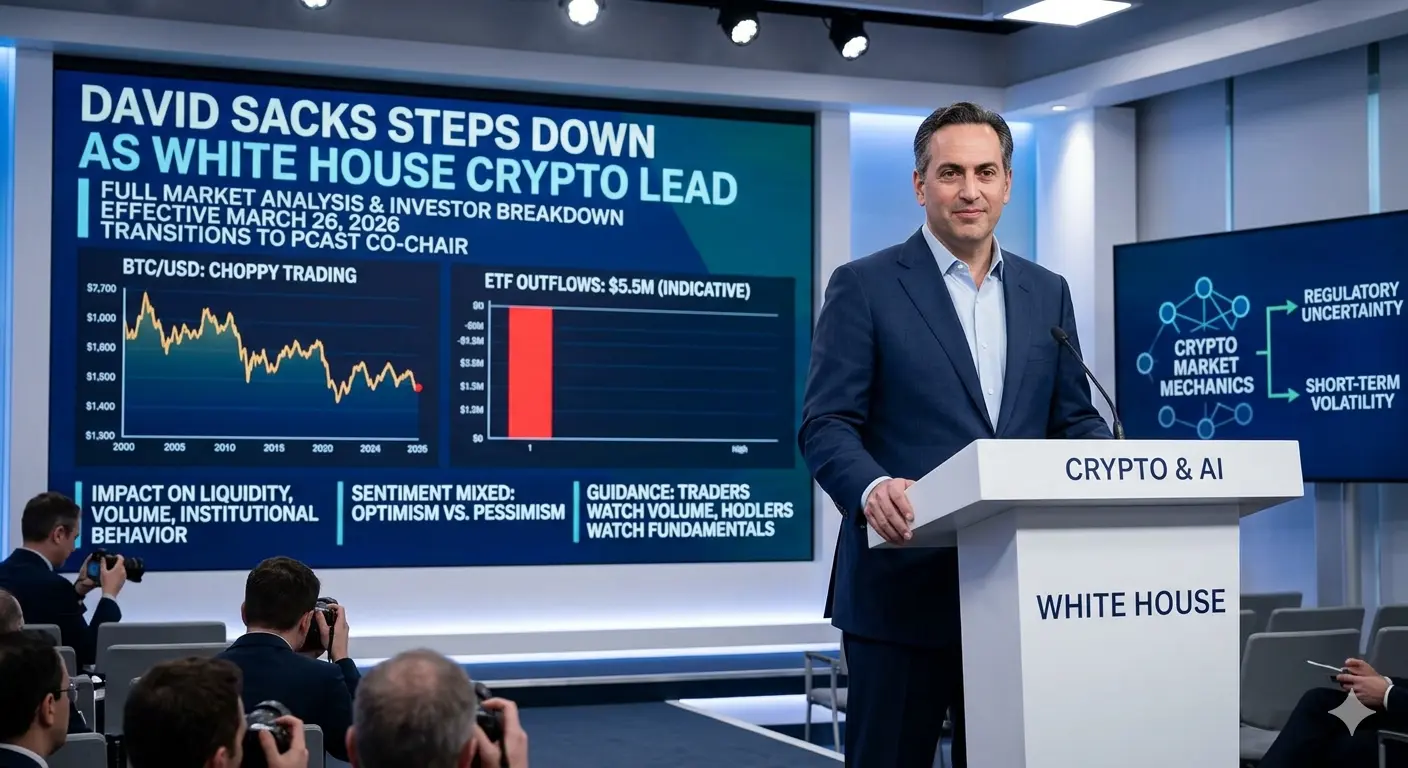
#DavidSacksStepsDownAsCryptoLead
🔹 Big News: Sacks Steps Down
David Sacks, the White House AI & Crypto Czar appointed by President Donald Trump, has officially stepped down from his crypto leadership role after reaching the legal maximum for his position. While it may seem like just one person leaving, this development carries major implications for crypto prices, trading volumes, liquidity, institutional behavior, and investor confidence worldwide.
🔹 Who Was David Sacks & Why He Mattered
Sacks was a key figure tasked with creating a clear legal framework for crypto, stablecoins, and digita
BTC-0,61%
ETH-1,29%
HighAmbitionvip
#DavidSacksStepsDownAsCryptoLead
🔹 Big News: Sacks Steps Down
David Sacks, the White House AI & Crypto Czar appointed by President Donald Trump, has officially stepped down from his crypto leadership role after reaching the legal maximum for his position. While it may seem like just one person leaving, this development carries major implications for crypto prices, trading volumes, liquidity, institutional behavior, and investor confidence worldwide.
🔹 Who Was David Sacks & Why He Mattered
Sacks was a key figure tasked with creating a clear legal framework for crypto, stablecoins, and digital asset adoption. His presence gave markets confidence that the U.S. government was moving toward regulatory clarity. On March 26, 2026, his official tenure ended due to legal limits, not a resignation from crypto advocacy. He now serves as Co-Chair of the President’s Council of Advisors on Science & Technology (PCAST), influencing crypto indirectly but no longer providing daily policy leadership.
🔹 Market Reaction: Choppy, Not Collapse
Bitcoin and Ethereum experienced sideways, choppy trading rather than a crash or rally, reflecting uncertainty rather than panic. Trading volumes spiked as short-term traders repositioned, and liquidity tightened due to major wallet withdrawals from exchanges. ETF outflows of around $5.5M also signaled institutional caution. Price retracements combined with higher volumes and lower liquidity demonstrate that sentiment and regulatory uncertainty are driving short-term market moves.
🔹 Investor Sentiment: Mixed Signals
Optimists point out that Sacks still influences policy and other pro-crypto figures may advance legislation, keeping long-term adoption intact. Pessimists warn the leadership gap could delay stablecoin and institutional frameworks, prompting short-term traders to liquidate positions. This explains the current choppy, sideways price behavior.
🔹 Market Mechanics: Price, Volume & Liquidity
Short-term BTC and ETH pullbacks, increased trading volumes, and reduced liquidity show how sensitive crypto is to sentiment and regulation. Lower liquidity amplifies price swings, higher volume reflects hedging, and ETF outflows reveal institutional caution. Globally, faster-moving regions like the EU, Singapore, and UAE could attract innovation and capital if U.S. regulatory clarity lags.
🔹 Practical Investor Guidance
HODLers: Focus on fundamentals and adoption trends.
Traders: Watch volumes, spreads, and liquidity for risk management.
Institutions: Likely to remain cautious until legal clarity emerges.
🔹 Long-Term Market Implications
Clear regulations could unlock institutional capital, improve liquidity, and stabilize prices.
Fragmented leadership may prolong sideways trading, higher volatility, and risk-off behavior.
Sudden policy shifts could act as sharp bullish or bearish catalysts.
🔹 Final Takeaway
This is not a crypto collapse but a regulatory reset. Liquidity, trading volume, investor psychology, and macro conditions are driving market behavior today. David Sacks still influences policy indirectly, but the lack of daily leadership introduces temporary uncertainty. The next major market driver will be who fills the leadership gap and how lawmakers resolve unresolved legislation, shaping future crypto trends.
repost-content-media
  • Reward
  • Comment
  • Repost
  • Share
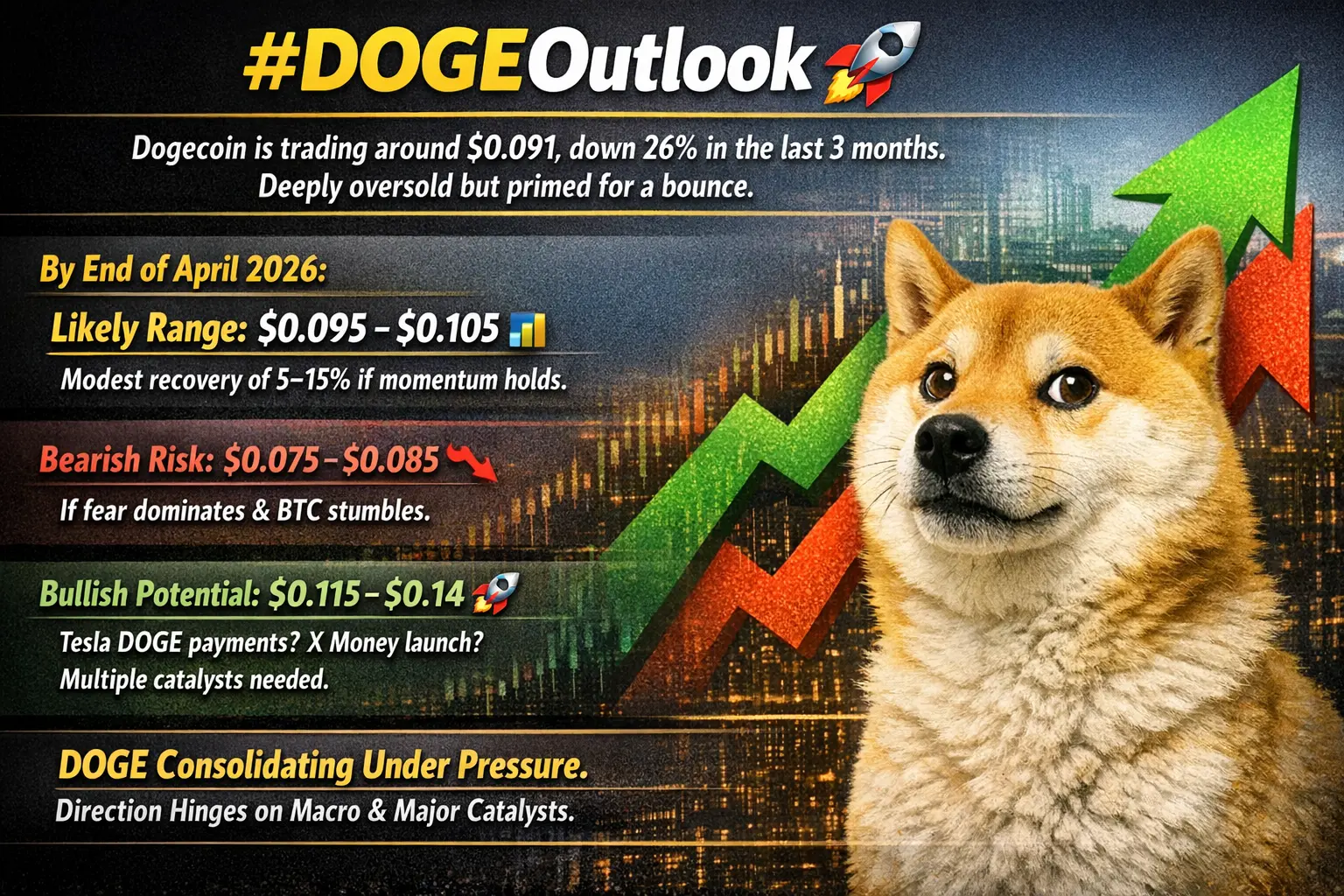
#PredictToWin1000GT :
#DOGEOutlook 🚀
Dogecoin is entering April 2026 at a critical point, trading around $0.091 after losing nearly 26% over the past three months. The broader trend still leans bearish, with moving averages signaling continued pressure, but momentum indicators suggest the asset is deeply oversold — a condition that often precedes a relief bounce. Right now, the market is caught between weak macro sentiment and the potential for a short-term recovery.
Looking ahead to the end of April, the most likely scenario places DOGE in the $0.095 to $0.105 range, reflecting a modest reco
DOGE-2,94%
BTC-0,61%
post-image
  • Reward
  • 6
  • Repost
  • Share
discoveryvip:
2026 GOGOGO 👊
View More
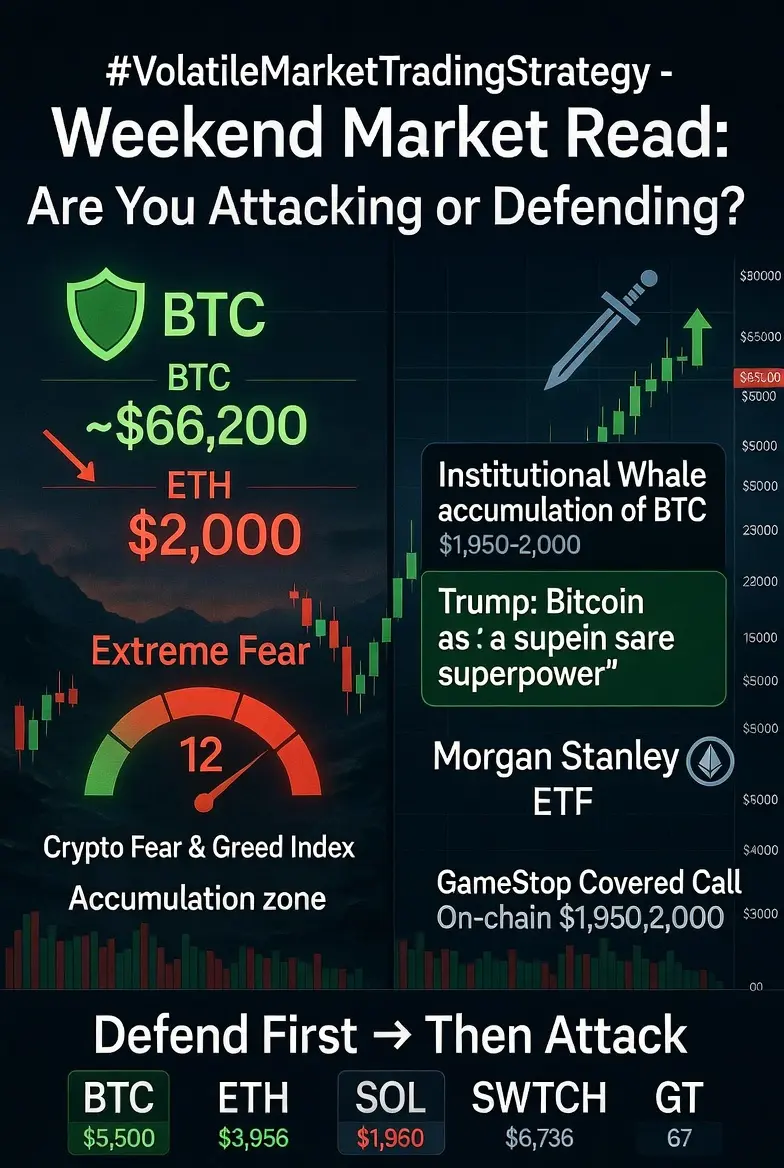
#VolatileMarketTradingStrategy
Weekend Market Read: Are You Attacking or Defending?
The market is entering the weekend under notable pressure, and this is precisely when strategic positioning becomes most critical. BTC currently sits at $66,287, down 2.28% on the day, reflecting cautious sentiment from a broad range of participants. ETH has slipped just below the $2,000 psychological level, now at $1,999, signaling stress among retail traders but opportunity for those who read market structure carefully. The Crypto Fear & Greed Index is at 12 — Extreme Fear. For the uninformed, this could app
BTC-0,61%
ETH-1,29%
SOL-2,23%
SIREN2,64%
HighAmbitionvip
#VolatileMarketTradingStrategy
Weekend Market Read: Are You Attacking or Defending?
The market is entering the weekend under notable pressure, and this is precisely when strategic positioning becomes most critical. BTC currently sits at $66,287, down 2.28% on the day, reflecting cautious sentiment from a broad range of participants. ETH has slipped just below the $2,000 psychological level, now at $1,999, signaling stress among retail traders but opportunity for those who read market structure carefully. The Crypto Fear & Greed Index is at 12 — Extreme Fear. For the uninformed, this could appear as a warning to exit. For the disciplined trader, this represents an alert to pay attention, analyze positions, and potentially enter strategically.
Markets at the weekend often behave differently from weekday sessions. Low participation and thin order books mean individual large trades, macro headlines, or unexpected events can amplify price swings. However, beneath these short-term oscillations, structural factors and institutional behaviors often reveal the true state of the market, and this weekend appears to be no exception.
My Weekend Outlook
I am not predicting a full market reversal over the weekend. Macro forces remain influential: U.S. Treasury yields recently touched April highs, signaling strong government bond demand; the U.S. dollar remains resilient; and global liquidity conditions are still relatively tight. These factors create pressure on risk assets, including major cryptocurrencies. Weekend trading is generally characterized by muted volume, meaning sudden price movements can be sharper than during regular sessions.
Despite these challenges, my bias leans cautiously bullish into next week. This is not derived solely from technical charts screaming “buy” signals but from subtle yet meaningful market behaviors:
Institutional Accumulation: On-chain metrics indicate that large holders and institutional wallets have added over 60,000 BTC during this very dip. Such accumulation at current price points suggests confidence and patient positioning rather than panic liquidation.
Policy Tailwinds: Former President Trump recently emphasized that the U.S. aims to become a “Bitcoin and crypto superpower.” Statements like this, while political, have implications for regulatory support, adoption sentiment, and broader market confidence.
ETF Infrastructure: Morgan Stanley is reportedly preparing a Bitcoin ETF with a fee of just 0.14%. The development of regulated, low-cost institutional demand avenues continues to build structural support for BTC and related assets.
Corporate Positioning: GameStop has strategically allocated its BTC holdings into a Covered Call strategy via Coinbase instead of liquidating. This reflects conviction and strategic positioning by corporate holders, not panic-driven exits.
Taken together, these factors indicate that the “smart money” is not abandoning positions. It is actively repositioning to take advantage of current market dislocations.
Tokens I Am Watching This Weekend
BTC / USDT — Bitcoin remains the anchor for market sentiment. Weekend behavior around support levels will influence the early trading direction next week. Holding $65,500 through the weekend could establish a healthy base, while reclaiming $68,000 with conviction early next week may quickly flip short-term sentiment and restore confidence among hesitant market participants.
ETH / USDT — Ethereum sits at a psychologically critical level near $2,000. Net outflows from spot ETFs suggest caution, and macroeconomic pressure appears more pronounced than with BTC. However, a consolidation base is forming rather than a mere bounce opportunity. DeFi inflows into protocols such as Aave remain robust, demonstrating that Ethereum’s fundamentals are intact even in a period of temporary stress.
SOL / USDT — Solana is trading at $83, down slightly but showing signs of sustained ecosystem engagement. Projects and protocol activity remain vibrant, with tokens like SIREN surging over 107% in the last 24 hours. Such movements suggest liquidity and enthusiasm remain alive in the Solana ecosystem, even when major cryptocurrencies experience downward pressure.
SWTCH (Switchboard) — Experiencing a 235% rise in 24 hours, this reflects renewed attention to oracle infrastructure. While not a direct trade recommendation, understanding the drivers behind such movements can provide insight into underlying market narratives that may impact broader market activity.
GT / USDT — Gate’s native token sits at $6.46 and is currently ranked #1 by user activity on the hot list this weekend. GT holders benefit from practical utilities including fee discounts, Launchpool access, and HODLer Airdrop eligibility. Holding GT through volatility is a strategic decision that extends beyond sentiment alone, reinforcing the token’s utility and value proposition within the ecosystem.
Key News and Events Worth Tracking This Weekend
U.S. Macro: Upcoming PCE inflation data and any Federal Reserve commentary will heavily influence whether this dip persists or reverses early next week. Movements in the dollar index (DXY) are particularly impactful: even slight weakness could provide breathing room for risk assets, including cryptocurrencies.
CLARITY Act: Ongoing regulatory discussions may crystallize U.S. crypto frameworks. A clearer regulatory landscape is likely to act as a structural catalyst for Ethereum and broader DeFi adoption.
Lido / LDO Treasury Buybacks: Shifts in on-chain liquidity for liquid staking tokens such as LDO can have subtle but meaningful market effects. Monitoring these flows is essential for understanding short-term dynamics.
Weekend Liquidity Considerations: Thin weekend participation can magnify price movements. Coordinated trades, unexpected news, or sudden liquidations can create outsized candlestick patterns. Managing position sizes carefully and avoiding blind engagement is crucial.
My Strategy This Weekend
I adopt a defend first, then attack approach:
No aggressive leveraged positions until BTC demonstrates a firm recovery above $67,500.
Gradual accumulation of Ethereum in the $1,950–$2,000 range, which historically attracts disciplined buyers.
Maintaining a watchlist of Solana ecosystem tokens to capture early momentum opportunities at market open on Monday.
Relying on alerts rather than constant screen-watching — patience and strategic observation often outperform reflexive trading during high volatility.
Extreme Fear readings, such as the current 12 on the Crypto Fear & Greed Index, typically appear near market bottoms rather than tops. The trades set up through measured discipline this weekend are likely to perform strongest when the market resumes normal trading
repost-content-media
  • Reward
  • Comment
  • Repost
  • Share
#PredictionMarketsInfluenceBTC? :
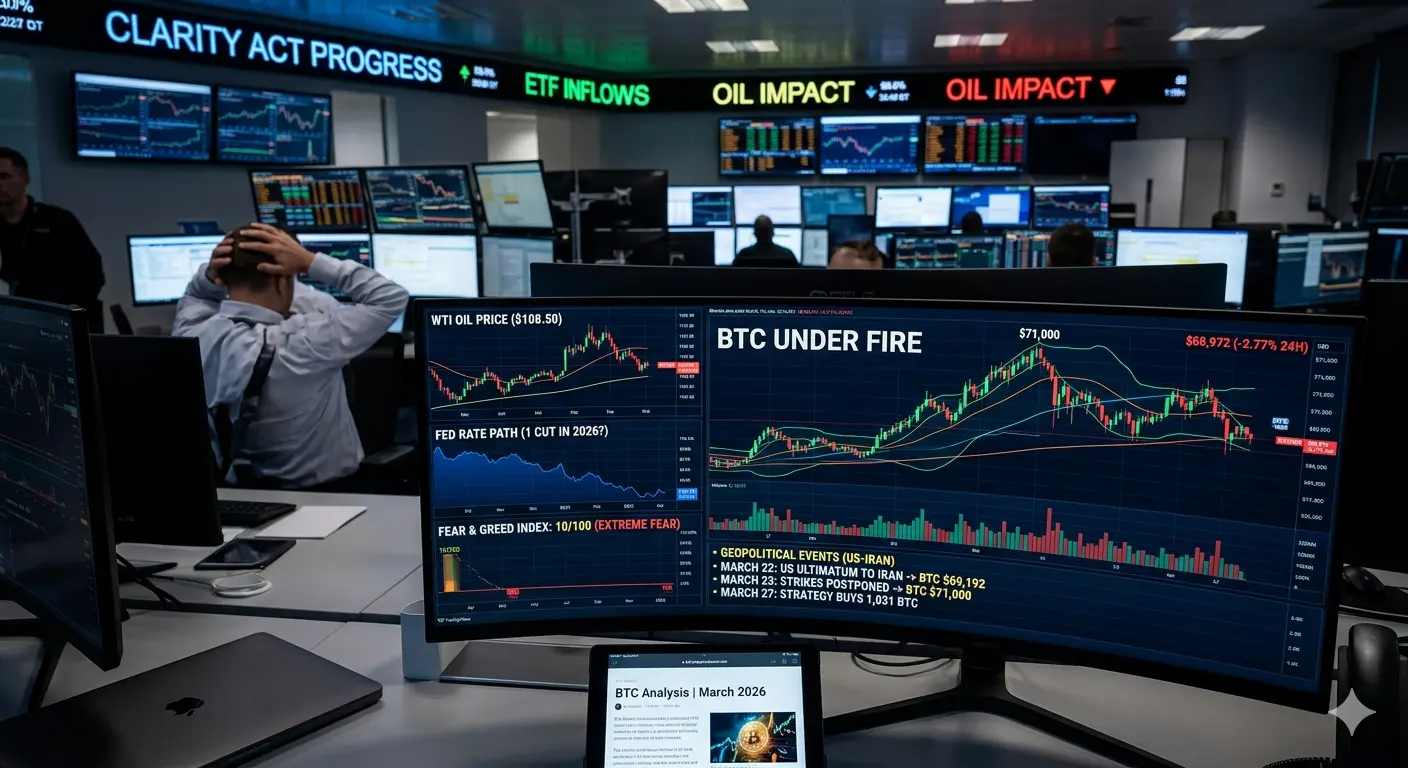
BTC Under Fire: How Far Can Bitcoin Go Amid US-Iran Tensions & Shifting Crypto Market Trends?
A Deep-Dive Analysis | March 2026
THE CURRENT SNAPSHOT
Bitcoin is trading at $68,972 — down 2.77% in the last 24 hours after touching a high of $71,000 just days ago. The Fear & Greed Index remains deeply fearful at 10/100, reflecting extreme uncertainty in the market. But this metric alone does not capture the full dynamics at play. BTC is currently responding not just to typical market sentiment, but also to complex geopolitical developments, macroeconomic policy de
HighAmbitionvip
#PredictionMarketsInfluenceBTC? :
BTC Under Fire: How Far Can Bitcoin Go Amid US-Iran Tensions & Shifting Crypto Market Trends?
A Deep-Dive Analysis | March 2026
THE CURRENT SNAPSHOT
Bitcoin is trading at $68,972 — down 2.77% in the last 24 hours after touching a high of $71,000 just days ago. The Fear & Greed Index remains deeply fearful at 10/100, reflecting extreme uncertainty in the market. But this metric alone does not capture the full dynamics at play. BTC is currently responding not just to typical market sentiment, but also to complex geopolitical developments, macroeconomic policy decisions, institutional accumulation patterns, and prediction market sentiment. Understanding Bitcoin’s near-term behavior requires examining all these forces together.
PART 1 — THE US-IRAN CRISIS: WHAT ACTUALLY HAPPENED AND HOW BTC REACTED
The US-Iran tension served as a real-time stress test for Bitcoin in 2026. Price reactions to political events have become sharper and more immediate than in previous cycles, showing that Bitcoin is increasingly intertwined with global macro events.
Timeline Highlights:
March 22: Trump issued a 48-hour ultimatum to Iran, threatening strikes on power plants if the Strait of Hormuz remained blocked. BTC reacted immediately, dropping 2.2% to $69,192 within hours, with $299 million in liquidations hitting the market, 85% of them long positions.
March 23: Strikes were postponed for five days after Trump described talks as “productive.” BTC surged 5% to $71,000, while oil prices dropped sharply — WTI crude fell 11% and Brent crude declined 8%.
March 25: Strategy (Michael Saylor's firm) acquired 1,031 BTC for $76.6 million, bringing their total holdings to 762,099 BTC, signaling continued institutional confidence despite geopolitical turbulence.
March 27 (today): BTC pulled back to $68,972 as macro uncertainty remained elevated.
Insight: Bitcoin is no longer isolated from geopolitical shocks. Missiles, ultimatums, and pipeline conflicts now move BTC prices in real time. While volatility is intense, recoveries are equally rapid, reflecting a more resilient and globally integrated market than observed in 2021–2022 cycles.
PART 2 — THE OIL-INFLATION-FED CHAIN REACTION
Many overlook the structural chain linking oil, inflation, and Bitcoin. The mechanism is straightforward but powerful:
Any US-Iran conflict threatens the Strait of Hormuz, which channels roughly 20% of global oil supply.
Supply fears push oil prices higher.
Elevated energy costs drive inflation higher, pressuring central banks to maintain or raise rates.
A stronger US Dollar, as a result, reduces liquidity for risk assets like crypto.
Reduced liquidity translates to lower BTC prices.
In March 2026, the Fed held rates steady and signaled only one potential 25bps cut for the year, citing rising energy costs as the primary reason inflation remains sticky. Citi’s analysts revised BTC price targets from $143,000 down to $112,000 under this macro regime. Oil is the single most critical variable — when it remains above $100/barrel, BTC faces structural headwinds; when it drops, like WTI’s 11% decline on March 23 following ceasefire signals, Bitcoin rallies strongly.
PART 3 — WHERE CAN BTC GO? THE PRICE SCENARIOS
Bitcoin’s path over the next weeks depends on how geopolitical, macro, and institutional forces interact. Analysts outline three plausible scenarios:
Bullish Scenario — Target: $84,000 to $100,000+
Bitcoin could reach these levels if Iran negotiations succeed and the Strait of Hormuz fully reopens, oil falls below $80/barrel, and the Fed signals one or two rate cuts. Sustained ETF inflows, particularly the recent $2.9 billion weekly inflow led by BlackRock’s IBIT, combined with ongoing institutional accumulation and the passage of US crypto legislation (CLARITY Act), would create a strong bullish environment. Technical targets based on Bollinger Bands indicate $84,000, with some analysts projecting $100,000+ under ideal conditions. CoinShares even models a “Fed pivot crisis scenario” where BTC could surge to $170,000 if emergency rate cuts become necessary.
Base Case Scenario — Range: $68,000 to $80,000
If geopolitical tension remains elevated but does not escalate into war, the Fed holds rates steady, and institutional buying continues, BTC is expected to trade within $68,000–$80,000. This scenario reflects a choppy, range-bound market — frustrating for traders but structurally stable for holders.
Bearish Scenario — Risk Zone: $58,000 to $63,000
Full military escalation by the US, sustained oil prices above $110/barrel, ETF outflows, and macro contagion across equities could push BTC down to $58,000–$63,000. This scenario materialized briefly on March 22 when BTC hit $63,000 intraday before rebounding. Continued escalation could see this zone tested again.
PART 4 — WHAT ELSE IS IN THE AIR? OTHER FORCES SHAPING CRYPTO TRENDS IN 2026
Institutional Accumulation — Demand Floors Are Strong
Strategy holds 762,099 BTC, the largest corporate holding globally.
BlackRock moved over $700 million in ETH and BTC to Coinbase Prime on March 25 alone.
Twenty One Capital became the second-largest publicly listed BTC holder.
Public companies now control over 5% of total BTC supply, creating a structural demand floor that supports rapid recovery from dips.
Bitcoin-Backed Mortgages — Mainstream Integration Accelerates
Coinbase, Fannie Mae, and Better Home & Finance launched BTC-backed mortgages in the US (March 26). Buyers can use BTC or USDC as collateral for down payments without selling holdings or triggering tax events, signaling growing mainstream acceptance of Bitcoin as a legitimate collateral asset.
Prediction Markets — Sentiment Amplifiers
Platforms like Kalshi and Polymarket directly influence retail and institutional positioning. Probability signals showing, for example, a 70% chance of BTC reaching $100,000, trigger real buying activity. Google integrates these predictions into its finance tools, exposing millions of users to crypto sentiment data.
CLARITY Act & Regulatory Certainty
The Act would classify digital assets as commodities, reducing regulatory uncertainty and supporting long-term structural bullishness. Delays or legal setbacks, however, remain a short-term risk, as highlighted by Citi’s recent BTC target revisions.
BlackRock Signals — Institutional Focus on Quality
Institutional money is concentrating heavily on Bitcoin and Ethereum, while altcoins face a tougher capital environment. BlackRock’s digital assets head called much of the broader crypto market “nonsense,” reinforcing that BTC’s institutional bid remains robust.
PART 5 — TECHNICAL READ RIGHT NOW
The technical landscape is mixed but informative. The daily MA7 has crossed below MA30 (death cross), signaling near-term bearishness. However, 4H MACD is forming a bullish divergence, and daily Williams %R is deeply oversold, suggesting a potential bounce around $68,000. Short-term indicators like 15-minute CCI and WR show overbought conditions, indicating likely cooling before any continuation. Support is concentrated in the $68,000–$68,150 zone, while resistance lies at $71,000–$72,000. A successful hold above support may allow BTC to target $84,000 based on Bollinger Bands projection, but head-and-shoulders formations visible on shorter intervals suggest traders exercise caution.
THE BOTTOM LINE
Bitcoin is under pressure but far from broken. Q1–Q2 2026 stress tests are unprecedented: live Middle East conflict, a hawkish Fed, and record institutional adoption are reshaping market structure. The tension between Iran-driven downside risk and institutional demand-floor support defines BTC’s near-term volatility. Oil prices remain the critical macro indicator; sustained drops provide buying opportunities, but only when confirmed. BTC does not need a dovish Fed to thrive — it needs avoidance of hawkish surprises. Current levels indicate resilience, and the structural story remains bullish in the medium term.
Data sourced from live market feeds, CoinDesk, AInvest, Phemex, CoinGecko, Forbes, and Gate as of March 27, 2026. This post is for informational purposes only and does not constitute financial advice. All investments carry risk.
This version keeps all original prices intact, removes chart tables, and converts technical observations into fully descriptive paragraph form while retaining the same headlines and in-depth discussion.
repost-content-media
  • Reward
  • Comment
  • Repost
  • Share
#WinGoldBarsWithGrowthPoints
#WinGoldBarsWithGrowthPoints | The Ultimate Gate Community Reward Revolution
Gate is redefining what community engagement means in crypto — and this campaign proves it in the most tangible way possible.
What Makes This Campaign Different?
The #WinGoldBarsWithGrowthPoints campaign is not just another reward system — it’s a real-value ecosystem where your daily activity transforms into physical wealth.
Unlike typical platforms that offer only digital perks, Gate introduces real gold bars as rewards — bridging the gap between Web3 engagement and real-world value.
Dee
HighAmbitionvip
#WinGoldBarsWithGrowthPoints
#WinGoldBarsWithGrowthPoints | The Ultimate Gate Community Reward Revolution
Gate is redefining what community engagement means in crypto — and this campaign proves it in the most tangible way possible.
What Makes This Campaign Different?
The #WinGoldBarsWithGrowthPoints campaign is not just another reward system — it’s a real-value ecosystem where your daily activity transforms into physical wealth.
Unlike typical platforms that offer only digital perks, Gate introduces real gold bars as rewards — bridging the gap between Web3 engagement and real-world value.
Deep Dive: Growth Points System
At the heart of this campaign lies the Growth Points mechanism, a behavioral reward engine designed to encourage meaningful participation.
You earn points through:
High-quality content creation
Insightful comments and discussions
Social engagement (likes, reactions)
Participation in trending topics & Hot Chats
Daily consistency via check-ins and tasks
This system doesn’t just reward activity — it rewards consistency, contribution, and influence.
Reward Mechanics — Smart & Inclusive
The campaign is structured to benefit both beginners and power users:
300 Points = 1 Draw Entry
Unlimited entries possible (based on activity level)
100% Winning Rate ensures zero disappointment
Reward Tiers Include:
🥇 10g Physical Gold Bars (Top-tier prize)
🎁 Exclusive Gate x Red Bull Gift Boxes
💳 VIP Experience Cards
💸 Trading Fee Rebates
🚀 Token Airdrops
This tiered reward structure creates a gamified experience, where higher engagement directly improves reward quality.
Market Impact & Strategic Angle
This campaign goes beyond rewards — it plays a role in ecosystem growth and market dynamics:
1. User Retention Engine
By incentivizing daily interaction, Gate strengthens user stickiness, which is critical in competitive crypto markets.
2. Content Quality Boost
As users compete for rewards, content quality naturally improves, benefiting the entire community.
3. Social Trading Expansion
More discussions = more insights → better-informed trading decisions across the platform.
4. Platform Activity Surge
Higher engagement often correlates with increased trading activity, indirectly supporting liquidity and market depth.
Winning Strategy (Pro Tips)
To maximize rewards, users should focus on:
Posting valuable and trend-based content
Engaging early in viral discussions
Maintaining daily consistency
Leveraging market insights & analysis posts
Building a recognizable presence in the community
Consistency beats randomness here — smart participation = higher probability of premium rewards.
Why Gold Matters Here
Gold isn’t just a reward — it’s a symbol of trust and value stability.
By offering gold, Gate is signaling:
Long-term commitment to users
Strong financial backing
A shift from “virtual rewards” to real asset incentives
This psychological factor significantly boosts campaign credibility.
Who Benefits the Most?
Content Creators → Earn while sharing insights
Active Traders → Convert market discussions into rewards
New Users → Easy entry, low barrier, guaranteed returns
Community Builders → Gain recognition + rewards
Final Verdict
This campaign is a perfect blend of gamification, real-world incentives, and community growth strategy.
Gate isn’t just rewarding users — it’s building a self-sustaining engagement economy where:
Activity → Points → Opportunities → Real Rewards
repost-content-media
  • Reward
  • Comment
  • Repost
  • Share
#CryptoMarketPullback
1. Why Did the Crypto Market Pull Back?
This is not a simple correction driven by one catalyst — it is a full-scale macro collision, a perfect storm where multiple high-impact forces hit the market simultaneously and created a cascading effect across all risk assets. The dominant trigger behind this pullback is the escalating US-Iran conflict escalation 2026, which has now stretched beyond four weeks and continues to inject uncertainty into global markets. As tensions intensified, critical energy infrastructure came under pressure, pushing oil prices sharply higher — Bre
HighAmbitionvip
#CryptoMarketPullback
1. Why Did the Crypto Market Pull Back?
This is not a simple correction driven by one catalyst — it is a full-scale macro collision, a perfect storm where multiple high-impact forces hit the market simultaneously and created a cascading effect across all risk assets. The dominant trigger behind this pullback is the escalating US-Iran conflict escalation 2026, which has now stretched beyond four weeks and continues to inject uncertainty into global markets. As tensions intensified, critical energy infrastructure came under pressure, pushing oil prices sharply higher — Brent crude surged to $114 while Oman crude approached $150. This spike in energy costs didn’t just affect commodities; it triggered a global risk-off environment where investors rapidly pulled capital out of volatile assets like crypto, equities, and tech. During the peak of this escalation in mid-March, Bitcoin dropped below $70K, highlighting how sensitive the market is to geopolitical shocks.
At the same time, the Federal Reserve delivered another blow to market sentiment. Instead of supporting growth expectations, the Fed held interest rates steady and signaled that there may be only one rate cut in all of 2026 — far below what markets had anticipated. Jerome Powell made it clear that rising energy prices are feeding inflation, limiting the central bank’s ability to ease policy. This hawkish stance immediately pressured risk assets, and the crypto market saw approximately $100 billion wiped out in a single day following the announcement. High interest rates reduce liquidity and make speculative investments less attractive, creating sustained downward pressure on Bitcoin and altcoins.
Adding further strain, the US Dollar strengthened significantly while US Treasury yields climbed to around 4.5%. This combination creates a powerful capital magnet, pulling funds away from Bitcoin into safer, yield-generating instruments like government bonds. Investors, especially institutions, tend to rotate into these safer assets during periods of uncertainty, leaving crypto markets with reduced inflows and weaker support levels.
On the derivatives side, the market experienced additional stress due to over $15 billion in options expiry across BTC, ETH, XRP, and SOL. This coincided with traditional market volatility events, amplifying price swings. As prices started falling, heavily leveraged long positions were liquidated in rapid succession, creating a cascade effect where each forced sell pushed prices lower, triggering even more liquidations. This type of chain reaction is one of the most aggressive downside accelerators in crypto markets and played a major role in the sharpness of this pullback.
Finally, market psychology has reached an extreme. The Fear & Greed Index is currently sitting at 12 out of 100 — a deep “Extreme Fear” reading that historically aligns with capitulation zones. At the same time, spot ETF outflows have accelerated as both retail traders and short-term institutional participants exit positions. Major financial institutions have also turned cautious, with Citi reducing its Bitcoin price target from $143,000 to $112,000, citing delays in crypto regulation progress in the United States. All of these elements combined have created a fragile and highly reactive market environment.
2. How Much Has BTC Dropped?
The scale of Bitcoin’s correction clearly reflects the intensity of current market conditions. Bitcoin reached its all-time high of approximately $126,000 in October 2025, marking the peak of bullish momentum. However, by February 5, 2026, the price had dropped to around $60,062, representing a decline of more than 50% from its peak in just four months. This level of drawdown is significant even by crypto standards and signals how quickly sentiment can reverse under macro pressure.
Following that drop, the market attempted a recovery in mid-March, with Bitcoin rebounding toward the $75,000–$76,000 range. This bounce suggested that buyers were stepping in, but the recovery lacked strong macro support. As of March 28, 2026, Bitcoin is trading at $65,998, reflecting a 4.24% decline in the past 24 hours alone. The daily price range has been volatile, fluctuating between a low of $65,558 and a high of $68,977. From the recent recovery peak near $76K, the market has dropped another 13–14% within a single week, reinforcing the idea that the market remains under heavy pressure and far from stable.
Overall, the structure shows a -50%+ correction from ATH to the February bottom, followed by a partial recovery, and then another -13% decline from the recent peak — a pattern that highlights ongoing instability and lack of strong bullish conviction.
3. Geopolitical Tension — What Happens If It Continues vs. Ends?
The future direction of the market is now heavily dependent on geopolitical outcomes, particularly how the US-Iran situation evolves. If tensions continue to escalate, oil prices are likely to remain elevated above the $120–150 range, keeping inflation high and forcing the Federal Reserve to maintain its hawkish stance. In this scenario, the US dollar would likely remain strong, bond yields would stay elevated, and risk appetite would remain suppressed. This would put continued pressure on Bitcoin, increasing the probability of a retest of the $60,000–62,000 support zone, with potential for even deeper downside if conditions worsen. Altcoins, which historically react more aggressively during downturns, could experience losses two to three times greater than Bitcoin. In an extreme prolonged scenario involving both war and recession, historical bear market patterns suggest a potential drawdown of up to 75% from the all-time high, which would theoretically place Bitcoin near $31,500 — though this remains a tail-risk scenario rather than a base expectation.
On the other hand, if tensions begin to de-escalate and a diplomatic resolution is reached, the market could shift rapidly. On March 25, Donald Trump introduced a five-day negotiation window for Iran, which briefly lifted market sentiment and pushed Bitcoin toward $71,500. If a meaningful agreement or ceasefire emerges, oil prices would likely decline, easing inflation concerns and allowing the Federal Reserve to adopt a more dovish stance. This shift could restore investor confidence, increase capital inflows into risk assets, and drive Bitcoin back above $75,000 with potential to target $84,000 based on technical indicators such as Bollinger Bands. At present, the conflict remains unresolved, making the market highly sensitive to headlines, where even a single geopolitical update can move Bitcoin by 3–5% within hours
.
4. What Are All the Factors Inside This Pullback? Full Summary
Every major force currently influencing the market plays a specific role in shaping Bitcoin’s price action. The US-Iran war escalation remains a high-impact negative driver due to its effect on energy prices and global risk sentiment. The Federal Reserve’s decision to hold rates and maintain a hawkish outlook adds further downside pressure by limiting liquidity. A strengthening US dollar and rising Treasury yields contribute additional medium-level negative impact by attracting capital away from crypto markets. The $15B+ options expiry and the resulting leveraged liquidations amplify volatility and accelerate downward movements, making corrections sharper and more aggressive.
At the same time, ETF outflows and stalled US crypto legislation create ongoing uncertainty, discouraging institutional participation in the short term. However, not all signals are negative. The Extreme Fear Index reading of 12 out of 100, while alarming on the surface, historically acts as a contrarian indicator suggesting that the market may be closer to a bottom than a top. Additionally, institutional players such as BlackRock and Grayscale, along with corporate buyers like Strategy (MicroStrategy), continue accumulating Bitcoin, signaling long-term confidence. Whale activity further supports this view, with over 60,000 BTC accumulated in the past month — a pattern that has historically preceded major upward moves.
Bottom Line — Bounce Back Timeline?
There is no fixed timeline for recovery because this market is currently driven by macro headlines rather than internal momentum. In the short term, over the next one to two weeks, Bitcoin is likely to remain fragile, trading within the $64K–$72K range as long as geopolitical uncertainty persists and the Federal Reserve maintains its current stance. Looking into Q2 2026, a meaningful recovery toward $75K–$84K becomes more realistic if geopolitical tensions ease and monetary policy expectations shift. Over the longer term in the second half of 2026, the ongoing accumulation by institutions and whales suggests that the foundation for the next bullish phase is being built quietly beneath the surface.
Historically whenever the Fear & Greed Index drops to levels like 12 out of 100, the market has been closer to forming a bottom than reaching a top. However, being near a bottom does not guarantee immediate upside. The market still requires a strong macro catalyst — either a clear de-escalation in geopolitical tensions or a shift in Federal Reserve policy — to trigger a sustained recovery.
repost-content-media
  • Reward
  • Comment
  • Repost
  • Share
#StablecoinDeYieldDebateIntensifies
The Core Fight: Who Owns the Yield?
The single biggest battle in crypto today isn’t about which blockchain wins or which Layer 2 scales fastest. It’s about who ultimately captures the yield — the holders, or the issuers themselves. Tether and Circle, the two largest stablecoin issuers, collectively control over $420 billion in U.S. Treasuries, money market funds, and other liquid reserves. Yet, the majority of stablecoin holders earn almost nothing from these massive reserve profits. In 2024 alone, Tether pocketed over $10 billion in profits from its reserv
AAVE-2,9%
MORPHO-2,17%
HighAmbitionvip
#StablecoinDeYieldDebateIntensifies
The Core Fight: Who Owns the Yield?
The single biggest battle in crypto today isn’t about which blockchain wins or which Layer 2 scales fastest. It’s about who ultimately captures the yield — the holders, or the issuers themselves. Tether and Circle, the two largest stablecoin issuers, collectively control over $420 billion in U.S. Treasuries, money market funds, and other liquid reserves. Yet, the majority of stablecoin holders earn almost nothing from these massive reserve profits. In 2024 alone, Tether pocketed over $10 billion in profits from its reserve allocations. Meanwhile, 58% of all stablecoin TVL generates less than 3% APY for holders — often below what even a standard savings account would pay.
USDC, for example, with a total TVL of $50.3 billion, delivers only 2.1% APY to holders, while USDT, with $85.7 billion TVL, offers 1.8% APY. Yield-bearing sUSDe, though offering higher APY of 4.1%, has a total TVL of only $2.1 billion, and most of its liquidity is concentrated on platforms like Aave and Morpho. This creates an unequal system where the infrastructure generates enormous yield, but only a small subset of active DeFi users can access it, leaving passive holders on the sidelines.
Globally, LATAM stablecoin volume reached $89 billion, but this usage is largely for remittances and savings, not for chasing yield. Users in Asia and Africa are following similar patterns: stability and accessibility are the priorities, not APY. This demonstrates the global stakes — regulatory decisions in the U.S. could ripple across continents, influencing adoption patterns in major emerging markets.
DeFi Yield Generation: The Reality of 2025
The DeFi ecosystem generated roughly $8 billion in on-chain yield in 2025. Automated Market Makers contributed $4.2 billion in trading fees, primarily from high-liquidity pools on Uniswap, SushiSwap, and Curve. Lending and borrowing platforms like Aave, Morpho, and Spark generated $1.76 billion, with APYs ranging from 2% to 5%, depending on demand, liquidity, and borrower risk. Real-World Asset protocols, including BlackRock’s BUIDL, contributed $600–900 million, offering returns typically between 1.5–3%, and perpetuals funding rates added another $300 million, albeit with high volatility and short-term exposure.
Despite these impressive numbers, passive stablecoin holders earn very little. Most yield remains concentrated in active protocols, creating a structural imbalance. The system works best for those who are actively managing their positions, providing liquidity, or participating in lending and borrowing. Passive holders — the majority — are left to rely on low, fixed APY rates from issuers who retain most of the profits.
Regulatory Flashpoint: Clarity Act 2026
The U.S. Senate’s Digital Asset Market Clarity Act, updated in March 2026, has sent shockwaves across crypto markets. Its most controversial provision bans passive yield, explicitly preventing stablecoin issuers from passing T-bill interest directly to holders. At the same time, it permits activity-based rewards, including lending, liquidity provisioning, and trading incentives.
The market reacted immediately. Circle stock dropped 12% in a single session, while Coinbase shares fell 8%. Active DeFi protocols experienced capital inflows, but lending spreads are compressing: Aave USDC is now at -1.97%, and sUSDe yields have compressed to -3.48%. This regulation forces passive holders into active management, increasing friction for average users and complicating adoption for retail investors who prefer a “set-and-forget” APY.
The legislation mirrors the earlier GENIUS Act of mid-2025, which already prohibited stablecoin yield on parked funds. By doubling down, the Clarity Act signals that regulators want yield to be earned through activity, not ownership, effectively shifting the ecosystem from a passive income model to an active participation economy.
Bull Case: DeFi Poised to Benefit
This regulatory shift could dramatically accelerate DeFi adoption. Capital that previously sat idle in stablecoins will flow into active protocols like Aave, Morpho, Pendle, and RWA lending vaults. The total stablecoin market could expand from current levels to $780 billion or more, potentially capturing the market traditionally held by money market funds.
Regulated DeFi yield could emerge as a legitimate product category, challenging the banks’ deposit monopoly. Even at reduced APY rates, absolute revenue could rise significantly. For example, $50 billion at 2% APY generates more total revenue than $10 billion at 5%, illustrating that a larger pie at lower yields can benefit the ecosystem. Moreover, this regulatory clarity could attract institutional participation, providing liquidity depth and long-term stability to the DeFi ecosystem.
Bear Case: Yield Compression and Friction Risks
On the other hand, the new framework risks friction and yield compression. Passive holders who expected stable returns of 4–5% are now forced to actively manage positions or join DeFi protocols, increasing complexity. Narrow legislative language creates compliance grey zones, potentially slowing institutional entry rather than accelerating it.
Global adoption could also be impacted. Users in LATAM, Asia, and Africa primarily rely on stablecoins for remittances and savings, not yield farming. Overly restrictive regulation could push these users toward unregulated alternatives, reducing the reach of compliant stablecoins and slowing broader adoption of crypto rails for everyday finance.
The Bigger Picture: Global Implications
The issue isn’t simply DeFi versus TradFi. It’s about whether public blockchain financial infrastructure should redistribute economic value to users or consolidate it at the issuer level, replicating the dynamics of traditional banks. Yield exists across AMMs, lending, RWA protocols, and perpetual funding rates, but the battle is over who owns it.
The next few months, including the Senate Banking Committee markup expected in late April 2026, could determine whether stablecoins evolve into efficient, regulated global savings rails or remain primarily a profit center for issuers. Positioning early is crucial: the choice is between capturing active yield in DeFi or remaining part of the issuer profit engine.
Bottom Line:
Yield exists everywhere in the ecosystem — from AMM fees and lending to RWA and perpetual protocols — but regulatory and structural dynamics are determining who benefits most. The fight is not theoretical; it’s already shaping markets, liquidity flows, APYs, and institutional participation. Crypto participants must choose whether to remain passive or become active to capture the emerging value streams.
repost-content-media
  • Reward
  • Comment
  • Repost
  • Share
#UKToSuspendCryptoPoliticalDonations
On March 25, 2026, UK Prime Minister Keir Starmer announced an immediate ban on all cryptocurrency donations to political parties, following the independent Rycroft Review that examined risks of foreign interference in UK politics. The announcement also introduced an annual £100,000 cap on donations from British citizens abroad and proposed reducing the political donation disclosure threshold from £11,180 to just £500, signaling a major tightening of transparency rules. This move comes amid fears that crypto donations, due to their inherent pseudonymity, c
BTC-0,61%
ETH-1,29%
HighAmbitionvip
#UKToSuspendCryptoPoliticalDonations
On March 25, 2026, UK Prime Minister Keir Starmer announced an immediate ban on all cryptocurrency donations to political parties, following the independent Rycroft Review that examined risks of foreign interference in UK politics. The announcement also introduced an annual £100,000 cap on donations from British citizens abroad and proposed reducing the political donation disclosure threshold from £11,180 to just £500, signaling a major tightening of transparency rules. This move comes amid fears that crypto donations, due to their inherent pseudonymity, could be exploited by foreign entities to influence UK political parties, as highlighted by past incidents involving Reform UK politicians and pro-Russian lobbying attempts.
The ban primarily affects Reform UK, the only Westminster party openly accepting Bitcoin, which had received £5.5 million in crypto donations in 2025, including a single £3 million contribution from Christopher Harborne. Traditional GBP donations are fully traceable through Companies House and HMRC, but crypto donations can obscure identity even on public blockchains, creating a high-risk vector for political finance. A cross-party parliamentary committee had already recommended a moratorium before Starmer’s announcement, providing institutional legitimacy to the ban.
While the direct financial impact on the crypto market is minimal, since the total volume of crypto donated to UK parties is a tiny fraction of global market liquidity, the signal is significant. Institutional and retail investors track government sentiment closely. The UK framing crypto as a vehicle for "illicit finance" and a threat to democratic integrity sends a negative regulatory signal, potentially influencing other jurisdictions. In contrast, the US has taken an embracing stance, integrating crypto into political donations, creating a global regulatory divide.
The ban also undermines the UK’s ambition to become a crypto hub. London has been courting crypto firms, promoting digital asset ETFs, and developing stablecoin frameworks. Yet legislating crypto out of politics while simultaneously welcoming it in finance sends mixed signals, potentially affecting liquidity inflows and the decision of crypto firms to base operations in the UK. Reform UK’s previous acceptance of Bitcoin was a visible political ally for crypto, providing legitimacy within the Westminster system. With this channel removed, the industry loses a key foothold in political influence.
The precedent risk is significant. If the UK, a G7 financial heavyweight, restricts crypto in political finance citing national security, other nations, including the EU, Canada, Australia, and Japan, may follow. This could affect global adoption sentiment and indirectly influence price volatility, trading volume, and institutional participation. HMRC’s intensified surveillance — over 100,000 “nudge letters” sent to crypto holders between 2020–2025, more than 40x those for equities — reinforces the picture of a government treating crypto as a financial risk to be contained rather than a mainstream technology.
It is critical to note what this does not mean: crypto ownership, trading, and exchanges like Gate remain unaffected, BTC and ETH fundamentals are unchanged, and institutional adoption in markets like the US continues unabated. The immediate market reaction in terms of liquidity and pricing was muted, but the broader regulatory sentiment creates a yellow-flag risk, particularly for institutions evaluating UK exposure or European expansion.
Bottom line: The UK crypto donation ban is a regulatory signal, not a market crash. It weakens political allies, complicates the crypto hub narrative, and sets a precedent other G7 nations may follow. Crypto holders and investors should monitor whether the EU or other major economies adopt similar restrictions, as that would be a market-moving escalation. For now, the ban highlights regulatory friction, underscores political scrutiny of crypto, and may affect trading volume, liquidity flows, and institutional confidence in UK-based crypto operations — all while global markets continue to price in contrasting US policy, creating a geopolitical regulatory split that could influence sentiment and adoption trends worldwide.
repost-content-media
  • Reward
  • Comment
  • Repost
  • Share
#CircleFreezes16HotWallets

On March 24‑26, 2026, Circle, the issuer of the major USDC stablecoin, temporarily froze USDC funds in 16 active hot wallets used by exchanges, casinos, forex and other crypto services amid a sealed U.S. civil case. Some wallets were later unfrozen after industry backlash.
Here’s everything you need to know — clearly & briefly:
🔍 1) What Really Happened
👉 Circle restricted access to 16 USDC hot wallets that were actively processing business transactions.
👉 These wallets held significant USDC liquidity, not dormant or suspicious addresses.
👉 A few wallets were
HighAmbitionvip
#CircleFreezes16HotWallets

On March 24‑26, 2026, Circle, the issuer of the major USDC stablecoin, temporarily froze USDC funds in 16 active hot wallets used by exchanges, casinos, forex and other crypto services amid a sealed U.S. civil case. Some wallets were later unfrozen after industry backlash.
Here’s everything you need to know — clearly & briefly:
🔍 1) What Really Happened
👉 Circle restricted access to 16 USDC hot wallets that were actively processing business transactions.
👉 These wallets held significant USDC liquidity, not dormant or suspicious addresses.
👉 A few wallets were later restored after community pushback — but a full explanation hasn’t been publicly shared.
Hot wallets are connected online and used for regular transfers — so freezing them disrupts routine operations.
📉 2) price & Market Reaction
📌 Stablecoin Shock: USDC’s price remained mostly stable, but market confidence wavered due to issuer control risk.
📉 Circle/CRCL Stock Moves: The company behind USDC saw sharp sell‑offs and stock pressure as investor anxiety rose.
💹 Volatility Spike: Uncertainty around freezing powers tends to increase trading volatility as traders adjust positions.
Key takeaway: Even though USDC stayed near its $1 peg, trust concerns drove short‑term price sensitivity and broader risk sentiment.
📊 3) Liquidity & Volume Impacts
💧 Stablecoin Liquidity Shift: Some USDC users rotated capital into other stablecoins like USDT, fragmenting liquidity flows.
📈 Higher Trading Volume: Short‑term activity spiked as traders rebalanced portfolios — typical when confidence is tested.
💱 Exchange & Service Flows: Businesses temporarily lost access to transaction liquidity, slowing transactions and cash flow.
Stablecoins are often the backbone of crypto liquidity, so disruptions can ripple into order book depth, execution quality, and funding rates.
🧠 4) Broader Market & Sentiment Effects
🔎 Trust & Permissionless Claims: Many in crypto argued this highlights the limitations of centralized stablecoins, sparking debate about censorship resistance.
⚖ Regulation Risk: Events like this often accelerate calls for clearer rules on stablecoin governance and issuer powers.
💬 Investor Psychology: The market reacts as much to perception as fundamentals — and perceived control over liquidity can shift sentiment.
🧠 5) How it Changes the DeFi/Ecosystem Landscape
📍 Stablecoin Choice Matters: Dependence on a single issuer heightens systemic risk — some users may diversify stablecoin holdings.
📉 Risk on Centralization: Investor focus may shift toward more decentralized alternatives or multi‑reserve stablecoins.
📈 Innovation & Compliance: Platforms might redesign protocols to reduce single‑point control risks while remaining compliant.
🧠 Quick Summary — What This Means for Crypto
✔ Price: USDC managed to stay pegged, but trust pressure created volatility in related assets.
✔ Volume: Trading volumes rose briefly as rotation and rebalancing took place.
✔ Liquidity: Some liquidity flows moved away from USDC, increasing fragmentation.
✔ Sentiment: Confidence questions around stablecoin centralized control became a market
🚀 Final Thought
Events like this remind the crypto world that security, transparency, and issuer governance matter just as much as protocols and technology. The market impact may be subtle in prices but profound in trust, behavior, and strategic liquidity decisions.
repost-content-media
  • Reward
  • Comment
  • Repost
  • Share
  • Pin