BTCFREE

vip
Age 2 Yıl
Peak Tier 1
No content yet
Recent trends in US oil prices have actually been quietly sounding the alarm for the market.
Data shows that the average US gasoline price has surged to $3.70 per gallon, up a full $1 from the low point in December last year, with gains approaching 28% since the Iran conflict. Oil price movements at this level have never been purely an energy issue—they're a signal that macro variables are starting to take effect.
From a historical perspective, once oil prices rise rapidly, they tend to form a familiar transmission chain: rising energy costs → inflation expectations pick up → monetary policy b
View Original
  • Reward
  • Comment
  • Repost
  • Share
# Recently, a friend with A9 has already liquidated their US stock positions, with a pretty direct attitude: "If it doesn't drop, I'm not getting in~"
This approach is actually quite typical and very realistic. When markets are at high levels, many people instinctively choose to get out first and observe from the sidelines. In trading, this isn't necessarily wrong. Dow Theory has a simple saying: when a trend becomes difficult to judge, observation itself is a form of position management~
But here's the issue. Markets never move according to "wait until I'm ready, then drop." Often, major tops
View Original
  • Reward
  • Comment
  • Repost
  • Share
Is this breaking historical records?
Historically, the Strait of Hormuz has almost never been truly "completely closed," but it has come close multiple times, most famously during the "Tanker War" phase in the 1980s~
The first major crisis occurred during the Iran-Iraq War.
Starting in 1984, Iran and Iraq attacked each other's tankers and merchant ships, a period known as the "Tanker War." Large numbers of tankers were attacked by missiles, mines, and speedboats, causing shipping risks to spike dramatically. However, even so, the Strait of Hormuz was never completely blocked. While global oil
View Original
  • Reward
  • Comment
  • Repost
  • Share
Next week's Bank of Japan move is getting increasingly tricky~
Whenever tensions flare up in the Middle East, oil prices spike right up, and for Japan, that's basically an "inflation accelerator." Japan relies on imports for roughly 90% of its energy, so when oil prices rise, the costs immediately feed into electricity bills, transportation, and raw material prices, naturally pushing CPI higher. What makes it worse is the yen's been underperforming lately—it's already fallen to around 160 against the dollar. This combo of a weak yen + high oil prices is practically the textbook case for import
View Original
  • Reward
  • Comment
  • Repost
  • Share
Next Thursday (March 19th) can be called the "central bank marathon day" for the forex market~
The Bank of Japan, Bank of England, and Swiss National Bank will unveil their interest rate decisions in succession. For forex traders, this kind of dense policy window often means volatility is about to "leverage up"~
The real key is actually not who raises rates or who stays put, but whether these central banks' policy rhythms diverge from the Federal Reserve. Once interest rate differential expectations shift, capital will reprice exchange rates like a tidal wave.
Two main pairs to watch:
USD/JPY
View Original
  • Reward
  • Comment
  • Repost
  • Share
# Recent Strait of Hormuz News Is Like an Information Stew
To be honest, the recent news about the Strait of Hormuz is looking more and more like a chaotic information stew.
On one side, Trump is pulling together a fleet of military ships saying he wants to escort tankers—the scene sounds imposing and powerful. On the other side, Iran is "selectively allowing passage" for tankers from countries other than the US and Israel, making the situation suddenly much more complex. There are lots of messages and multiple stances, but the core logic is actually quite simple: the game is still on.
## The
View Original
  • Reward
  • Comment
  • Repost
  • Share
The chain reactions from this Iran war – the difficulty in restoring shipping through the #Strait of Hormuz seems much greater than many initially predicted~
You can see it from the recent changes in tanker transit numbers – shipping activity has clearly cooled down. The reason is actually straightforward: war brings not just military risks, but chain reactions in insurance, shipping safety, and various countries' energy strategies. Many tankers would rather remain idle than sail directly into a powder keg.
From a macro market perspective, the Strait of Hormuz has always been the global energy
View Original
  • Reward
  • Comment
  • Repost
  • Share
After all these years of trading, I've gradually come to realize one thing: truly striving for "pressure-free trading" is actually the real secret~
Many traders tend to back themselves into a corner: heavy positions, full positions, adding leverage—a single candle can make your heart race. Often the problem isn't insufficient technique, but rather emotions collapsing first. Dow Theory talks about trends, but if your position size makes you uncomfortable, even the best trend you won't be able to hold~
The truly comfortable trading state is actually quite simple: your position size is within the
View Original
  • Reward
  • Comment
  • Repost
  • Share
March 14th is White Day~
This date is quite interesting—it comes from that mathematical constant that countless STEM students love and hate: π (3.14). The digits of pi never end, cycling endlessly with no conclusion, so many people use it as a symbol of "eternity." In other words, expressing love on this day carries a simple meaning: love, like π, can be endless~
In life, we're always busy with work, making money, watching the charts, staring at K-lines more intently than anyone else, but sometimes we forget the most important thing—actually saying out loud that we love someone.
So today, why
View Original
  • Reward
  • Comment
  • Repost
  • Share
Recently, many people have begun discussing a question: Has the market already released all of its risks?
To be honest, from a technical structure perspective, it might be a bit early to talk about "complete release" right now~
Looking at major global stock indices, they are basically all near historical highs. Dow theory has a simple logic: the longer a trend runs, the greater the reverse forces accumulate internally. In other words, the more stable the market appears, the more energy actually builds up underneath.
Many people treat one or two sharp drops as risk clearing, but in reality, the
  • Reward
  • Comment
  • Repost
  • Share
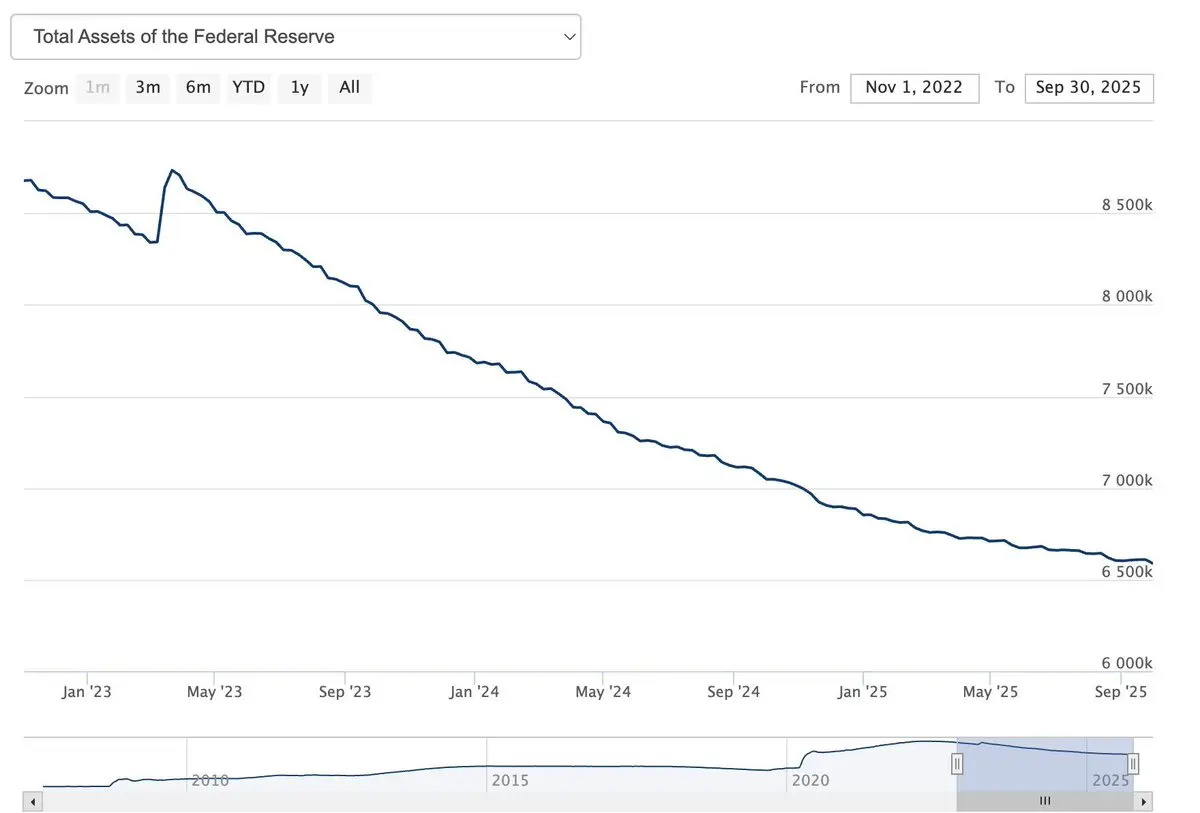
Recently, many people are only fixated on index fluctuations, but they're overlooking something more fundamental——liquidity is being slowly drained away~
From the speed and duration of the Fed's balance sheet reduction, this round of global financial environment is actually not easy at all. Throughout history, whenever liquidity tightens continuously, markets often don't collapse immediately, but first maintain high-level volatility, then suddenly amplify fluctuations at a certain turning point. Dow Theory puts it quite plainly: the true inflection point of a trend often occurs when everyone l
View Original
post-image
  • Reward
  • Comment
  • Repost
  • Share
⏳⏳⏳
The global economy today is increasingly resembling a classic script~
Many people keep waiting for a "black swan," as if crisis must suddenly fall from the sky. But historically, most major crises don't arrive this way—they're more like a gray rhino slowly approaching—everyone can see it coming, yet always feels it's not quite upon us yet~
From a macroeconomic perspective, elevated asset prices, continuously expanding debt levels, and gradually slowing growth momentum stacked together already represent an accumulation of long-term risk. Dow Theory contains similar logic: trends often begin
View Original
  • Reward
  • Comment
  • Repost
  • Share
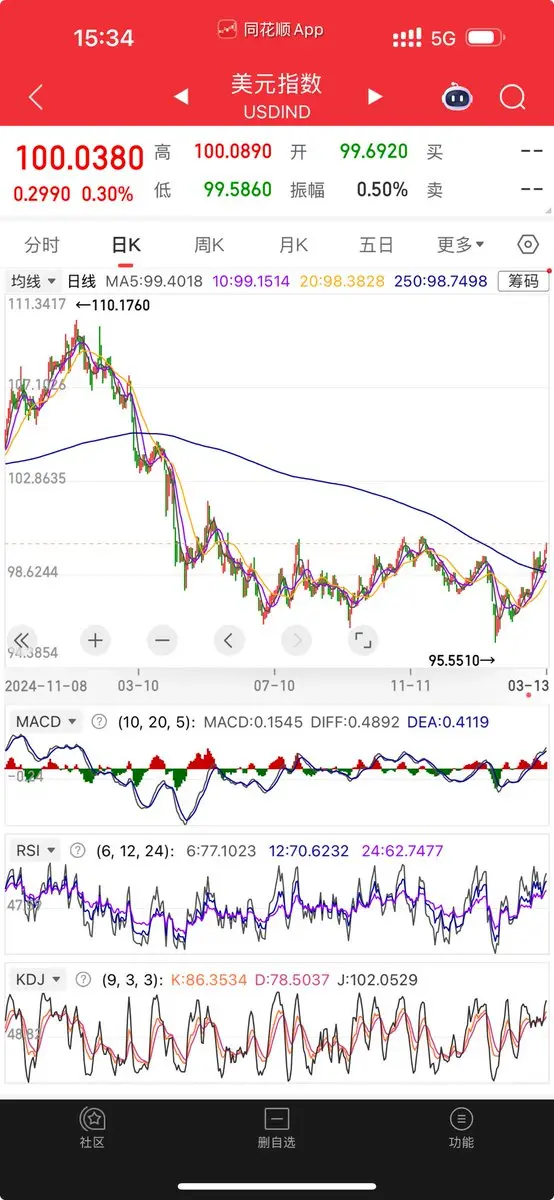
The US Dollar Index #USDINX has entered an upward trend~
View Original
post-image
  • Reward
  • Comment
  • Repost
  • Share
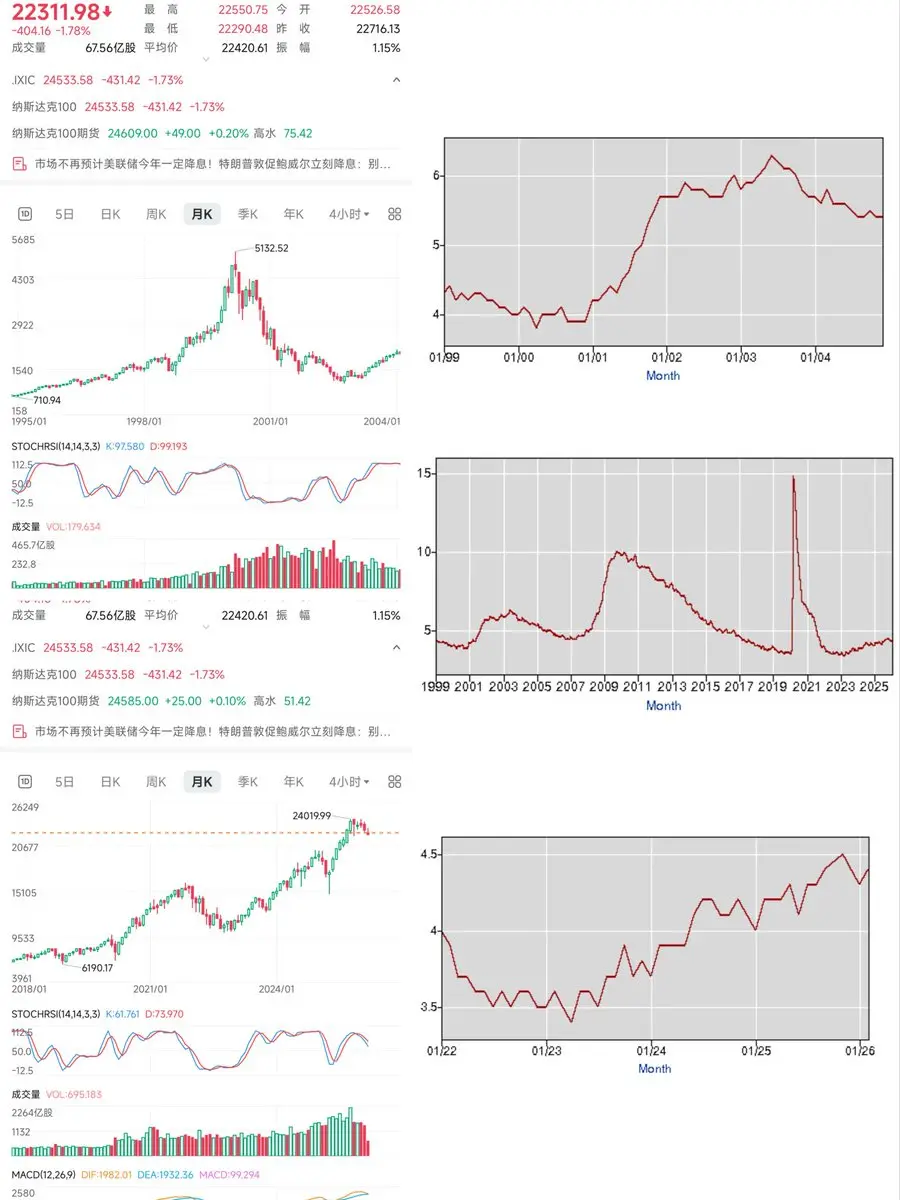
I'm releasing some data today that could be very important or not so important, depending on how you interpret it~
① Trend chart of the #IXIC index around the bursting of the internet bubble in 2000.
② US unemployment rate data trend chart from 1999-2004.
③ US unemployment rate data trend chart from 1999-2026. (The peak impact of the COVID-19 pandemic is crystal clear)
④ US unemployment rate data trend chart from 2022-present.
⑤ Latest monthly K-line chart of the Nasdaq index #IXIC.
Share your thoughts on these objective data~
Specific data can be found on the Department of Labor official webs
View Original
post-image
  • Reward
  • Comment
  • Repost
  • Share
This song feels really special~
Maybe I'm really getting old~
View Original
  • Reward
  • Comment
  • Repost
  • Share
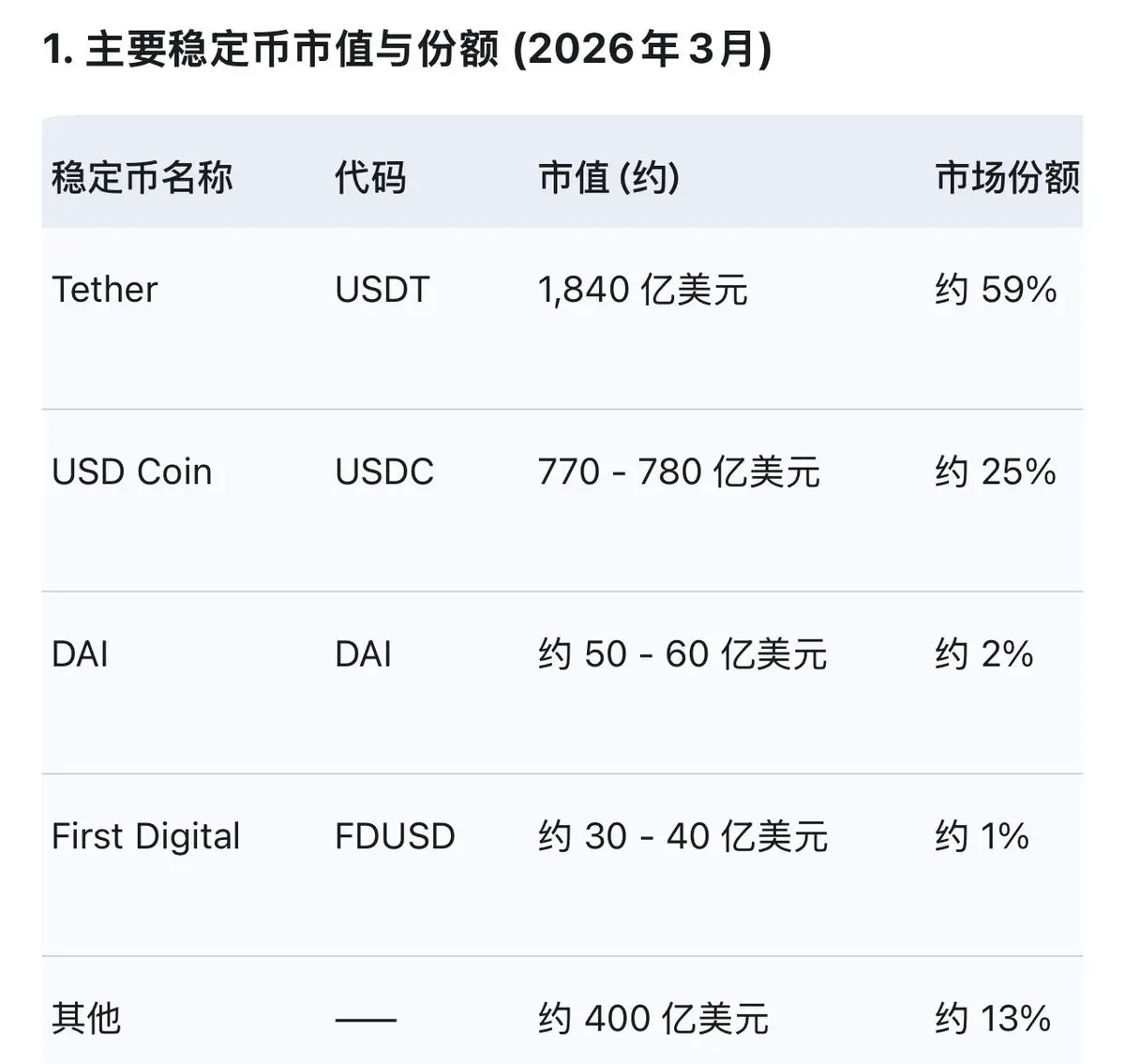
As of March 2026, the global stablecoin market has shown strong growth momentum, with a total market capitalization surpassing $312 billion. Currently, the market remains highly concentrated, with the top two giants (Tether and USDC) accounting for nearly 90% of the market share.
View Original
post-image
  • Reward
  • Comment
  • Repost
  • Share
The recent global situation indeed feels increasingly "off"~
Geopolitical conflicts, economic divergence, policy swings—various variables seem to be stacking up simultaneously. On the surface, financial markets are still functioning, but underlying uncertainties are gradually rising. Many crises are never sudden; they often brew slowly within the macro environment and are only ignited suddenly at a certain point~
When markets operate at high levels for a long time and macro variables begin to change intensively, the trend often enters a sensitive phase. It may still appear as volatility on the
View Original
  • Reward
  • Comment
  • Repost
  • Share
Today’s “Macro Blind Box” is all about the U.S. February CPI~
It’s time for the US stock market and #Bitcoin to play the high-stakes game~
The market’s current consensus is that the year-over-year CPI is around 2.4%–2.5%, indicating that overall inflation remains moderate but still above the Federal Reserve’s 2% target.
In other words, this data isn’t just a number; it directly influences rate cut expectations, the dollar’s movement, and risk asset sentiment.
Three scenarios:
① CPI below expectations (cooling inflation)
The market will re-commit to rate cuts, and US stocks and Bitcoin are like
BTC2,01%
View Original
  • Reward
  • Comment
  • Repost
  • Share
Here's an interesting data point~
SharpLink Gaming released a report stating that due to the decline in Ethereum prices, the company's net loss in 2025 will reach $734.6 million. But at the same time, quarterly staking income has increased by nearly 50%, reaching $15.3 million.
This is a typical crypto market logic: the business is making money, but the price is losing money~
Many people only focus on on-chain revenue but overlook the cyclical fluctuations of asset prices. Wave theory explains it clearly: during large-scale corrections, the destructive power of price movements often exceeds im
ETH2,64%
View Original
  • Reward
  • Comment
  • Repost
  • Share
I started clearly bearish on Bitcoin around mid-August 2025, which many people found hard to believe at the time. Even when new highs were reached in October, I still said one thing: a new high does not change the overall bear market structure. As the market has developed to this point, it has also given a fairly honest answer~
There's a simple logic here: trend reversals often occur at the strongest price points. A new high at a high level is sometimes not a continuation of a bull market, but rather the final emotional surge at the end of a cycle. In wave structures, this stage often correspo
BTC2,01%
View Original
  • Reward
  • Comment
  • Repost
  • Share
  • Pin