Using stablecoins, fintech companies can enter new markets where traditional banking service opportunities are limited, and provide more convenient and efficient financial solutions on a global scale.
Written by: Christine Cai
Compiled by: Songxue, Golden Finance
The lending market is constantly evolving, moving from a traditional, bank-centric framework to a more diverse, technologically advanced ecosystem. This evolution has been particularly evident since the global financial crisis (GFC) and is fundamentally reshaping the landscape of capital aggregation and allocation.
However, the current market structure still faces considerable friction. We believe that integrating blockchain into the existing financial technology stack will increase the efficiency of capital flows and expand access.
Following the global financial crisis, traditional banks played a diminished role in capital allocation, paving the way for fintech lending companies such as SoFi and Ramp. These companies are leveraging online platforms, data analytics and machine learning to fill this gap with innovative solutions such as buy now pay later (BNPL) options.
Despite progress, issues such as antiquated payment systems and funding gaps for SMEs remain. Stablecoins can help overcome these challenges by revolutionizing the payment of funds at superior cost and speed. By leveraging stablecoins, fintech companies can enter new markets with limited opportunities for traditional banking services and provide more convenient and efficient financial solutions on a global scale.
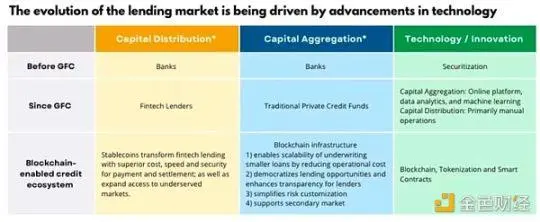
Private credit boomed after the global financial crisis, growing to $1.6 trillion and becoming a competitive source of large-scale financing. However, compared to the innovative state of capital allocation, the growth of capital aggregation has historically been hampered by its manual processes and plethora of intermediaries, making it uneconomical to bring on board large numbers of smaller limited partners.
Tokenization can simplify and automate these intensive operational processes. This efficiency brings two major advantages. First, it is now more economically feasible to underwrite small loans. Second, it democratizes investment opportunities and lowers barriers to entry for a wider range of lenders, including those with smaller capital contributions that are often overlooked today. Other benefits include increased transparency, secondary liquidity, and simplified risk customization enabled by the programmability of smart contracts.
According to recent Bain & Company research, alternative investments account for a low share of individual portfolios (individuals hold 50% of global wealth, but only 5% are allocated to alternatives, while public pensions allocate approximately 25% to the same asset class ). Despite the barriers of varying liquidity needs and the highly manual nature of the alternative fund industry, Bain made a clear point that tokenization could help the private markets industry tap into the $150 trillion individual investor space, “unlocking… Potentially generating approximately $400 billion in additional annual revenue for the alternative investment industry."
Expanding the role of stablecoins in capital allocation: In 2023, companies such as Visa, Mastercard, and Checkout.com will integrate stablecoins with a variety of applications. By 2024, we expect wider adoption of global payments, driven by increasing regulatory transparency in jurisdictions such as Hong Kong and the UK. A key development in this space is stablecoin-based lending services. These services are expected to be particularly impactful in areas where traditional bank financing is inefficient or scarce.
Tokenization of alternative asset funds: Over the past year, pioneers such as Hamilton Lane and KKR have adopted tokenization strategies to attract individual investors by lowering costs and lowering minimum subscription amounts. Looking forward to 2024, we expect that more private credit funds will explore the advantages of tokenization and use blockchain technology to optimize capital aggregation. At the same time, private credit solutions based on DeFi will continue to grow and solve the financing gap of the real economy.
In summary, blockchain technology is critical to improving efficiency and access to capital markets through innovations such as stablecoins and tokenization.
Disclaimer: The information on this page may come from third parties and does not represent the views or opinions of Gate. The content displayed on this page is for reference only and does not constitute any financial, investment, or legal advice. Gate does not guarantee the accuracy or completeness of the information and shall not be liable for any losses arising from the use of this information. Virtual asset investments carry high risks and are subject to significant price volatility. You may lose all of your invested principal. Please fully understand the relevant risks and make prudent decisions based on your own financial situation and risk tolerance. For details, please refer to
Disclaimer.


