Winning Web3 protocols and applications will become globally accessible public goods for their specific use cases.
**Written by **Gagra Ventures
Compiled by: Shenchao TechFlow
Recently, Gagra Ventures published the article “The New “Value Stack””, which mainly discusses the evolution of the value chain in Web3 and distributed technology businesses. It explores how decentralized and autonomous agents are impacting the global technology sector, and how Web3 protocols and applications can form a globally accessible public good. The article also discusses how companies like Amazon achieve business success by controlling different levels of the value stack, and how these principles apply to a Web3 environment. Shenchao compiled the full text.
background
In traditional technology, it is well known that companies that target the “last mile” of the final customer can usually reap the greatest value in the product’s value chain. The last mile is also the most competitive, so it still makes sense for risk-averse founders to extend along the value chain and produce the intermediate components or services that make up the final product.
In the Web3 distributed technology business world, where middlemen are ideally minimized, all decentralized, and services automated, it is easy to conclude that the value chain is inverted. The earliest infrastructure to run Web3 applications were behemoths like Bitcoin and Ethereum, and each network had its own paradigm (such as “Internet Money” and “Internet Computer”) for applications to take advantage of its openness. As a result, investors realize that the protocols themselves may capture more value relative to the applications running on them.
This thinking has led to most capital flowing towards Web3 infrastructure, such as so-called layer 1, layer 2, and even layer 3 (or application-specific chains/rollups). However, the vision behind it has evolved from being monolithic to being more modular, spawning more infrastructure startups to fund.
Since then, we have also seen the emergence of a number of applications that have significantly benefited from using Ethereum to reduce deployment and distribution costs, while also by issuing tokens that do not necessarily capture the value generated by the product (mainly due to regulatory reasons , which is temporary) gained significant upside. Uniswap is a good example, although they have just started charging fees. Although at its peak, its valuation was much lower than that of Ethereum, this application was developed and brought to market significantly slower than competing Web2 online trading applications, while it benefited from outsourcing most of its operating costs to Ethereum verification authors and maintainers. This is a good business model.
So with the emergence of these applications, the narrative has shifted over a period of time, with a lot of public and private market investment flowing into new super application contenders in Web3, mainly in gaming and DeFi applications (such as liquidity staking).
We have been thinking about which thinking framework can present the best Web3 business model with the most value. This gave rise to our concept of the “Value Stack,” which currently guides our investment decisions and portfolio composition.
The power to shape a new value stack
We believe two core trends will define the global technology industry. Starting with software and the internet (which will become synonymous as the security gap between offline and online shrinks), we expect these trends to then trickle down to the physical world.
These trends are:
- Decentralization, driven by the proliferation of public blockchains and blockchain-like (deterministic, trustless, censorship-resistant) distributed systems. It starts with a set of systems around any asset, including autonomous processes. We see technologies like blockchain as a “lasso” for artificial intelligence, just as legal systems curb real-world violence as humans turn to agriculture. This will result in everything (first digital assets, then physical assets) coming to the network. In the near future, as scalability and bandwidth bottleneck issues will inevitably be resolved, blockchain-like cryptographic systems will provide better security while keeping everyone and everything connected, so no longer Requires internal setup and downloadable client;
- Driven by artificial intelligence and robotics, autonomous agents will emerge in both the digital and physical worlds. Machines will account for the vast majority of Internet traffic and usage. We believe that the final form of consumer applications will be highly customizable AI agent interfaces combined with the mundane; while more creative and engaging applications may end up being gamified experiences for human users while still maintaining High degree of artificial intelligence component.
To reiterate: We believe that most business processes, as well as our user experience, will be automated while the parameters and preferences we set for them remain within our verifiable control. Additionally, scalability limitations and complexity are current bottlenecks for decentralized analogs of the best Web2 products and will be resolved over the next 3 to 5 years, so we assume this will be resolved by the time the argument starts to fully work.
It also means that we will end up with a very different value chain because these technologies are global in nature. Everything will be online and connected. The main takeaway here is that the Internet value stack will eventually become homogeneous across the globe.
In our view, winning applications and protocols will become global public goods managed and accessed through a distributed network similar to a public blockchain. There may be jurisdiction-specific rules and restrictions for interacting with them, but most of the time, it’s still the same stack.
What is the value stack?
Now, let’s use a simple example to explain what we call the “value stack.”
Amazon can be thought of as an infinite store shelf at first, with books first and then everything else—the last mile they capture. They captured consumers by offering and expanding beyond their original book offerings. Over time, Amazon transitioned from initially being a reseller publisher to becoming its own publisher, creating a platform with Kindle and later other content platforms with Amazon Prime. But what really allowed them to reduce costs and ultimately become profitable was moving down the technology stack and the value stack and selling access to the backend, which sits idle 95% of the year except during Christmas shopping. This gave birth to their cloud platform AWS. Additionally, to improve the customer experience and develop new customers (who would otherwise use brick-and-mortar stores), they had to move further into the value creation chain, establish exceptionally fast delivery services, and ultimately have the largest fleet of private jets and drones in the United States. They also work with manufacturers to sell some of their most popular products under their own brands to keep prices attractively low and delivery fast.

This is roughly how e-commerce platforms transform themselves into cloud, infrastructure and logistics companies - by moving vertically down the value stack and owning it. From the top last mile all the way to manufacturing to squeeze out all the profit margins and satisfy customers. Of course, they also rely on common infrastructure like TCP/IP on the Internet or concrete roads in the physical world, which also constitutes the value chain. But to maintain dominance of its business, Amazon needs to own a vertical stack, and it must do so incrementally after first locking in the major parts that give it real growth factors. Other business giants are in similar situations to varying degrees.
It is a more natural process for a company to go deeper into the value chain that makes up its main product than to expand into adjacent or entirely new markets, although they still do it all the time, with varying degrees of success. They always have a better chance of fully owning the vertical value stack of their business rather than dominating horizontally (i.e. across multiple markets/jurisdictions/platforms). Owning part of the value chain creates economies of scale and thus avoids competition. Lateral expansion into new markets is riskier and less clear-cut.
No matter how strong Amazon’s vertical value stack is in the US and other select regions, they can’t own it globally, so they either rely on partners with better distribution in a particular region or face having similar ones in other regions Types of vertical stack companies compete and dominate there – such as China’s Alibaba. They may never be exact replicas of each other, for example Alibaba does not own any warehouses or logistics operations, but rather owns other parts of its value chain (financial services through Alipay) to achieve dominance in its local market.
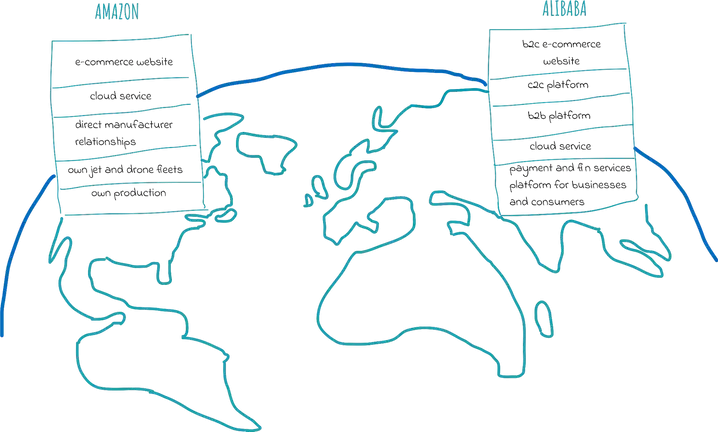
Therefore, the winning business model in traditional technology is to develop the value stack vertically from the top down to achieve the largest profit margins possible and avoid competition. But that still doesn’t prevent these businesses from being disrupted occasionally.
Value Stack in Web3
We believe that ultimately winning Web3 protocols and applications will become globally accessible public goods for their specific use cases, as widest access often creates a power law dynamic (most people use 1 or 2 winning solutions). These distributed products are typically networks of service providers + users (e.g. Bitcoin) or just users (e.g. Uniswap). They are also inherently censorship-resistant, open to operate 24/7, and equally open for anyone to contribute to or build on top of them. Given this environment, users and contributors have no reason not to consider the winning solution as the product of choice for a specific use case. The winners are likely to be those with the most mindshare, liquidity, and other network effects.
This also means that Web3 is composed of multiple applications and protocols, each of which occupies a part of this decentralized global value creation chain, but no single application can fully own it. Interoperability and openness require a certain degree of specialization (depending on the domain). In a world where everything is open source, you need to be the absolute best or have the largest network effect. Furthermore, if you reduce interoperability features to enforce it, users will simply choose a different solution that doesn’t do that because that’s what’s valuable to them. In the end, you can certainly still build your own full value stack, but the incentives have shifted toward building on top of existing solutions rather than creating everything on top of your solution. The benefits of lowering the cost of setting up your protocol and distributing it to the broadest user base (wallets on the blockchain) are numerous, and the more contributors this open source technology has, the more powerful it becomes. This is an economic, cultural and even social movement that is difficult to reverse.
Extending the metaphor of the value stack to the idea of being composed of technology layers, from a vertical perspective, the value slice accounted for by a particular application or protocol may appear smaller/thinner (limited vertical value capture) for the reasons mentioned above. However, the nature of the global marketplace created by Web3 allows these businesses to serve many more users than regional winners like Amazon or Alibaba. Therefore, from a horizontal perspective, Web3 may have greater potential value than similar Web2 products.
We see Web3 winners growing horizontally in their respective categories, rather than growing vertically. The global value stack is a single homogeneous set of layers stacked vertically into a large technology stack, with each protocol and application being a single slice of that layered body.

In this scenario, what is the winner in the “storage” field? It is the protocol that hosts data for most of the internet around the world, such as in China and the US and everywhere else, which means it occupies AWS, Alibaba Cloud, Azure, Tencent Cloud, Google Cloud, Hetzner and all other clouds and current local storage The storage part of the business. Now, multiply that by the ever-expanding storage needs of a digital world, where AI generates and consumes orders of magnitude more data than we do today, and you get a rough idea of the scale such a value stack layer might occupy. .
The key question is, given the open source nature of these technologies, how do you ensure that you capture the majority of the value they create while winning in network effects? We firmly believe that we are at the beginning of figuring out the best economics for such systems. Experimentation with digital assets representing access/ownership of these platforms is only beginning to break through. The rapid path to liquidity for these tokens is both a gift and a curse, as it incentivizes people to launch these tokens as quickly as possible and with only minor improvements based on the trial and error of early iterations. However, it’s difficult for a product whose price continues to fall to reverse direction. That’s why these failures in token economics can come at a heavy cost to the builders of even highly successful products.
We strongly believe that a great era of token design and a testing platform for the most complex and cutting-edge economic theories is coming. We know from the economists who work with our portfolio companies that most people in traditional economics have career paths that are dull and boring because of how little they produce in the real world. In token economics, by contrast, they can implement and continually adapt these closed loop network economies.
How we put our framework into practice
As an investor, you want the winner or at least the second largest protocol/application to serve their respective stack. We believe that protocols downstream of the value chain (i.e., at the end of the Internet) will be more like a “winner takes all” commodity. And the application layer may have multiple simultaneous winners that address the needs of different user groups but remain prevalent in their respective market segments.
Additionally, we don’t know which layer of the stack will be the winner capturing the most value, and we expect demand for each service/protocol will be cyclical, but margins will be higher the further up the stack you go (think economic cycles necessities versus non-essentials), including middleware (for example, the rise of gaming is more conducive to some middleware than the rise of productivity software). So, you want to own as many winners in each category as possible and throughout the entire stack to get defensiveness in your portfolio.
Furthermore, while we don’t know how valuable each category might be, heuristics may lead one to pick the larger categories first. We prefer projects in areas that don’t appear to be competitive but make sense from both first principles and founder talent perspectives.
The key to ensuring you have a winner or strong competitor is to make sure they have the defenses to build a moat around them. We believe that in a world of interconnectedness, this means network effects first and powerful value capture mechanisms second. So, as investors, we work primarily with portfolio companies to improve their composability with other portfolio companies and the wider sector, but also to design the most appropriate value capture mechanisms.
The thing to note about network effects is that over the past 20 years of Internet growth, we’ve learned that technology is a popularity contest, and it’s not always the best solution that gets the most adoption. However, we encourage portfolio teams to have uncompromising freedom when the technology itself is not consumer-facing. It will become even more important in a world where integrated decision-making is driven by artificial intelligence, which removes human bias and social thinking when choosing the best technology. That adds a whole side of things to think about, but that’s not the thing to consider right now.


