With the rise of Ethereum and the upcoming Cancun upgrade, ARB continues to break through all-time highs, and the other L2s also begin to exert force.
Written by: Luccy
Arbitrum’s native governance token ARB continues to break new highs. On January 3, according to the OKX market, as of the time of writing, ARB briefly exceeded $1.94, breaking new highs again, with a 24-hour increase of 10.33%. According to L2BEAT data, Arbitrum’s value locked exceeds US$20 billion, making it the largest L2 rollup.
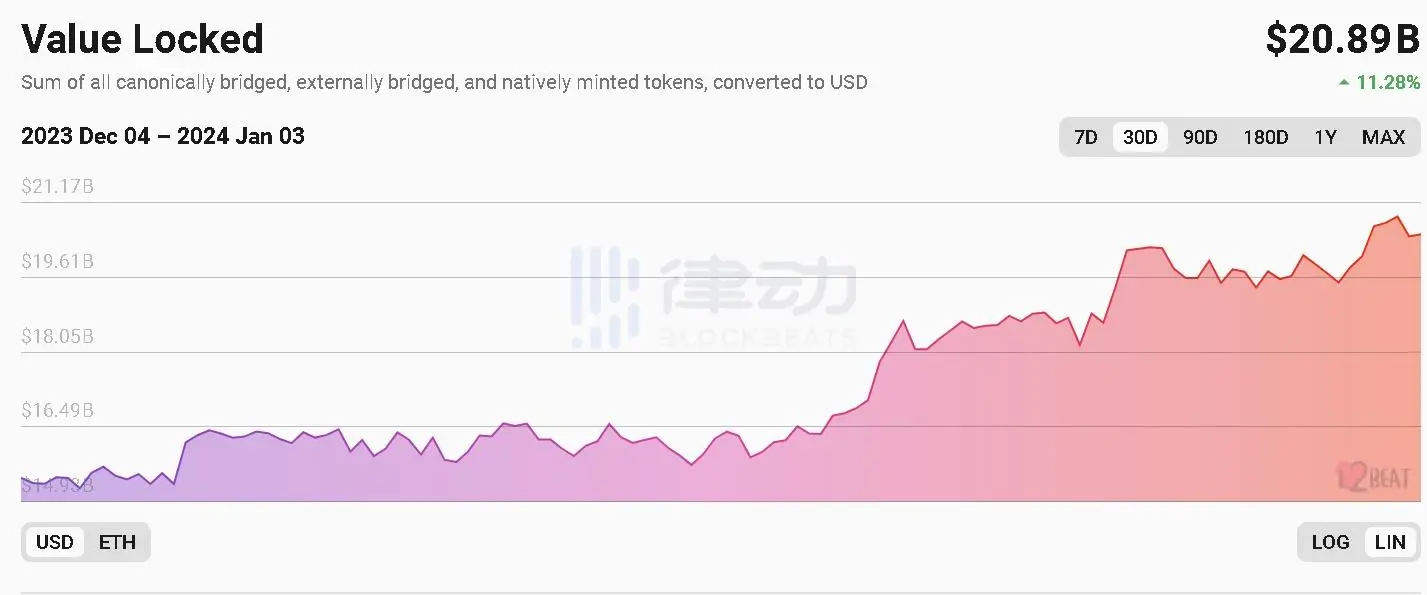
ARB up 60% since December
On July 7, 2023, the Arbitrum community passed two proposals, AIP-1.1 and AIP-1.2. Among them, proposal AIP-1.1 proposes that the remaining 700 million ARB of the foundation be placed in a “smart contract-controlled lock” and be unlocked within four years. Proposal AIP-1.2 aims to modify several governance documents of the Arbitrum ecosystem, including lowering the threshold for the number of ARB Tokens required to publish improvement proposals on the chain from 5 million to 1 million.
The massive unlocking caused a brief rise in the price of ARB, but then the price fell all the way, and only started to improve after falling to a low of $0.74 on September 11.
From a time perspective, ARB follows the price increase of OP. According to The Block data, starting from the fourth quarter of 2023, Arbitrum’s daily transaction volume increased from 670,000 to 926,000, an increase of 38%. The daily transaction volume of the OP mainnet increased by 20%, from 354,000 to 431,000. After hitting an all-time high of $4.10, OP has been trading near the peak.
As the second largest Optimistic Rollup in TVL, OP surged nearly 69% every week, a development consistent with the OP mainnet’s TVL of over $5 billion. Although everyone criticizes Optimism for its inaction on decentralization, Optimism seems to be able to turn the situation around with the actual market success brought by OP-Stack. But a more reasonable market evolution trend is that OP-Stack’s success will be further amplified, and OP-Stack’s blank areas will naturally have other successors.
The focus of OP-Stack stack promotion is to achieve shared Sequencer. The more strategic alliances OP has in the future, the greater the benefits they can capture through Sequencer. On the contrary, the interests of multiple parties involved will also become greater. This social consensus will become New constraints other than technology have solidified Optimism’s position as a big brother.
As an Ethereum company, it can be seen that a major factor driving the trend of ARB is ETH. Arbitrum’s fundamental role as Ethereum L2 means that ARB may be closely related to ETH. If ETH slows its momentum, ARB may do the same. Similarly, if ETH moves towards $2,500, many crypto researchers predict that ARB may rise to $2.
In addition, ARB’s surge stems from market expectations for Ethereum Improvement Proposal (EIP) 4844 on the one hand, and Vitalik’s post celebrating Arbitrum’s implementation of the first phase of Rollup on the other.
Cancun upgrade expectations
On December 22, @sassal0x, founder of The Daily Gwei and co-founder of EthHub, announced on the social media platform that Ethereum developers will implement EIP-4844 on January 17, when Dencun, the next major upgrade of Ethereum, will be launched. The test network Goerli is launched.
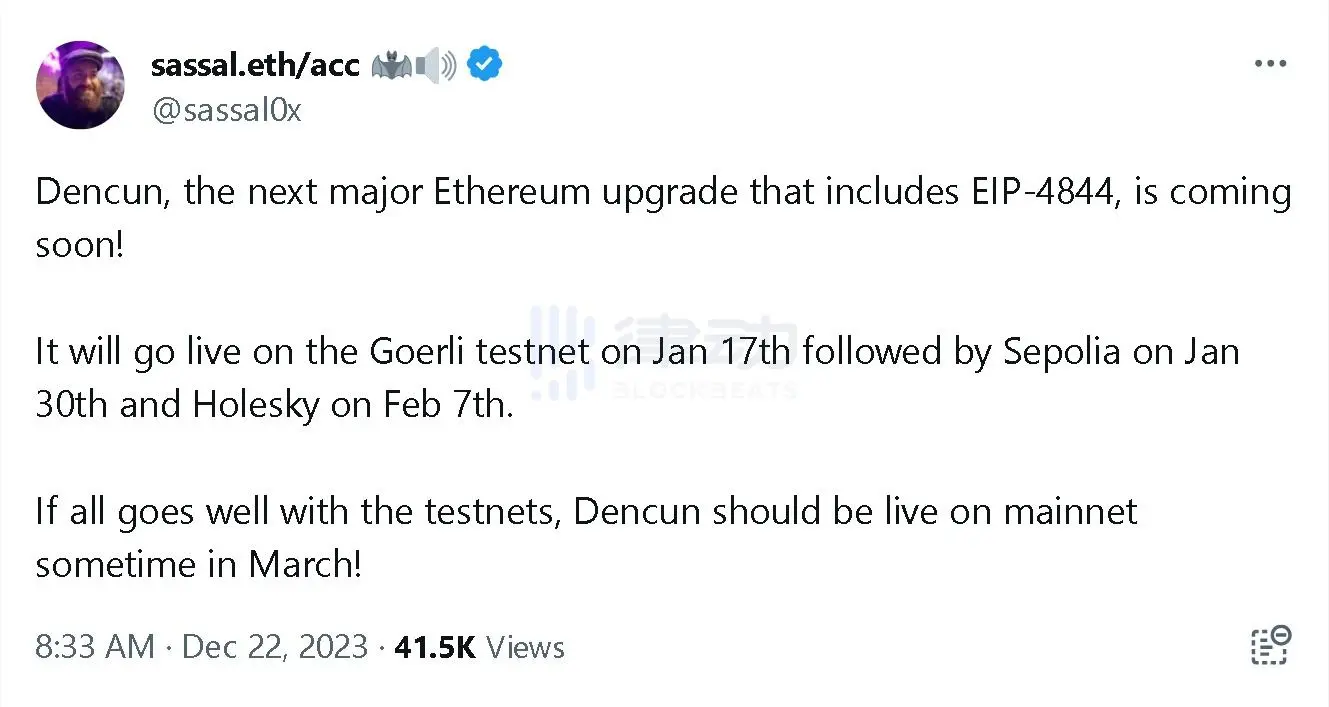
EIP-4844 was co-created by Ethereum researcher Dankrad Feist and Ethereum co-founder Vitalik Buterin. It is also the core content of the Cancun upgrade. It is a mid-term transitional solution to improve the performance of Ethereum L1+L2 and solve the problem of gas fees. .
EIP-4844 will feature original danksharding, a concept named after Feist that aims to increase the total number of transactions that Ethereum can handle. Danksharding is a full implementation of the Rollup extension that will bring a lot of space to Ethereum for Rollup to dump compressed transaction data. It introduces a new transaction type (blob carrying transactions) to reduce transaction fees on Ethereum.
Compared with the full node storage structure of calldata, Blob is designed as temporary storage for some nodes, which can greatly increase the upper limit of data submitted by Layer2 to the main network at a time and expand its TPS. At the same time, since it is only temporary storage, the data storage efficiency will be improved. Data storage costs have also plummeted. The improvement of DA capability is due to the temporary storage of 1 month, which is more than enough to cope with the 7-day fraud proof time window of OP-Rollup.
This means that EIP-4844 can increase Rollup’s TPS (transactions per second) while reducing Gas fees. Simply put, after EIP-4844, Rollup does not have to compete with ETH native applications to use ETH block space, which is bullish for L2.
Rollup Phase 1
In March 2023, Arbitrum officially announced the first Rollup to enter the first phase.
At the end of the year, Vitalik posted a good review on Warpcast, saying, “This is a real progress in decentralization. I hope to see ten Rollups enter the first phase next year and achieve a certain degree of sequencer decentralization.” Comments released Hours later, ARB prices were up 22%.
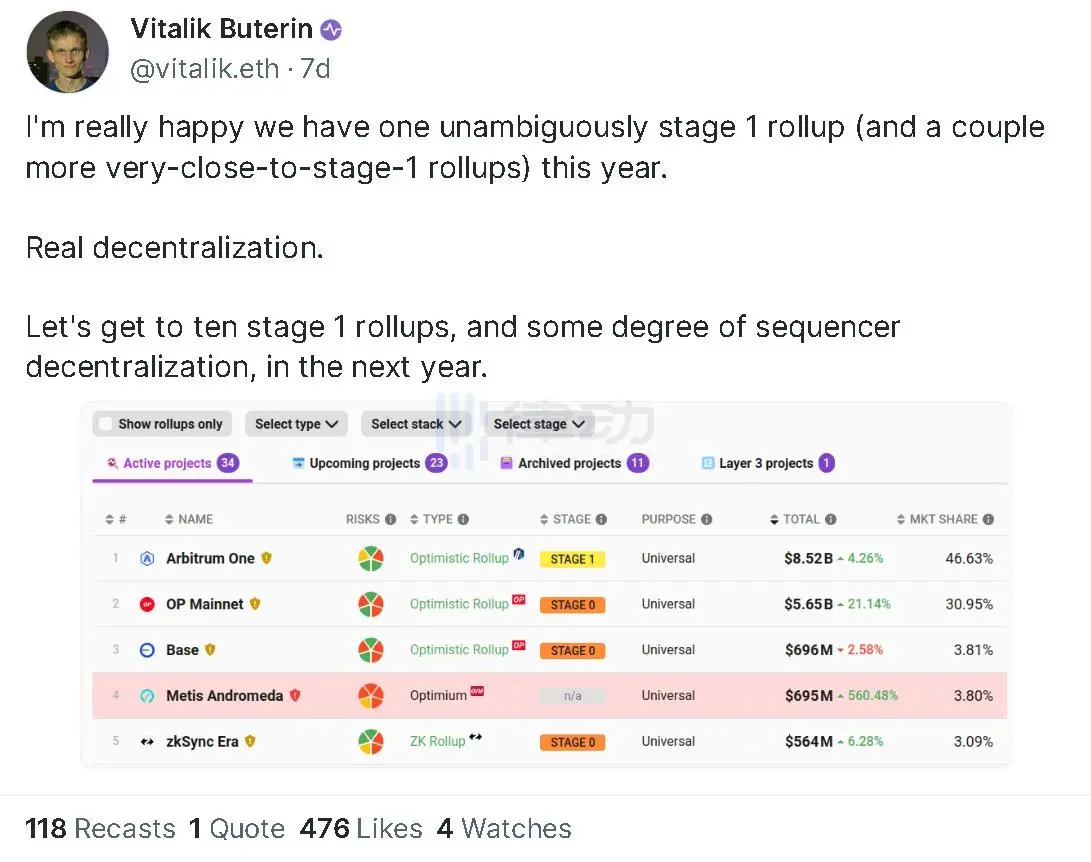
Being a first-stage Rollup means that Arbitrum has met the five requirements for complete decentralization. According to data from L2BEAT, as of the time of writing, Arbitrum is the only L2 that has completed the five requirements of the first phase.
According to Vitalik’s initial proposal on the Ethereum Magicians Forum, the five requirements are: 1. A complete and fully functional proof system is deployed; 2. At least 5 external participants can submit fraud proofs; 3. Users do not need to obtain authorized operators. Exit can be achieved with the help of the Security Council; 4. If unnecessary upgrades are implemented by a more centralized participant than the Security Council, users have at least 7 days to exit; 5. The Security Council is properly established.
In addition, it is worth noting that on December 29, Arbitrum ecological game Layer3 Xai will distribute the first season airdrop, and airdrop snapshots have been taken for Xai Odyssey Legend and Pioneer participants and Sentry Node Key holders.
Low valuation, high “odds”
In addition to ARB, the rise of Ethereum and expectations for the Cancun upgrade also drove the rise of other L2 tokens. On December 27, according to OKX market data, Layer 2 project tokens experienced general rises. Among them, OP’s 24-hour increase 19.38%; MATIC rose 18.34% in 24 hours; METIS rose 17.1% in 24 hours.
Among them, in addition to star projects such as Starknet and zksync, there are also some projects with low valuations but high “odds” such as Metis and ZK Fair.
Placed
Metis is an Ethereum Layer 2 expansion solution developed based on Optimistic Rollup. It is a Layer 2 expansion and general infrastructure project co-founded by Elena Sinelnikova, Kevin Liu and Yuan Su in 2018. The price of its native token METIS rose from $20 to $90, a 350% surge in just two weeks.
On December 18, MetisDAO announced the establishment of the Metis Ecosystem Development Fund (Metis EDF). With the establishment of Metis EDF, a fund of up to 4.6 million METIS will be used to promote project deployment, product development and builder rewards in the ecosystem.
Currently, projects in the Metis ecosystem include DEX Hermes built on Metis, which is positioned as a highly capital-efficient AMM that can provide users with low-cost, near-zero slippage transactions; the first DEX NetSwap in the Metis ecosystem can be used on Swap transactions are performed on the Metis network.
The Hummus protocol is a unilateral AMM built on Metis that allows users to exchange stablecoins with extremely low losses. Its native token is HUM. Users can stake stablecoins to earn HUM and use the staked HUM rewards to increase the income from staking stablecoins. The Metis project background also brings native memes VMUM and BARSIK to the meme currency project on this chain.
According to the official blog post, Metis is expected to become the first decentralized sorter’s Optimistic Rollup early next year, and the distribution of the Metis Ecological Development Fund will take place one week after the Metis decentralized sorter goes online. In the future, with the launch of the decentralized sorter and the stimulation of ecological funds, new projects in the Metis ecosystem are still worth looking forward to.
ZKFair
ZKFair is the first ZK-L2 based on Polygon CDK and Celestia DA, and is technically supported by Lumoz RaaS. ZKFair is a completely fair launch and community-driven, aiming to solve the current pain points of high L2 valuation, multiple PUAs, and high user participation threshold. ZKFair is a completely fair launch and community-driven, aiming to solve the current pain points of high L2 valuation, multiple PUAs, and high user participation threshold.
On the day the ZKFair testnet was launched, more than 30,000 users poured into the community and tried to interact on the testnet. Its innovative economic model has always been the focus of community users. ZKFair uses USDC as the handling fee token, and its own token is ZKF, with a total amount of 10 billion. All tokens are distributed to the community through airdrops.
2.5 billion of them will be airdropped to community users, including Polygon zkEVM, zkSync, Linea, Scroll, ZKSpace interactive address, Lumoz point holders, Ordinals community, etc. Users can now check the community airdrop amount on the official website zkfair.io. No more ZKF tokens will be issued in the future. At that time, all 10 billion ZKF tokens will be released and circulated uniformly.
After the mainnet went online, the cross-chain bridge Owlto Finance announced its successful integration with the ZKFair mainnet. The former is the first cross-chain bridge to support the ZKFair mainnet. Users can now use Owlto Finance to quickly and safely transfer assets into the ZKFair network on all mainstream L2 networks such as Ethereum, zkSync Era, Scroll, Optimism, Arbitrum, and Linea. At the same time, users can share 75% of ZKFair’s token airdrop share through Owlto.
Mainnet online, airdrop expected
Starknet
In the Layer 2 arena, Starknet is ranked as the four kings along with Arbitrum, Optimism, and zkSync. Compared with zkSync in the same camp, Starknet uses zk-STARKs, which has higher transparency and security.
On December 1, 2023, the Starknet Foundation stated that it had conducted an airdrop snapshot and would distribute STRK tokens to certain past active users and contributors in the first quarter of 2024, while unlocking tokens issued in the past. On December 8, the Starknet Foundation stated that it plans to distribute more than 1.8 billion STRK tokens across multiple initiatives, and an initial 50 million STRK will be used for on-chain incentives in DeFi. This move attracted many investors to start laying out the Starknet ecosystem in advance.
There are more than 170 projects under construction in the Starknet ecosystem. Among them, most of the ecology is in an early stage. In layman’s terms, most protocol applications have not issued coins. RabbitX and Loot Realm are among the few projects that have issued assets.
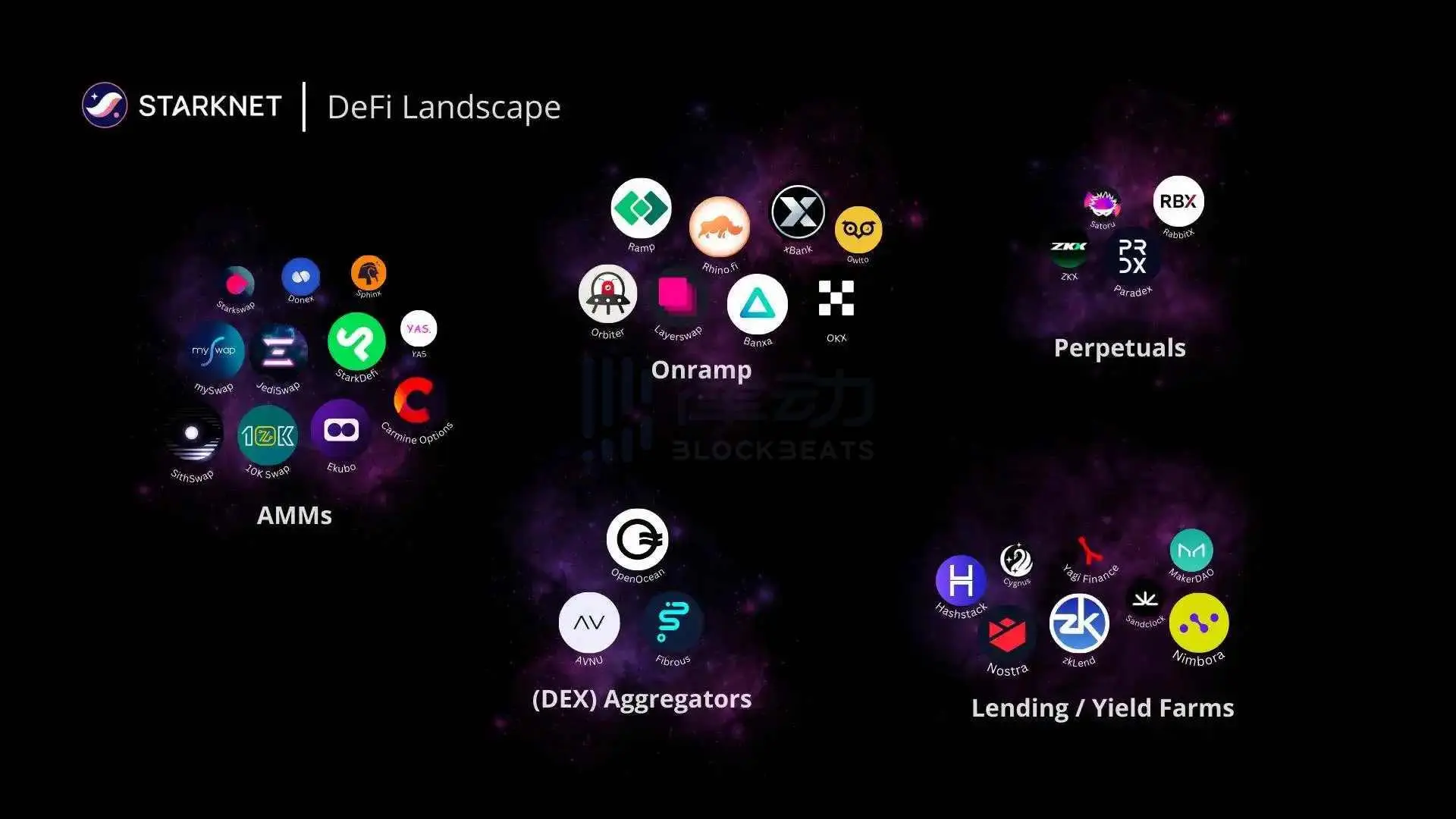
Recently, the official released a map of the main applications of DeFi on the Starknet network, including five tracks: cross-chain bridge, AMM/DEX, aggregator, lending, and derivatives. Perhaps with the issuance of Starknet’s currency, Starknet’s official incentives for the DeFi protocol in its ecosystem, and the recovery of the overall market, the above figures in 2024 will further increase, and it will also benefit ecological projects in the entire L2.
zkSync
The market has become desensitized to the technical narrative of ZK-Rollup and OP-Rollup. There is a high probability that zkSync will no longer regard technological breakthroughs as its core selling point, but will instead focus on the hard nut of “ecology”.
In terms of ecology, in the context of fierce competition in Layer 2, zkSync has to do its best to support a top-level Derivative platform. Inspired by Holdstation’s currency issuance, its Derivatives’ average daily trading volume has climbed to more than 20M, its APY has climbed to a maximum of 69%, and its Fees have reached US$200,000 on the 30th. Its Tokenomics is forming a Flywheel model in which Gas subsidizes users, attracts users to trade, accumulates more Fees, and subsidizes more users.
After zkSync quietly completed the boojum upgrade and integrated STARK and SNARK certificates, zkSync’s gas fee has been significantly reduced by about 30% in the past 30 days, which has reached the same level as Arbitrum. In addition, the original user experience advantages have allowed it to further gain Wider users and traffic.
On the other hand, since at least half of zkSync’s current data comes from the work of the Lumao Party, everyone’s willingness to pay gas is also based on the premise of anticipating airdrops. zkSync itself uses non-aware account abstraction to lower the user threshold, and uses NFT gameplay to expand the community. Pudgy Penguins, including members of Matter labs, have frequently spoken out on AA account abstraction recently. Community members speculate that the use of wallets with AA account abstraction is a possibility. Airdrop Criteria.
Overall, zkSync mainnet has been online for more than half a year, and it has indeed firmly established itself as the ZK-Rollup duo, and even its market expectations are far above Starknet. Although being in the spotlight for a long time has accumulated huge public opinion baggage and pressure, the community generally believes that zkSync will have a certain layout in community activities.
Taiko
Taiko is a decentralized Ethereum equivalent of ZK-Rollup, inheriting the security guarantees of Ethereum while offering lower transaction fees. Taiko enables developers and users to use Ethereum securely without having to consider any changes. Additionally, due to its decentralized design, Taiko is able to support a vibrant community of block proposers, provers, and node operators.
Taiko is a based rollup (Based Rollup), the first of its kind among competing products. It does not have a centralized orderer, instead relying on Ethereum validators to order transactions and blocks. As a debatable rollup, Taiko allows application chains to define their own proof systems and adopt newer, more efficient validity proofs as technology advances without modifying Taiko’s core protocol.
On December 5, Taiko announced the launch of the Taiko Grants Cycle 2 developer incentive program, with a total incentive pool of US$30 million. On December 8, Taiko announced the launch of a community education event on Galxe, which mainly includes three tasks: using Particle to create a wallet driven by account abstraction, creating a .taiko domain name, reading official articles and taking quizzes. Users who complete tasks will receive loyalty points.
Taiko is currently fine-tuning the new design and Rollup contract code base. Once completed, this will be deployed as Taiko’s Alpha-6 testnet, featuring a four-layer proof system. In the upcoming A6 testnet, Taiko will adopt a 24-hour cooldown period for all tiers. Finally, Taiko’s main goal is to make Disputable Rollup combine the advantages of Optimistic Rollup and ZK-Rollup.
Forget it
The Manta public chain is the first ETH L2 built on Celeasita, raising $60 million in funding. Airdrop 5% of the token supply. Provides native yields for ETH and stables.
New Paradigm, a liquidity incentive activity within the ecosystem launched by Manta, is similar to the Blast liquidity staking launched by Blur a while ago. The basic logic is that the total reward is 3% (basic reward) + 2% (additional reward) + 1.5% (ecosystem Rewards) = 6.5%. Users pledge ETH or USDC and receive blind box fragment rewards. The fragments can be exchanged for blind boxes, and the NFTs released from the blind boxes can be exchanged for future token airdrops.
As early as January 2024, users can exchange the NFTs they receive into token rewards. 69 days after receiving the token reward, users can unlock and transfer the pledged ETH and USDC from the Manta ecosystem. Currently, you need to use an invitation link to enter the event page.


