The crypto faction in the Brazilian Congress is expecting the issuance of a decree to establish a 3.5% tax on stablecoin transactions to file a draft bill and block this initiative. The Parliamentary Front for the Free Market argues that the measure would constitute an overreach of the Executive branch.
Brazil’s Crypto Faction Vows To Block Stablecoin Taxation Decree
A battle is brewing between the Brazilian government and Congress on stablecoin taxation.
The so-called crypto faction in the Brazilian Congress is preparing several actions to confront the issuance of a decree establishing a 3.5% tax on stablecoin transactions, directed to foreign currency movements, known as the Tax on Foreign Transactions (IOF).
While the decree has not been issued, members of the Parliamentary Front for the Free Market have already established a course of action directed to block the measure and bring the discussion to Congress. While the first move is to show strong opposition to the measure before being issued, the front would introduce a proposed legislative decree, a legislative draft that seeks to suspend executive orders that lawmakers believe exceed the executive’s authority.
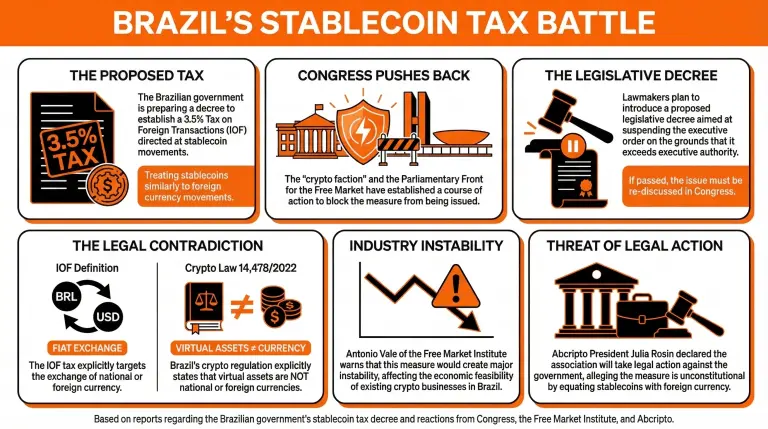
If the proposed legislative decree were to be passed, the issue would have to be re-discussed in Congress, and it could even be repealed.
Antonio Vale, coordinator of the Free Market Institute, told Portal do Bitcoin that there are regulatory contradictions to implement this stablecoins transaction tax.
He assessed:
“The decree that defines the IOF tax on foreign exchange states that the taxable event is the exchange of national or foreign currency. However, Law 14,478/2022, which regulates the crypto sector in Brazil, explicitly states that virtual assets are not national or foreign currencies.”
Vale also stated that this measure would create instability for the local crypto industry, as it could affect the economic feasibility of already existing businesses in Brazil.
Julia Rosin, President of Abcripto, the Brazilian Association of Cryptoeconomics, has also declared against this expected decree, claiming it will take legal action against the government. Rosin alleges that the measure is unconstitutional, equating stablecoins with foreign currency and contradicting current regulations.
FAQ
- What taxation issue is currently arising in Brazil regarding stablecoins?
A conflict is developing over a proposed 3.5% tax on stablecoin transactions, aimed at foreign currency movements.
- What actions is the Brazilian Congress considering against the new decree?
Members of the Parliamentary Front for the Free Market are preparing to block the tax decree and propose a legislative measure to suspend executive orders perceived as overreaching.
- What are the concerns raised about the stablecoin tax by industry experts?
Antonio Vale noted that the tax contradicts existing regulations, as Law 14,478/2022 specifies that virtual assets are not considered national or foreign currencies.
- What stance has the Brazilian Association of Cryptoeconomics taken on the taxation measure?
Julia Rosin, President of Abcripto, opposes the decree, claiming it is unconstitutional and promotes plans to take legal action against the government.
Disclaimer: The information on this page may come from third parties and does not represent the views or opinions of Gate. The content displayed on this page is for reference only and does not constitute any financial, investment, or legal advice. Gate does not guarantee the accuracy or completeness of the information and shall not be liable for any losses arising from the use of this information. Virtual asset investments carry high risks and are subject to significant price volatility. You may lose all of your invested principal. Please fully understand the relevant risks and make prudent decisions based on your own financial situation and risk tolerance. For details, please refer to
Disclaimer.
Related Articles
Hong Kong’s first batch of stablecoin issuers has been unveiled! Out of 36 applications, only 2 received licenses: HSBC and TetherPoint Finance
The Hong Kong Monetary Authority has announced the inaugural stablecoin issuer licensing scheme, and Tidepoint Financial Technology, led by HSBC Bank and Standard Chartered Bank, has been approved. This regulatory framework is designed to protect users’ interests, promote the application of compliant stablecoins, address financial pain points, and drive the development of Hong Kong’s digital assets.
CryptoCity14m ago
Is it possible to bypass Financial Supervisory Commission regulations to buy crypto by card? Odingding rolls out a U.S. debit card crypto purchase service, Wallet Pro
OdinTin launches OwlPay and Wallet Pro services, focusing on B2B cross-border payments. By combining stablecoin technology with international financial systems, it demonstrates its fintech transformation. Through a partnership with MoneyGram, Wallet Pro enables cross-border transfers to buy stablecoins with cash and operates in the U.S. market. The company’s offshore model avoids Taiwan’s strict regulation, and under the new draft law, it challenges the market’s competitive landscape, which will affect local businesses’ compliance strategies in the future.
CryptoCity33m ago
Ondo Finance submits a letter to the U.S. SEC requesting no enforcement action, concerning on-chain record-keeping of tokenized securities rights on the rights chain
Ondo Finance filed a request with the SEC on April 13, seeking confirmation that recording securities interests on the Ethereum mainnet in a tokenized form is compliant under certain patterns. Ondo believes that this on-chain recording can improve collateral monitoring, optimize processes, and simplify reconciliations, with the goal of operating in coordination with traditional finance.
GateNews2h ago
Encourage innovation! U.S. judges ban Arizona state regulation of prediction markets, and halt the prosecution of Kalshi
A U.S. federal district court ruled that Arizona is barred from using its gambling laws to prosecute prediction market platform Kalshi, finding that the U.S. Commodity Futures Trading Commission has exclusive jurisdiction. The ruling affects the boundary between state and federal authority over financial market regulation, and Kalshi insists that its business is a financial product rather than traditional gambling. Courts in different states have reached different decisions regarding prediction markets, and the Trump family has also expressed support for prediction markets.
CryptoCity2h ago
The American Bankers Association criticizes the White House’s stablecoin report, saying it overlooks the core risks of interest-bearing stablecoins
The American Bankers Association criticized the stablecoin report released by the White House Council of Economic Advisers, saying its analysis was wrong. It emphasized that allowing stablecoins to pay interest would lead to local banks’ deposits flowing out and would tighten credit, countering the report’s claim about the effects of the proposed ban.
GateNews2h ago
Can bypassing Financial Supervisory Commission regulations for buying crypto with credit cards be possible? OdenDing pushes a Wallet Pro crypto-purchase service with U.S. debit cards
OdinTing launches OwlPay and Wallet Pro services, focusing on B2B cross-border payments. By combining stablecoin technology with international financial systems, it showcases its fintech transformation. Through a partnership with MoneyGram, Wallet Pro enables cross-border transfers of stablecoins purchased with cash and operates in the U.S. market. The company’s offshore model bypasses Taiwan’s strict regulation and challenges the competitive landscape under the new draft law, which will in the future affect local players’ compliance strategies.
CryptoCity3h ago


