The single release model can no longer meet the demands
The birth of Virtuals Protocol is to support builders, rather than restrict them to a single path. As the proxy market continues to evolve, our release mechanisms have also developed.
In 2024, our focus is on validating the feasibility of the proxy market itself. Early prototypes prioritized speed and experimentation to verify whether proxies can exist on-chain, be publicly traded, and begin to coordinate real economic value. The goal at this stage was not optimization, but exploration.
By 2025, the focus shifted to “Fair Access.” We introduced the Genesis mode to ensure large-scale fairness, allowing everyone to participate through contribution rather than capital. This mode successfully democratized releases and established transparency. However, over time, its limitations became apparent: relying solely on fairness does not strengthen belief, and the lack of an embedded fundraising path makes it difficult for high-quality builders to sustain long-term development.
The Unicorn mode emerged as a correction to the above issues. It refocuses the system on “belief,” linking funds to performance, rewarding early trust, and providing asymmetric returns. For builders seeking funding support and public accountability, the Unicorn mode has indeed achieved the desired effect. However, as the ecosystem matures, it becomes clear that different builders face different challenges.
Early-stage teams need distribution channels, growing teams need capital formation, and teams with established credibility and large-scale releases require a clear market entry path.
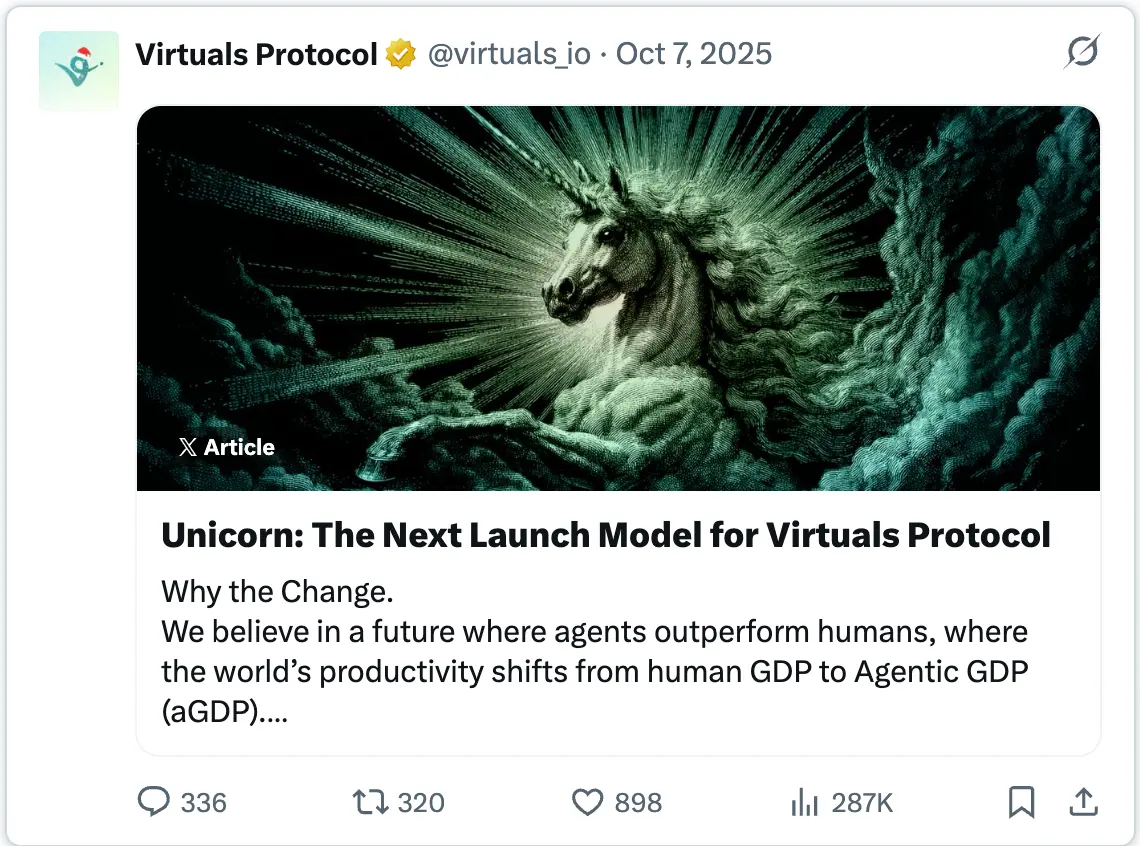
We proudly introduce Pegasus, Unicorn, and Titan. These three mechanisms together form a unified proxy release framework, supporting early experimentation, belief-based growth, and large-scale releases, while maintaining shared liquidity, unified ownership, and a coherent ecosystem.
Comparison of release mechanisms
Image translation: Gemini
How to choose the right launch mechanism? Pegasus: Distribution-first, unbiased allocation
Pegasus is designed for early builders who want to quickly release, test ideas, and gain reputation through actual usage rather than prioritized token distribution. It prioritizes distribution and community formation while keeping the release structure lightweight.
Pegasus does not include protocol-reserved team allocations or automatic fundraising mechanisms. Almost all token supply is allocated to liquidity, with only a small portion reserved for ecosystem airdrops. Founders wishing to hold tokens must purchase them under the same market conditions as others, ensuring that token holdings are earned through actual performance rather than pre-allocation.
By binding through a bonding curve, it implements a transparent price discovery mechanism that automatically transitions to Uniswap once a threshold is reached. Pegasus effectively answers a core question: does the market really need this proxy?
Unicorn: Belief, Capital, and Accountability
Unicorn is designed for builders who want to raise significant capital without sacrificing consistency. It maintains open participation while introducing reward structures for belief and strengthening accountability.
All Unicorn releases start small and open, with no pre-sales, whitelists, or restrictive allocations. Anti-sniper mechanisms prevent bots from dominating early trades, converting initial volatility into protocol-native buybacks that enhance liquidity.
The core feature of Unicorn is Automated Capital Formation (ACF). Part of the team tokens are only sold automatically and transparently once the project demonstrates real market appeal, with valuations ranging from 2 million to 160 million USD fully diluted valuation (FDV). Founders do not receive funding before proving market value; instead, they earn funds through market recognition.
Unicorn reassigns ownership with real meaning by directly linking returns, funds, and reputation to performance, rather than promises.
Titan: Large-scale Structured Release for Trusted Teams
Titan is designed for teams with a clear foundation in credibility, scale, and capital needs. Titan releases are suitable for projects that have reached a high readiness baseline.
This typically includes teams with existing products, verified track records, institutional support, or clear real-world deployment pathways. Since these teams do not require early market validation, Titan does not rely on bonding curves, phased discovery, or protocol-mandated distribution mechanisms.
Titan releases require a minimum valuation of 50 million USD and at least 500,000 USDC in liquidity paired with $VIRTUAL at the time of the first token generation event (TGE). This ensures market depth, reduces volatility caused by insufficient liquidity, and aligns Titan releases with builders prepared for large-scale operations.
Transaction tax for Titan releases is fixed at 1%. Tokenomics, vesting plans, and distribution structures are fully defined by the founding team but must comply with standard protocols and regulatory constraints.
Teams choosing Titan need to invest capital upfront and accept higher transparency, liquidity, and long-term participation in the Virtuals ecosystem. In return, they gain clear market entry or migration paths, deep initial liquidity, and immediate legitimacy without manual restrictions.
Titan exists to support proxy projects that are already prepared to operate at an institutional or ecosystem scale.
Titan Migration
Titan also supports migration of existing proxy tokens into the Virtuals ecosystem. This pathway is suitable for projects with active tokens, existing holders, or liquidity, seeking deeper integration with the Virtuals stack (including $VIRTUAL liquidity, ACF compatibility, and long-term ecosystem coherence).
Titan migration follows the same baseline requirements as Titan releases, including a minimum implied valuation of 50 million USD and at least 500,000 USDC in liquidity paired with $VIRTUAL . These requirements ensure market depth during migration, minimize disruption to current holders, and maintain consistency in large-scale integration.
The Road Ahead
The proxy market is still evolving. As it develops, Virtuals Protocol continues to adapt.
Every release mechanism in Virtuals is based on lessons learned from builder practice and real market behavior. Early prototypes taught us how proxies are born; Genesis mode demonstrated how fairness can scale; Unicorn proved how belief and capital formation can align. Pegasus, Unicorn, and Titan are the synthesis of these experiences, building a flexible yet resilient system.
This framework is not static but designed to evolve as proxies mature, builder needs change, and proxy economies expand into new domains. Our goal is not to lock builders into a single mode but to provide the right model at the right time, without sacrificing liquidity, ownership, or ecosystem coherence.
Through listening, careful iteration, and open release, Virtuals Protocol continues to set standards for proxy release, growth, and integration.
Proxy release has never had a single correct path.
The only right way is to adapt to current market demands and maintain self-discipline as the market evolves.
This page may contain third-party content, which is provided for information purposes only (not representations/warranties) and should not be considered as an endorsement of its views by Gate, nor as financial or professional advice. See Disclaimer for details.
Overview of the three proxy deployment mechanisms for Virtuals: Pegasus, Unicorn, and Titan
Author: Virtuals Protocol
Compiled by: Deep潮 TechFlow
The single release model can no longer meet the demands
The birth of Virtuals Protocol is to support builders, rather than restrict them to a single path. As the proxy market continues to evolve, our release mechanisms have also developed.
In 2024, our focus is on validating the feasibility of the proxy market itself. Early prototypes prioritized speed and experimentation to verify whether proxies can exist on-chain, be publicly traded, and begin to coordinate real economic value. The goal at this stage was not optimization, but exploration.
By 2025, the focus shifted to “Fair Access.” We introduced the Genesis mode to ensure large-scale fairness, allowing everyone to participate through contribution rather than capital. This mode successfully democratized releases and established transparency. However, over time, its limitations became apparent: relying solely on fairness does not strengthen belief, and the lack of an embedded fundraising path makes it difficult for high-quality builders to sustain long-term development.
The Unicorn mode emerged as a correction to the above issues. It refocuses the system on “belief,” linking funds to performance, rewarding early trust, and providing asymmetric returns. For builders seeking funding support and public accountability, the Unicorn mode has indeed achieved the desired effect. However, as the ecosystem matures, it becomes clear that different builders face different challenges.
Early-stage teams need distribution channels, growing teams need capital formation, and teams with established credibility and large-scale releases require a clear market entry path.
The single release model cannot satisfy all needs

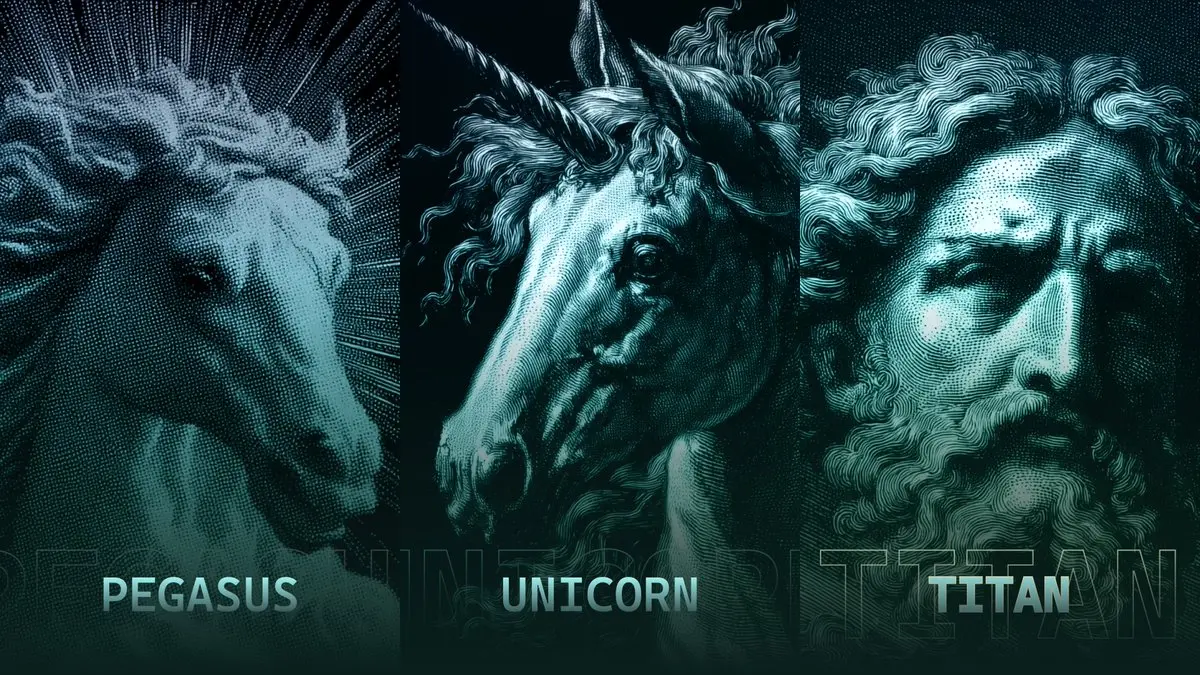
Image: Pegasus (left), Titan (center), Unicorn (right)
We proudly introduce Pegasus, Unicorn, and Titan. These three mechanisms together form a unified proxy release framework, supporting early experimentation, belief-based growth, and large-scale releases, while maintaining shared liquidity, unified ownership, and a coherent ecosystem.
Comparison of release mechanisms
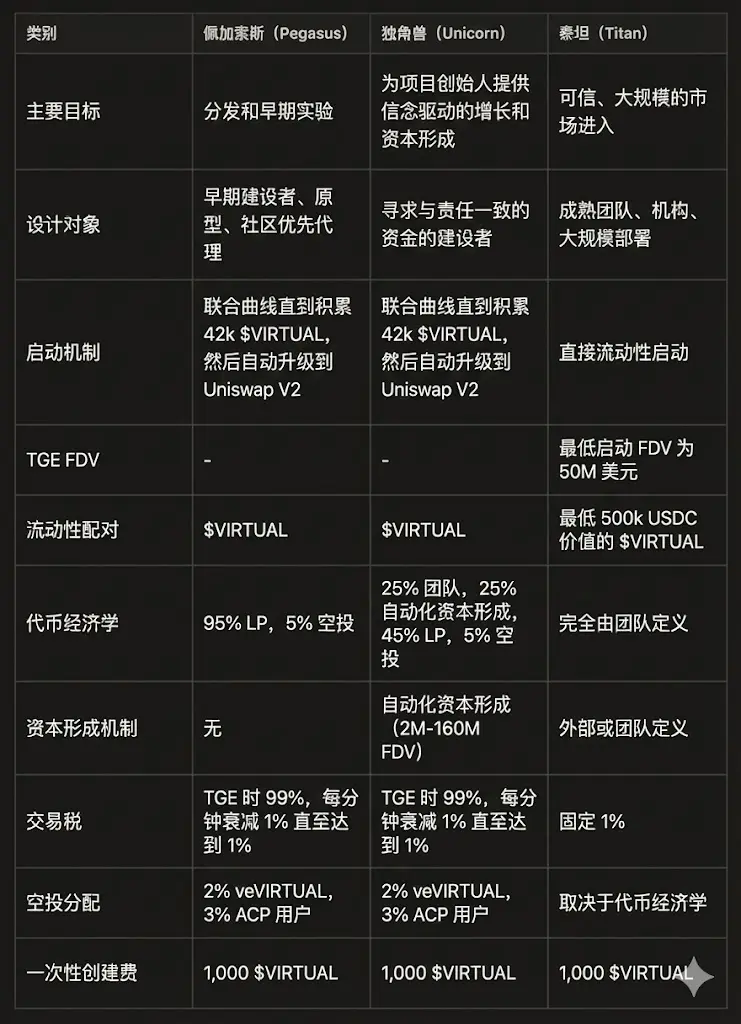
Image translation: Gemini
How to choose the right launch mechanism? Pegasus: Distribution-first, unbiased allocation

Pegasus is designed for early builders who want to quickly release, test ideas, and gain reputation through actual usage rather than prioritized token distribution. It prioritizes distribution and community formation while keeping the release structure lightweight.
Pegasus does not include protocol-reserved team allocations or automatic fundraising mechanisms. Almost all token supply is allocated to liquidity, with only a small portion reserved for ecosystem airdrops. Founders wishing to hold tokens must purchase them under the same market conditions as others, ensuring that token holdings are earned through actual performance rather than pre-allocation.
By binding through a bonding curve, it implements a transparent price discovery mechanism that automatically transitions to Uniswap once a threshold is reached. Pegasus effectively answers a core question: does the market really need this proxy?
Unicorn: Belief, Capital, and Accountability

Unicorn is designed for builders who want to raise significant capital without sacrificing consistency. It maintains open participation while introducing reward structures for belief and strengthening accountability.
All Unicorn releases start small and open, with no pre-sales, whitelists, or restrictive allocations. Anti-sniper mechanisms prevent bots from dominating early trades, converting initial volatility into protocol-native buybacks that enhance liquidity.
The core feature of Unicorn is Automated Capital Formation (ACF). Part of the team tokens are only sold automatically and transparently once the project demonstrates real market appeal, with valuations ranging from 2 million to 160 million USD fully diluted valuation (FDV). Founders do not receive funding before proving market value; instead, they earn funds through market recognition.
Unicorn reassigns ownership with real meaning by directly linking returns, funds, and reputation to performance, rather than promises.
Titan: Large-scale Structured Release for Trusted Teams

Titan is designed for teams with a clear foundation in credibility, scale, and capital needs. Titan releases are suitable for projects that have reached a high readiness baseline.
This typically includes teams with existing products, verified track records, institutional support, or clear real-world deployment pathways. Since these teams do not require early market validation, Titan does not rely on bonding curves, phased discovery, or protocol-mandated distribution mechanisms.
Titan releases require a minimum valuation of 50 million USD and at least 500,000 USDC in liquidity paired with $VIRTUAL at the time of the first token generation event (TGE). This ensures market depth, reduces volatility caused by insufficient liquidity, and aligns Titan releases with builders prepared for large-scale operations.
Transaction tax for Titan releases is fixed at 1%. Tokenomics, vesting plans, and distribution structures are fully defined by the founding team but must comply with standard protocols and regulatory constraints.
Teams choosing Titan need to invest capital upfront and accept higher transparency, liquidity, and long-term participation in the Virtuals ecosystem. In return, they gain clear market entry or migration paths, deep initial liquidity, and immediate legitimacy without manual restrictions.
Titan exists to support proxy projects that are already prepared to operate at an institutional or ecosystem scale.
Titan Migration

Titan also supports migration of existing proxy tokens into the Virtuals ecosystem. This pathway is suitable for projects with active tokens, existing holders, or liquidity, seeking deeper integration with the Virtuals stack (including $VIRTUAL liquidity, ACF compatibility, and long-term ecosystem coherence).
Titan migration follows the same baseline requirements as Titan releases, including a minimum implied valuation of 50 million USD and at least 500,000 USDC in liquidity paired with $VIRTUAL . These requirements ensure market depth during migration, minimize disruption to current holders, and maintain consistency in large-scale integration.
The Road Ahead
The proxy market is still evolving. As it develops, Virtuals Protocol continues to adapt.
Every release mechanism in Virtuals is based on lessons learned from builder practice and real market behavior. Early prototypes taught us how proxies are born; Genesis mode demonstrated how fairness can scale; Unicorn proved how belief and capital formation can align. Pegasus, Unicorn, and Titan are the synthesis of these experiences, building a flexible yet resilient system.
This framework is not static but designed to evolve as proxies mature, builder needs change, and proxy economies expand into new domains. Our goal is not to lock builders into a single mode but to provide the right model at the right time, without sacrificing liquidity, ownership, or ecosystem coherence.
Through listening, careful iteration, and open release, Virtuals Protocol continues to set standards for proxy release, growth, and integration.
Proxy release has never had a single correct path.
The only right way is to adapt to current market demands and maintain self-discipline as the market evolves.
– aGDP