Pi Network (PI) has been one of the most controversial projects in the crypto assets space since its launch in 2019. Despite facing severe skepticism, years of latency in going online, and an opaque operating model, Pi Network still maintains astonishing user stickiness and popularity, attracting millions of people to faithfully “clock in for daily attendance mining” every day. What secrets lie behind this contradictory phenomenon? Why are ordinary people flocking to it while professional investors generally avoid it?
Pi Network: The Huge Gap Between Commitment and Reality
(Source: CoinTelegraph)
Pi Network was founded in 2019 by a founding team claiming to have a background from Stanford University, with the slogan of “redefining crypto assets mining,” promising users that they can “mine” Pi coin using only a smartphone application without the need for professional equipment. The project employs the Stellar Consensus Protocol (SCP) and a social “security circle” mechanism, rather than traditional Proof of Work (PoW), claiming that this will create a more inclusive crypto assets ecosystem.
However, the road from commitment to reality is exceptionally long:
2019: Project launched, commitment to open the mainnet in the short term.
February 2025: After multiple delays, PI finally launches its long-awaited mainnet.
Current situation: Issues such as migration latency, KYC backlog, and uneven access still exist.
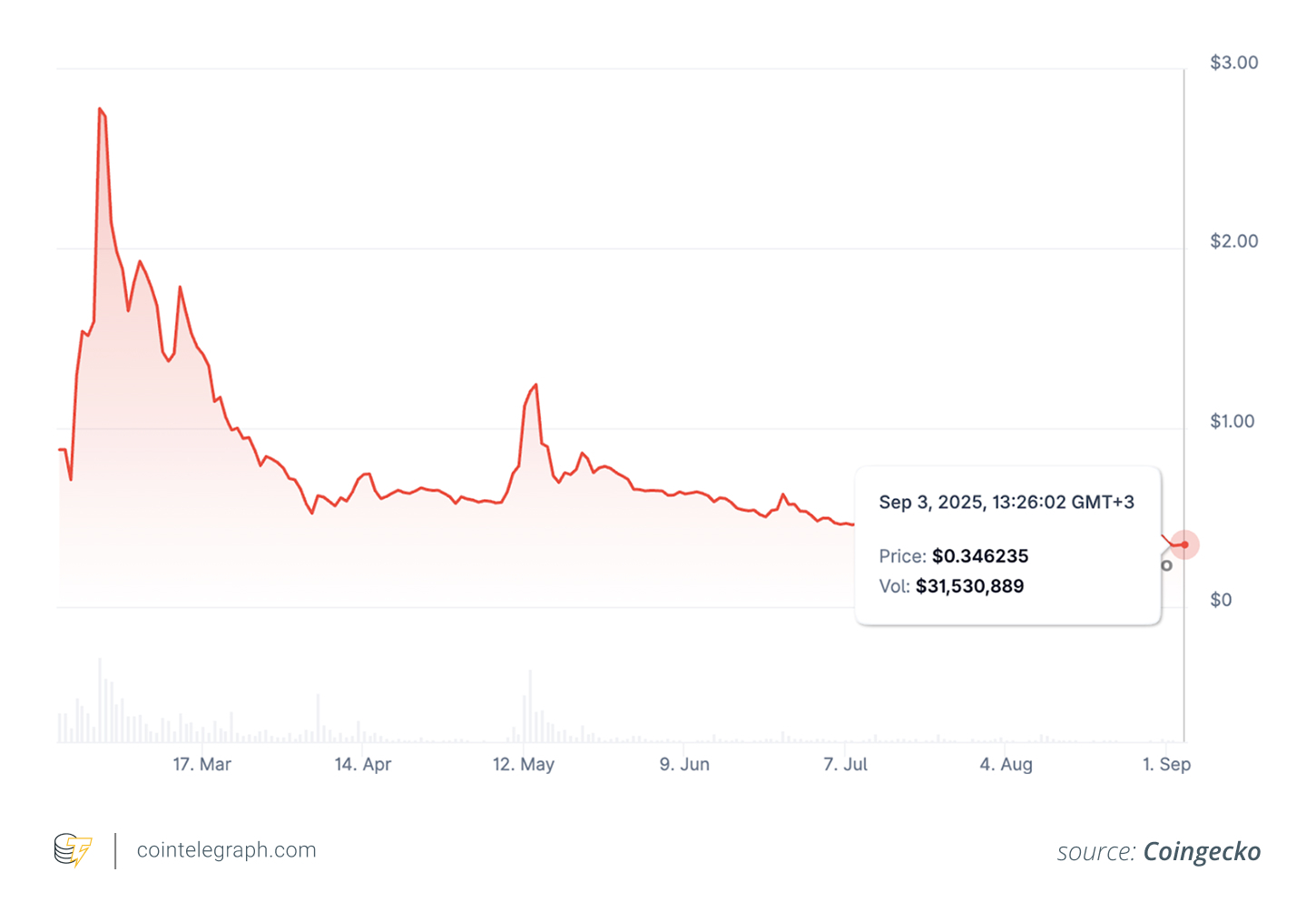
The price of Pi coin has also experienced drastic fluctuations, plummeting from nearly $3 at the beginning of 2025 to around $0.34 in September 2025, a drop of up to 90%.
Five Major Warning Signs: Why Professional Investors Avoid Pi Network
Despite Pi Network claiming to have tens of millions of users, cryptocurrency professionals and analysts are generally skeptical about it, mainly based on the following five key issues:
1. Highly centralized control structure
Although Pi Network claims to be an “open network”, in reality, control is highly centralized in the hands of the core team. All validator nodes are still operated by the project developers rather than independent community members, which goes against the fundamental principle of decentralization in Crypto Assets.
2. Opaque Token Economics
(Source: CoinTelegraph)
Pi has set a maximum supply of 100 billion tokens, distributed as follows:
· 65% used for community Mining rewards
· 20% allocated to the core team
· 10% used for foundation reserves
· 5% allocated for liquidity
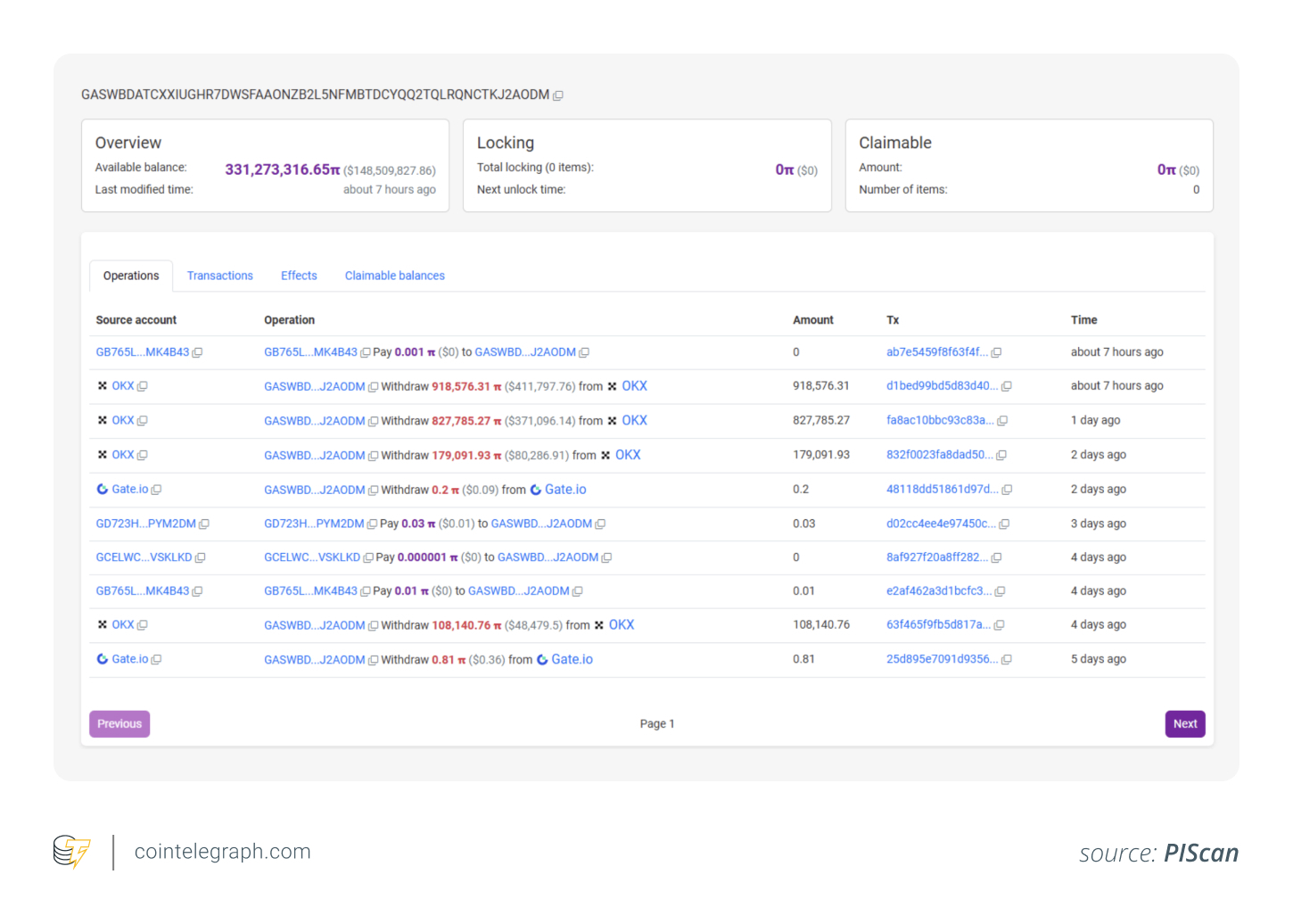
However, the actual circulation depends on how many tokens migrate to the mainnet, and this process is strictly controlled, lacking transparency. More concerning is a mysterious wallet named “GAS…ODM” that has quietly accumulated 331 million Pi coins, raising concerns about market manipulation.
3. Recommendation mechanism similar to multi-level marketing
The core growth mechanism of Pi Network heavily relies on referrals and the expansion of “security circles”. New users must join through the invitation code of existing users. Each successful invitation rewards an additional 25% mining bonus, and this tiered recruitment system is very similar to a multi-level marketing (MLM) model.
4. Listing Restrictions and Liquidity Issues
Even after the mainnet launch, the trading venues for Pi are still limited to exchanges like Gate and other platforms have refused to list Pi due to tokenomics and centralization issues, which severely restricts its liquidity and price discovery mechanism.
5. Privacy Risks Brought by Centralized KYC
To migrate the Mining Pi to the mainnet, users must complete the “Know Your Customer” (KYC) verification by uploading government identification and completing facial recognition. This sensitive data is stored on centralized servers rather than in user-controlled systems, posing serious privacy and security risks.
Decrypting the Lasting Appeal of Pi Network: Why Millions Are Still “Mining”?
In the face of so many problems and doubts, why can Pi Network still maintain strong user loyalty? There are four key psychological and social factors behind this phenomenon:
1. Psychological Appeal of Zero Threshold Participation
The biggest attraction of the Pi Network lies in its extremely low participation threshold:
· No need to invest funds
· No professional knowledge required
· Mining equipment that requires no power consumption
· You only need to click the button once daily to confirm “Mining”
This “zero risk, potentially high return” psychological model is highly attractive to ordinary users lacking experience in Crypto Assets, especially in emerging market countries. According to web analysis, the main users of the Pi Network come from Vietnam (10.2%), South Korea (8.2%), India (6.66%), the United States (6.6%), and Ethiopia (5.2%).
2. Community Identity and Sense of Belonging
Pi Network has successfully created a strong sense of community identification:
· Users refer to themselves as “Pioneers”
· Daily attendance, recommendations, and team building form social rituals.
· Events like PiFest and “Pi Map” strengthen community cohesion.
This sense of belonging and collective identity is more valuable to many users than actual economic returns, explaining why user loyalty remains high even when token prices plummet by 90%.
3. Action-First Inclusive Design
Pi Network positions itself as “the cryptocurrency of the smartphone era,” eliminating complex wallets and Mining equipment, and simplifying participation to a one-click operation. This design is particularly appealing to those:
· Non-technical background users
· People lacking bank accounts
· Beginners who are interested in traditional Crypto Assets but hesitant to take the plunge.
Against the backdrop of over 6.9 billion global smartphone users, this strategy targets a potential user base that is much larger than the traditional Crypto Assets market.
4. The Economics of Hope and Dreams
The narrative of Pi Network deliberately focuses on a long-term vision rather than current practicality. For many users, participating in Pi is not just an investment, but also a form of hope:
· I hope early participants can reap substantial rewards.
· Hope to become the next early adopter of Bitcoin
· Hope to change economic fate through simple actions
This hope-driven participation model redefines issues such as migration latency or listing restrictions as temporary obstacles rather than fundamental flaws.
The Future of Pi Network: A Turning Point is Near
The durability of the Pi Network has never been reflected in short-term prices, but rather in its ability to transform public curiosity into practical functionality. For observers and participants, the following four key indicators will determine its future direction:
Decentralization Process: Will the core team truly delegate authority and allow independent validators to participate in network governance?
Mainstream exchange listings: The attitudes of large exchanges like Binance will greatly affect the liquidity and value of Pi.
Ecosystem Development: The emergence of practical applications and use cases is more effective in demonstrating project value than promotion.
KYC and migration progress: A transparent and continuously growing number of on-chain users is the foundation of any functional economy.
If these milestones can be smoothly advanced, the popularity of Pi Network may eventually translate into substantial value. If progress continues to stagnate, then this project may ultimately prove to be a well-designed “attention scam,” whose main product is always hope rather than practical functionality.
Regardless of the outcome, the phenomenon of Pi Network provides us with a profound case study in sociology and psychology, demonstrating the eternal appeal of low-risk, high-return promises and the powerful influence of community identity in the digital age.


