Stablecoins are one of the most efficient payment systems in history, but unfortunately, they resemble a surveillance network, where every commercial transaction is public data.
Written by: Rishabh Gupta
Compilation: Block unicorn
Introduction
In December 2024, three German marketing professors did something that should scare every business accepting cryptocurrency payments. They decoded 22.7 million retail stablecoin transfers and reconstructed complete customer intelligence for eight direct-to-consumer (D2C) brands—covering everything from wallet shares, order frequency, average order amounts, to peak sales times.

No hacking skills required. No insider access needed. Just public blockchain data and a few lines of Python scripts.
This is the stablecoin privacy paradox of 2025.
Stablecoins are achieving great success. The data is shocking: the use of stablecoins on Base is no longer a niche experiment. Analysis by Token Terminal shows that in just the first quarter of 2025, the total transaction volume on L2 reached approximately $3.81 trillion - a historic high, surpassing the early growth curve of mainstream credit card networks.
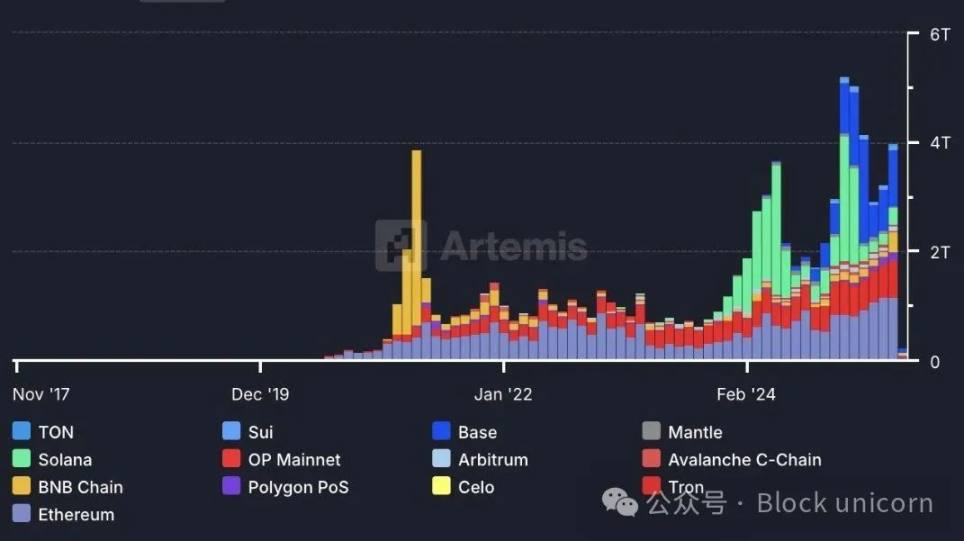
Main Chain Stablecoin Trading Volume
Even after accounting for internal jumps, this figure still reaches trillions. 65% of the total locked value in Ethereum—about 130 billion dollars—is now concentrated in stablecoins. Tether holds nearly 120 billion dollars in U.S. Treasury bonds, with quarterly profits reaching billions. Businesses that use Stripe stablecoin payments have double the number of countries covered compared to those that do not use stablecoin payments.
From all important indicators, stablecoins have achieved product-market fit, and their scale is large enough to compel traditional fintech companies to take them seriously.
So, why should I write an article about privacy for an industry that has already made a fortune?
The success of stablecoins has made them the most dangerous payment method in the world. It is not dangerous for users, but it is dangerous for businesses.
Every transaction you make is a data point for your competitors to analyze. Every salary you pay turns into workplace intelligence. Every invoice you settle exposes your supply chain. Every time a customer pays, it reveals your business model. In the wave of adopting stablecoins, we have built a global financial monitoring system where your business intelligence can be easily accessed by searching on Etherscan.
Ironically, we have created the most efficient cross-border payment system in history, but it broadcasts your financial strategies to anyone interested in viewing them.
This is not about ideology or the dreams of cyberpunk. This is the harsh reality: your competitors may know your customer acquisition cost better than your Chief Marketing Officer.
As stablecoin payments are expected to reach 2 trillion dollars by 2028, this issue will become more severe.

We are heading towards $50 trillion. Why is this frightening?
Stablecoins have broken every growth record in the crypto space. 65% of Ethereum’s total locked value—approximately $130 billion—is now in stablecoins, with institutional funds pouring in at an unprecedented rate, and we are witnessing a complete transformation of global payments.
Commitment is real: instant cross-border transactions, minimal fees, and 24/7 operations. No wonder the number of countries where businesses using stablecoin payments sell their products has doubled.
But few mention: all these benefits come with a hidden cost - complete financial transparency.
Current Privacy Nightmares
Salary Comparison Trap
Alice, a founder who has just raised $500,000, of which $200,000 is in cryptocurrency. She hired three developers from India, Vietnam, and Argentina, with salaries set according to local market rates. Everyone prefers payment in cryptocurrency because it is faster, cheaper, and hassle-free without bank procedures.
Then reality struck. Each developer discovered the salaries of others on the chain. Those with lower salaries began to hint at raises. Alice wanted to help, but the budget was limited. Although each salary was competitive locally, the transparency caused discontent. Research on “jealousy tax” proved that this was not an isolated case — but a quantifiable phenomenon. The company must either pay more for high performers or accept the reality of damaged team morale.
This is not theoretical. This is happening in many crypto-native (as well as current internet capital markets, non-crypto-native) startups.
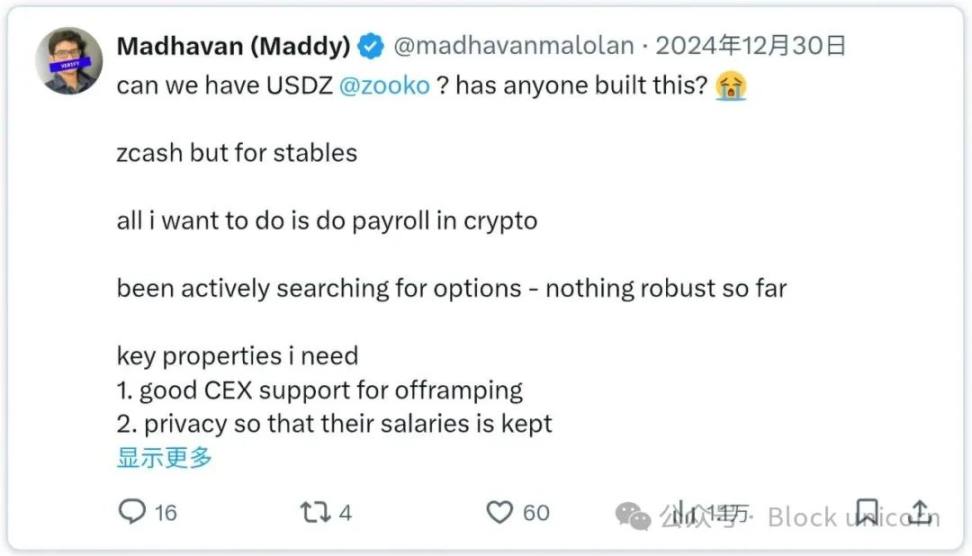
The Nightmare of Privacy Rights
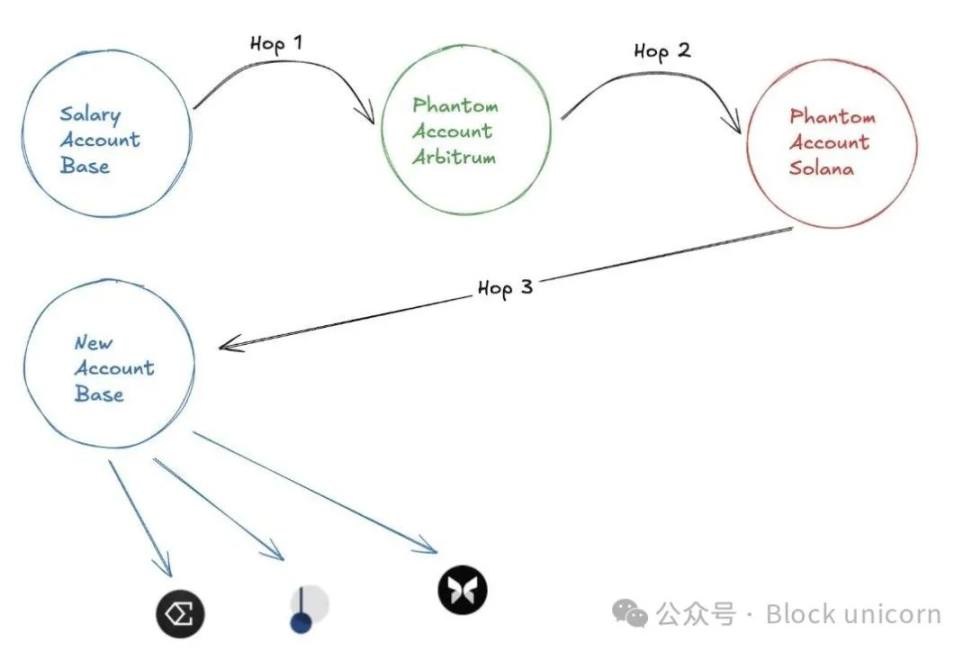
Bob is a blockchain developer working for a well-known L2 protocol, with a monthly salary of $12,000. He stores his salary in a hardware wallet – secure and professional. But now he needs to buy groceries, pay rent, and live his life.
If he spends directly from his salary account, his landlord, ex, and competitors can accurately know his income and assets. So, Bob did what thousands of others did: he “mixed” funds through a centralized exchange or obscured his financial trail through 3-4 bridge transactions and multiple exchanges.
Ironically, we built decentralized finance (DeFi) to escape intermediaries, but privacy issues force users back to centralized services—now with added costs, tax complexities, and compliance risks.
Competitive Intelligence Disaster
Charlie runs a successful online pharmacy in Argentina that accepts USDC payments. His competitor Don noticed Charlie’s growth and decided to investigate. After several hours of on-chain analysis, Don discovered that 80% of Charlie’s transactions were concentrated in a specific time period. Further digging revealed Charlie’s entire customer acquisition strategy—target audience, regions, and effective marketing channels.
Tang freely obtained the business intelligence that Charlie had painstakingly accumulated. No need for corporate espionage. Just Etherscan.
institutional time bomb
These are just issues at the retail level. The impact at the institutional level is crucial for survival.
When every flow of funds is visible, when every strategic transaction is public, when your competitors can track your cash flow in real-time - how do you compete? How do you negotiate? How do you maintain a strategic advantage?
Corporate Finance Reality: Imagine a Fortune 500 multinational company considering reallocating $2 billion among its subsidiaries in Asia. Traditional Channels: 3-day settlement, $50,000 fees, zero transparency. Transparent Stablecoin: Instant settlement, $100 fees, but full strategic exposure.
Certain fiscal rebalancing reveals regional performance. Each vendor payment exposes supply chain relationships and pricing. Every internal transfer between jurisdictions indicates which markets are prioritized and underperforming. Payment timing patterns may leak company plans or market entry strategies months in advance.
Using stablecoins greatly improves efficiency. However, the cost of privacy is fatal.
Institutions claim that privacy is their top concern, yet they are building on transparent chains. This disconnect between established demands and actual infrastructure is a disaster.
But the problem is: they have no choice. Most activities take place on public chains. There, liquidity dominates. 90% of DeFi protocols run there. Stablecoins settle there. The composability with existing infrastructure is non-negotiable for many participants. For example, Paypal was the first to launch its stablecoin on Solana.
A central crypto bank I spoke with mentioned that their current “solution” is to handle order execution in a departmental manner, with one team managing position information and another team handling execution — this is done to ensure that no one has the complete picture.

Even Michael Saylor, the biggest corporate advocate for Bitcoin, understands this danger. He strongly warns against publicly sharing wallet addresses, stating that “no institutional or corporate security analyst would consider it a good idea to make all traceable wallet addresses public.”
However, despite Saylor’s cautious approach, the blockchain analytics platform Arkham Intelligence gradually tracked MicroStrategy’s Bitcoin holdings. In February 2024, they announced that they had identified 98% of MicroStrategy’s Bitcoin holdings, and by May 2025, they discovered an additional 70,816 BTC, tracking a total of 525,047 BTC (approximately $5.45 billion) — accounting for 87.5% of the company’s total holdings.

Danger is not limited to finance. Recently in France, four masked men attempted to kidnap Paymium CEO Pierre Noizet’s daughter and grandson in broad daylight in downtown Paris. The family became a target precisely because the transparency of blockchain exposed their wealth to criminals.
This is not an isolated incident. Jameson Lopp maintains a comprehensive database that records hundreds of physical attacks against cryptocurrency holders. The pattern is clear: blockchain transparency leads to violence in the real world.
There are new cases every year:
Invasion of a residence, the victim was tortured to hand over the private key.
Kidnapping incident, demanding cryptocurrency ransom
Targeted robberies at meetings and gatherings
Attack family members to force obedience
When your wallet address is public, you expose not only your financial strategies. You and your family are also targeted. The “$5 wrench attack” is no longer a theoretical issue—it has become a growing pattern with hundreds of verified cases.

Scalable Disaster
The truly frightening thing is: these problems multiply as the scale of adoption grows.
- 100 billion USD: annoying but manageable
- 1 trillion USD: a serious competitive disadvantage
- 5 trillion USD: Business secrets completely collapsed
We are building a global financial system where everyone can see each other’s cards. This is not a feature—it’s a catastrophic flaw.
As stablecoin payments are expected to reach $2 trillion by 2028, we are not discussing a future issue. We are already experiencing it. With each day of delay, more business intelligence leaks, more salary data becomes public, and more competitive advantages evaporate.
The issue is not whether stablecoins need privacy, but whether we will implement privacy protection before transparent taxation becomes too expensive.
Why have all the “solutions” failed (to date)
The crypto industry has been trying to solve privacy issues for many years. Billions in venture capital, thousands of hours of developer time.
However, by 2025, Bob will still need to perform four bridging operations to make his rent payment privately.
Let’s be honest about why all solutions (other than mixers) have failed to achieve scalability.
privacy chain
“We will build privacy from scratch!” Dozens of L1 and L2 chains have promised.
Reality Check:
- Bridging delay: Incoming funds need to wait for 20 minutes, and outgoing funds also need 20 minutes.
- New wallet setup: Download special software, create a new key, learn the new interface
- Chain synchronization issue: “Why does my balance show zero? Oh, still synchronizing…”
- Liquidity desert: Want to exchange? Good luck dealing with a 15% slippage.
- Ghost town problem: Privacy transactions are only effective under network effects.
Why it failed: Asking users to leave the current chain for privacy is like asking them to move to another country for better privacy laws. This friction kills the application before it even starts.
additional privacy tools
Some protocols have tried different methods: providing privacy on existing chains. But there are also drawbacks:
User Experience:
- Need to download new software (hope it’s not malware)
- Need to generate zero-knowledge proofs (ZK proofs)
- Need to pay 10 times the Gas fee for privacy transactions
- You need to trust that other users are compliant (they often are not compliant)
- Pray that the smart contract has no vulnerabilities (there may be)
centralized exchange (CEX) mixing coin
The reality is: people use Binance or other CEX as privacy tools. Deposit from one address, then withdraw to another address. Centralized mixing requires extra steps.
Question:
- KYC (Know Your Customer) goes against the original intention
- The exchange may freeze your funds
- A tax nightmare for many users
- Not available in many jurisdictions
- User experience has significantly declined
Why “effective”: Because it is readily available. This illustrates the current state of privacy tools.
Are there regulatory concerns about introducing privacy features into stablecoins?
Please remember that regulators do not oppose confidentiality itself - they oppose privacy that facilitates malicious actors and where law enforcement cannot take action.
The following are the measures we deem necessary:
- Check key access permissions: There should be an appropriate access control list that allows certain viewers to inspect the keys when issues are discovered.
- On-demand transparency: Amounts and counterparties are encrypted by default, but court orders can unlock the full transaction history—no forks, no need to reissue tokens.
- Real-time anti-money laundering / anti-terrorist financing screening - a check should be conducted each time liquidity is incorporated into the privacy protocol to ensure its source is legitimate, or whether the address has interacted with high-risk addresses, or is itself a high-risk address. This is not limited to sanctions but also covers terrorist financing, human trafficking, and other major vulnerabilities.
- Anti-mixing coin guard: Funds should not be completely untraceable.
- Emergency freeze switch: Tokens can be immediately locked through multi-signature, but due process must be followed.
While providing regulatory agencies with subpoena-level access similar to today, avoid permanently exposing everyone’s salaries, invoices, and trading strategies to the entire world.
What’s next?
Stablecoins are one of the most efficient payment systems in history, but unfortunately, they resemble monitoring networks, where every commercial transaction is public data. The trading volume of stablecoins is approaching $5 trillion, and every dollar broadcasts your strategy to competitors. This is not a long-term sustainable plan. Clearly, the solution is not to abandon stablecoins—but to add privacy protections that are compatible with existing infrastructure and meet regulatory requirements.


