In 2026, the competitive frontier for enterprise software has shifted from a "feature war" to an "interface reconstruction." This article delves into how AI is reshaping the three core systems of SAP, Salesforce, and ServiceNow: during the implementation phase, AI agents are used to reduce migration risks worth hundreds of millions of dollars; in the usage phase, "Large Action Models (LAMs)" simplify complex interfaces; and in the expansion phase, lightweight applications replace bloated custom development. The ultimate goal of AI is not to replace these "Systems of Record (SoR)," but to rewrite the interaction logic, gradually rendering cumbersome traditional software "invisible" and turning them into underlying databases for AI-driven "Systems of Action (SoA)."
2026-03-20 06:11:25
Bittensor is a decentralized AI network that builds an open machine learning marketplace through Subnets, Miners, and Validators. It uses the Yuma consensus mechanism to evaluate models and distribute TAO rewards, turning AI capabilities into a priced and incentivized resource.
2026-03-19 13:51:04
Bittensor (TAO) is a decentralized network that combines blockchain and artificial intelligence. It uses a subnet structure to allow AI models to compete in an open market and earn rewards based on their performance.
2026-03-19 13:47:24
TAO is the native token of the Bittensor network, playing a central role in incentive distribution, network security, and value capture within a decentralized AI ecosystem. Through an inflationary issuance model, staking mechanisms, and subnet based incentives, TAO supports an economic system where AI models compete, are evaluated, and rewarded based on performance.
2026-03-19 13:41:50
A Bittensor Subnet functions as an independent AI task marketplace within the network. Each subnet builds its own incentive structure around specific use cases such as text generation, image recognition, or prediction. Through miners supplying models, validators assessing output quality, and dynamic TAO and Alpha token allocation, subnets enable the production and pricing of machine intelligence in a decentralized way.
2026-03-19 13:36:01
Bittensor, Fetch.ai, and SingularityNET share a common goal: using token incentives to drive the supply of AI resources, whether models, compute, or services, while building open networks that lower barriers to AI access and challenge the dominance of centralized platforms. However, their core differences lie in the technical layers they operate on and how they capture value. Rather than competing within a single track, they address three distinct stages of decentralized AI, model production, task execution, and service distribution.
2026-03-19 13:31:52
Gate Research: Large language models and AI agent technologies are pushing trading systems into a new stage of development. Quantitative trading, which previously relied heavily on programming skills and complex engineering systems, is gradually evolving into product forms with much lower barriers to entry. Gate has introduced products such as AI Quant Workspace and Gate for AI, which aim to integrate strategy generation, backtesting, and automated execution within a single platform through natural language interaction, no-code quant tools, and unified trading interfaces, allowing more users to participate in strategy trading. As AI technology continues to mature, trading platforms are also evolving from traditional matching tools into AI-driven trading infrastructure.
2026-03-19 10:19:29
Fetch.ai is a decentralized network that integrates artificial intelligence with blockchain infrastructure. Its architecture is built around Autonomous Economic Agents (AEA), allowing software and devices to perform tasks, exchange data, and settle value without relying on centralized platforms.
By enabling machines to act as independent participants in economic systems, Fetch.ai introduces a new model where interactions are automated, data flows more efficiently, and transactions occur without direct human coordination. This approach lays the foundation for a smart economy in which intelligent agents continuously optimize decisions, resources, and outcomes across digital and real world environments.
2026-03-19 09:47:36
FET is the native token introduced by Fetch.ai, designed to support a decentralized economic network powered by artificial intelligence. Within this system, autonomous agents can interact, exchange data, coordinate resources, and transfer value without direct human intervention, enabling more efficient and automated digital economies.
2026-03-19 09:41:41
FET serves as the native token within the Fetch.ai network, playing a central role in supporting value exchange, protocol execution, and on-chain settlement among Autonomous Economic Agents (AEA). This allows machines and software to autonomously engage in economic activities without the need for centralized platforms.
2026-03-19 09:36:06
Tether has introduced the QVAC AI framework, allowing mobile devices to train models with billions of parameters and dramatically reducing the barrier to computational power. This article examines the technical foundations, industry implications, and far-reaching effects on decentralized AI and the computing power market.
2026-03-18 11:20:18
Tether has launched the QVAC Fabric framework, which supports cross-platform LoRA fine-tuning for the BitNet model. With this advancement, large language models can now operate and be trained on mobile devices and conventional hardware. This breakthrough greatly reduces the barriers to AI development and paves the way for new opportunities in decentralized AI.
2026-03-18 10:57:30
Global investment in AI infrastructure is expected to exceed $700 billion. This article uses the "AI Five-Layer Cake" model (energy, chips, cloud, models, applications) to deeply deconstruct the profit flow patterns in the AI era: revenue flows upward, while capital sinks downward. The article reveals a harsh truth: while model companies like OpenAI are still "burning cash" on billions in computing costs, the underlying layers—Nvidia (chips), TSMC (manufacturing), ASML (equipment), and power suppliers—are reaping huge profits through monopolistic barriers in the physical world. This is an investment guide that teaches you how to switch from a "consumer mindset" to a "supply chain mindset" to identify确定性 opportunities within the AI technology stack.
2026-03-17 10:53:11
AI agents for market research are automated systems designed to collect, process, and interpret large volumes of data for decision-making. In market research, they combine structured data and real-time information sources such as Gate News and Gate Info to identify trends, assess sentiment, and generate insights. As digital asset markets evolve, integrating multiple data layers has become essential for understanding market behavior. Examining how these systems operate helps clarify their role in modern financial analysis workflows.
2026-03-17 09:49:13
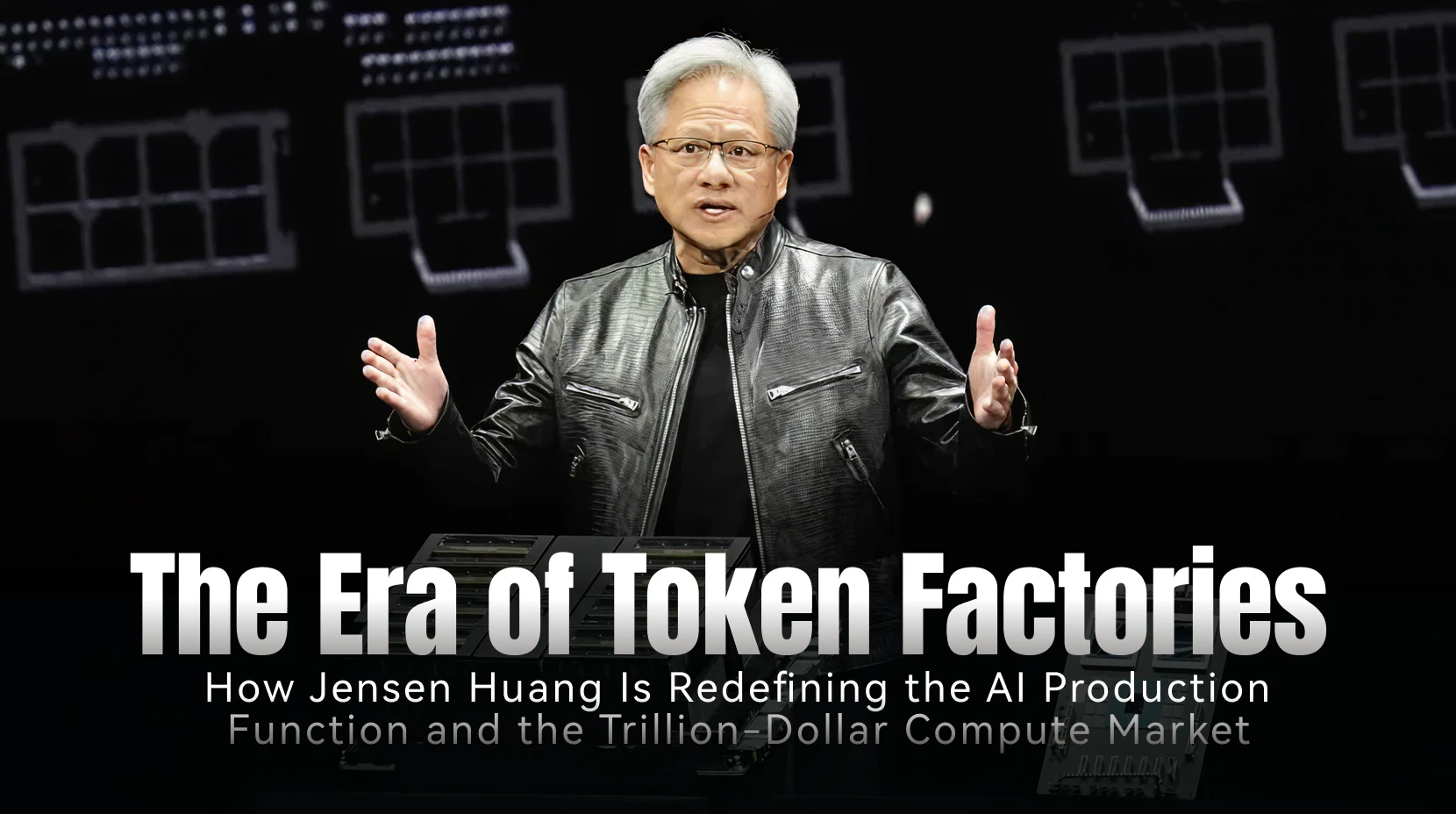
At NVIDIA GTC 2026, Jensen Huang characterized the data center as a “token factory,” signaling AI’s transition from model competition to an inference-driven economy. This article delivers a comprehensive analysis of the AI token economy, computational power business models, and the structural dynamics underpinning the trillion-dollar market.
2026-03-17 09:33:04