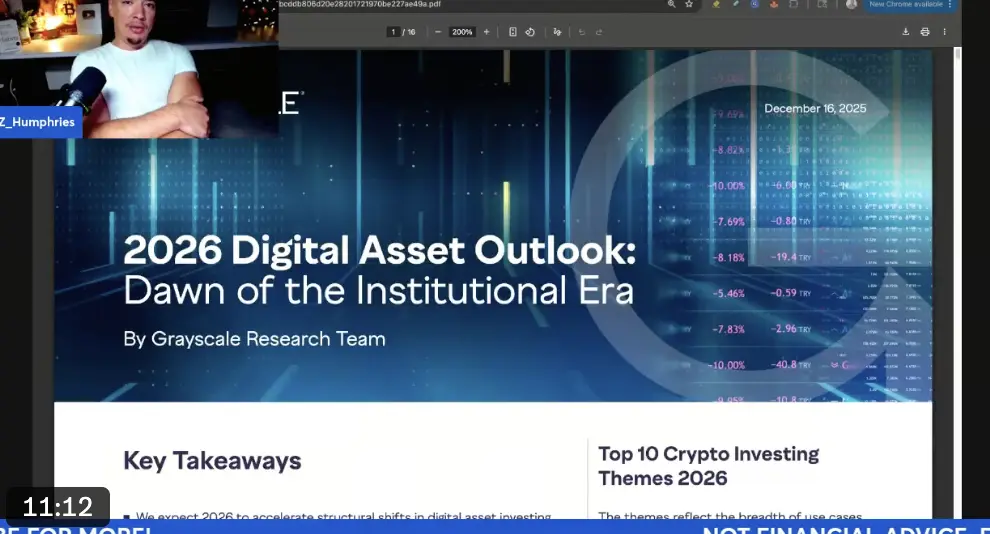
As 2025 comes to a close, Grayscale Research has released its outlook for the year ahead, predicting that regulatory progress—particularly a bipartisan U.S. crypto market structure bill—will be the dominant force driving digital asset markets in 2026, while concerns over quantum computing remain overstated in the near term.
(Sources: X)
Regulatory Framework Expected to Drive Institutional Adoption
Grayscale analysts anticipate the passage of comprehensive U.S. legislation in 2026, establishing clearer rules for digital assets across registration, disclosure, asset classification, and insider protections.
This framework would harmonize oversight between agencies like the SEC and CFTC, providing the legal certainty long sought by the industry.
The firm argues that robust regulation would accelerate institutional participation, enabling regulated financial firms to hold digital assets on balance sheets and conduct transactions directly on blockchains.
Such developments could mark the beginning of a more mature, institution-led era for crypto, with increased on-chain activity and broader economic integration.
Quantum Computing Risks: Real but Distant
While acknowledging the theoretical threat quantum computers pose to current cryptographic standards—potentially allowing private keys to be derived from public ones—Grayscale views this as a long-term issue rather than an imminent price driver.
The report expects quantum topics to generate headlines and debate in 2026 but predicts minimal material impact on asset valuations next year.
Most major blockchains, including Bitcoin, will eventually require upgrades to post-quantum cryptography. However, Grayscale believes markets will not significantly discount networks based on quantum preparedness in the coming year.

(Sources: Coin Metrics)
Broader Market Implications
Clearer U.S. rules, potentially mirrored in other major economies, could unlock substantial capital flows by reducing legal ambiguity.
Financial institutions may increasingly view digital assets as viable for portfolios and operations, shifting the market from retail speculation toward institutional frameworks.
Grayscale emphasizes that regulatory clarity would catalyze utility-driven growth, distinguishing sustainable projects from speculative ones.
Potential Risks and Counterarguments
The report contrasts with community concerns raised in recent discussions, including:
- Quantum breakthroughs eroding Bitcoin confidence
- Unexpected Fed tightening triggering risk-asset selloffs
- Midterm election outcomes stalling pro-crypto policy
- Failure to pass key bills like Clarity slowing adoption
- Stablecoin de-pegging events (e.g., USDT issues)
- Major DeFi hacks cascading to RWAs
- AI advancements diverting capital from Web3
Grayscale downplays most near-term disruptive scenarios, focusing instead on regulatory tailwinds as the primary 2026 catalyst.
Outlook for 2026: Regulation as the Key Catalyst
With foundational progress in 2025—including stablecoin laws and ETF expansions—Grayscale sees 2026 as the year crypto transitions from regulatory uncertainty to structured growth.
The anticipated market structure bill would provide the clarity needed to bridge traditional finance and blockchain, potentially ushering in broader institutional adoption and more stable market dynamics.
While quantum and other risks merit monitoring, Grayscale concludes that regulatory evolution—not technological disruption—will define crypto’s trajectory in the year ahead.
Disclaimer: The information on this page may come from third parties and does not represent the views or opinions of Gate. The content displayed on this page is for reference only and does not constitute any financial, investment, or legal advice. Gate does not guarantee the accuracy or completeness of the information and shall not be liable for any losses arising from the use of this information. Virtual asset investments carry high risks and are subject to significant price volatility. You may lose all of your invested principal. Please fully understand the relevant risks and make prudent decisions based on your own financial situation and risk tolerance. For details, please refer to
Disclaimer.
Related Articles
BlockBeats releases March trading platform data: spot trading volume down 21.35%, futures trading volume down 6.14%
Gate News message, on April 10, BlockBeats released the March trading platform rankings. The data shows that in March 2026, the spot trading volume of major CEXs decreased by 21.35% compared with February, and the perpetual futures trading volume decreased by 6.14% compared with February. In the same period, the perpetual futures trading volume of major Perp DEXs decreased by 9.35% compared with February, while website traffic increased by 26.58%.
GateNews5m ago
The RWA market is expected to reach $400B by 2030, representing an increase of over 1,000%
Market maker Keyrock and tokenization platform Securitize jointly released a report predicting that the on-chain transferable distributed RWA market will grow from $29.0 billion to $400.0 billion, an increase of over 1,000%. It is expected that by 2028, RWA perpetual contracts could account for 50% of the total on-chain derivatives market. Currently, tokenized RWAs account for less than 0.1% of the global tokenizable market.
GateNews2h ago
StarkWare researchers propose a QSB proposal, allowing Bitcoin to achieve post-quantum security without changing the protocol
StarkWare researchers proposed a quantum-safe Bitcoin scheme called QSB, aiming to replace the elliptic curve mechanism with hash assumptions to counter the threats posed by Shor’s algorithm. The scheme can run within existing scripts, requires no consensus changes, but does require submitting a transaction to a specific service.
GateNews2h ago
Galaxy Digital reports a full-year net loss of $241 million, with its core operating business turning a profit
Galaxy Digital releases its annual financial report, with a full-year net loss of approximately $241 million, but an adjusted EBITDA of $216 million, indicating core operating profit. The gross profit from its digital asset business is approximately $505 million. After the earnings report was released, the company’s stock price rose by more than 11%.
GateNews5h ago
DeFi Development discloses that it held 2.22 million SOL as of the end of March and more than 656k dfdvSOL.
Gate News, April 9, the Solana treasury company DeFi Development listed on Nasdaq released its March operating report. The report shows that as of the end of March, the company held 2.22 million SOL, and the amount of the liquid staking token dfdvSOL increased from 513k to more than 656k. In addition, DeFi Development said it will continue to advance its strategic investment in the stablecoin protocol Apyx.
GateNews16h ago
S&P Global report: The stablecoin market size exceeds $316 billion, and the banking industry as a whole is still in a wait-and-see phase
An S&P Global Market Intelligence report shows that although the stablecoin market has already surpassed $316B, the banking industry’s strategic positioning for stablecoins is still in an early stage, with only 7% of surveyed banks developing relevant frameworks. Banks are concerned about issues such as deposit outflows and impacts on revenue, and it is expected that large banks will explore tokenized deposits, while mid-sized and smaller banks will use fiat deposits to participate.
GateNews17h ago


