Bitcoin’s most well-known corporate holder, MicroStrategy Executive Chairman Michael Saylor, has once again sent a key signal on social media. He posted a chart tracking the company’s Bitcoin holdings with the caption “Back to the orange dot?”, which the market widely interpreted as a prelude to another round of purchases. Currently, MicroStrategy holds a total of 650,000 Bitcoins, worth approximately $57.8 billion, at an average cost of $74,436 per coin. Meanwhile, on-chain data shows the hash ribbon indicator has turned bearish again, putting pressure on miners. The weekly report on public company Bitcoin holdings shows that eight companies, including Cango Inc. and ABTC, increased their Bitcoin holdings last week. Saylor’s hint, combined with ongoing institutional accumulation, provides investors with critical psychological and data anchors for identifying the market bottom amid overall market pressure.
The “Orange Dot” Code: Saylor’s Market Signal and MicroStrategy’s Disciplined Accumulation
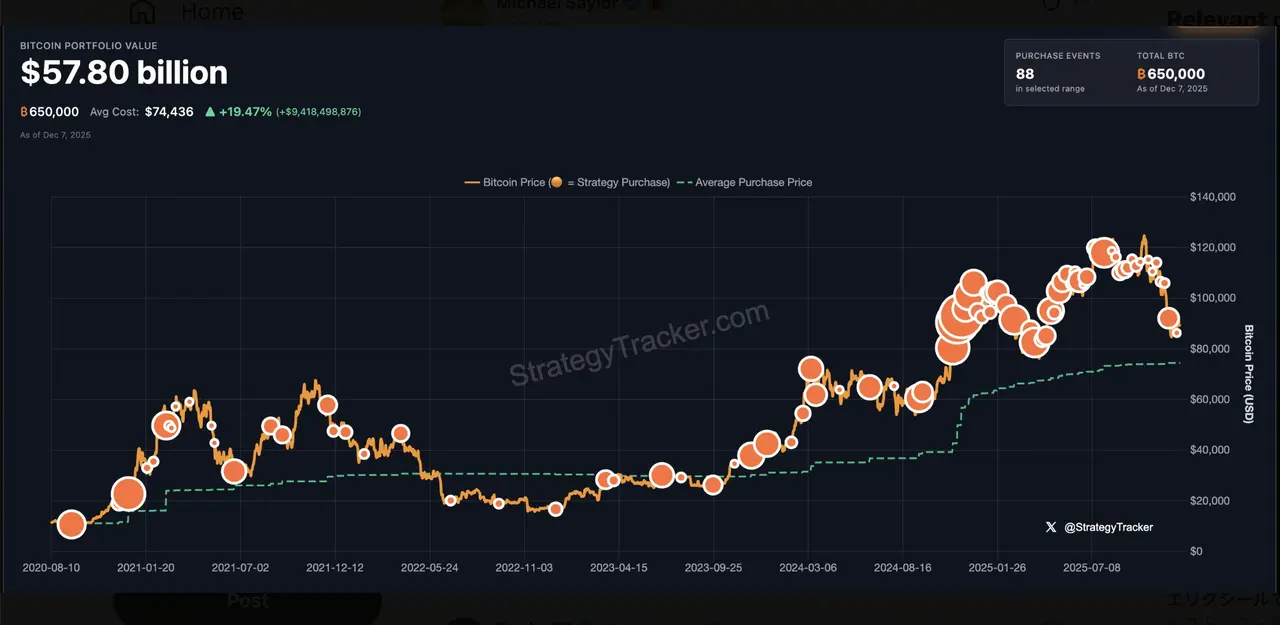
Every move Michael Saylor makes has long been an important sentiment barometer for the Bitcoin market. He recently shared a chart from StrategyTracker on social media, accompanied by the seemingly simple yet meaningful question: “Back to the orange dot?” In crypto community jargon, the “orange dot” refers to the orange data points on the chart marking each confirmed Bitcoin purchase by MicroStrategy. Historically, when Saylor highlights this chart and mentions the orange dot, it often serves as a warm-up for the company’s upcoming purchase announcement.
(Source: X)
This chart itself is a chronicle of MicroStrategy’s “faith” and “discipline” in Bitcoin. It clearly shows that as of now, MicroStrategy’s Bitcoin reserves have reached an astonishing 650,000 coins, with a total portfolio value of about $57.8 billion and an average purchase cost of $74,436. More importantly, the chart records 88 distinct purchase events, tracing a steadfast accumulation curve that cuts across different market cycles and ignores short-term price fluctuations. This dollar-cost averaging strategy of “buying on dips and rallies alike” perfectly embodies Saylor’s core philosophy of treating Bitcoin as the “ultimate store of value.”
The most recent purchase occurred during heightened market fear, with MicroStrategy buying 130 Bitcoins for about $10 million, once again proving its consistent contrarian approach. Saylor’s public hint is not only a confident display of his company’s strategy but also sends a powerful message to the entire market: for true long-term holders, current price volatility may actually be a prime opportunity to accumulate “digital property.” This whale’s unwavering stance undoubtedly serves as a shot of confidence for investors in a choppy market.
MicroStrategy Bitcoin Holdings Key Data (as of publication)
Total Holdings: 650,000 BTC
Total Value: around $57.8 billion
Average Purchase Cost: $74,436
Historical Purchase Events: 88
Recent Activity: Bought 130 BTC during market fear
Holding Rank: Largest publicly listed corporate Bitcoin holder worldwide
On-Chain Alerts and Hope: Signs of a Market Bottom Emerging?
While Saylor is sending positive signals, on-chain data paints a more complex, even somewhat grim, picture. According to a Glassnode chart shared by Bitcoin Archive, a key miner indicator—the “hash ribbon”—has turned bearish again. This indicates that Bitcoin network hash rate growth has stalled or declined, with some high-cost miners shutting down due to profit pressure. Historically, prolonged miner capitulation often marks an essential stage in forming a long-term market bottom by flushing out the most vulnerable leverage in the market.
Another noteworthy indicator is the net unrealized profit/loss of short-term holders, which has also fallen below zero. This reveals that after recent price declines, many new investors who bought Bitcoin in the past month or two are now underwater. Market analysis generally holds that when short-term holders are broadly at a loss, selling pressure gradually subsides, as there are fewer willing “capitulating” sellers. Bitcoin Archive notes that the coexistence of these conditions has historically pointed to significant market bottoms.
Despite these on-chain signals indicating immense market stress, sophisticated traders are closely watching to see if this will lay the groundwork for a strong rebound. The current widespread weakness also aligns with early signals of stalling Bitcoin momentum ahead of the Fed’s FOMC decision. Thus, the market stands at a delicate juncture: on one side, the potential bottom structure formed by miner capitulation and short-term holder losses; on the other, continued pressure from macro uncertainty. Saylor’s “orange dot” at this time adds a new narrative dimension to the bull-bear tug-of-war.
Institutional Holdings Weekly Report: Public Company Buying Spree Quietly Continues
Looking beyond MicroStrategy and on-chain data, a broader trend is quietly unfolding. According to BitcoinTreasuries.NET, eight public companies disclosed increased Bitcoin holdings over the past seven days. This powerfully refutes the “institutions are leaving” narrative and indicates that corporate interest in Bitcoin as a balance sheet asset remains undimmed by market volatility.
During this round of accumulation, aside from MicroStrategy’s routine operations, Cango Inc. purchased 130.6 Bitcoins, while ABTC led the week with an acquisition of 363 Bitcoins. Other companies such as Bitdeer, BitFuFu, and Hyperscale Data also expanded their Bitcoin reserves. Now, the world’s top 100 public companies collectively hold more than 1.059 million Bitcoins. This steady institutional buying aligns with the broader trend of whale addresses and large investment funds accumulating Bitcoin.
These continuous buying actions carry profound significance. They prove that at least some corporate decision makers see the current market correction as a strategic allocation opportunity, not a risk-off signal. This “buy the dip” corporate behavior model, sparked when MicroStrategy established Bitcoin as its primary treasury asset four years ago, has gradually become an observable paradigm. It has created a buyer base with a longer-term, asset-restructuring mindset, distinct from short-term traders, providing price support not reliant on retail sentiment.
In-Depth Analysis: Resonance Between Saylor’s Signal and Market Cycles
Overall, Michael Saylor’s latest hint is far from an isolated event—it resonates with the specific stage of the current market cycle. From a behavioral finance perspective, Saylor plays the role of an “opinion leader,” and his public moves can significantly influence market sentiment and decision-making, especially among institutional investors. When negative on-chain data is pervasive and market confidence is shaken, this kind of resolute stance from the largest holder helps stabilize sentiment and reshape the narrative.
Further analysis shows that MicroStrategy’s purchase discipline, together with the ongoing accumulation by many public companies, points to a core logic: against the backdrop of inflation and other long-term challenges facing fiat currencies, the rationale for using Bitcoin as a corporate reserve asset and hedge is being understood and adopted by more companies. This is no longer the pioneering experiment of the 2020–2021 cycle but is gradually evolving into a replicable treasury management option. Although individual company purchases may be small relative to daily trading volume, their demonstration effect and the cumulative “illiquid supply lock-up” are not to be underestimated.
For retail investors, the current market presents a classic “contradictory picture”: on one side, painful and purging on-chain indicators; on the other, institutional accumulation reflecting conviction and long-term thinking. History doesn’t repeat exactly, but it often rhymes. Whether Saylor’s “orange dot” can once again ignite a market rally may depend not only on MicroStrategy’s actions alone, but on whether this institutional consensus of “accumulating in fear” can withstand macro headwinds and ultimately drive the market into its next phase. In this process, staying rational and focusing on substantive on-chain data rather than pure sentiment noise will be an essential skill for navigating the cycle.
Disclaimer: The information on this page may come from third parties and does not represent the views or opinions of Gate. The content displayed on this page is for reference only and does not constitute any financial, investment, or legal advice. Gate does not guarantee the accuracy or completeness of the information and shall not be liable for any losses arising from the use of this information. Virtual asset investments carry high risks and are subject to significant price volatility. You may lose all of your invested principal. Please fully understand the relevant risks and make prudent decisions based on your own financial situation and risk tolerance. For details, please refer to
Disclaimer.


