This week, Google released a study describing how, in theory, a quantum computer could derive Bitcoin’s private key in 9 minutes—sending ripple effects into Ethereum, other tokens, private banks, and possibly everything in this world.
Quantum computers are easy to misunderstand as a faster version of ordinary computers. But they are not a stronger chip or a larger cluster of servers. They are a completely different kind of machine—different all the way down from the atomic level.
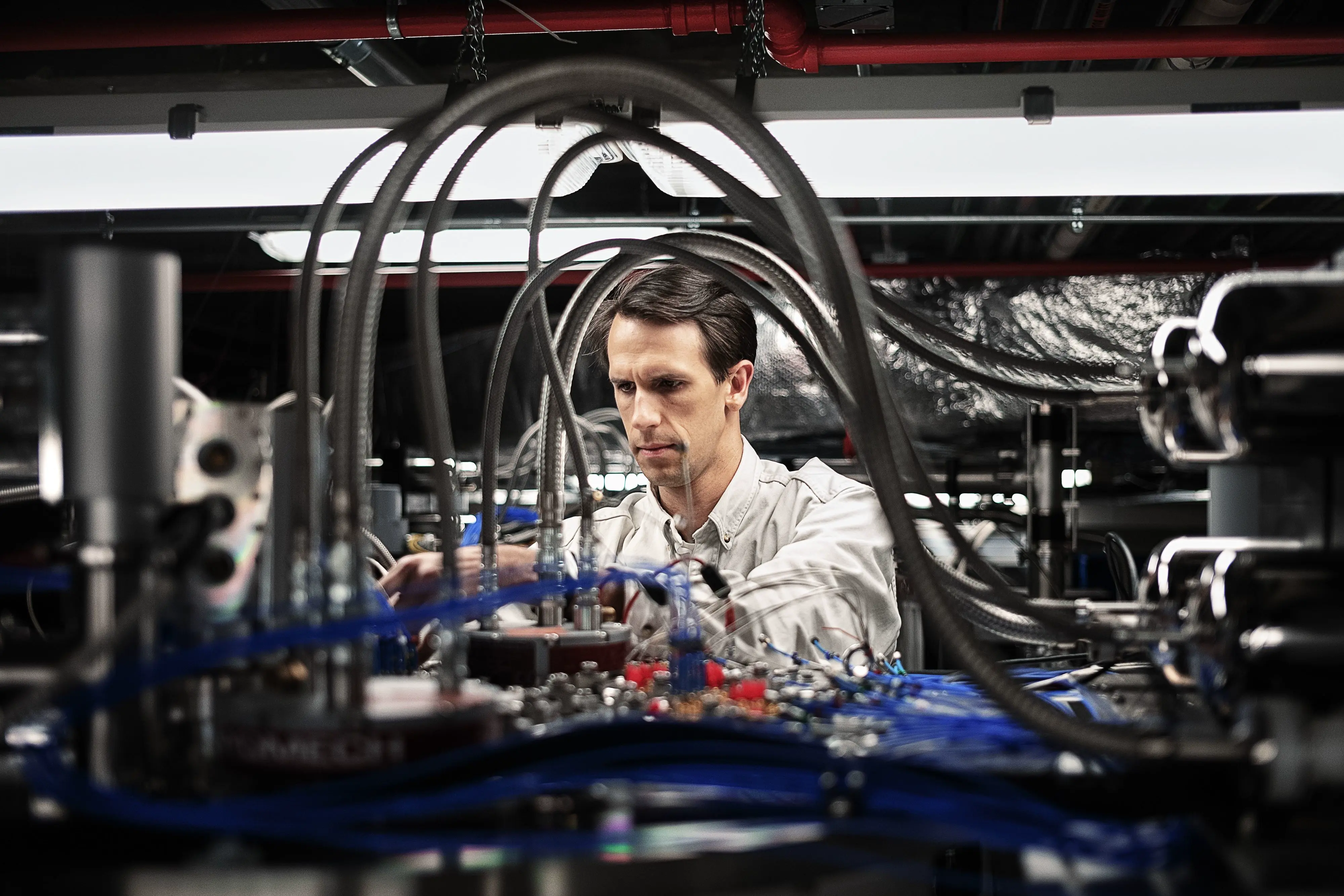
A quantum computer begins with a very small, very cold metal loop, where particles start to behave in ways that they do not behave under normal conditions on Earth—ways that change what we still consider the basic laws of physics.
Understanding that, in a physical sense, is the boundary between merely reading about a quantum threat and truly grasping it.
How do computers and real quantum computers work
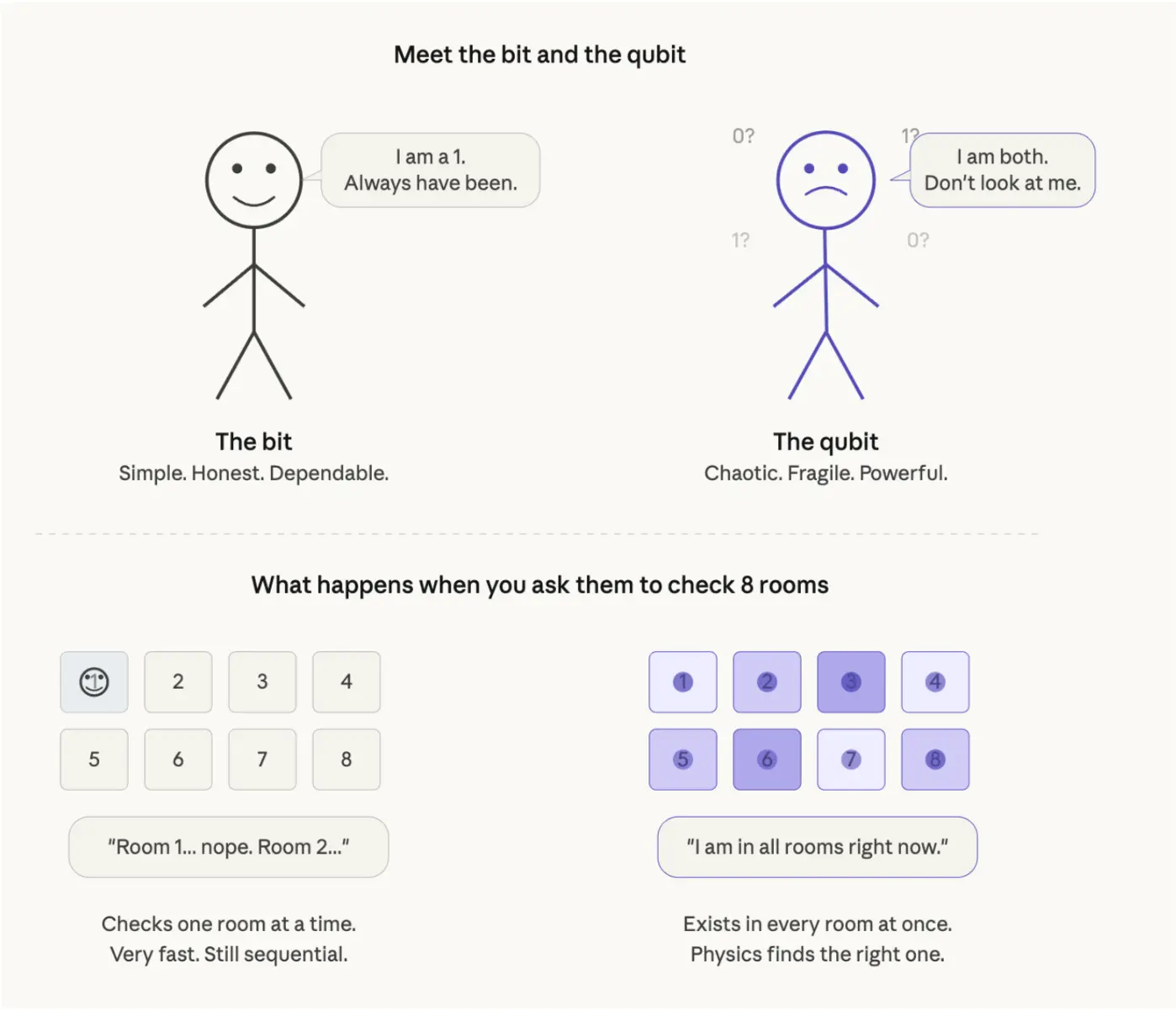
Ordinary computers store information using bits—each bit is just 0 or 1. A bit is an extremely tiny switch. Physically, it is a transistor on a “chip”—a micro gate that either lets current pass through (1) or doesn’t let it pass through (0).
Every photo, every Bitcoin transaction, every word you’ve ever typed is stored as patterns of switches like that—on or off. There is nothing mysterious about a bit; it is a physical object in one of two definite states.
All simple calculations are just arranging those 0s and 1s very quickly. A modern chip can perform billions of such operations every second, but it still carries out each one individually, in order.
Quantum computers use something called qubits instead of bits. A qubit can be 0, 1, or—and this is the weird part—both at the same time!
This can happen because a qubit is a completely different kind of physical object. The most common form, and the one Google uses, is an ultra-small superconducting metal loop cooled to about 0,015 degrees above absolute zero—colder than anything that exists in outer space, yet still existing on Earth.
At that temperature, electricity runs through the loop without resistance, and the current is said to be in a quantum state.
Inside that superconducting loop, the current can run clockwise (called 0) or counterclockwise (called 1). But at the quantum scale, the current doesn’t necessarily have to choose a direction—and it actually flows in both directions at the same time.
Don’t confuse it with switching back and forth between two states very quickly. That current can be measured, verified through experiments, and confirmed by observation as being simultaneously in both states.
Mind-blowing physics
So far so good? Great, because the next part is where things get truly strange: the physics behind how it works is not immediately intuitive, and it wasn’t invented to be intuitive.
Everything humans interact with in everyday life follows classical physics, which assumes that objects are in a place at a particular time. But particles don’t behave like that at the ultra-small scale.
An electron has no definite position until you look at it. A photon has no definite polarization until you measure it. A current in a superconducting loop doesn’t flow in a definite direction until you force it to choose.
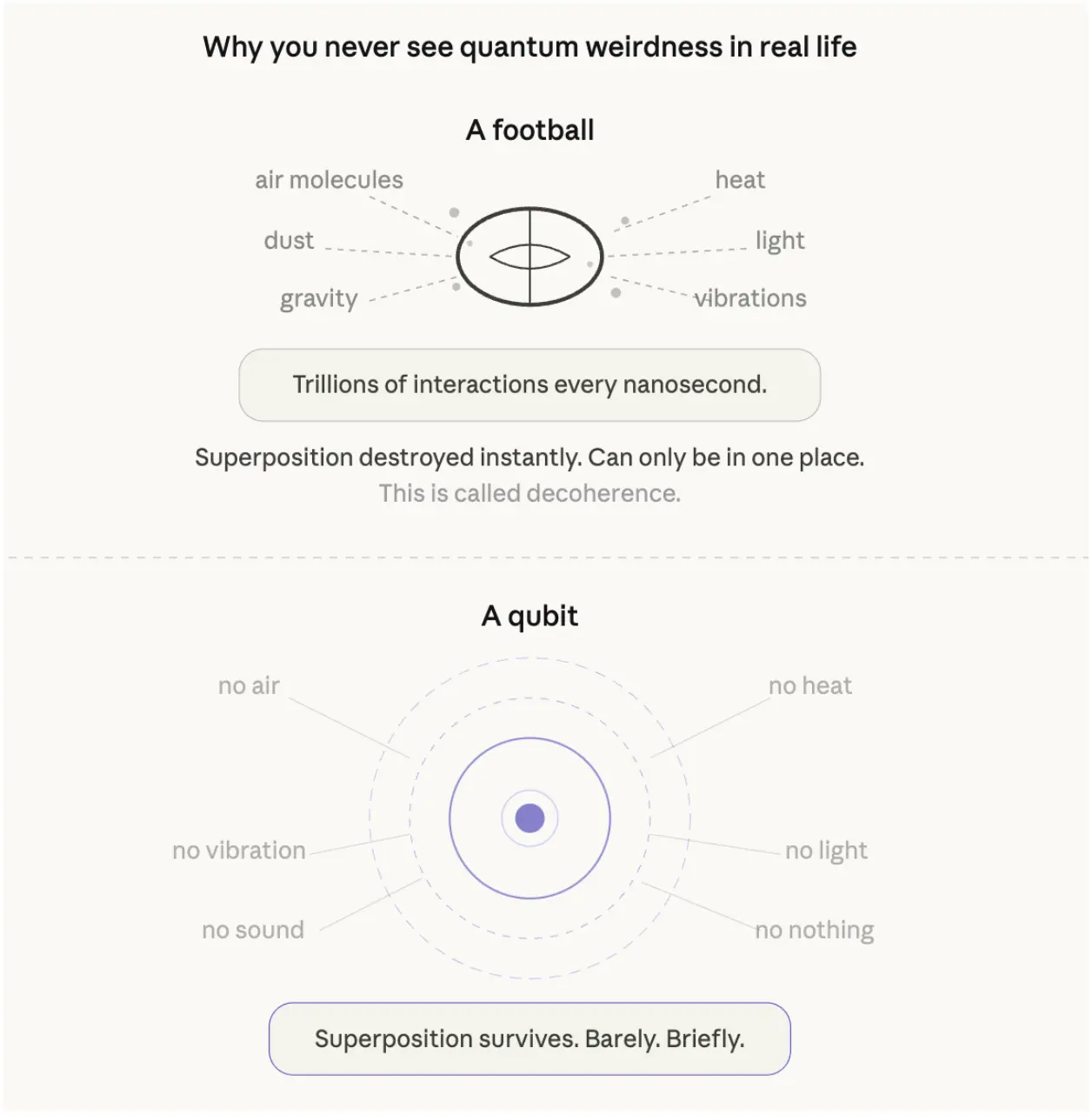
The reason we don’t experience this in daily life is a phenomenon called quantum decoherence. When a quantum system interacts with its environment—air molecules, heat, vibrations, and light—the superposed state collapses almost immediately.
A soccer ball can’t be in two places at once because it is interacting with hundreds of billions of air molecules, dust, sound, heat, gravity, and so on every nanosecond. But if you isolate a tiny current in a vacuum environment near absolute zero, shielding it from any possible disturbances, then quantum behavior can persist long enough to compute.
That’s why quantum computers are so difficult to build. Scientists are designing physical environments where the rules that prevent this from happening are held back long enough for a computation to finish.
Google’s machine operates in dilution refrigerators the size of large rooms, colder than anything that exists in nature, and wrapped in multiple layers of shielding to protect it from electromagnetic interference, vibrations, and thermal radiation.
And the qubits remain extremely fragile even like that. They lose their quantum state continuously, so “error correction” becomes the dominant topic in every discussion about scaling up.
So a quantum computer isn’t a faster version of a classical computer. It exploits a different set of physical rules—only applicable at extremely small scales, extremely low temperatures, and over extremely short time periods.
Now scale that up.
Two ordinary bits can be in one of four states (00, 01, 10, 11), but only one state at a time (because the current flows in only one direction). Two qubits can represent all four states at once, because the current is flowing in every direction at the same time.
Three qubits represent eight states. Ten qubits represent 1.024. Fifty qubits represent more than one quadrillion. The number doubles with every additional qubit, so scaling up is extremely exponential.
The second trick is something called quantum entanglement. When two qubits are entangled, measuring one qubit immediately tells the observer something about the other qubit, no matter how far apart they are. This allows a quantum computer to coordinate across the entire set of those states simultaneously in a way that ordinary parallel computation can’t do.
And these quantum computers are set up so that wrong answers cancel each other out (like overlapping ripples that flatten out), while the correct answers are amplified (like overlapping waves piling up higher). By the end of the computation, the correct answer has the highest probability of being observed.
So this isn’t brute-force speed. It’s a completely different way of computing—one that lets nature explore a space of possibilities that grows exponentially, and then “collapses” to the correct answer through physics rather than logic.
A massive threat to cryptography
It is precisely this mind-blowing physics that makes it scary for encryption.
The math that protects Bitcoin relies on the assumption that checking every possible key would take longer than the age of the universe.
But quantum computers don’t check every key one by one. They explore them all at the same time and use interference to make the correct answer emerge.
That’s the key connection to Bitcoin. In one direction, from a private key to a public key, it takes only a few milliseconds. In the other direction, from a public key back to a private key, a classical computer would take a million years—or even longer than the age of the universe. That asymmetry is what proves that someone is holding their coins.
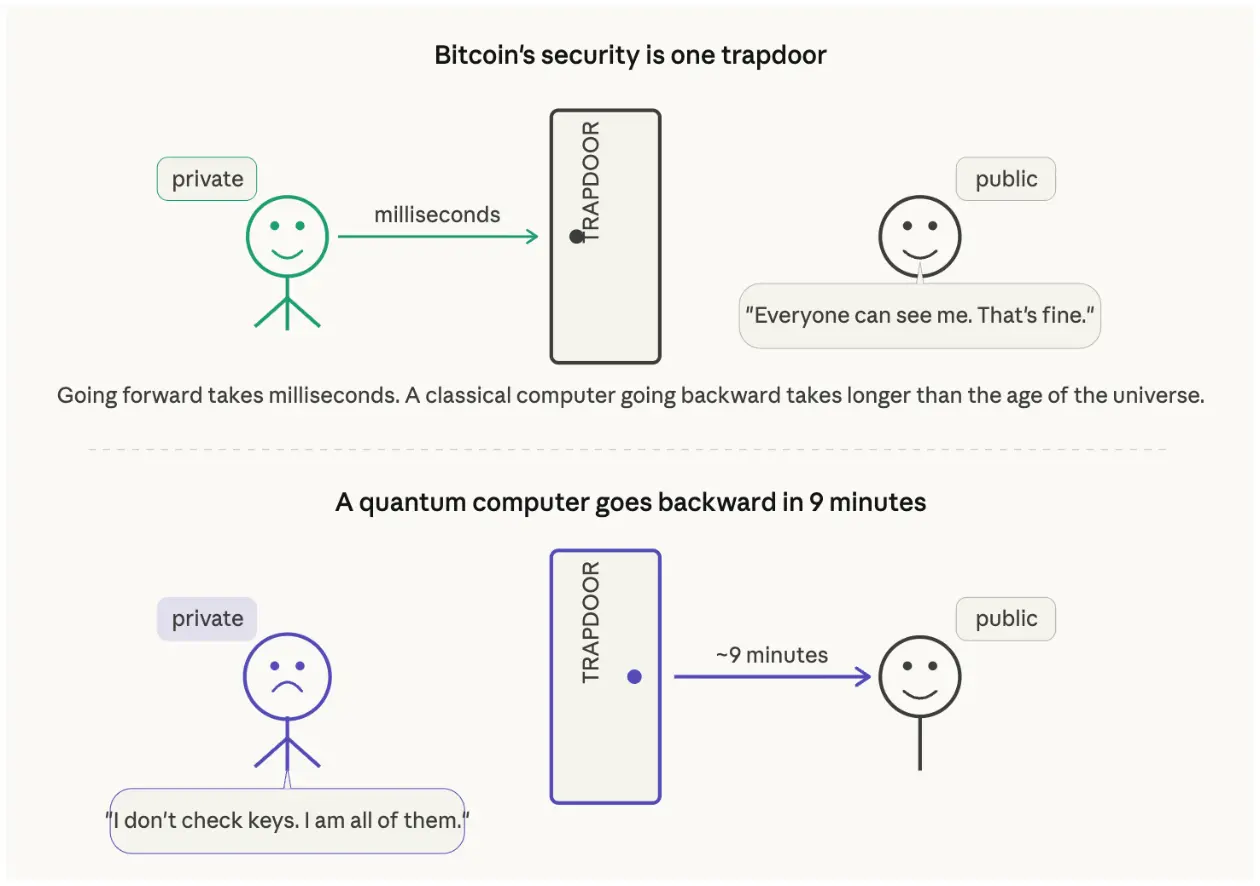
A quantum computer running an algorithm called Shor can go back through that “gauntlet.” This week’s Google paper shows that it can do so with far fewer resources than everyone else previously estimated, and within a time window directly competing with Bitcoin’s block confirmation time.
That’s why the threat from quantum computers breaking blockchain encryption is making people genuinely worried.
What such an attack would do step by step, what exactly the Google paper changed, and what it means for the 6.9 million bitcoins that have been exposed will be the topic of the next part in this series.


