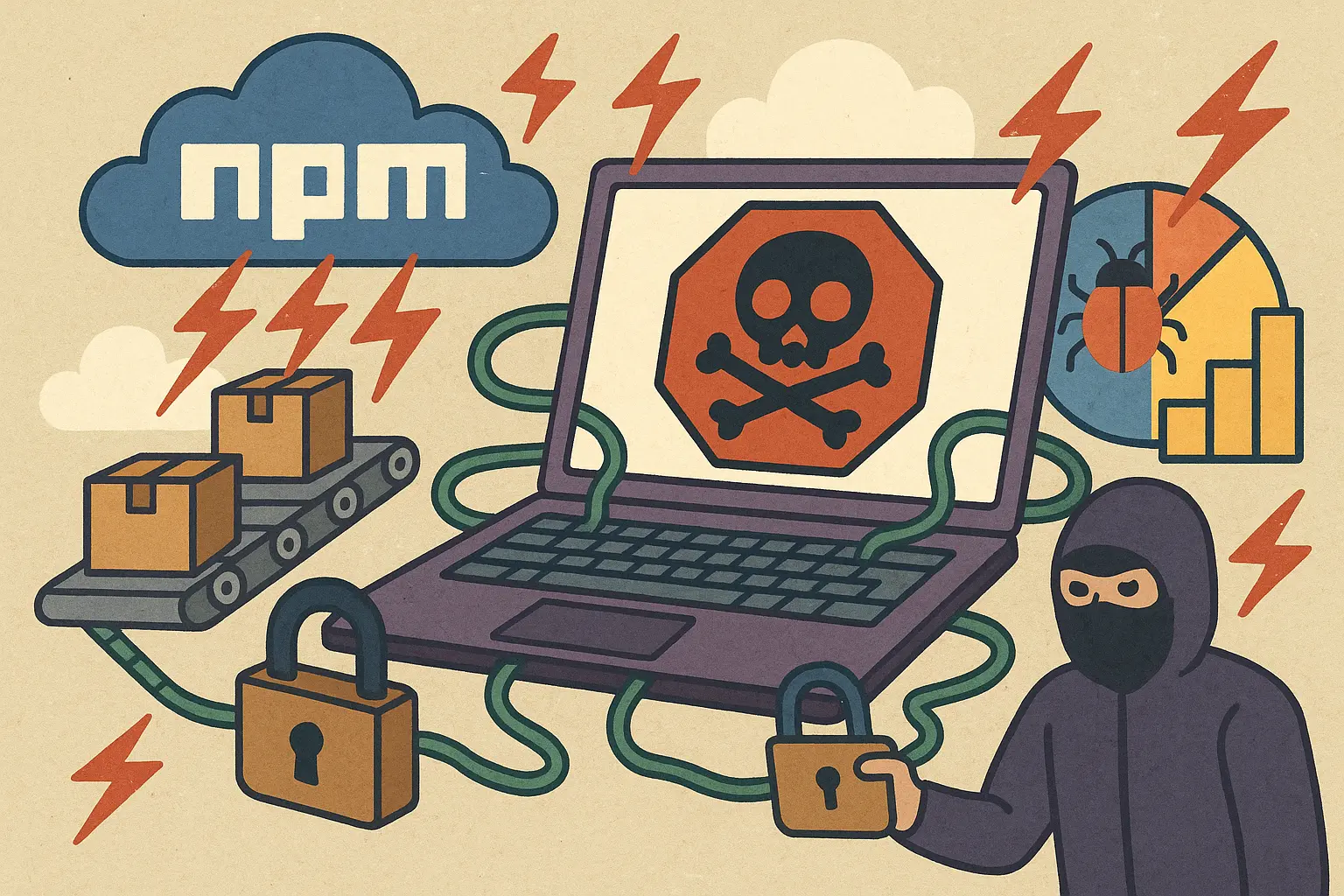
On March 31, the security research firm Socket detected an active supply-chain attack targeting the npm core package axios. The attacker compromised axios’s lead maintainer jasonsaayman’s npm account, published malicious versions, and injected malicious dependency packages to deploy a cross-platform remote access trojan (RAT), targeting macOS, Windows, and Linux systems.
Attack Chain Breakdown: The Complete Process from Account Takeover to RAT Self-Destruction
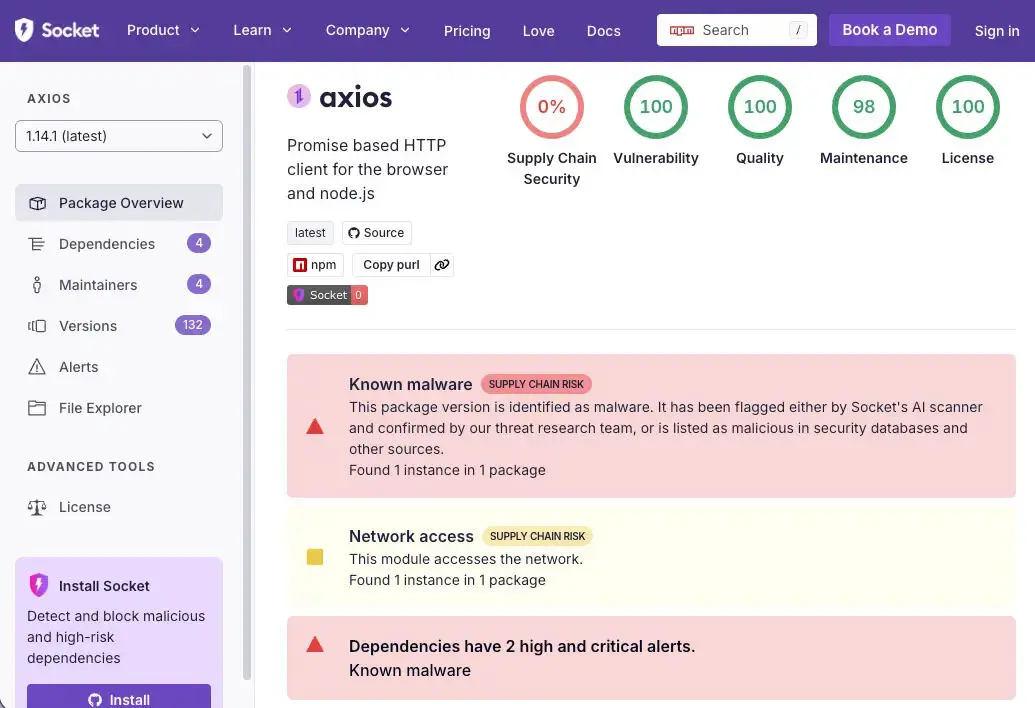 (Source: Socket)
This incident was a carefully orchestrated multi-step supply-chain attack. First, the attacker compromised the maintainer’s account and changed the email to ifstap@proton.me, then used the stolen npm access credentials to manually publish malicious versions, fully bypassing axios’s legitimate GitHub Actions + OIDC Trusted Publisher release process. In the GitHub repository, the two malicious versions have no corresponding commits, tags, or release records.
The attacker’s preparations were equally precise: they controlled another account (nrwise, nrwise@proton.me) and, about 18 hours earlier, first published a clean decoy version plain-crypto-js@4.2.0 to establish a history, then released a malicious 4.2.1 version at 23:59 UTC on March 30.
After the malicious postinstall hook executed, the RAT dropper (setup.js) connected to the command-and-control server sfrclak[.]com:8000 to deliver platform-specific payloads. After execution, it self-destructed and replaced package.json with a clean stub, causing subsequent checks to find no traces of infection in the node_modules directory.
Key Technical Indicators of the Attack (IOCs)
Malicious package versions: axios@1.14.1, axios@0.30.4, plain-crypto-js@4.2.1
C2 server: sfrclak[.]com / 142.11.206.73 / [.]com:8000
macOS infection artifacts: /Library/Caches/com.apple.act.mond
Windows infection artifacts: %PROGRAMDATA%\wt.exe, %TEMP%\6202033.vbs
Linux infection artifacts: /tmp/ld.py
Attacker accounts: jasonsaayman (compromised), nrwise (attacker-created account)
Emergency Response Guide: Confirming Exposure and Remediation Steps
Because the malicious dropper self-destructs after execution, you can’t confirm infection by checking the node_modules directory. The correct approach is to directly check the lockfile (package-lock.json or yarn.lock) to see whether it contains version records for axios@1.14.1 or axios@0.30.4.
Safe version rollback: 1.x users should downgrade to axios@1.14.0; 0.x users should downgrade to axios@0.30.3, and after removing the plain-crypto-js directory from node_modules, reinstall dependencies.
If you find any RAT infection artifacts in the system (com.apple.act.mond, wt.exe, ld.py), do not attempt to clean them in place. Instead, rebuild from a known-good state and immediately rotate all credentials that may have been exposed, including npm tokens, AWS access keys, SSH private keys, CI/CD configuration keys, and .env file values.
For cryptocurrency and Web3 developers, axios is a core HTTP library for many DeFi protocol frontends, crypto asset management tools, and on-chain data query services. A compromised development environment may lead to wallet private keys, seed phrases, or API keys being leaked to attackers—so it’s recommended to prioritize reviewing and rotating all sensitive credentials.
Frequently Asked Questions
How do I confirm whether I’ve installed an affected axios version?
Because the malicious dropper self-destructs after execution, you can’t confirm infection by checking the node_modules directory. You should directly check whether the lockfile contains records for axios@1.14.1 or axios@0.30.4, and verify whether a plain-crypto-js directory exists in node_modules. You can run npm list axios or directly search for the version strings in the lockfile.
What specific impact does this supply-chain attack have on cryptocurrency and Web3 developers?
axios is a commonly used HTTP library for Web3 front-end applications and DeFi protocol interfaces. A compromised development environment may expose sensitive credentials such as private keys, seed phrases, exchange API keys, or CI/CD configuration—so affected developers should prioritize reviewing and rotating all potentially exposed crypto-related credentials.
How can I protect against future npm supply-chain attacks?
Key preventive measures include: always using npm ci --ignore-scripts in CI/CD to disable postinstall hooks; pinning versions for critical dependency packages; regularly reviewing lockfile change records; and deploying tools such as Socket and Aikido to enable real-time malicious software monitoring for dependency packages.
Disclaimer: The information on this page may come from third parties and does not represent the views or opinions of Gate. The content displayed on this page is for reference only and does not constitute any financial, investment, or legal advice. Gate does not guarantee the accuracy or completeness of the information and shall not be liable for any losses arising from the use of this information. Virtual asset investments carry high risks and are subject to significant price volatility. You may lose all of your invested principal. Please fully understand the relevant risks and make prudent decisions based on your own financial situation and risk tolerance. For details, please refer to
Disclaimer.
Related Articles
Aave Suspends rsETH Reserve Operations Across Ethereum, Arbitrum, and Other Networks to Mitigate Systemic Risk
Gate News message, April 23 — Aave announced it has suspended rsETH reserve-related operations across Ethereum mainnet, Arbitrum, Base, Mantle, and Linea networks to mitigate systemic risk during the asset recovery process.
The measure aims to preserve additional funds while the recovery plan is
GateNews24m ago
JPMorgan: DeFi hackers are increasingly common, and interest in compression mechanisms to address TVL stagnation is drawing capital into USDT
JPMorgan Chase’s report believes that DeFi continues to face ongoing vulnerabilities, cross-chain bridge and oracle attacks are frequent, causing TVL to stagnate and weakening institutional investors’ willingness to invest, with capital shifting to USDT that is traceable and can be frozen. The KelpDAO and Rhea Finance attacks reveal risk-management risks; centralized stablecoins and custodial solutions are more favored. In the long run, improving this will require going beyond insurance and governance. DeFi will not be able to return to the 2021 era of high TVL, and stablecoins will become even more concentrated.
ChainNewsAbmedia31m ago
Circle Chief Economist Proposes Raising USDC Rates on Aave Amid KelpDAO Fallout
Gate News message, April 23 — Gordon Liao, Circle's chief economist, has proposed raising USDC lending parameters on Aave v3 Ethereum Core this week following a $292 million KelpDAO rsETH exploit that triggered a liquidity crisis across the protocol. Liao's Request for Comment suggests increasing "S
GateNews1h ago
Major CEX Upgrades Fraud Detection System with Machine Learning and Rule Engine, Cuts Response Time to Hours
Gate News message, April 23 — A major centralized exchange announced an overhaul of its anti-fraud system by integrating machine learning models with rule-based engines, implementing a dual-track strategy where models handle long-term defense and rules enable rapid response. The unified framework
GateNews1h ago
Meta Pool Warns of Fraudulent Contract Impersonating Official Staking Pool and Token
Gate News message, April 23 — Meta Pool has identified a suspicious smart contract attempting to impersonate its legitimate staking pool and token. The platform emphasized that the fraudulent contract has no association with Meta Pool or any official NEAR liquid staking
GateNews2h ago
JPMorgan: DeFi Exploits and Stagnant TVL Continue to Limit Institutional Adoption
Gate News message, April 23 — JPMorgan analysts say persistent decentralized finance exploits and weak growth continue to limit institutional interest in the sector. The recent Kelp DAO attack wiped approximately $20 billion from DeFi's total value locked (TVL) in just days, according to a report le
GateNews2h ago


