Resolv Labs halted its decentralized finance ( DeFi) protocol early Sunday morning after an exploit allowed an attacker to mint tens of millions of unbacked USR stablecoins, sending the token sharply off its dollar peg.
What Caused the Resolv Labs Hack and USR Depeg?
The incident struck the Resolv DeFi platform, which offers yield strategies tied to delta-neutral positions on bitcoin and ethereum, with its USR stablecoin marketed as a dollar-pegged asset backed by liquid collateral. Before the breach, the protocol’s total value locked exceeded $500 million, supported by audits, a bug bounty program, and custody integrations.
According to onchain data and project disclosures, the attacker deposited roughly $100,000 to $200,000 in USDC into a contract tied to USR issuance before exploiting a two-step minting process. By manipulating parameters within the request and completion flow, the attacker minted about 80 million USR—far exceeding the initial deposit and creating a large pool of unbacked tokens.
Analysts pointed to weaknesses tied to a permissioned service role and insufficient validation checks between minting steps. Early assessments suggest the issue may involve an off-chain component, such as a compromised signer or flawed backend validation, rather than a traditional smart contract bug.
After minting the tokens, the attacker rapidly converted USR into wrapped variants and sold across multiple decentralized exchanges, including Curve and Uniswap. Prices collapsed during the sell-off, with USR trading as low as a few cents in some pools. The attacker extracted an estimated $23 million to $25 million, largely converted into ethereum, while continuing to move funds across wallets.
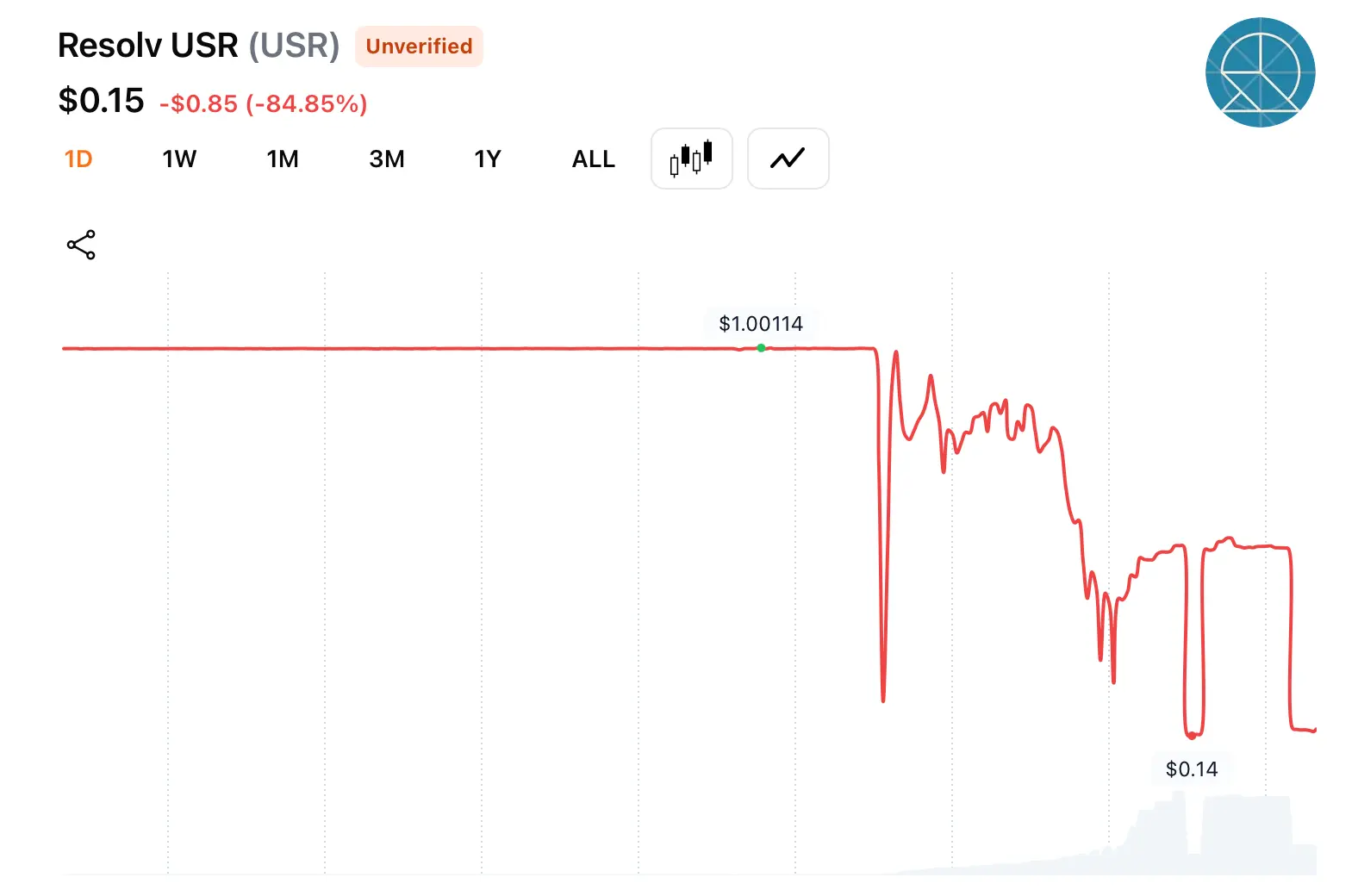 Resolv stablecoin USR depegged.
The exploit triggered a swift depeg, with USR falling from $1 to as low as $0.025 in certain liquidity pools before partially recovering later in the day. Several integrated protocols moved quickly to limit exposure, pausing markets or disabling collateral tied to Resolv assets.
Resolv stablecoin USR depegged.
The exploit triggered a swift depeg, with USR falling from $1 to as low as $0.025 in certain liquidity pools before partially recovering later in the day. Several integrated protocols moved quickly to limit exposure, pausing markets or disabling collateral tied to Resolv assets.
Resolv Labs said it paused all protocol functions immediately and is investigating recovery options. The team emphasized that the underlying collateral pool remains intact and that no backing assets were drained, framing the loss as a result of unbacked issuance rather than collateral failure. Users were advised to avoid interacting with affected assets while the review continues.
FAQ 🔎
- **What caused the USR stablecoin to depeg?**An exploit allowed the minting of tens of millions of unbacked USR tokens, flooding the market.
- **How much was lost in the Resolv Labs exploit?**The attacker extracted an estimated $23 million to $25 million in value.
- **Were user funds or collateral drained from the protocol?**No, the collateral pool remained intact; losses stemmed from unbacked token issuance.
- **Is the Resolv protocol still operational?**No, all functions are paused while the team investigates and works on recovery.
Disclaimer: The information on this page may come from third parties and does not represent the views or opinions of Gate. The content displayed on this page is for reference only and does not constitute any financial, investment, or legal advice. Gate does not guarantee the accuracy or completeness of the information and shall not be liable for any losses arising from the use of this information. Virtual asset investments carry high risks and are subject to significant price volatility. You may lose all of your invested principal. Please fully understand the relevant risks and make prudent decisions based on your own financial situation and risk tolerance. For details, please refer to
Disclaimer.
Related Articles
Hong Kong SFC issues two tokenized offering circulars on the same day (26EC22 / 26EC23): Full breakdown of VATP secondary trading and primary subscription and redemption rules
The Hong Kong Securities and Futures Commission will issue two guidance circulars for tokenized products in 2026, covering primary-market subscription and redemption and secondary-market trading requirements, respectively. The circulars will clearly define the responsibilities of product providers, liquidity requirements, and fair pricing mechanisms. The new regulatory framework will affect how the industry operates and will create new business opportunities for compliance lawyers, forming a template for tokenized finance regulation in the Asia-Pacific region.
ChainNewsAbmedia37m ago
World Upgrades World ID to Full-Stack Proof-of-Human Protocol Spanning 160 Countries
World has launched an upgraded World ID protocol for secure digital verification in various sectors. It enhances privacy and supports AI applications while managing user identities across 160 countries, verifying nearly 18 million individuals.
GateNews3h ago
Cobo Launches AI-Powered Agentic Wallet for Secure Autonomous On-Chain Transactions
Cobo has launched the Cobo Agentic Wallet, enabling AI agents to conduct on-chain transactions under user-defined controls. Utilizing Multi-Party Computation for security and incorporating Pact and Recipes protocols, it supports various operational modes for diverse risk levels.
GateNews4h ago
Pi Network issues a node upgrade warning: if you haven’t upgraded by April 27, you risk being disconnected
Pi Network has issued an official notice to node operators, requiring them to complete the mandatory upgrade of the agreement version 22.1 (v22.1) by April 27, 2026; otherwise, they face the risk of their nodes being cut off from network connectivity. According to a Pi Network announcement, this upgrade must be carried out in strict version order. Currently, the system is running on version 21.2; the next step is to upgrade to v22.1, and no versions may be skipped.
MarketWhisper5h ago
Spark's Prudent ETH Lending Strategy Proves Justified as Aave Faces Liquidity Crisis Across Multiple Chains
Spark's strategy chief defended maintaining high borrowing rates on SparkLend despite user migration to Aave, citing current market conditions. Aave is experiencing liquidity issues, raising concerns about potential bad debt if ETH prices drop significantly.
GateNews5h ago
Tether: USDT transfer resumed, suspension during the rsETH incident investigation has been lifted
Tether and the LayerZero team’s all-chain stablecoin project USDT0 posted on the X platform on April 20. The USDT0 transfer function has been restored to normal, and overall system integrity has not been affected. There has been no change in risk exposure, and all transactions in progress prior to the suspension have been settled. Previously, USDT0, for precautionary purposes, paused the USDT0 OFT cross-chain bridge infrastructure during the rsETH incident investigation.
MarketWhisper5h ago


