The Chinese government has issued its first official risk alert regarding the industrial infiltration of AI Agents, targeting the crayfish.
(Background: Beware! ClawHub hides 1,184 malicious skills: stealing crypto wallet private keys, SSH keys, browser passwords)
(Additional context: After the rise of OpenClaw: an open-source crayfish that has shaken up which U.S. stocks?)
The crayfish OpenClaw became an instant hit in China, with many tech giants promoting installation and providing one-click access to later-stage services, making it a popular AI tool among the public. While the crayfish gained popularity, Chinese authorities have started to contain it.
The China National Industrial Information Security Development Research Center (hereafter “Security Center”) issued a rare specialized risk alert on March 12, directly targeting OpenClaw’s rapid infiltration into domestic industrial sites. This marks China’s first official regulatory warning concerning AI Agent applications in industry.
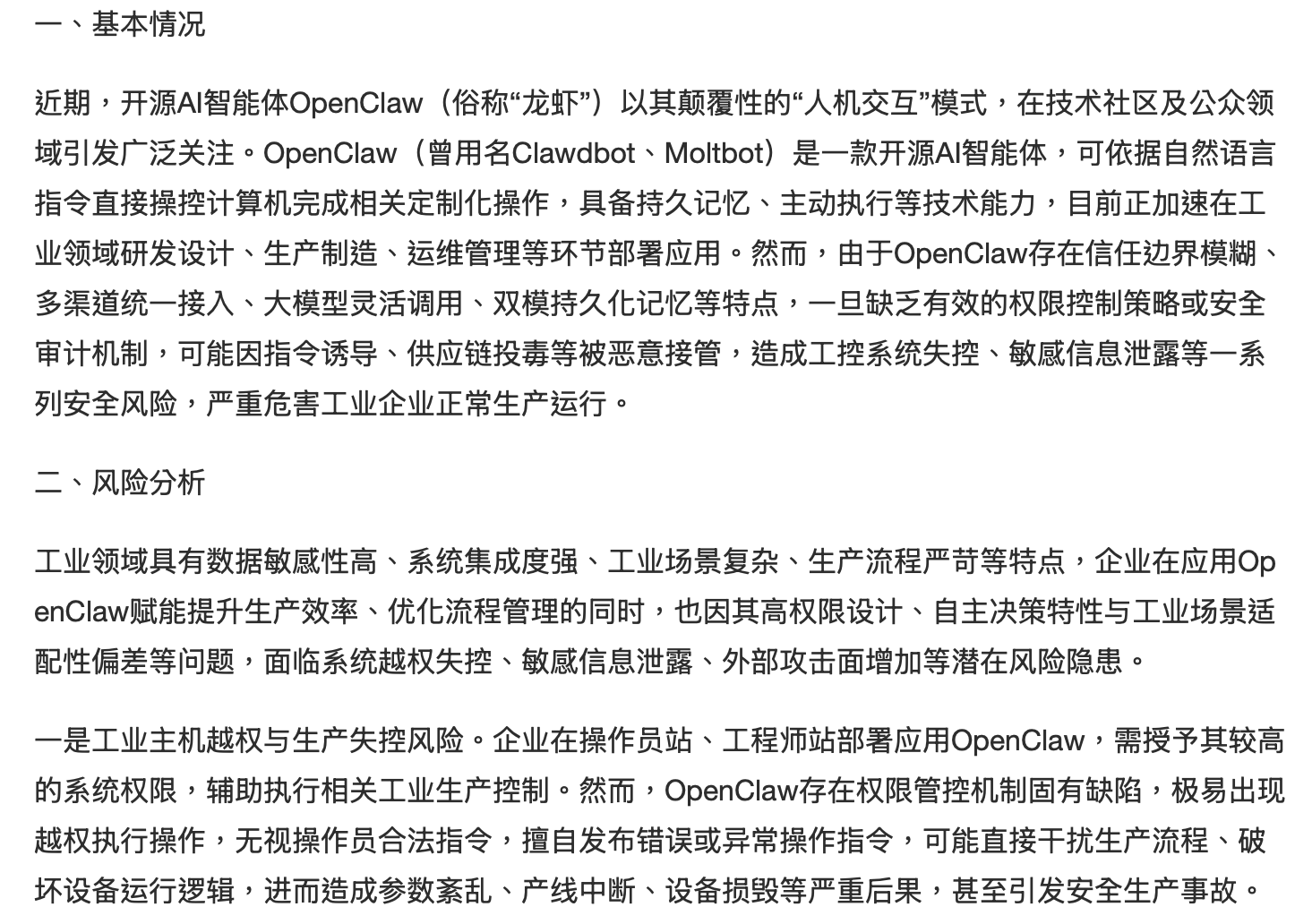
The alert states that OpenClaw is accelerating its deployment in industrial research and development, manufacturing, and operations management. The capabilities of AI Agents make them highly promising in factory environments, but the security risks they pose cannot be mitigated by traditional firewalls.
Three Major Industrial Risks of Using Crayfish
The Security Center specifically lists three risks:
1. Industrial Host Overreach and Production Control Risks: Attackers can use “prompt injection” techniques to induce Agents to execute commands beyond authorized scope, which may modify production parameters or, in severe cases, cause control system failures. In highly automated settings, a single malicious command could propagate through the Agent’s operation chain, affecting the entire production process.
2. Sensitive Industrial Information Leakage Risks: Once deployed in factories, OpenClaw often has the ability to read design documents, process parameters, and supplier data. If malicious modules are embedded into the Agent’s skill set via supply chain poisoning, these sensitive data could be exfiltrated unnoticed.
3. Expanded Attack Surface and Amplified Attack Effects: AI Agents inherently operate across multiple systems and platforms. This means that once compromised, attackers can use the Agent’s identity to coordinate actions across various systems, rendering traditional single-point defenses nearly ineffective.
Official Chinese Recommendations
The Security Center advises industrial enterprises to refer to the “Industrial Control System Network Security Protection Guidelines” and the “Industrial Internet Security Classification and Grading Management Measures,” and to conduct self-assessments based on the “Six Do’s and Six Don’ts” recommendations published by the Cybersecurity Threat and Vulnerability Information Sharing Platform (NVDB) of the Ministry of Industry and Information Technology.
The issuance of this alert signals a “sudden brake” by Chinese authorities on the rapid deployment of AI Agents in industry.
Disclaimer: The information on this page may come from third parties and does not represent the views or opinions of Gate. The content displayed on this page is for reference only and does not constitute any financial, investment, or legal advice. Gate does not guarantee the accuracy or completeness of the information and shall not be liable for any losses arising from the use of this information. Virtual asset investments carry high risks and are subject to significant price volatility. You may lose all of your invested principal. Please fully understand the relevant risks and make prudent decisions based on your own financial situation and risk tolerance. For details, please refer to
Disclaimer.
Related Articles
PACE Act Targets Faster Payments With Fed Access for Fintechs
PACE Act introduces optional federal licensing for fintechs, requiring compliance, reserves, and oversight by the OCC.
Direct access to Fed systems like FedNow and Fedwire aims to cut delays, lower costs, and reduce reliance on banks.
Industry groups support the bill, citing improved
CryptoFrontNews3h ago
Peter Schiff calls the Strategy STRC a Ponzi scheme, criticizing the SEC for inadequate regulation
Bitcoin critics and gold supporter Peter Schiff posted on X on April 23, saying that the STRC perpetual preferred stock introduced by MicroStrategy (Strategy) is “the most obvious Ponzi scheme to date,” and criticizing the U.S. Securities and Exchange Commission (SEC) for failing to effectively stop Michael Saylor from promoting STRC.
MarketWhisper5h ago
Sberbank plans to offer cryptocurrency trading; the Russian Duma has passed the bill on its first reading
According to a report by TASS on April 22, Ruslan Vestrovskiy, senior vice president and head of wealth management at Russia’s Sberbank, said at the Moscow Exchange Forum that once cryptocurrency-related regulation is implemented and exchanges begin organized trading, Sberbank will provide its customers with cryptocurrency trading services. On the same day, the Russian State Duma passed the first reading of a bill on cryptocurrency regulation.
MarketWhisper5h ago
U.S. Crypto Market Structure Bill Nears Stablecoin Rewards Breakthrough as Illicit Finance and Ethics Concerns Resurface
Gate News message, April 23 — Negotiations on a broader U.S. cryptocurrency market-structure bill, known as the Clarity Act, are in a "good spot" on stablecoin rewards, according to key negotiators Senators Angela Alsobrooks (D-Md.) and Thom Tillis (R-N.C.), even as other contentious issues includin
GateNews5h ago
UK FCA raids eight P2P crypto trading venues in London, issues a stop order
On April 22, the UK Financial Conduct Authority (FCA) announced that its enforcement team, together with Her Majesty’s Revenue and Customs (HMRC) and the Southwest Regional Organized Crime Unit (SWROCU), conducted raids on eight suspected illegal peer-to-peer (P2P) cryptocurrency trading venues in London on April 21, issuing stop orders at each location. The FCA confirmed that there are currently no legally registered P2P crypto platforms in the UK.
MarketWhisper5h ago


