
ARK Invest and Unchained jointly released the latest white paper, systematically refuting the market narrative of “Quantum Day” (Q Day). The white paper states that the risk of quantum computing compromising Bitcoin will not impact the market through a single sudden event but will instead evolve gradually through foreseeable technological advancements. The core conclusion of the report is clear: Bitcoin currently does not face an immediate threat from quantum computing.
Five-Stage Framework: How Quantum Threats Evolve from Zero to Critical Point
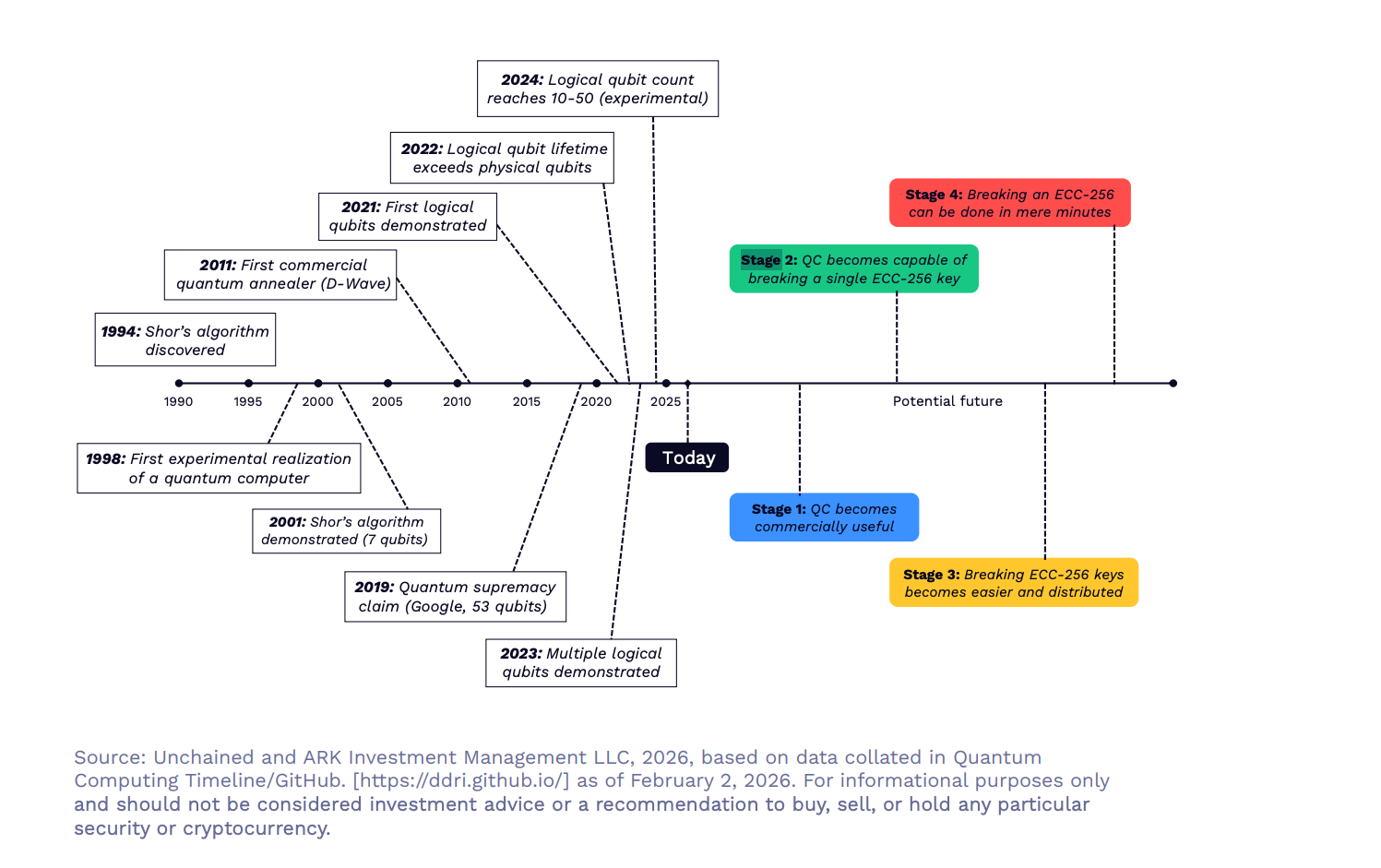
(Source: Ark Invest)
The five-stage roadmap proposed by ARK Invest and Unchained provides a systematic framework to track the development of quantum computing technology from commercial beginnings to cryptographic threats:
Stage 0 (Current): Quantum computers exist but have no commercial applications. Today’s technology is in the “NISQ era”—about 100 logical qubits, circuit depths of a few hundred quantum gates—far below the minimum threshold needed to crack Bitcoin’s elliptic curve cryptography (ECC): at least 2,330 logical qubits and tens of millions to billions of quantum gates.
Stage 1: Quantum systems achieve commercial applications in specific industries such as chemistry and materials science but are unrelated to cryptocurrencies.
Stage 2: Quantum technology can crack weak keys or outdated cryptosystems. This is the first practical threat posed by cryptographically relevant quantum computers (CRQC), targeting the most vulnerable systems rather than Bitcoin’s 256-bit ECC.
Stage 3: Bitcoin faces its first real risk—ECC could theoretically be cracked, but the process would still take a long time. Bitcoin stored before 2011 with P2PK addresses (whose public keys have long been exposed) is more vulnerable, while modern address formats provide stronger resistance against quantum attacks.
Stage 4: Critical tipping point. When quantum computers can crack private keys faster than Bitcoin’s 10-minute block time, and if no protocol-level actions are taken, Bitcoin will face a “serious threat as a useful monetary system—posing a survival threat to the protocol itself.”
Post-Quantum Cryptography (PQC) Is Already Ahead
The report highlights a key reassuring finding: current progress in post-quantum cryptography (PQC) is ahead of the development of CRQCs capable of cracking Bitcoin encryption. Proposals for quantum-secure Bitcoin addresses (such as BIP-360) already exist, and stakeholders with vested interests in the network have strong incentives to implement protective measures when necessary.
Three Scenarios and a Reasonable 10- to 20-Year Time Frame
The report also presents three possible timelines for threat realization:
Pessimistic Scenario (Sudden Breakthrough): An unexpected leap in quantum technology catches the Bitcoin community off guard. However, the report believes Bitcoin can still survive because multiple PQC proposals can be rapidly deployed under pressure.
Optimistic Scenario (Technological Stagnation): Quantum computing faces long-term stagnation due to physical and engineering barriers, giving Bitcoin ample time to advance research, testing, and upgrades.
Balanced Scenario (Mainstream Prediction): Quantum computers reach Stage 3 within 10 to 20 years. The report suggests that within this timeframe, the PQC research community will achieve enough algorithm breakthroughs to give Bitcoin developers sufficient time to complete adaptive upgrades.
Frequently Asked Questions
Why does ARK Invest believe there will be no sudden “Q Day” event?
The “Q Day” hypothesis assumes a sudden leap in quantum computing technology capable of breaking all existing encryption without warning. However, ARK Invest’s analysis indicates that progress in quantum computing follows observable physical and engineering paths, with each threat stage showing precursors (such as incremental improvements in qubit count and error rates), providing markets and protocols with enough time to react.
Do Bitcoin holders need to take any action now?
The report suggests no urgent action is necessary at present. Most modern Bitcoin addresses (like P2WPKH, P2TR) already have some quantum resistance; the higher risk lies with addresses created before 2011 (P2PK), whose public keys have been exposed for a long time. Holders of such old addresses may consider migrating to modern address formats.
How long would it take to upgrade the Bitcoin protocol to post-quantum security?
The co-author of BIP-360 previously estimated that a full post-quantum upgrade could take about seven years. ARK Invest and Unchained’s report believe that, under the balanced scenario, the timeline for quantum computers to reach the technological level that poses a real threat to Bitcoin is 10 to 20 years, leaving enough time for the Bitcoin development community to implement necessary upgrades—provided the upgrade efforts are initiated and advanced in a timely manner.
Disclaimer: The information on this page may come from third parties and does not represent the views or opinions of Gate. The content displayed on this page is for reference only and does not constitute any financial, investment, or legal advice. Gate does not guarantee the accuracy or completeness of the information and shall not be liable for any losses arising from the use of this information. Virtual asset investments carry high risks and are subject to significant price volatility. You may lose all of your invested principal. Please fully understand the relevant risks and make prudent decisions based on your own financial situation and risk tolerance. For details, please refer to
Disclaimer.
Related Articles
Broadridge launches an integrated crypto and token-asset platform, supported monthly up to $8 trillion
Broadridge Financial Solutions has launched an integrated digital asset platform for Canadian wealth management firms, enabling companies to provide cryptocurrency and traditional investment services in a single system and addressing the issue of fragmented infrastructure. The platform supports a wide range of digital assets and includes compliance control tools to lower the barrier for institutions to enter the market. This comes at a critical time when financial institutions are competing for digital asset infrastructure, strengthening the platform’s market competitiveness.
MarketWhisper6h ago
Bernstein: The Bitcoin market has already priced in the risk from quantum computing, and developers have 3 to 5 years to push forward with a post-quantum upgrade
Bernstein’s research report states that the Bitcoin pullback reflects market concerns about the risks of quantum computing, and argues that the quantum threat is manageable and does not constitute a systemic risk. Current technological progress provides a cushion for Bitcoin, giving developers 3 to 5 years to push forward a post-quantum upgrade. Institutional investors will help drive consensus formation, but user migration remains the main challenge.
GateNews17h ago
WisdomTree saw net inflows of $98 million of digital assets in Q1, with assets under management reaching $867 million
Gate News news, April 13, asset management company WisdomTree released a March monthly performance report showing that in the first quarter of 2026 its digital-asset net inflows totaled $98 million, and as of March 31 its digital-asset assets under management reached a record $867 million. The report noted that although the overall cryptocurrency market has been lackluster, WisdomTree’s digital-asset business saw significant growth thanks to the launch of tokenized money market funds. (Businesswire)
GateNews18h ago
Saudi Arabia’s Crypto Market Projected to Reach $47.8 Billion by 2034
The Saudi Arabian cryptocurrency market is projected to grow from $24.9 billion in 2025 to $47.8 billion by 2034.
Key Takeaways:
SAMA is backing projects like mBridge to grow the market to $47.8 billion by 2034.
High youth interest in DeFi and gaming is fueling a 7.51% annual growth rate for
Coinpedia18h ago
CoinShares: Net inflows of $1.1 billion into digital asset investment products last week, the highest single-week level this year
According to CoinShares’ research report, digital asset investment products recorded a net inflow of $1.1 billion last week, the highest in the year to date. Bitcoin saw inflows of $871 million, Ethereum inflows of $196.5 million, and XRP inflows of $19.3 million, with the U.S. driving the dominant inflows. Overall market risk appetite rebounded, reflecting investor demand.
GateNews22h ago
VC professionals: There may be fewer than 20 institutions in the industry that are truly still investing in the seed round.
Varys Capital venture investment chief Tom Dunleavy noted that in the past six months, the crypto VC funding environment has changed significantly: well-funded projects are proactively coming to them, while most VC capital has run out or shifted to late-stage investments, extending the fundraising cycle to 2–3 months. Only a few institutions are still making early-stage investments, and in the future they may see investment opportunities on a historic scale.
GateNews04-13 07:31


