


ema vs ma
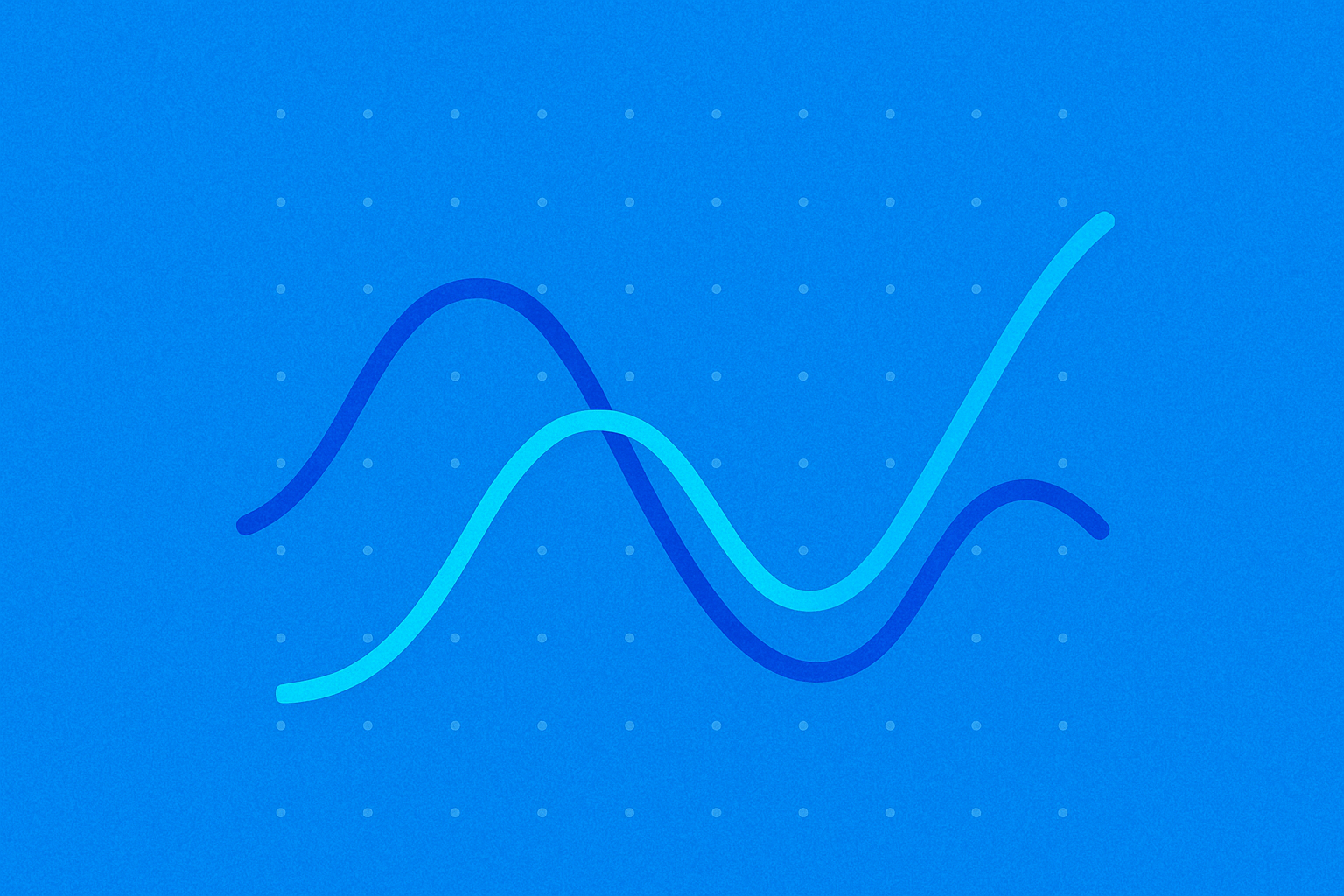
What Are Exponential Moving Average (EMA) and Moving Average (MA)?
Exponential Moving Average (EMA) and Moving Average (MA) are both trendlines calculated from historical prices. MA, or simple moving average, assigns equal weight to each price, while EMA gives greater weight to more recent prices.
On a chart, an MA averages the closing prices over the past N days, resulting in a smoother line. EMA, by emphasizing recent data, reacts more sensitively to new price changes. Both are commonly used for trend analysis, dynamic support and resistance, and generating buy/sell signals in crypto trading candlestick charts.
How Do EMA and MA Work?
The primary difference between EMA and MA lies in their weighting methods. MA averages the past N prices with equal weighting, which makes it slower to adapt and more prone to lag. EMA applies a smoothing factor so that newer prices have higher weight, keeping the line closer to current market conditions.
This difference leads to two practical effects: First, EMA responds faster to sudden moves, making it suitable for short-term trading or highly volatile assets. Second, MA filters out market noise better, making it ideal for identifying medium- to long-term trends and robust support/resistance levels. Neither weighting method "predicts the future"; they simply adjust how much emphasis is placed on recent versus older data.
How Are EMA and MA Used in Crypto Trading?
EMA and MA serve three main functions: trend identification, observing dynamic support/resistance, and capturing crossover signals.
For example, on the BTC/USDT daily chart, price staying above a rising MA50 is often seen as a sign of an uptrend. For short-term trades on ETH/USDT’s 1-hour chart, EMA20 is frequently used due to its responsiveness to fast price moves.
When price approaches and stabilizes near an MA or EMA, traders often treat these lines as "dynamic support." If price drops below and consolidates under the line, it may act as "dynamic resistance." It’s important to confirm these observations with volume changes and higher timeframe trends to avoid relying solely on a single indicator.
How Should You Choose EMA and MA Parameters?
Common timeframes for EMA and MA are short-term, medium-term, and long-term. Short periods like 5, 10, or 20 are used to capture rapid changes; medium periods like 30 or 50 help observe phase-based trends; long periods like 100 or 200 focus on major trends and turning points.
Parameter selection guidelines include:
- For intraday or swing trading, use sensitive EMAs (10-20) to track momentum.
- For trend following, use stable MAs (50-200) to filter out noise.
- The more volatile the asset, the shorter the period can be; in noisy consolidation markets, longer periods offer more stability.
More parameters don’t always mean better results. Over-tuning can lead to "curve fitting"—appearing perfect historically but unstable in live trading. Start with standard combinations like EMA20 with MA50, then fine-tune based on asset characteristics.
How Do You Interpret EMA and MA Signals?
EMA and MA generate three common types of signals: crossover, position, and slope.
-
Crossover signals: When a shorter-period moving average crosses above a longer-period moving average ("golden cross"), it suggests strengthening momentum; crossing below is called a "death cross." For instance, EMA20 crossing above MA50 is often seen as a bullish sign. The signal is more reliable if volume increases simultaneously.
-
Position signals: Price above an upward-sloping MA or EMA indicates strength; price below a downward-sloping line suggests weakness. These are especially useful for assessing pullbacks or rebounds.
-
Slope signals: The steeper the moving average line, the stronger the momentum; a flattening slope signals weakening strength. Slope helps determine if a trend is "losing steam."
These signals should not be used in isolation. Confirming with higher timeframe trends, key price levels, and volume can significantly reduce false signals.
How Do You Set Up EMA and MA on Gate?
EMA and MA can be directly added to charts on Gate. Here are the basic steps:
Step 1: Open Gate’s website or app, navigate to the spot or futures trading page, select a trading pair like BTC/USDT and expand the candlestick chart.
Step 2: Click "Indicators," find "MA" and "EMA" in the list or search bar, and add them to your chart.
Step 3: Go into indicator settings to adjust periods (such as MA50 or EMA20) and modify colors or line styles for easier distinction.
Step 4: Save your setup as a template in the upper right corner of the chart for one-click application across other trading pairs.
As of January 2026, leading platforms including Gate provide multi-period overlay and customizable styles for both MA and EMA—enabling diverse strategy deployment.
What Are the Pros and Cons of EMA and MA?
EMA and MA each have distinct advantages. EMA’s strength is its fast response—more closely tracking rapid market moves—while its weakness is increased sensitivity to noise, which can result in false signals. MA’s advantage is its smoothness—ideal for analyzing medium- to long-term trends; its downside is slower reaction speed, which may miss early trend reversals.
EMA is preferable during clear trending and high volatility periods; MA works better in complex structures or sideways markets by reducing erroneous trades. Many traders use both together—EMA20 for short-term momentum, MA50 for mid-term trend assessment—balancing their respective weaknesses.
What Are the Risks and Pitfalls of EMA and MA?
Both EMA and MA lag behind actual price movements; no moving average can "predict" market changes. Common mistakes include acting aggressively on a single crossover event, constantly tweaking periods seeking "perfect settings," or ignoring major news events and liquidity shifts.
For capital safety, always set stop-loss orders and practice position management. Moving average signals may fail during high volatility or news-driven moves—with frequent crossovers resulting in false signals. Beginners should test with small positions in backtesting or demo environments before applying in live markets.
How Should EMA and MA Be Combined With Other Indicators?
EMA and MA are often paired with momentum and trend indicators. When used with RSI, follow upward-trending EMAs when RSI is not overbought. With MACD, moving average crossovers supported by expanding MACD histogram reinforce signal reliability. With volume indicators, breakouts above moving averages accompanied by high volume are more dependable.
On Gate charts, you can add MA, EMA, RSI, MACD together and annotate key price levels. If multiple indicators align directionally, consider entering or increasing positions; if there’s divergence among indicators, reduce position size or remain on the sidelines.
How Do You Make Practical Choices Between EMA and MA?
The choice between EMA and MA should be based on your trading timeframe, asset volatility, and strategy goals. Short-term traders tend toward EMAs for speed; medium- to long-term traders prefer MAs for stability and noise filtering. Often, combining both provides a more balanced perspective.
In practice, start with a standard set (such as EMA20 + MA50), save as a template in Gate charts, and continually review performance across different market conditions. Adjust periods and weighting according to your style. Remember: moving averages are tools—not guarantees—risk management and consistent execution determine success.
FAQ
Why Is EMA Faster Than SMA?
EMA (Exponential Moving Average) assigns higher weight to recent prices while SMA (Simple Moving Average) treats all historical prices equally. This means EMA captures trend changes faster—making it popular among short-term traders—whereas SMA changes more gradually and is preferred for long-term trend analysis. For identical periods, EMA usually turns earlier than SMA.
Should Beginners Start With EMA or SMA?
Starting with SMA is recommended. Its calculation logic is straightforward (simply averaging values), making it easier to grasp the basic concept of moving averages. EMA is more responsive but involves exponential weighting—making it harder to understand at first. Master SMA before learning EMA for a smoother transition.
Will There Be Obvious Differences Between 5-Day EMA and 5-Day SMA for the Same Asset?
Yes—there will be noticeable differences. The 5-day EMA stays closer to current price with more frequent fluctuations; the 5-day SMA remains smoother. During sharp declines, EMA will turn downward sooner; during rebounds, EMA rises faster. Displaying both lines on Gate’s candlestick chart clearly shows EMA is consistently "more sensitive" than SMA.
Which Is More Prone To False Signals: EMA or SMA?
EMA is more likely to produce false signals due to its heightened sensitivity to recent price moves—short-term volatility or market manipulation can trigger misleading trading cues. SMA reacts slower but filters out noise better, resulting in fewer false signals overall. It’s best practice to confirm moving average signals with other indicators (such as volume or RSI).
What Is a Good Setting for EMA Periods?
Common settings include short-term (7-14 days), medium-term (21-50 days), long-term (120-200 days). Shorter periods make EMAs more sensitive—helpful for spotting short-term opportunities but susceptible to false signals; longer periods provide stability but slower reactions. Beginners should use default parameters on platforms like Gate (e.g., EMA12 or EMA26) until familiar with their effects before adjusting for personal trading style.
Related Articles

Exploring 8 Major DEX Aggregators: Engines Driving Efficiency and Liquidity in the Crypto Market

What Is Copy Trading And How To Use It?
