The blockchain landscape is increasingly evolving into a multi-chain ecosystem. Different public chains, Layer 2 networks, and application-specific chains operate independently, each with its own asset systems, user communities, and technical strengths. However, because blockchains are inherently designed without native interoperability, these networks cannot communicate directly. As a result, value and liquidity are fragmented across isolated “on-chain islands.”
Cross-chain bridges emerged as critical infrastructure in response to this limitation. Much like bridges in the physical world, they connect otherwise isolated blockchains, enabling assets and data to move across networks. This connectivity makes cross-chain bridges indispensable in a multi-chain ecosystem, supporting the growth of decentralized finance, NFTs, and blockchain gaming across chains.
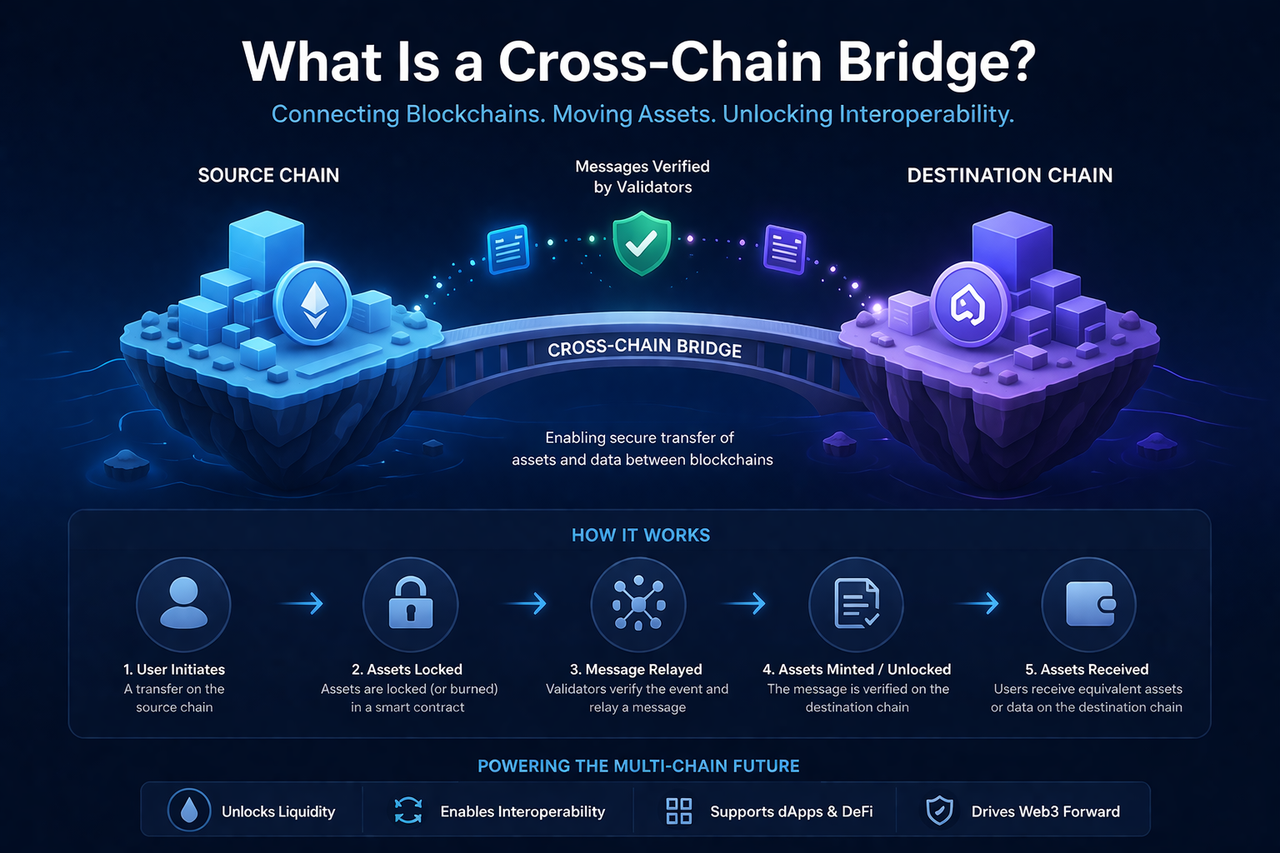
What Is a Cross-Chain Bridge?
As a technical solution designed to facilitate the transfer of assets or data between different blockchains. The Cross-Chain Bridge primary function is to break down the barriers between chains, allowing users to move value or execute operations across multiple networks.
Since most blockchains lack built-in interoperability, cross-chain bridges introduce an additional protocol layer to enable information transfer and state synchronization between chains, effectively creating “cross-chain connectivity.”
At its core, a cross-chain bridge does not directly transfer assets. Instead, it synchronizes asset states across chains, enabling value to be represented on another network. This mechanism forms the foundation of blockchain interoperability.
Why Cross-Chain Bridges Are Essential in a Multi-Chain Ecosystem
As multi-chain architectures and Layer 2 solutions continue to grow, independent asset pools and application ecosystems have emerged across networks. Without effective connectivity, assets remain confined to individual chains, limiting their usability and liquidity.
Cross-chain bridges address this by enabling seamless movement between networks. Users can choose where to operate based on factors such as transaction cost, performance, or application availability. For example, transferring assets from a mainnet to a lower-cost network to participate in DeFi is one of the most common use cases.
In addition, cross-chain bridges provide developers with the infrastructure needed to build cross-chain applications, allowing a single application to operate across multiple blockchains.
How Do Cross-Chain Bridges Work? Core Mechanisms Explained
The underlying logic of cross-chain bridges revolves around two key components: asset handling and message verification. The core process can be summarized as follows:
Assets are locked or burned on the source chain → a cross-chain message is generated and transmitted → the destination chain verifies the message and releases or mints corresponding assets.
Based on this framework, most cross-chain bridges adopt one of three primary mechanisms:
-
Lock and mint: Assets are locked on the source chain, and equivalent wrapped assets are minted on the destination chain, such as wETH.
-
Burn and mint: Assets are burned on the source chain and reissued as native assets on the destination chain.
-
Lock and unlock (liquidity pool): Pre-supplied liquidity is used to release assets directly on the destination chain without minting.
Additionally, intent-based cross-chain approaches are emerging. Users simply specify their desired outcome, and the system automatically determines the optimal route and executes the transaction, reducing operational complexity.
Key Participants and Network Structure
Cross-chain bridges rely on multiple roles working together.
Users initiate cross-chain requests, while validators or relayers monitor on-chain events and transmit messages. Some bridges also depend on oracles or validation networks to confirm transaction authenticity.
Structurally, cross-chain bridges can be categorized as decentralized or centralized, with differences primarily in their validation mechanisms and trust models. These differences directly impact their security.
Main Use Cases of Cross-Chain Bridges
Cross-chain bridges are used across a wide range of blockchain scenarios.
For asset transfers, users can move assets from a main chain to Layer 2 networks to reduce transaction costs. In DeFi, bridges allow users to shift strategies and access liquidity across different chains.
They also enable NFT and in-game asset transfers across chains, as well as cross-chain governance and data transmission, which are becoming increasingly important use cases.
Types of Cross-Chain Bridge Protocols and Design Differences
Cross-chain bridges vary significantly in design. From a functional perspective, they can be divided into asset bridges focused on transferring value, and general-purpose bridges that support cross-chain messaging. From a structural standpoint, they can be categorized as native bridges or third-party bridges.
Bridge aggregators further enhance usability by integrating multiple cross-chain protocols into a single interface and automatically selecting the optimal route. This reduces user friction and improves efficiency.
In practice, different protocols vary widely in mechanism design, validation methods, and user experience. Below is a brief overview of several major cross-chain protocols and their distinct design directions:
-
Wormhole, LayerZero: Focus on cross-chain communication and general messaging
-
Stargate, Synapse: Focus on liquidity and asset bridging
-
Across: Focus on intent-driven design and user experience optimization
-
CCTP: Emphasizes native asset transfers
-
Rubic: Provides aggregation and abstraction layers
Wormhole: A General Messaging Bridge for Multi-Chain Connectivity
Wormhole is a general-purpose cross-chain protocol that supports both asset transfers and cross-chain messaging. Its core mechanism is based on lock and mint, with cross-chain messages verified by a decentralized Guardian network.
It supports multiple non-EVM chains, such as Solana, making it a key infrastructure component for connecting heterogeneous blockchains.
Across Protocol: Intent-Based Cross-Chain Architecture
Across Protocol adopts an intent-driven model, where users simply define their desired outcome. A competitive relayer network then identifies and executes the optimal path automatically.
Its core advantage lies in combining liquidity relayers with delayed settlement, enabling fast and low-cost transfers. It represents a broader trend toward user experience optimization in cross-chain design.
Stargate Finance: Unified Liquidity Pool Model
Stargate is built on the LayerZero cross-chain communication protocol and uses a lock and unlock liquidity pool model rather than traditional wrapped assets.
Its key advantage is enabling native asset transfers with “instant finality,” meaning users can immediately use their assets on the destination chain without waiting for additional confirmations.
Synapse Protocol: Low-Cost Cross-Chain Liquidity Network
Synapse Protocol focuses on cross-chain asset transfers and swaps, supported by multi-chain liquidity pools.
By optimizing routing and liquidity distribution, it reduces cross-chain costs and is well suited for frequent, small transactions. It also supports cross-chain messaging and is gradually evolving into a more general-purpose bridge.
LayerZero: Cross-Chain Communication Infrastructure
LayerZero is not a traditional bridge, but a foundational cross-chain communication protocol. It enables message passing between chains through a combination of light nodes, oracles, and relayers.
Applications built on LayerZero, such as Stargate, benefit from more flexible cross-chain design, positioning it closer to an infrastructure layer rather than a standalone bridge.
Circle CCTP: A Burn and Mint Model for Native Transfers
Circle’s Cross-Chain Transfer Protocol, or CCTP, uses a burn and mint mechanism to enable native stablecoin transfers across chains.
Instead of relying on asset custody, it burns assets on the source chain and reissues them on the destination chain. This avoids the complexity of wrapped assets, though it requires robust verification mechanisms.
Rubic: A Cross-Chain Bridge Aggregator
Rubic represents a cross-chain bridge aggregator. Its core function is to integrate multiple cross-chain protocols and liquidity sources into a unified interface.
Users do not need to understand the underlying bridge mechanisms. The system automatically selects the best route to complete transactions. This reflects a broader trend toward abstraction and aggregation in cross-chain solutions.
Security Risks and Attack Vectors of Cross-Chain Bridges
Because cross-chain bridges often manage large volumes of assets, security remains a primary concern.
Risks generally fall into two categories. The first is technical risk, including smart contract vulnerabilities and logic flaws. The second is trust-related risk, such as compromised validation mechanisms or failures in access control.
In real-world incidents, attacks often stem from weak validation systems or overly centralized control, leading to unauthorized asset transfers. As a result, cross-chain bridges are considered one of the higher-risk areas in blockchain security.
Advantages and Limitations of Cross-Chain Bridges
The main advantage of cross-chain bridges is their ability to unlock liquidity and increase flexibility, allowing assets to move freely across ecosystems.
However, their limitations are equally significant. These include elevated security risks, complex mechanisms, and reliance on additional trust assumptions. While they offer convenience, they also introduce higher barriers to safe usage.
Future Trends in Cross-Chain Technology
Cross-chain technology is evolving toward higher levels of abstraction, with “chain abstraction” emerging as a key direction. This concept aims to allow users to perform cross-chain operations without needing to understand the underlying blockchains.
At the same time, standardization efforts are improving compatibility between protocols. On the security front, multi-layer validation mechanisms and modular architectures are being introduced to reduce systemic risk.
In the future, cross-chain bridges may become more deeply integrated with wallets, trading platforms, and other services, delivering a more unified user experience.
Conclusion
Cross-chain bridges are essential infrastructure in a multi-chain ecosystem. At their core, they enable value transfer across blockchains through asset locking and state synchronization.
While they play a critical role in unlocking liquidity and enabling cross-chain applications, their security risks and complexity cannot be overlooked. Understanding how they work provides a clearer framework for navigating the evolving cross-chain landscape.
FAQs
What is the core function of a cross-chain bridge?
It enables the transfer of assets and data between different blockchains, improving interoperability.
Why must assets be locked or burned in cross-chain transfers?
To prevent duplication across chains and ensure consistency in total supply.
Are cross-chain bridges fully decentralized?
Not all bridges are fully decentralized. Some still rely on specific validators or operators.
Are cross-chain bridges safe?
They carry inherent risks, and their security depends on contract design and validation mechanisms.
What is the difference between cross-chain transfers and exchange transfers?
Cross-chain bridges operate on-chain, while exchange transfers rely on centralized custody systems.
Can all blockchains support cross-chain functionality?
Not all blockchains natively support cross-chain interactions. Most require specific protocols or bridge integrations.







