SEC Trading and Markets Division Clarifies Custody Standards for Crypto Asset Securities
Statement Background and Scope
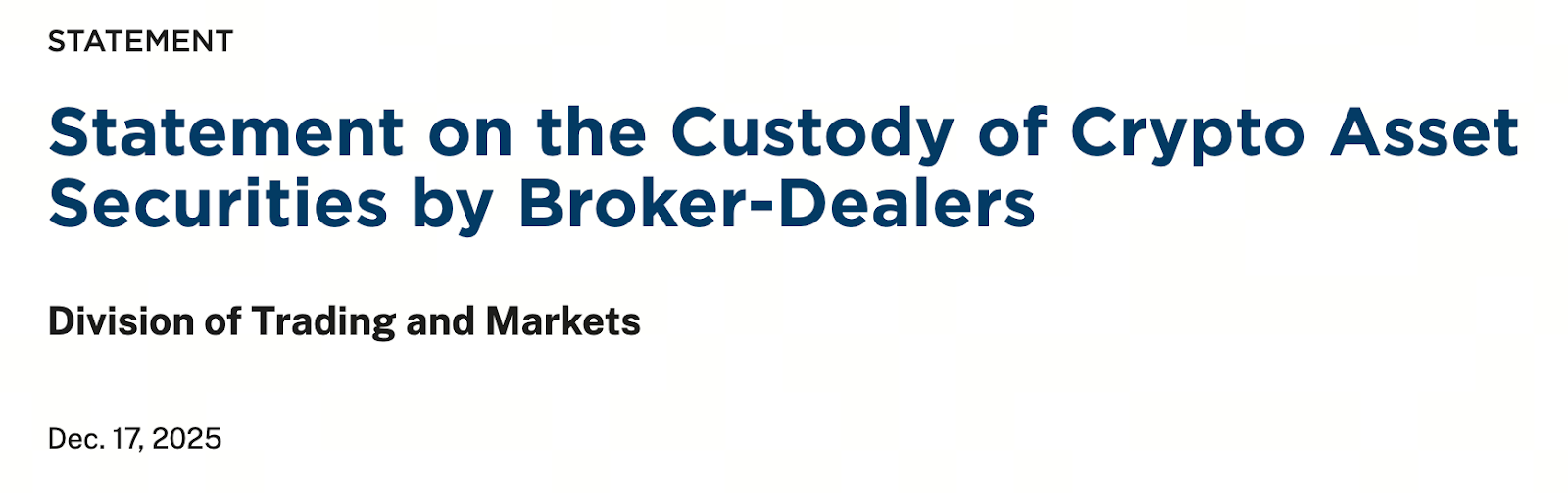
(Source: U.S. Securities and Exchange Commission)
The SEC’s Division of Trading and Markets issued this statement to clarify how Rule 15c3-3(b)(1) applies to crypto asset securities. This guidance is directed at all broker-dealers holding crypto asset securities for clients, including those also engaged in traditional securities business. It is important to emphasize that this statement reflects only the staff’s views; it is not an official rule or guidance and does not alter existing legal obligations. Instead, it serves as a transitional statement as regulators continue to evaluate related issues.
Core Requirements for Physical Possession under Rule 15c3-3
Under Rule 15c3-3, broker-dealers must promptly obtain and continuously maintain physical possession or control over customers’ “fully paid securities” and “excess margin securities.” This statement from the Division of Trading and Markets focuses solely on the criteria for “physical possession” and does not address other financial responsibility or compliance requirements. Provided certain conditions are met and proper measures are taken, regulators will not object to a broker-dealer regarding itself as having physical possession of clients’ crypto asset securities.
Direct Access and Transfer Capability for Crypto Assets
If a broker-dealer chooses to self-custody clients’ crypto asset securities, it must be able to directly access these assets and have the technical capability to transfer them on the relevant distributed ledger. This means the broker-dealer must have actual control over the asset’s technology and transfer mechanisms, not simply rely on third parties.
Risk Assessment Mechanisms for Distributed Ledger Technology
Before taking on custody of crypto asset securities, broker-dealers must develop and implement written policies and procedures to assess the distributed ledger technology and its network used by the asset, and must review these assessments regularly.
Evaluations must address system performance, scalability, security, governance structure, and the impact of protocol updates, hard forks, or other technical changes. The goal is to identify significant technical or operational risks that could affect the broker-dealer’s ability to hold the assets and to implement effective risk controls.
Do Not Treat as Held When Major Issues Exist
If a broker-dealer is aware of significant security flaws or operational issues in the technology or network supporting a crypto asset, or if these present material risks to its business, the asset should not be considered as held by the broker-dealer. This determination is focused on risks directly tied to custody, not market volatility or reputational factors.
Private Key Security and Access Controls
Broker-dealers must establish internal controls that meet industry best practices to prevent theft, loss, or unauthorized use of private keys. Policies and controls must ensure that, except for the broker-dealer itself, no third party—including clients or affiliates—can transfer crypto assets without authorization.
Asset Protection and Contingency Planning for Emergencies
Broker-dealers must have clear contingency plans for scenarios such as blockchain failures, 51% attacks, hard forks, or airdrops to ensure the security and accessibility of crypto asset securities during unexpected events.
These arrangements must also provide for compliance with legal asset freezes or transfers and enable the smooth transfer of assets to a qualified receiver if the broker-dealer ceases operations, enters liquidation, or bankruptcy proceedings.
Statement Nature and Compliance Reminder
The Division of Trading and Markets emphasizes that this statement does not create new legal obligations and does not replace existing broker-dealer duties regarding investment advice, suitability, or best interest standards. All related assessments and actions must still comply with other applicable regulations.
To learn more about Web3, click to register: https://www.gate.com/
Summary
This statement from the SEC’s Division of Trading and Markets does not introduce a new regulatory framework for crypto asset securities. Instead, it clarifies under what conditions broker-dealers may be considered to have physical possession of crypto asset securities in terms of technology, risk management, and operations under the existing Rule 15c3-3. For the market, this shows regulators are seeking a practical path for compliant custody of crypto asset securities without amending current rules, while sending a clear signal that compliance is achievable, though subject to strict standards.
Share
Content
Statement Background and Scope
Core Requirements for Physical Possession under Rule 15c3-3
Direct Access and Transfer Capability for Crypto Assets
Risk Assessment Mechanisms for Distributed Ledger Technology
Do Not Treat as Held When Major Issues Exist
Private Key Security and Access Controls
Asset Protection and Contingency Planning for Emergencies
Statement Nature and Compliance Reminder
Summary


Related Articles
2025 BTC Price Prediction: BTC Trend Forecast Based on Technical and Macroeconomic Data
Flare Crypto Explained: What Is Flare Network and Why It Matters in 2025

Pi Coin Transaction Guide: How to Transfer to Gate.com
How to Use a Crypto Whale Tracker: Top Tool Recommendation for 2025 to Follow Whale Moves

What is N2: An AI-Driven Layer 2 Solution