As the cryptocurrency market has evolved from being retail-driven to increasingly institutional, its structure has undergone significant change. Larger capital inflows have led to growing trade sizes, while trading behavior has shifted from simple buying and selling to more sophisticated asset allocation and risk management strategies. In this context, the traditional order book model used by exchanges has begun to show its limitations, especially when handling large orders where liquidity depth is often insufficient.
When a large order enters the order book, it tends to consume multiple price levels quickly, causing slippage and sometimes short-term volatility. This not only increases trading costs but also makes execution outcomes less predictable. As a result, the market has turned to alternative methods for executing large trades without affecting public prices. Crypto OTC trading has emerged rapidly to meet this need.
From a broader market perspective, OTC trading represents an important yet relatively “invisible” layer of liquidity within the crypto ecosystem. Although the process is not publicly visible, it carries a substantial volume of institutional capital flows, particularly in scenarios such as asset allocation, fund rebalancing, and treasury management for projects. In these cases, OTC has effectively become the standard execution path.
Basic Concept of OTC Trading
Cryptocurrency OTC trading refers to transactions conducted outside of public exchanges, where buyers and sellers trade directly or through intermediaries. Unlike order book trading, OTC transactions are not displayed publicly; instead, they are executed through private negotiation or quotation systems.
The defining feature of this model is its private execution. Because trading intent is not exposed to the broader market, it helps prevent price fluctuations caused by large orders. OTC trades are also typically executed in a single block, meaning the entire order is completed at once after a price is agreed upon, rather than being filled in multiple parts.
Key Participants in OTC Trading
The OTC market relies on coordination among several key participants. Market makers play the most critical role by continuously providing bid and ask quotes, ensuring liquidity. Brokers or OTC platforms act as intermediaries, connecting counterparties and improving matching efficiency.
On the demand side, institutional investors and high-net-worth individuals form the primary trading base, often executing large transactions for asset allocation purposes. On the supply side, miners, project teams, and long-term holders provide tradable assets. This multi-layered participation structure allows the OTC market to flexibly match diverse trading needs.
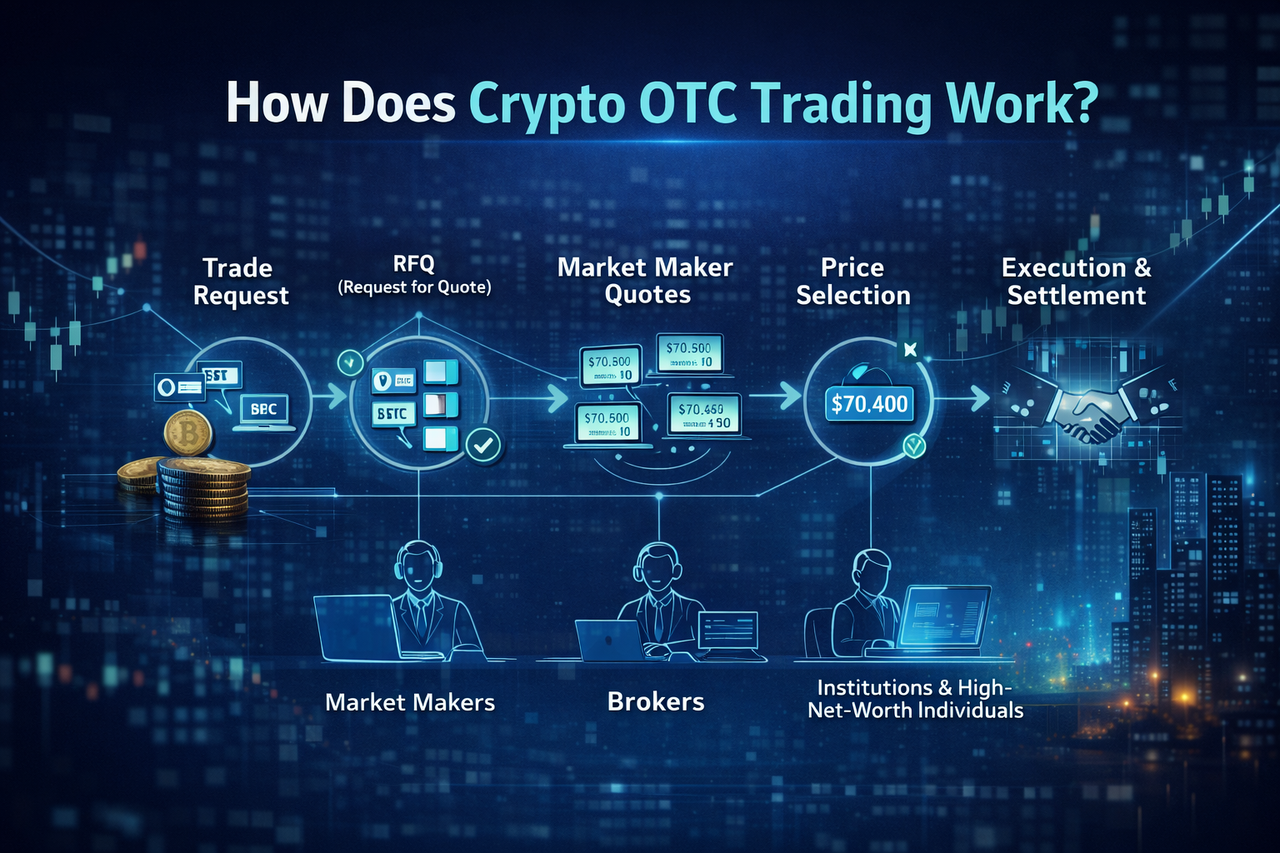
Complete OTC Trading Workflow
-
Trade Initiation
OTC trading usually begins with a clearly defined trading requirement. The trader determines the asset type, trade size, and execution objective. In institutional settings, this process is often generated automatically by trading systems and adjusted based on investment strategies.
-
RFQ (Request for Quote) Stage
Once the requirement is defined, the trader sends a request for quotes to multiple market makers through the RFQ mechanism. This request typically includes the trade size and direction but is not disclosed publicly, helping prevent market anticipation.
-
Market Maker Quoting
After receiving the RFQ, market makers provide quotes based on current market prices, liquidity conditions, and their own risk exposure. These quotes usually include a spread and remain valid for a short period.
-
Quote Evaluation and Decision
After receiving multiple quotes, the trader must choose among them. While price is important, factors such as execution certainty, speed, and counterparty reliability also influence the final decision.
-
Trade Execution
Once a quote is accepted, the trade is executed at the agreed price. Unlike exchange trading, OTC transactions are typically completed as a single block, avoiding the uncertainty of partial fills.
-
Settlement and Delivery
After execution, both parties complete asset transfers through custodial accounts or settlement systems. In some cases, third-party custodians are involved to reduce counterparty risk and enhance transaction security.
Key Mechanisms in OTC Trading
RFQ Mechanism: The Core of Price Discovery
The RFQ mechanism enables price discovery in a private environment by introducing multiple competing quotes. This approach enhances price competitiveness while avoiding the impact typically seen in public markets.
Market Maker Pricing Logic
When providing quotes, market makers consider market prices, volatility, and their own inventory levels. The spread embedded in the quote reflects both risk compensation and the cost of providing liquidity.
Role of Algorithmic Trading
With technological advancements, algorithmic trading has become an integral part of the OTC process. By automating RFQ distribution and quote selection, algorithms significantly improve execution efficiency and help identify optimal trading paths.
Differences Between OTC and Exchange Execution
The fundamental difference between OTC and exchange trading lies in their execution mechanisms. Exchanges rely on order books to match trades and discover prices, while OTC transactions are executed through private quotations. The former emphasizes transparency and continuous trading, while the latter focuses on stability and execution certainty.
This distinction determines their respective use cases. Exchanges are better suited for smaller, high-frequency trades, whereas OTC is more appropriate for large transactions and institutional operations. Together, they form a complementary relationship within the broader market ecosystem.
Advantages and Limitations of OTC Trading
The primary advantage of OTC trading is its ability to reduce slippage and avoid market impact. By executing trades privately, participants can complete large transactions without affecting public prices. Additionally, customized pricing mechanisms lead to more stable execution outcomes.
However, OTC trading also has limitations. Counterparty risk is one of the most significant concerns; if the other party fails to fulfill the agreement, it may threaten capital security. Furthermore, since the quoting process is not transparent, price visibility is relatively limited, making evaluation more challenging.
Real-World Applications of OTC Trading
In practice, OTC is widely used in institutional asset allocation, fund rebalancing, and project treasury management. For example, when institutions need to complete large-scale allocations quickly, executing through exchanges may cause significant price movements, whereas OTC provides a more stable alternative.
Additionally, during periods of heightened volatility or tight liquidity, OTC is often used as a key tool to reduce execution risk. This flexibility allows it to remain effective across different market conditions.
Summary
Cryptocurrency OTC trading enables efficient execution of large transactions through the RFQ mechanism and market maker quoting systems. Its full workflow includes trade initiation, quote collection, execution, and settlement. With the growing adoption of algorithmic trading, the process continues to improve in efficiency and reliability. As market structures evolve, OTC will remain a core component of institutional trading and a vital pillar of the crypto financial ecosystem.
FAQs
What is the fundamental difference between OTC and exchange trading?
OTC trading is conducted through private quotations without relying on a public order book, whereas exchanges use matching mechanisms for transparent trading.
Why are large trades better suited for OTC?
Because OTC avoids direct impact on market prices, reducing slippage.
What role does RFQ play in OTC?
RFQ is used to request quotes from multiple market makers and is essential for obtaining the best available price.
Does OTC trading have no market impact at all?
Not entirely, but its direct impact is significantly lower than that of exchange trading.
Is OTC trading safe?
When conducted with reliable counterparties or through custodial mechanisms, risks can be effectively managed, though careful evaluation is still necessary.







