From Spot to Futures: How to Properly Understand Futures Trading Features — A Gate Exchange Case Study

12-18-2025, 2:48:35 AM
Beginner
Quick Reads
As investors become more experienced with spot trading, many turn their attention to contract trading. This article uses Gate as a case study to systematically outline the key mindset shifts needed when moving from spot to contract trading. It also offers a detailed analysis of the core mechanics of contract trading features, providing beginners with the guidance they need for a seamless transition.

Why Spot Traders Are Turning Their Attention to Futures Trading
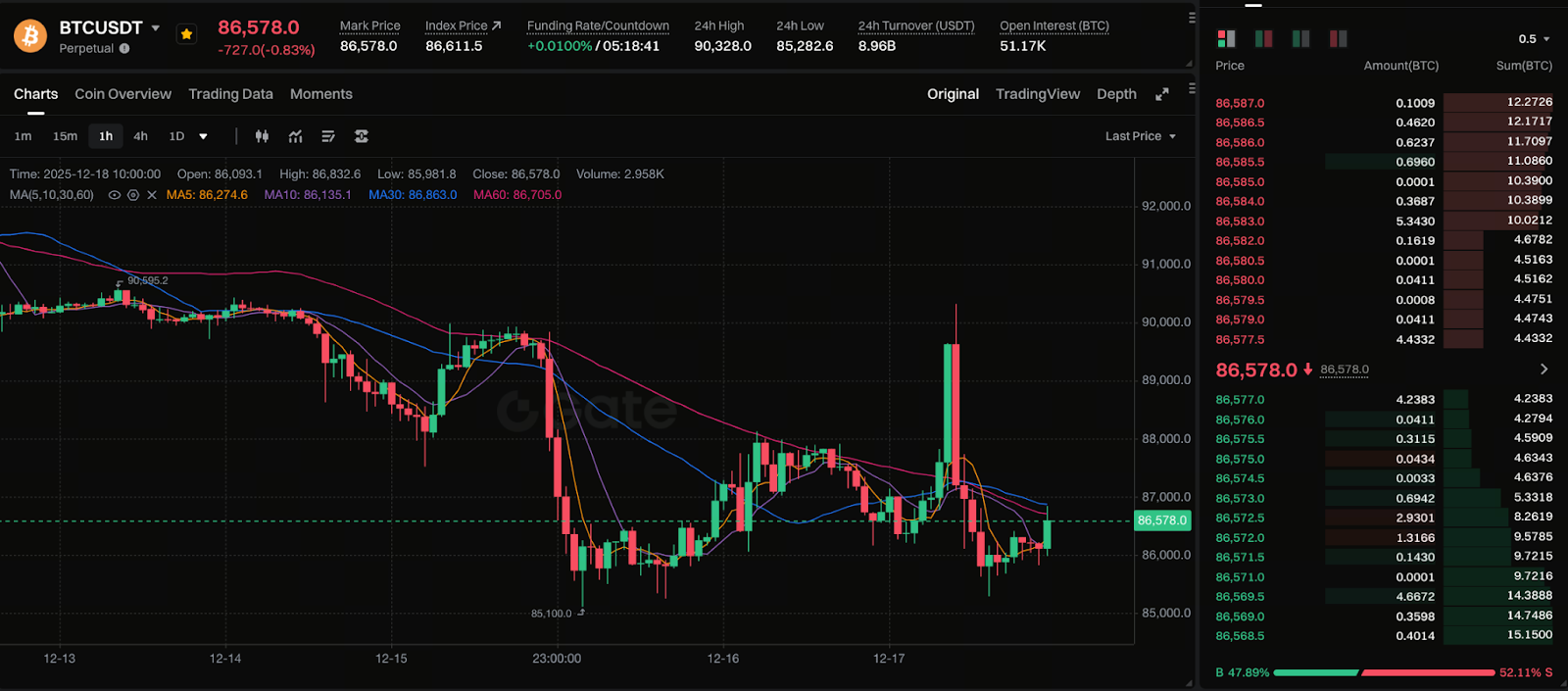

Image source: https://www.gate.com/futures/USDT/BTC_USDT

In the cryptocurrency market, most investors initially start with spot trading. As the market matures, users encounter several practical challenges:

  • Spot capital utilization remains low during volatile conditions
  • In downtrends, investors can only passively hold or cut losses
  • Spot trading struggles to fully capture short-term opportunities

At this stage, futures trading features come into focus. Futures are not designed to replace spot trading, but rather to provide more ways to implement trading strategies.

Key Differences Between Futures and Spot Trading

Spot trading is fundamentally about buying and holding assets. In contrast, the core of futures trading is managing price direction and risk exposure. The main differences include:

  • Futures do not involve asset ownership
  • You can go long or short
  • P&L depends on position size and leverage
  • Emphasis on risk control and position management

As a result, futures trading functions operate more like a comprehensive financial toolset, not simply a buy-sell interface.

Core Structure of Gate Futures Trading

Using Gate as an example, the futures trading interface consists of several key components:

  • Contract selection area
  • Leverage and margin settings
  • Position information and risk ratio display
  • Liquidation price and margin changes
  • Take-profit and stop-loss modules

These functions are interconnected, together forming a robust position management system.

From “Trading” to “Position Management”: A Mindset Shift

Spot traders typically focus on two questions:

  • When to buy
  • When to sell

In futures trading, the focus shifts to:

  • Is my position size appropriate?
  • Does my leverage match current market volatility?
  • Is my risk within a controllable range?

This shift means that effective use of futures features relies less on frequent trades and more on continuous position monitoring.

Three Critical Functional Insights for Futures Trading

1. Leverage Is a Capital Efficiency Tool—Not Just a Profit Multiplier

Within Gate’s futures system, leverage primarily determines the proportion of margin required. Using low leverage prudently can actually enhance position stability.

2. Liquidation Mechanism Is a Rule—Not an Accident

The liquidation price is not a “system risk,” but an integral part of contract rules. Understanding how liquidation prices are determined is fundamental to using futures features effectively.

3. Take-Profit and Stop-Loss Are Essential to Every Position

In futures trading, any position lacking a stop-loss is inherently incomplete. Gate’s automated take-profit and stop-loss features are designed precisely for this reason.

How Beginners Can Transition from Spot to Futures

If you’re already comfortable with spot trading, you can approach the futures market step by step:

  • Select major trading pairs you know well
  • Use the lowest available leverage
  • Start with minimal position sizes to gain experience
  • Focus on monitoring your risk ratio and liquidation price
  • Don’t chase profits—just ensure you understand the process

The goal at this stage is to master the operation of futures trading features, not to generate quick profits.

Summary: Futures Are Not an Upgrade to Spot, but a Distinct Tool

Many beginners mistakenly view futures as a “more advanced form of spot trading,” which is a common misconception. In reality, futures trading offers a wholly different trading logic.

On established platforms like Gate, the futures system is equipped with robust risk controls. Ultimately, what determines your results is whether you understand and respect these features. For beginners, using futures trading features safely is far more important than short-term gains or losses.

Author: Max
* The information is not intended to be and does not constitute financial advice or any other recommendation of any sort offered or endorsed by Gate.
* This article may not be reproduced, transmitted or copied without referencing Gate. Contravention is an infringement of Copyright Act and may be subject to legal action.

Share

Crypto Calendar
Hayabusa Yükseltmesi
VeChain, Aralık ayında planlanan Hayabusa yükseltmesini duyurdu. Bu yükseltmenin, protokol performansını ve tokenomi'yi önemli ölçüde artırmayı hedeflediği belirtiliyor ve ekip, bu güncellemeyi bugüne kadarki en çok fayda odaklı VeChain sürümü olarak nitelendiriyor.
VET
-3.53%
2025-12-27
Litewallet Gün Batımları
Litecoin Vakfı, Litewallet uygulamasının 31 Aralık'ta resmi olarak sona ereceğini duyurdu. Uygulama artık aktif olarak korunmamakta olup, bu tarihe kadar yalnızca kritik hata düzeltmeleri yapılacaktır. Destek sohbeti de bu tarihten sonra sona erecektir. Kullanıcıların Nexus Cüzdan'a geçiş yapmaları teşvik edilmektedir; Litewallet içinde geçiş araçları ve adım adım bir kılavuz sağlanmıştır.
LTC
-1.1%
2025-12-30
OM Token Göçü Sona Erdi
MANTRA Chain, kullanıcıları OM token'larını 15 Ocak'tan önce MANTRA Chain ana ağına taşımaları için bir hatırlatma yayınladı. Taşıma işlemi, $OM'nin yerel zincirine geçişi sırasında ekosistemdeki katılıma devam edilmesini sağlar.
OM
-4.32%
2026-01-14
CSM Fiyat Değişikliği
Hedera, Ocak 2026'dan itibaren KonsensüsSubmitMessage hizmeti için sabit USD ücretinin $0.0001'den $0.0008'e yükseleceğini duyurdu.
HBAR
-2.94%
2026-01-27
Vesting Kilidi Gecikti
Router Protocol, ROUTE tokeninin Hakediş kilidinin 6 aylık bir gecikme ile açılacağını duyurdu. Ekip, projenin Open Graph Architecture (OGA) ile stratejik uyum sağlamak ve uzun vadeli ivmeyi koruma hedefini gecikmenin başlıca nedenleri olarak belirtiyor. Bu süre zarfında yeni kilit açılımları gerçekleşmeyecek.
ROUTE
-1.03%
2026-01-28
sign up guide logosign up guide logo
sign up guide content imgsign up guide content img
Sign Up

Related Articles

2025 BTC Price Prediction: BTC Trend Forecast Based on Technical and Macroeconomic Data

Beginner

2025 BTC Price Prediction: BTC Trend Forecast Based on Technical and Macroeconomic Data

This article will provide a systematic interpretation of the Bitcoin price trend in 2025 from the perspectives of technical analysis, on-chain data, and macroeconomic factors, combining the latest trends and data, and supplemented with example charts to help investors form a comprehensive judgment.
7-11-2025, 10:42:17 AM
Flare Crypto Explained: What Is Flare Network and Why It Matters in 2025

Beginner

Flare Crypto Explained: What Is Flare Network and Why It Matters in 2025

Discover what Flare Crypto is, how it works, its use cases, tokenomics, and why it's gaining traction in the blockchain space in 2025.
4-15-2025, 1:21:45 AM
Pi Coin Transaction Guide: How to Transfer to Gate.com

Beginner

Pi Coin Transaction Guide: How to Transfer to Gate.com

Pi Network is a decentralized cryptocurrency network for the general public, using the Stellar Consensus Protocol (SCP) consensus mechanism, which allows users to easily mine Pi tokens from their mobile devices and use them for payments and transactions. With the official opening of the mainnet on February 20, 2025, investors can deposit and trade $PI on exchanges such as Gate.com. This article details how to securely transfer Pi Coins to Gate.com, including obtaining a deposit address, completing the transfer using the Pi Network mainnet wallet, and the exchange's arrival confirmation process. In addition, we have analysed $PI investment risks, including market volatility, compliance and potential fraud risks, to remind investors to take risk management before trading.
2-25-2025, 8:21:43 AM
How to Use a Crypto Whale Tracker: Top Tool Recommendation for 2025 to Follow Whale Moves

Beginner

How to Use a Crypto Whale Tracker: Top Tool Recommendation for 2025 to Follow Whale Moves

This article will take you through what is a crypto whale tracker and why it has become the "must-have weapon" for encryption investors. We will recommend seven mainstream Whale tracking tools, and combined with usage scenarios, teach you how to efficiently use these tools to obtain first-hand signals from the market. Of course, Whale behavior may also be a "lure," so while using these tools, you also need to have a certain level of judgment and data interpretation ability. This article is suitable for beginners to quickly get started, as well as for experienced players to optimize strategies.
4-14-2025, 6:57:17 AM
What is N2: An AI-Driven Layer 2 Solution

Beginner

What is N2: An AI-Driven Layer 2 Solution

This article introduces N2 (Niggachain AI Layer 2), the world's first AI-driven Layer 2 blockchain solution. N2 combines AI technology and quantum computing resistance to address the limitations of traditional blockchains in scalability, transaction speed, and cost. Its core technologies include '0-second block time', AI-driven network optimization, and quantum-resistant security protection, aiming to improve transaction efficiency and ensure system stability.
12-23-2024, 7:21:00 AM
Understand Baby doge coin in one article
Beginner

Understand Baby doge coin in one article

Baby Doge Coin, also known as "Baby Dog Token", is a meme token derived from the Dogecoin community, which gained popularity through Elon Musk's tweets and enhanced token utility through mechanisms such as deflation, payment integration, and NFT ecosystem. This article comprehensively analyzes the project background, token information, application scenarios, and market performance of Baby Doge, helping investors quickly understand its potential and risks.
2-14-2025, 4:53:03 PM