Bitcoin’s Shift Toward the Post-Quantum Era: Why It’s “Not Hard” but Could Take 5–10 Years
Why Bitcoin Faces Quantum Computing Challenges
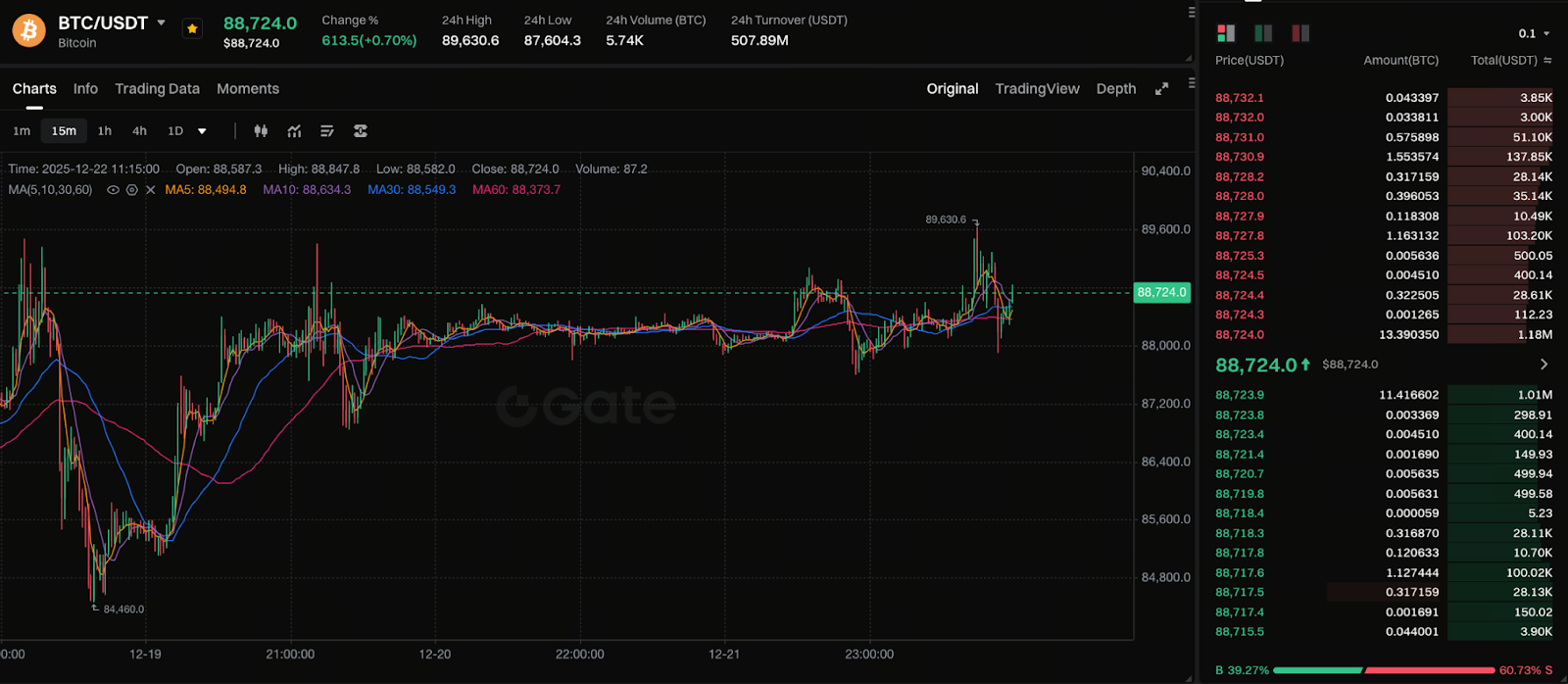
Image: https://www.gate.com/trade/BTC_USDT
Bitcoin’s security relies on modern cryptography, with hash functions and the Elliptic Curve Digital Signature Algorithm (ECDSA) at its core. In conventional computing environments, these algorithms are virtually immune to brute-force attacks. However, the rise of quantum computing has disrupted this assumption.
In theory, a sufficiently advanced quantum computer could use Shor’s algorithm to derive private keys at a fraction of the computational cost required by traditional methods. Once this technology matures, Bitcoin addresses with exposed public keys could become vulnerable. Although quantum computing remains in its infancy, its long-term implications are already a central topic in the crypto industry.
What Is Bitcoin in the “Post-Quantum Era”?
“Post-quantum migration” does not mean Bitcoin must be completely redesigned. Instead, it refers to the gradual adoption of post-quantum cryptography (PQC) in the future to replace or enhance current signature mechanisms.
Today, the global cryptography community has proposed several quantum-resistant algorithms, such as those based on lattice cryptography or hash-based signatures. These approaches are theoretically resilient to quantum attacks and offer technical pathways for future Bitcoin security upgrades.
Is It Really “Easy” from a Technical Perspective?
From a technical perspective, adding support for new cryptographic algorithms in Bitcoin is not inherently difficult. The protocol is designed to be upgradeable, allowing new signature rules to be implemented through a soft fork or hard fork. As a result, some developers argue that “migrating Bitcoin to the post-quantum era is not technically complex.”
However, Bitcoin is not governed by a single authority. Any protocol upgrade requires widespread consensus among miners, nodes, wallet providers, and users. While the technical changes may be straightforward, achieving social coordination is much more challenging.
Why Migration Still Requires 5–10 Years
Industry experts generally estimate that Bitcoin’s post-quantum migration will take 5–10 years for several key reasons:
1. Bitcoin prioritizes stability, so any modifications to its security core demand extensive, long-term testing and auditing.
2. With hundreds of millions of addresses and wallets worldwide, migration must proceed gradually, requiring old and new systems to coexist for years.
3. User education and infrastructure upgrades are also time-intensive, as exchanges, custodians, and hardware wallet providers all need to synchronize their updates.
Therefore, even though quantum threats are not imminent, the Bitcoin community prefers to plan proactively and advance cautiously.
Potential Impact on Bitcoin Price and Market
From a market standpoint, quantum risk is more of a long-term variable than a short-term bearish factor. Rational investors typically view it as part of technological progress, not a sign of systemic failure.
If the Bitcoin community provides a clear upgrade roadmap, it could strengthen market confidence. Conversely, a prolonged lack of solutions could heighten market volatility during periods when quantum computing becomes a hot topic.
How Investors Should Rationally View Quantum Risk
For most investors, quantum computing does not warrant immediate action. Instead, it’s more important to monitor the progress of discussions among Bitcoin’s core developers and the broader community, recognizing that this is a gradual, long-term process.
In the coming years, quantum security is likely to act as a slow-moving variable, gradually shaping market perceptions rather than abruptly changing the foundation of Bitcoin’s value.
Share
Content


Related Articles

2025 BTC Price Prediction: BTC Trend Forecast Based on Technical and Macroeconomic Data

Flare Crypto Explained: What Is Flare Network and Why It Matters in 2025

Pi Coin Transaction Guide: How to Transfer to Gate.com

How to Use a Crypto Whale Tracker: Top Tool Recommendation for 2025 to Follow Whale Moves

What is N2: An AI-Driven Layer 2 Solution