Understanding Bitcoin Dominance: A Comprehensive Guide

2025-10-27 10:21:55
Altcoins
Bitcoin
Crypto Insights
Crypto Trading
Cryptocurrency market
Article Rating : 3.5
half-star
0 ratings
Understanding Bitcoin Dominance provides a comprehensive guide to BTC.D, a metric determining Bitcoin's market share in the cryptocurrency world. The article explores how Bitcoin dominance affects altcoins and offers insights for traders to optimize strategies, understanding market cycles and dynamics. It addresses the significance and limitations of BTC.D charts, emphasizing their role in refined trading. Ideal for investors seeking informed portfolio decisions, it integrates BTC.D with broader market analytics, ensuring well-rounded comprehension.
Understanding Bitcoin Dominance: A Comprehensive Guide

Understanding Bitcoin Dominance: BTC.D Explained

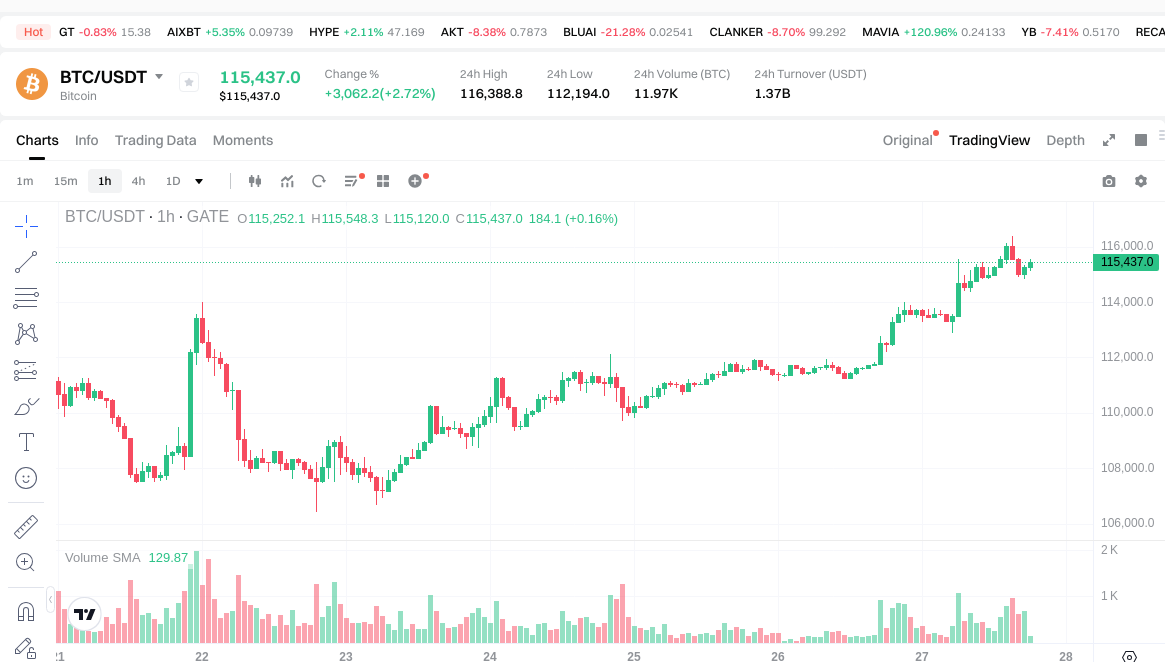
Bitcoin dominance (BTC.D) is a crucial metric in the cryptocurrency market that measures Bitcoin's share of the total market capitalization. This article explores the concept of Bitcoin dominance, its implications, and its significance for traders and investors. image_url
What Is Bitcoin Dominance?

Bitcoin dominance, often abbreviated as BTC.D, represents the percentage of the total cryptocurrency market capitalization that Bitcoin holds. It is calculated by dividing Bitcoin's market cap by the total market cap of all cryptocurrencies. This metric helps investors understand the relative strength of Bitcoin compared to other cryptocurrencies.

Bitcoin dominance can fluctuate based on market conditions. When it rises, it typically indicates a conservative market leaning towards Bitcoin. Conversely, when it falls, it often signals growing interest in other cryptocurrencies, sometimes leading to a period of increased altcoin activity.

What Is the Bitcoin Dominance Chart (BTC.D)?

The Bitcoin Dominance Chart (BTC.D) is a technical tool that visualizes Bitcoin's market share over time. It displays Bitcoin's percentage of the total crypto market cap, allowing traders to track trends and shifts in market dynamics. The chart includes parameters such as different timeframes and the inverse relationship between Bitcoin and other cryptocurrency market shares.

How To Read the Bitcoin Dominance Chart

Interpreting the BTC.D chart provides valuable insights into market cycles and sentiment. High dominance suggests a Bitcoin-led market or capital flight from other cryptocurrencies, while low dominance indicates increased risk appetite and strong performance of alternative digital assets. Sudden shifts in the chart may precede or follow major market movements, acting as leading or lagging indicators.

How BTC.D Impacts Other Cryptocurrency Prices

Bitcoin dominance has a direct effect on the performance of other cryptocurrencies. For example, when BTC.D is rising and Bitcoin's price is also increasing, other cryptocurrency prices typically drop or gain less than Bitcoin. Conversely, when BTC.D is falling and Bitcoin's price is rising, other cryptocurrency prices tend to rise more than Bitcoin. Understanding these relationships can help traders make more informed decisions.

Why Bitcoin Dominance Matters for Your Crypto Trading Strategy

Bitcoin dominance is a valuable tool for refining crypto trading strategies. It offers insights into risk sentiment, helps in timing entries for other cryptocurrencies, aids in understanding market cycle positioning, provides diversification cues, and can serve as an exit indicator. By integrating BTC.D into their analysis, traders can better align their portfolios with evolving market trends.

Limitations of the Bitcoin Dominance Chart

While the BTC.D chart is useful, it has limitations. It doesn't reflect market cap manipulation, ignores trading volume, excludes the influence of stablecoins, and can be less relevant during extreme market phases. Additionally, it's most effective when used in conjunction with other analytical tools rather than in isolation.

Conclusion

Bitcoin dominance is a powerful indicator that provides valuable insights into the cryptocurrency market dynamics. By understanding and utilizing BTC.D, traders and investors can make more informed decisions about their cryptocurrency portfolios. However, it's essential to recognize its limitations and use it as part of a comprehensive analysis strategy rather than relying on it exclusively. As the crypto market continues to evolve, staying informed about metrics like Bitcoin dominance will remain crucial for navigating this dynamic landscape.

FAQ

What is Bitcoin dominance (BTC.D)?

Bitcoin dominance is a metric that measures Bitcoin's share of the total cryptocurrency market capitalization, calculated by dividing Bitcoin's market cap by the total market cap of all cryptocurrencies.

How does Bitcoin dominance impact other cryptocurrency prices?

When BTC.D rises and Bitcoin's price increases, other cryptocurrency prices typically drop or gain less than Bitcoin. Conversely, when BTC.D falls and Bitcoin's price rises, other cryptocurrencies tend to rise more than Bitcoin.

What are the limitations of the Bitcoin Dominance Chart?

The BTC.D chart doesn't reflect market cap manipulation, ignores trading volume, excludes the influence of stablecoins, and can be less relevant during extreme market phases. It's most effective when used with other analytical tools.

* The information is not intended to be and does not constitute financial advice or any other recommendation of any sort offered or endorsed by Gate.
Related Articles
Bitcoin Dominance Suggests Shift in Cryptocurrency Market Trends

Bitcoin Dominance Suggests Shift in Cryptocurrency Market Trends

The article analyzes a notable shift in the cryptocurrency market as the Altcoin Season Index drops to 12, highlighting Bitcoin's dominance. It explores historical patterns indicating potential altcoin rallies following periods of significant Bitcoin strength. The content addresses investor concerns on market dynamics, presenting opportunities for strategic altcoin accumulation. Structured logically, it covers the decline of the Altcoin Index, historical precedents, and strategic insights for market participants. Key topics include Bitcoin dominance, altcoin opportunities, historical cyclical patterns, and strategic positioning for potential capital gains.
2025-11-18 03:31:42
# How Does AERGO Price Volatility Compare to Bitcoin: 2025 Analysis with Support and Resistance Levels?

# How Does AERGO Price Volatility Compare to Bitcoin: 2025 Analysis with Support and Resistance Levels?

# AERGO Price Volatility Analysis: 2025 Comparative Study with Bitcoin Support and Resistance Levels This comprehensive guide examines **AERGO price volatility** against Bitcoin's market dynamics, providing traders and investors with actionable technical insights. The article tracks AERGO's trajectory from $0.01354723 ATL to $0.658178 ATH, currently trading at $0.06612, while comparing its 17% intraday fluctuation range against Bitcoin's institutional stability. Readers will discover critical **support levels at $0.0584 and resistance at $0.0722**, alongside correlation analysis revealing AERGO's independent market movements relative to BTC and ETH. Perfect for Gate traders seeking volatility opportunities, technical analysts optimizing entry/exit strategies, and cryptocurrency portfolio managers evaluating risk-adjusted positioning, this analysis delivers essential **support and resistance zones** with mixed technical signals (7 buy vs. 6 sell) for 2025-2026 trading cycles.
2026-01-02 09:36:12
# What is driving TXC price volatility and how does it compare to Bitcoin?

# What is driving TXC price volatility and how does it compare to Bitcoin?

The article analyzes TEXITcoin (TXC) price volatility and its comparison with Bitcoin, highlighting the mixed signals in TXC's current trading range and the technical factors influencing its behavior. It addresses the emerging market structure of TXC against Bitcoin's mature framework, emphasizing TXC's high volatility and weaker correlation to Bitcoin. The article serves traders and investors by providing insights into risk management and strategic decision-making based on support and resistance levels, historical price patterns, and market dynamics. It underscores the need for distinct strategies for TXC due to its unique risk profile, contrasting it with Bitcoin's stability.
2025-12-26 10:09:31
PENGU Price Analysis: Volatility Patterns, Support at $0.0087 and BTC Correlation

PENGU Price Analysis: Volatility Patterns, Support at $0.0087 and BTC Correlation

Dive into the world of PENGU, where volatility reigns supreme. From $0.00598 to $0.0341 in 2025, this cryptocurrency's price history is a rollercoaster of opportunity and risk. Discover key support and resistance levels, explore its correlation with Bitcoin, and unravel the 30-day volatility mystery. Are you ready to navigate PENGU's turbulent waters?
2025-06-28 14:04:44
Movement (MOVE) Price Analysis: Volatility Comparison with BTC and ETH in 2025

Movement (MOVE) Price Analysis: Volatility Comparison with BTC and ETH in 2025

In 2025, the cryptocurrency market witnessed a seismic shift as Movement's price volatility surpassed both Bitcoin and Ethereum. This unprecedented development sent shockwaves through the industry, challenging long-held assumptions about market dynamics. Dive into our analysis to uncover the factors behind Movement's extreme price swings and their impact on the crypto landscape.
2025-06-24 03:30:41
AB Coin Price Analysis: Historical Trends, Volatility & Correlation with BTC/ETH

AB Coin Price Analysis: Historical Trends, Volatility & Correlation with BTC/ETH

Dive into the fascinating world of cryptocurrency correlations, where Bitcoin and Ethereum reign supreme. Uncover the intricate dance of digital assets as we analyze their intertwined relationships across bull runs, bear markets, and sideways trends. Learn how these correlations impact your investment strategy and navigate the crypto seas with confidence.
2025-06-25 03:17:01
Recommended for You
MOOO vs ARB: A Comprehensive Comparison of Two Leading Blockchain Governance Tokens

MOOO vs ARB: A Comprehensive Comparison of Two Leading Blockchain Governance Tokens

# Article Overview: MOOO vs ARB Comprehensive Comparison This article provides an in-depth investment comparison between MOOO (Hashtagger's SocialFi utility token) and ARB (Arbitrum's Layer 2 governance token), analyzing their market positioning, price performance, and investment potential. It addresses critical questions for cryptocurrency investors: which token offers better value, risk-adjusted returns, and alignment with individual investment strategies. The analysis covers historical price trends, tokenomics, ecosystem development, and 2026-2031 price forecasts across conservative and optimistic scenarios. Designed for both beginner and experienced investors, this guide offers actionable allocation recommendations, risk assessments, and strategic insights to support informed decision-making in the evolving blockchain governance token market on Gate.

2026-01-05 20:13:36
ONC vs OP: Understanding the Key Differences Between Oncorhynchus and Oncorhynchus Populations in Pacific Salmon Management

ONC vs OP: Understanding the Key Differences Between Oncorhynchus and Oncorhynchus Populations in Pacific Salmon Management

# Article Overview: ONC vs OP Investment Comparison Guide This comprehensive guide analyzes the investment value comparison between One Cash (ONC) and Optimism (OP), two distinct cryptocurrency assets with vastly different market trajectories and use cases. The article examines historical price trends, tokenomics, institutional backing, and ecosystem development to help investors make informed decisions. It addresses critical questions: Which token offers better investment potential? How do risk profiles differ? What are optimal allocation strategies for various investor types? Through detailed market analysis, 2026-2031 price predictions, and risk assessments, this guide serves beginner, experienced, and institutional investors seeking Layer 2 infrastructure exposure. Detailed comparisons include liquidity metrics, governance frameworks, technical architecture, and regulatory positioning, with actionable investment recommendations and comprehensive risk warnings for the volatile cryptocurrency market. **Ke
2026-01-05 20:12:07
RUNI vs APT: A Comprehensive Comparison of Two Leading Application Performance Testing Frameworks

RUNI vs APT: A Comprehensive Comparison of Two Leading Application Performance Testing Frameworks

# RUNI vs APT: A Comprehensive Comparison of Two Leading Application Performance Testing Frameworks ## Article Overview This comprehensive analysis compares RUNI and APT across pricing dynamics, market positioning, and investment value. RUNI, launched in 2024, delivers blockchain development tools and launchpad services, while APT, established in 2022, operates as a high-performance Layer 1 blockchain utilizing Move programming language. The article examines historical price trends, supply mechanisms, ecosystem maturity, and 2026-2031 price forecasts to answer the critical question: which asset represents superior investment value? By analyzing market capitalization rankings, trading volumes on Gate, technology risk factors, and regulatory exposure, this guide empowers investors to align cryptocurrency portfolio allocation with their risk tolerance and investment objectives. **Key Topics:** RUNI price prediction | APT cryptocurrency comparison | Layer 1 blockchain investment | Move programming language | b
2026-01-05 20:11:58
An Introduction to Bitcoin ATMs

An Introduction to Bitcoin ATMs

This comprehensive beginner’s guide explains how to use Bitcoin ATMs, including details on fees, locations, and step-by-step instructions. Discover how to purchase BTC with cash, review essential security practices, and see how Bitcoin ATMs compare to online exchanges like Gate. Use this guide to trade cryptocurrencies safely and efficiently.

2026-01-05 19:42:20
What is PCE Deflator and How Does It Work?

What is PCE Deflator and How Does It Work?

# Understanding the PCE Deflator: A Comprehensive Guide The PCE deflator serves as the Federal Reserve's primary inflation measurement tool, tracking price changes across consumer goods and services with broader scope than traditional metrics. This guide explains how the PCE deflator works, its calculation methodology, and its significance for policymakers, investors, and economists. Discover why the PCE deflator outperforms the CPI, how it influences monetary policy decisions, and its emerging relevance to cryptocurrency market sentiment on platforms like Gate. Whether you're analyzing economic trends or making investment decisions, understanding PCE deflator fundamentals equips you with insights into inflation dynamics, purchasing power erosion, and strategic asset allocation in response to macroeconomic pressures.

2026-01-05 19:38:56
Gala - Gaming Blockchain Ecosystem

Gala - Gaming Blockchain Ecosystem

# Article Introduction This comprehensive guide explores Gala, a blockchain-based gaming platform revolutionizing Web3 gaming through decentralized infrastructure and mainstream adoption strategies. Discover how Gala integrates NFT gaming, LG Smart TV distribution, and AAA titles while maintaining genuine user utility beyond speculation. Learn about GalaChain infrastructure, market positioning, token economics, and investment considerations. Perfect for crypto investors, gamers, and developers seeking insights into Gala's ecosystem maturation, cross-chain bridge development, and strategic partnerships. This resource answers key questions about gameplay, asset trading on Gate, token acquisition, earning mechanisms, platform advantages, and risk assessment—offering both technical analysis and practical guidance for navigating the evolving Web3 gaming landscape.

2026-01-05 19:35:03




