RUNI vs APT: A Comprehensive Comparison of Two Leading Application Performance Testing Frameworks

Introduction: RUNI vs APT Investment Comparison
In the cryptocurrency market, the comparison between RUNI and APT has become an increasingly relevant topic for investors. The two assets demonstrate significant differences in market capitalization rankings, use cases, and price performance, representing distinct positioning strategies within the crypto asset landscape. RUNI (Runes Terminal): Launched in 2024, it has gained market recognition by providing blockchain development tools and services, including a launchpad platform, block explorer, and token creation platform designed to support blockchain projects and developers. APT (Aptos): Since its launch in 2022, it has established itself as a high-performance Layer 1 blockchain, leveraging the Move programming language and Move virtual machine to deliver secure and scalable blockchain infrastructure. This article will conduct a comprehensive analysis of RUNI vs APT across historical price trends, supply mechanisms, ecosystem development, and market positioning, addressing the key question investors are asking:
"Which is the better investment option currently?"
I. Price History Comparison and Current Market Status
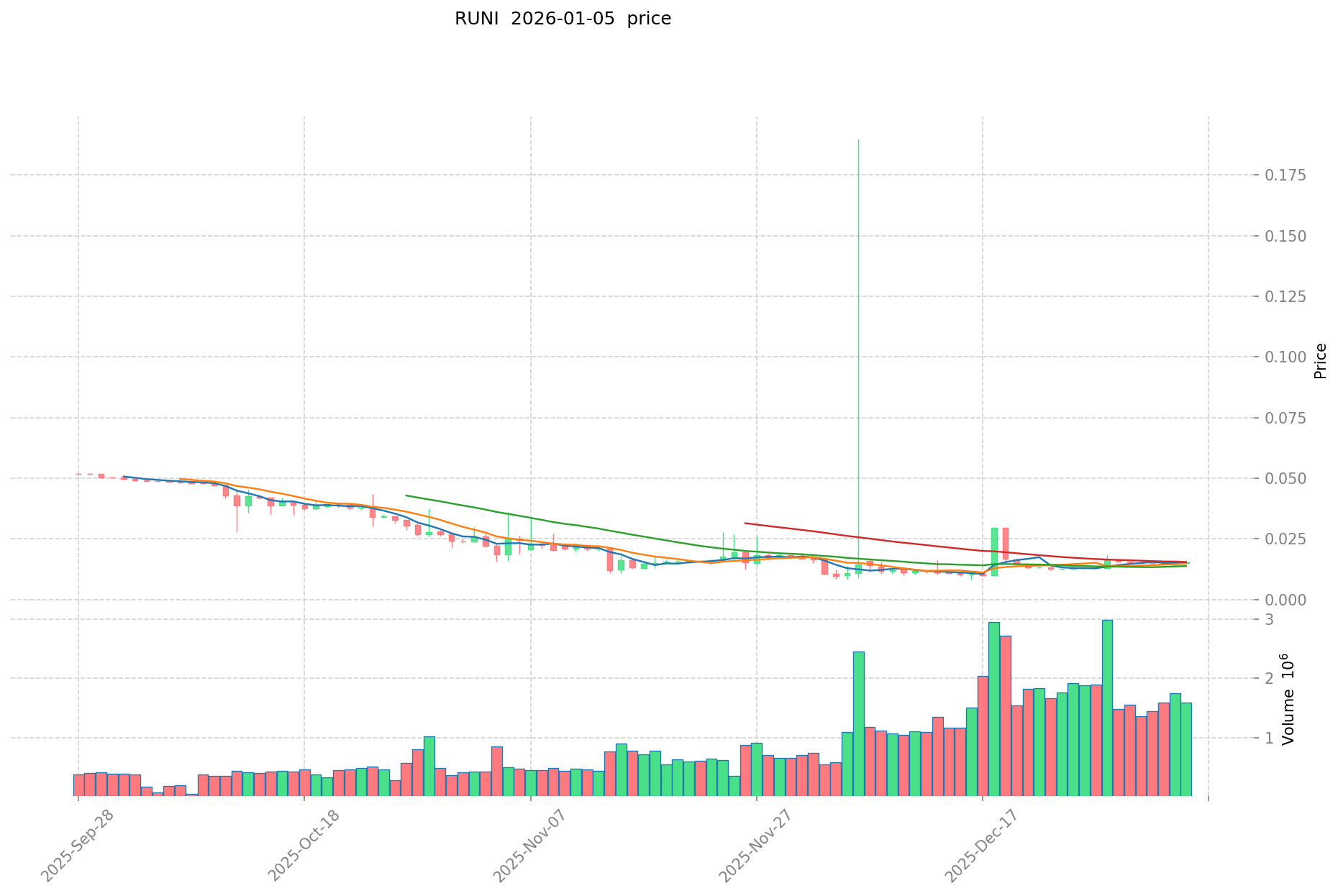
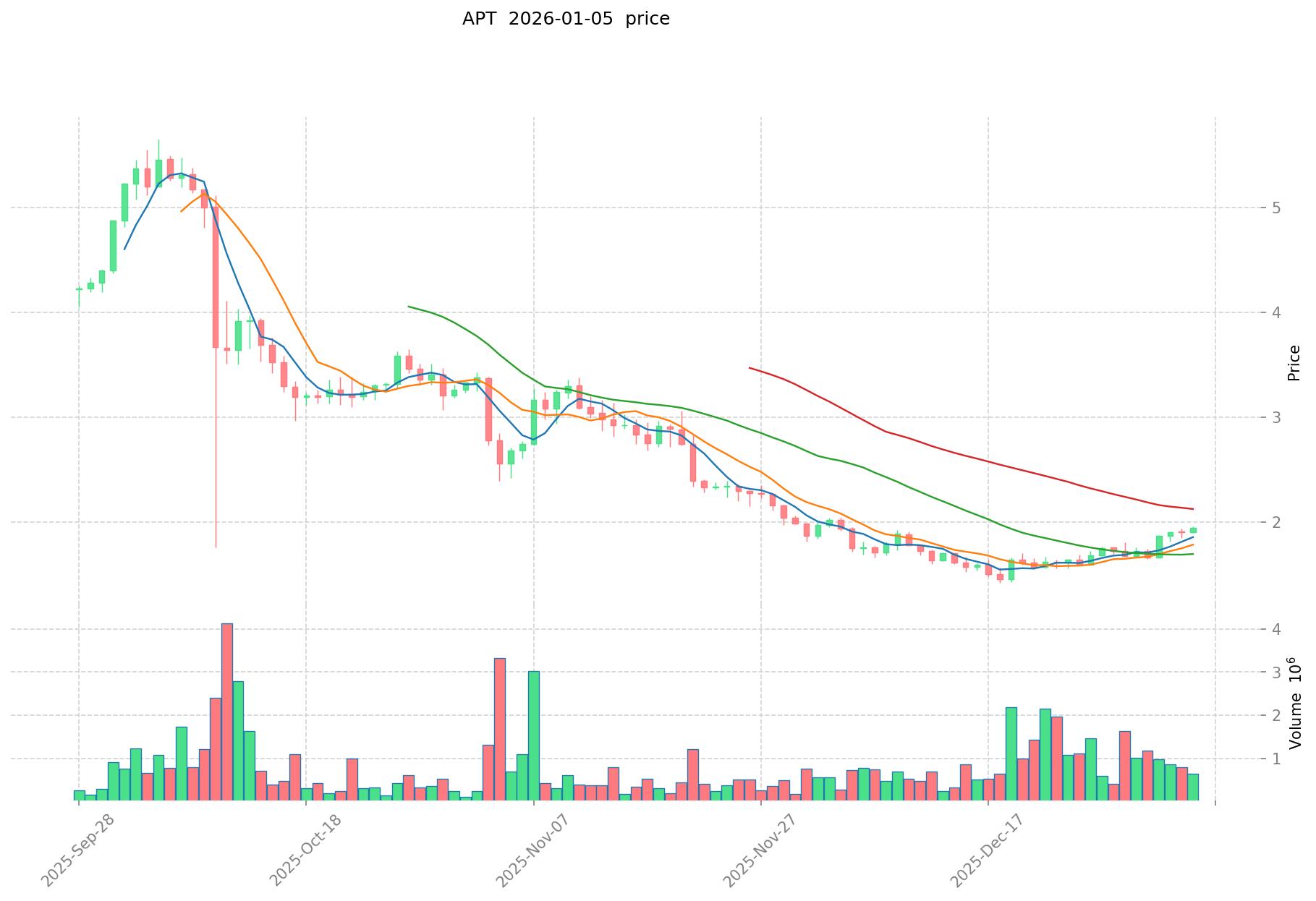
RUNI (Runesterminal) and APT (Aptos) Historical Price Trends
- July 2, 2024: RUNI reached its all-time high of $2.836 following its launch on the Runes terminal platform.
- January 26, 2023: APT achieved its all-time high of $19.92 during the early bull market phase after mainnet launch in October 2022.
- Comparative analysis: From its peak to the current period, RUNI has declined from $2.836 to $0.01514, representing a 94.66% depreciation. In contrast, APT has fallen from $19.92 to $1.9759, representing a 90.10% depreciation from its historical maximum.
Current Market Status (January 6, 2026)
- RUNI current price: $0.01514
- APT current price: $1.9759
- 24-hour trading volume: RUNI $24,117.63 vs APT $1,959,843.33
- Cryptocurrency Fear & Greed Index: 26 (Fear)
Click to view real-time prices:
- View RUNI current price Market Price
- View APT current price Market Price
Arbitrage Pricing Theory (APT) and Core Investment Value Factors for Cryptocurrency Assets
I. Overview of Arbitrage Pricing Theory
Arbitrage Pricing Theory (APT) is a foundational framework in financial asset valuation that establishes pricing equilibrium through the principle of no-arbitrage. The core concept posits that if arbitrage opportunities exist in the market, investors will execute buy-sell transactions to capture risk-free profits, thereby restoring asset prices to equilibrium. APT operates on the basis of the law of one price and assumes that asset returns are governed by factor models.
II. Core Factors Influencing Investment Value Under APT Framework
I. Factor Model Components
APT employs multi-factor models to explain expected returns across securities. The fundamental APT pricing equation is expressed as:
E(r_i) - r_f = λ₁b_i1 + λ₂b_i2 + ... + λₖb_iₖ
Where r_f represents the risk-free rate, λ represents the risk premium per unit of factor sensitivity, and b_ij denotes the factor loadings.
Key macroeconomic factors identified by Chen, Roll, and Ross (1983) include:
- Industrial production index
- Unexpected inflation
- Changes in default risk premium (measured by yield differential between AAA and BBB corporate bonds)
- Unexpected changes in the term structure of interest rates (measured by yield differential between long-term and short-term government bonds)
II. Market Risk Premium
The market risk premium E(r_M) - r_f represents the expected return differential between market portfolio returns and the risk-free rate. This factor captures systematic market risk exposure and reflects broader market sentiment and macroeconomic conditions.
III. Size Effect and Value Effect
The Fama-French three-factor model (1993) extends APT by incorporating:
- Size effect (SMB - Small Minus Big): The return differential between small-cap and large-cap portfolios
- Value effect (HML - High Minus Low): The return differential between high book-to-market and low book-to-market portfolios
These factors explain cross-sectional variations in expected returns that market risk alone cannot account for.
III. Application of APT in Cryptocurrency Asset Valuation
I. Multi-Factor Sensitivity Analysis
Cryptocurrency assets exhibit differential sensitivities to various macroeconomic and market factors. An asset's investment value under APT depends on:
- Correlation with market indices and risk assets
- Inflation hedge characteristics relative to macroeconomic cycles
- Regulatory environment sensitivity across jurisdictions
- Adoption rates and network effects as idiosyncratic factors
II. Risk Premium Determination
The risk premium for cryptocurrency assets reflects:
- Volatility and systematic risk exposure
- Liquidity premium requirements
- Regulatory and geopolitical risk factors
- Technology development risk and ecosystem maturation
III. Equilibrium Pricing Mechanisms
APT-based valuation requires identification of no-arbitrage equilibrium conditions. For cryptocurrency assets, arbitrage elimination occurs through:
- Cross-exchange price convergence
- Futures-spot basis compression
- Derivative pricing efficiency
The framework implies that assets with similar factor exposures should command similar expected returns when adjusted for risk premiums.
IV. Critical Assumptions and Limitations
APT relies on several key assumptions:
- Sufficient diversification opportunities exist to construct efficient portfolios
- Markets are sufficiently liquid to enable arbitrage execution
- Factor exposures remain relatively stable over relevant time horizons
- Transaction costs and constraints do not prevent arbitrage activity
For cryptocurrency markets, these assumptions face particular challenges due to:
- Emerging market maturity and liquidity constraints
- High volatility reducing prediction reliability
- Regulatory uncertainties introducing factor instability
- Technology risk as a non-traditional but material factor
V. Comparative Analysis Framework
Asset valuation under APT requires systematic comparison across:
- Factor sensitivities and loading coefficients
- Risk premium magnitudes
- Idiosyncratic risk components
- Cross-factor correlations affecting diversification benefits
III. 2026-2031 Price Forecast: RUNI vs APT
Short-term Forecast (2026)
- RUNI: Conservative $0.0122634-$0.01514 | Optimistic $0.015897
- APT: Conservative $1.7757-$1.973 | Optimistic $2.86085
Mid-term Forecast (2027-2029)
- RUNI may enter growth consolidation phase, expected price range $0.012569985-$0.026421429535625
- APT may enter growth consolidation phase, expected price range $1.740186-$4.59865902825
- Key drivers: institutional capital inflows, ETF adoption, ecosystem development
Long-term Forecast (2030-2031)
- RUNI: Base scenario $0.022714826111562-$0.027939236117221 | Optimistic scenario $0.033163646122881-$0.037997361119421
- APT: Base scenario $3.885074006625-$4.195879927155 | Optimistic scenario $4.506685847685-$5.6224791023877
RUNI:
| 年份 | 预测最高价 | 预测平均价格 | 预测最低价 | 涨跌幅 |
|---|---|---|---|---|
| 2026 | 0.015897 | 0.01514 | 0.0122634 | 0 |
| 2027 | 0.021570715 | 0.0155185 | 0.012569985 | 2 |
| 2028 | 0.019471837875 | 0.0185446075 | 0.010199534125 | 22 |
| 2029 | 0.026421429535625 | 0.0190082226875 | 0.01482641369625 | 25 |
| 2030 | 0.033163646122881 | 0.022714826111562 | 0.013401747405821 | 50 |
| 2031 | 0.037997361119421 | 0.027939236117221 | 0.025424704866671 | 84 |
APT:
| 年份 | 预测最高价 | 预测平均价格 | 预测最低价 | 涨跌幅 |
|---|---|---|---|---|
| 2026 | 2.86085 | 1.973 | 1.7757 | 0 |
| 2027 | 3.45620275 | 2.416925 | 1.740186 | 23 |
| 2028 | 3.406414095 | 2.936563875 | 2.43734801625 | 49 |
| 2029 | 4.59865902825 | 3.171488985 | 2.06146784025 | 61 |
| 2030 | 4.506685847685 | 3.885074006625 | 3.22461142549875 | 97 |
| 2031 | 5.6224791023877 | 4.195879927155 | 3.1049511460947 | 113 |
IV. Investment Strategy Comparison: RUNI vs APT
Long-term vs Short-term Investment Strategies
- RUNI: Suitable for investors focused on blockchain development tool ecosystems and launchpad platform adoption, seeking exposure to emerging infrastructure projects with higher growth potential
- APT: Suitable for investors pursuing Layer 1 blockchain infrastructure stability, Move programming language ecosystem maturation, and established protocol sustainability
Risk Management and Asset Allocation
- Conservative investors: RUNI 5-10% vs APT 15-25%
- Aggressive investors: RUNI 20-35% vs APT 30-40%
- Hedging instruments: Stablecoin allocation, options strategies, cross-asset portfolio diversification
V. Comparative Risk Analysis
Market Risk
- RUNI: Extreme volatility with 94.66% depreciation from peak; limited trading volume ($24,117.63 daily) creates liquidity risk; newer market presence since 2024 increases price discovery uncertainty
- APT: Significant depreciation of 90.10% from peak; substantially higher trading volume ($1,959,843.33 daily) provides greater liquidity; longer market history since 2022 establishment
Technology Risk
- RUNI: Early-stage development platform stability, launchpad execution risk, block explorer scalability, token creation mechanism reliability
- APT: Move programming language adoption risks, virtual machine security validation, Layer 1 consensus mechanism performance, network upgrade execution
Regulatory Risk
- Global regulatory policies: Both assets face emerging cryptocurrency regulation frameworks; blockchain development tools and Layer 1 protocols face distinct regulatory scrutiny; jurisdictional variations in token classification and trading restrictions create differential compliance pressures
VI. Conclusion: Which Is the Better Buy?
📌 Investment Value Summary
- RUNI advantages: Lower entry price point ($0.01514), emerging infrastructure positioning, blockchain development tool ecosystem expansion potential
- APT advantages: Established Layer 1 infrastructure, significantly higher liquidity, longer operational history demonstrating protocol stability, institutional recognition as mature blockchain platform
✅ Investment Recommendations
- Beginner investors: APT positioning offers greater stability and liquidity; lower technical barriers to understanding Layer 1 blockchain fundamentals; higher trading volume reduces execution slippage
- Experienced investors: RUNI presents higher risk-reward profile with infrastructure tool specialization; APT provides diversified Layer 1 exposure; portfolio combination addressing both infrastructure layers and tooling ecosystems
- Institutional investors: APT demonstrates institutional-grade liquidity and operational maturity; RUNI requires assessment of development platform adoption trajectory and ecosystem traction metrics
⚠️ Risk Disclaimer: Cryptocurrency markets demonstrate extreme volatility. The 2026-2031 forecasts presented reflect conditional scenarios dependent on market adoption, regulatory developments, and macroeconomic factors. This analysis does not constitute investment advice. All cryptocurrency investments carry substantial capital risk including potential total loss.
FAQ
RUNI和APT分别是什么?它们的定义和基本特性有什么区别?
RUNI是基于区块链的去中心化社交平台代币,主要用于用户激励和治理。APT(Aptos)是Aptos公链的原生代币,采用Move编程语言,强调高性能和安全性。两者都是Layer1公链生态的重要资产,但应用场景不同。
RUNI和APT在性能表现上有什么差异?
APT采用Move语言设计,交易吞吐量和确认速度更优,性能约为8000 TPS。RUNI基于不同架构,交易处理能力相对较低。APT在复杂合约执行中表现更稳定高效。
RUNI和APT的应用场景分别是什么?适用于哪些用户或场景?
RUNI主要服务于亚太地区的安全框架需求;APT(东盟+3)则专注于区域稳定与经济合作。两者分别适用于相关区域的政府机构、组织及参与区域事务的机构用户。
RUNI和APT在安全性和风险管理方面有什么不同?
APT采用权益证明共识机制,安全性更高,风险管理更完善。RUNI采用动态验证模型,具有更灵活的风险管理策略,两者都具备多层防护机制,APT生态更成熟。
RUNI和APT的成本或价格如何对比?性价比哪个更高?
RUNI和APT均为加密资产,价格波动取决于市场供需。APT在流动性和采用度上更具优势,性价比相对较高。建议根据项目基本面和风险承受能力综合判断。
我应该选择RUNI还是APT?如何根据自己的需求做出选择?
根据投资目标选择:RUNI适合看好生态发展的长期持有者,APT更适合追求稳定性和主流认可度的投资者。若看重技术创新选RUNI,若偏好市场认可度选APT。
Share
Content
Introduction: RUNI vs APT Investment Comparison
I. Price History Comparison and Current Market Status
I. Overview of Arbitrage Pricing Theory
II. Core Factors Influencing Investment Value Under APT Framework
III. Application of APT in Cryptocurrency Asset Valuation
IV. Critical Assumptions and Limitations
V. Comparative Analysis Framework
III. 2026-2031 Price Forecast: RUNI vs APT
IV. Investment Strategy Comparison: RUNI vs APT
V. Comparative Risk Analysis
VI. Conclusion: Which Is the Better Buy?
FAQ
How to Buy Cryptocurrency


Trending Cryptocurrencies



2025 APT Price Prediction: Key Factors That Could Drive Aptos Token to New Heights

2025 KAS Price Prediction: Analyzing Key Factors Driving the Future Value of Kaspa

2025 MOVE Price Prediction: Analyzing Growth Factors and Market Trends in the Evolving Cryptocurrency Landscape

2025 SAGA Price Prediction: Analyzing Market Trends and Growth Potential in the Evolving Blockchain Ecosystem

FOXY vs APT: Comparing Modern Threat Detection Systems in Enterprise Security Environments

Is Kaspa (KAS) a good investment?: Analyzing the potential of this high-throughput blockchain project

TradFi vs DeFi: How Traditional Finance is Integrating with Blockchain on Hedera

MicroStrategy Bitcoin Holdings and MSCI Index Inclusion Impact on Crypto Stock Performance

TradFi vs DeFi: Understanding Traditional Finance and Decentralized Finance in Web3

Grayscale Ethereum Staking ETF: How to Earn Passive Income with ETHE

American Banks Bitcoin FOMO: Morgan Stanley and Bank of America ETF Filings