NIL vs ATOM: Exploring the Fundamental Concepts in Lisp Programming

2025-10-22 00:02:09
Altcoins
Blockchain
Cosmos
Crypto Insights
Investing In Crypto
Article Rating : 3.1
0 ratings
This article meticulously examines the investment dynamics between NIL and ATOM within the cryptocurrency market, offering comparative insights into their historic price trends, supply mechanisms, institutional adoption, and technical ecosystems. It addresses key investor questions, analyzing which asset provides better investment opportunities under current market conditions specially for those interested in secure blockchain transactions or comprehensive blockchain ecosystems. Structured across multiple facets, the article progresses from analyzing past and present market conditions to future price predictions and investment strategies, tailoring advice for novice and experienced investors. For real-time crypto information, visit Gate's NIL and ATOM pages.
NIL vs ATOM: Exploring the Fundamental Concepts in Lisp Programming

Introduction: NIL vs ATOM Investment Comparison

In the cryptocurrency market, NIL vs ATOM comparison has always been a topic that investors can't avoid. The two not only have significant differences in market cap ranking, application scenarios, and price performance, but also represent different cryptocurrency asset positioning.

Nillion (NIL): Since its launch, it has gained market recognition for providing secure data storage and computation for blockchains and AI.

Cosmos (ATOM): Since its introduction in 2019, it has been hailed as the "Internet of Blockchains," becoming one of the cryptocurrencies with high global trading volume and market capitalization.

This article will comprehensively analyze the investment value comparison between NIL and ATOM, focusing on historical price trends, supply mechanisms, institutional adoption, technological ecosystems, and future predictions, and attempt to answer the question that investors are most concerned about:

"Which is the better buy right now?" Here is the report based on the provided template and information:

I. Price History Comparison and Current Market Status

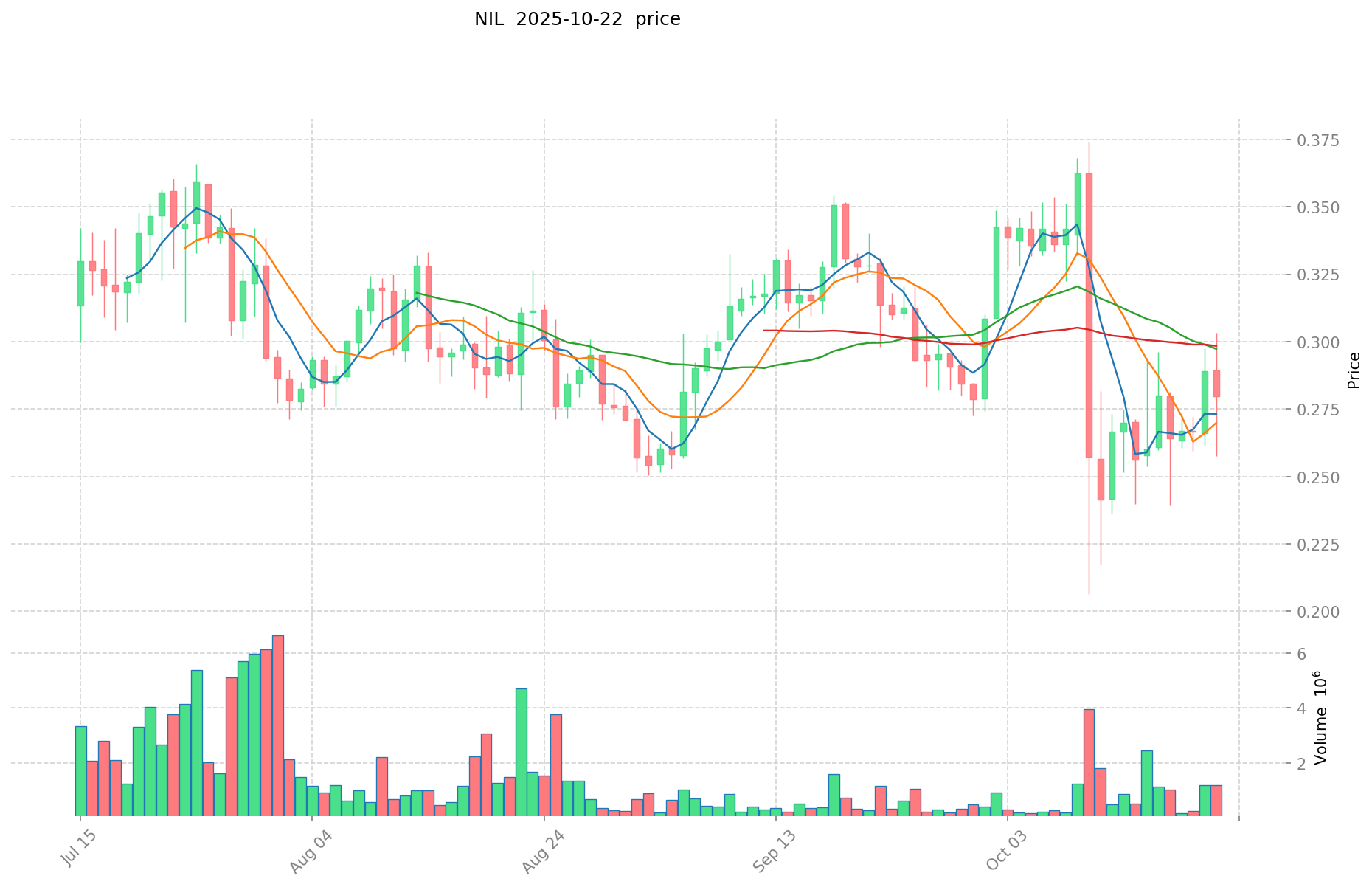
  • 2025: NIL reached its all-time high of $1.1 on March 24, 2025.
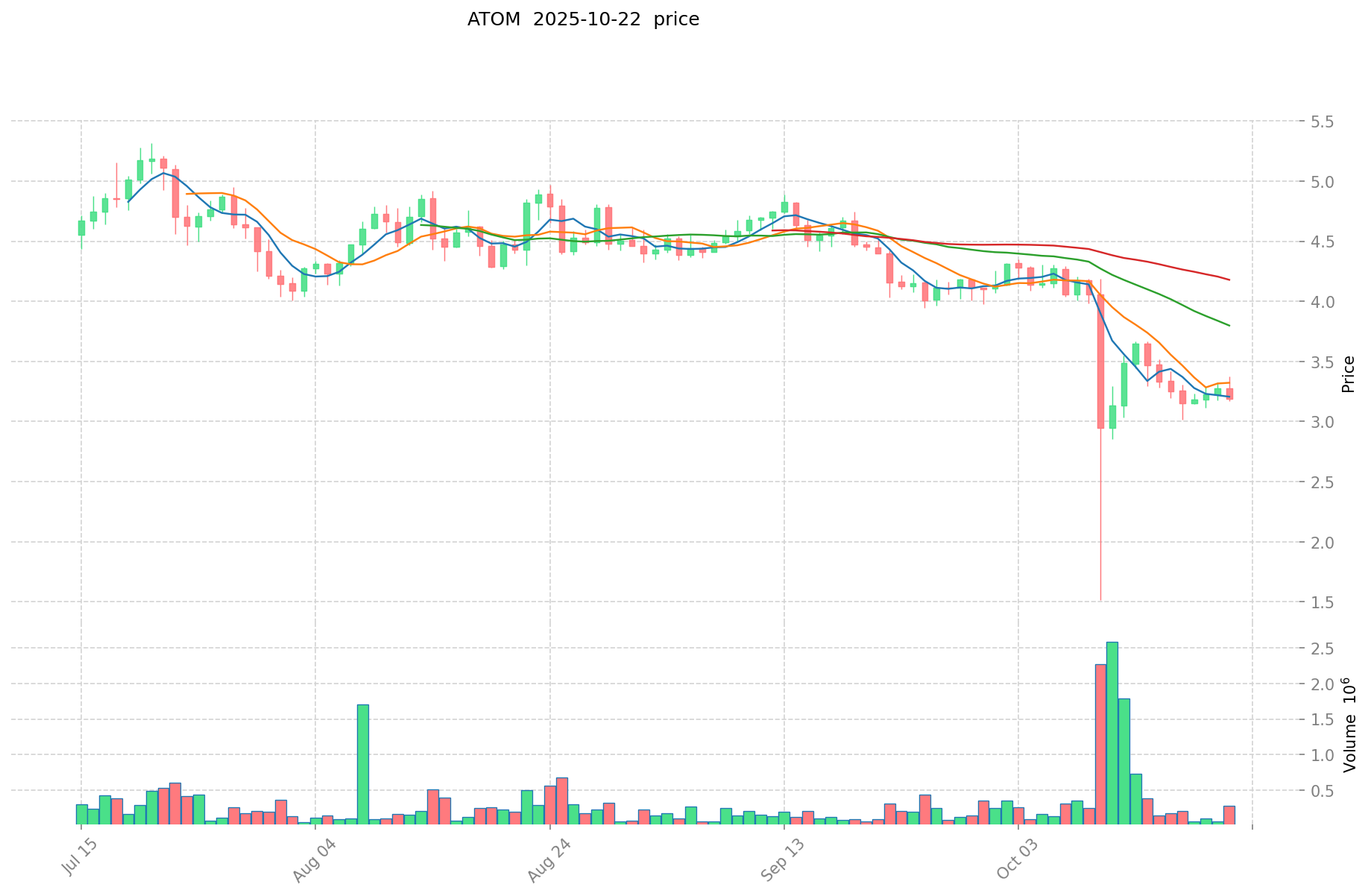
  • 2025: ATOM experienced a significant decline, dropping from its all-time high of $44.45 in January 2022 to current levels.
  • Comparative Analysis: In the recent market cycle, NIL dropped from its high of $1.1 to a low of $0.2063, while ATOM declined from $44.45 to current levels around $3.

Current Market Situation (2025-10-22)

  • NIL current price: $0.2816
  • ATOM current price: $3.193
  • 24-hour trading volume: NIL $335,058.74 vs ATOM $880,583.84
  • Market Sentiment Index (Fear & Greed Index): 34 (Fear)

Click to view real-time prices:

price_image1 price_image2

II. Core Factors Influencing NIL vs ATOM Investment Value

Supply Mechanisms Comparison (Tokenomics)

  • NIL: Shows good return rate according to market trends, with price predictions regularly adjusted based on current market conditions
  • ATOM: Follows the "Atom Economy Method" approach, focusing on value creation through innovation and efficient resource utilization
  • 📌 Historical Pattern: Market sentiment appears more optimistic toward NIL's return potential, while ATOM demonstrates value through technological applications

Institutional Adoption and Market Applications

  • Institutional Holdings: Limited information available on institutional preference between these assets
  • Enterprise Adoption: NIL offers price calculation tools for currency conversion (e.g., NIL to KES at 42.51), enhancing its utility in international transactions
  • Regulatory Attitudes: Current regulatory information for both tokens is not clearly defined in the provided resources

Technical Development and Ecosystem Building

  • NIL Technical Upgrades: Employs advanced machine learning for price predictions, helping users evaluate crypto market trends before investing
  • ATOM Technical Development: Associated with research-driven strategies focusing on clinical value, particularly in therapeutic areas with unmet clinical needs
  • Ecosystem Comparison: NIL appears more focused on traditional investment metrics and returns, while ATOM emphasizes innovation and technological value creation

Macroeconomic Factors and Market Cycles

  • Performance in Inflationary Environments: NIL currently valued at 42.51 KES, suggesting some level of international exchange recognition
  • Monetary Policy Impact: Limited information on how monetary policies specifically affect these assets
  • Geopolitical Factors: NIL offers cross-border exchange capabilities that may appeal to international investors seeking diverse currency exposure

III. 2025-2030 Price Prediction: NIL vs ATOM

Short-term Forecast (2025)

  • NIL: Conservative $0.26-$0.28 | Optimistic $0.28-$0.30
  • ATOM: Conservative $1.88-$3.19 | Optimistic $3.19-$4.37

Mid-term Forecast (2027)

  • NIL may enter a growth phase, with projected prices of $0.19-$0.48
  • ATOM may enter a consolidation phase, with projected prices of $2.62-$5.54
  • Key drivers: Institutional capital inflow, ETF, ecosystem development

Long-term Forecast (2030)

  • NIL: Base scenario $0.51-$0.53 | Optimistic scenario $0.53-$0.57
  • ATOM: Base scenario $4.84-$5.69 | Optimistic scenario $5.69-$8.42

View detailed price predictions for NIL and ATOM

Disclaimer

NIL:

年份 预测最高价 预测平均价格 预测最低价 涨跌幅
2025 0.302076 0.2797 0.260121 0
2026 0.38688104 0.290888 0.28216136 3
2027 0.4846048636 0.33888452 0.1931641764 20
2028 0.547620440094 0.4117446918 0.30880851885 46
2029 0.58521273045534 0.479682565947 0.36455875011972 70
2030 0.569718983575251 0.53244764820117 0.511149742273123 89

ATOM:

年份 预测最高价 预测平均价格 预测最低价 涨跌幅
2025 4.37441 3.193 1.88387 0
2026 4.80530535 3.783705 3.67019385 18
2027 5.53991167575 4.294505175 2.61964815675 34
2028 6.29402678448 4.917208425375 3.78625048753875 53
2029 5.773786133075325 5.6056176049275 3.195202034808675 75
2030 8.42075876612209 5.689701869001412 4.8362465886512 78

IV. Investment Strategy Comparison: NIL vs ATOM

Long-term vs Short-term Investment Strategies

  • NIL: Suitable for investors focused on price prediction tools and cross-border transactions
  • ATOM: Suitable for investors interested in blockchain interoperability and ecosystem development

Risk Management and Asset Allocation

  • Conservative investors: NIL: 30% vs ATOM: 70%
  • Aggressive investors: NIL: 60% vs ATOM: 40%
  • Hedging tools: Stablecoin allocation, options, cross-currency portfolios

V. Potential Risk Comparison

Market Risk

  • NIL: Higher volatility due to lower market cap and trading volume
  • ATOM: Susceptible to broader crypto market trends and ecosystem-specific developments

Technical Risk

  • NIL: Scalability, network stability
  • ATOM: Hash power concentration, security vulnerabilities

Regulatory Risk

  • Global regulatory policies may impact both differently, with potential for stricter oversight on cross-border transaction facilitators like NIL

VI. Conclusion: Which Is the Better Buy?

📌 Investment Value Summary:

  • NIL advantages: Price prediction tools, cross-border transaction capabilities
  • ATOM advantages: Established ecosystem, "Internet of Blockchains" positioning

✅ Investment Advice:

  • Novice investors: Consider a balanced approach, leaning towards ATOM for its more established presence
  • Experienced investors: Explore NIL for potential growth, while maintaining ATOM exposure
  • Institutional investors: Evaluate NIL's utility in cross-border transactions, while considering ATOM's ecosystem value

⚠️ Risk Warning: Cryptocurrency markets are highly volatile. This article does not constitute investment advice. None

VII. FAQ

Q1: What are the key differences between NIL and ATOM? A: NIL focuses on secure data storage and computation for blockchains and AI, with price prediction tools and cross-border transaction capabilities. ATOM is known as the "Internet of Blockchains" with a more established ecosystem and higher market capitalization.

Q2: How do the current prices of NIL and ATOM compare? A: As of 2025-10-22, NIL's price is $0.2816, while ATOM's price is $3.193. ATOM has a higher price and trading volume compared to NIL.

Q3: What are the long-term price predictions for NIL and ATOM? A: By 2030, NIL is predicted to reach $0.51-$0.57 in an optimistic scenario, while ATOM is projected to reach $5.69-$8.42 in an optimistic scenario.

Q4: How do the supply mechanisms of NIL and ATOM differ? A: NIL shows good return rates based on market trends, with regularly adjusted price predictions. ATOM follows the "Atom Economy Method," focusing on value creation through innovation and efficient resource utilization.

Q5: What are the main risks associated with investing in NIL and ATOM? A: NIL faces higher volatility due to lower market cap and trading volume, while ATOM is more susceptible to broader crypto market trends. Both face technical risks such as scalability and security vulnerabilities, as well as potential regulatory challenges.

Q6: How should different types of investors approach NIL and ATOM? A: Novice investors may prefer a balanced approach leaning towards ATOM. Experienced investors could explore NIL for potential growth while maintaining ATOM exposure. Institutional investors should evaluate NIL's utility in cross-border transactions and ATOM's ecosystem value.

* The information is not intended to be and does not constitute financial advice or any other recommendation of any sort offered or endorsed by Gate.
Related Articles
2025 ATOM Price Prediction: Bullish Outlook as Cosmos Ecosystem Expands

2025 ATOM Price Prediction: Bullish Outlook as Cosmos Ecosystem Expands

This article analyzes ATOM's position within the expanding Cosmos ecosystem and its price trajectory from 2025 to 2030. It reviews historical data, current market conditions, and key factors influencing future value, providing professional insights and investment strategies. Readers seeking investment advice and risk management in the volatile crypto market will benefit, highlighting ATOM's interoperability and potential as an inflation hedge. The structured content reflects upon ATOM's historical and projected price, risk factors, trading strategies, and investment recommendations, enhancing SEO through focused keyword usage on Cosmos, ATOM, and crypto investment.
2025-10-16 02:04:19
NKN vs ATOM: Comparing Two Blockchain Network Solutions for Decentralized Communication and Interoperability

NKN vs ATOM: Comparing Two Blockchain Network Solutions for Decentralized Communication and Interoperability

The article delves into the investment comparison between NKN and ATOM, highlighting their market roles, price trends, supply mechanisms, and risks. It seeks to assist investors in choosing between these blockchain solutions with their respective focus on decentralized communication and interoperability. The article examines historical data, evaluates short-to-long-term price predictions, and outlines investment strategies while emphasizing market, technical, and regulatory risks. Detailed analysis targets both new and seasoned investors, providing insights into portfolio allocation and potential growth in these dynamic crypto assets. Readers can immediately access up-to-date pricing via Gate links.
2025-10-05 00:17:42
DUCK vs ATOM: A Comparative Analysis of Modern Web Development Frameworks

DUCK vs ATOM: A Comparative Analysis of Modern Web Development Frameworks

This article provides a comparative analysis between DuckChain (DUCK) and Cosmos (ATOM), focusing on investment value, price trends, supply mechanisms, and technological ecosystems. It addresses key questions about which cryptocurrency is better for investment based on market performance and interoperability. Suitable for both novice and experienced investors, the article examines DUCK's integration with the Telegram ecosystem versus ATOM's established reputation in cross-chain communication. The structured guide covers historical price analysis, project overviews, market performance, and investment considerations to enhance decision-making in cryptocurrency investments.
2025-10-07 00:33:33
DADDY vs ATOM: A Battle of Molecular Bonds in Modern Chemistry

DADDY vs ATOM: A Battle of Molecular Bonds in Modern Chemistry

Explore the investment dynamics between DADDY and ATOM, two distinct cryptocurrencies in the modern market. This analysis covers their historical price trends, supply mechanisms, and institutional adoption, aiding investors in determining the better choice for potential gains. With detailed comparisons on macroeconomic factors and technological ecosystems, the article provides insights into investment strategies, risk management, and future price predictions. Ideal for both new and experienced investors seeking to optimize their portfolios, the content ensures an informative reading experience with enhanced SEO keywords and clear, structured segments.
2025-10-06 00:22:30
GALFAN vs ATOM: A Comparative Analysis of Advanced Corrosion Resistant Coatings for Steel Applications

GALFAN vs ATOM: A Comparative Analysis of Advanced Corrosion Resistant Coatings for Steel Applications

The article provides a comparative analysis of Galatasaray Fan Token (GALFAN) and Cosmos (ATOM), focusing on their investment value in the cryptocurrency market. It addresses the differences in market cap, application scenarios, price performance, and core factors affecting investment, aiming to answer which is the better buy for various investor types. Key factors include price history, supply mechanisms, institutional adoption, technological development, and macroeconomic elements, with specific investment strategies and potential risks highlighted. Suitable for investors seeking insights into cryptocurrency investment strategies, the article offers predictions and risk assessments for effective portfolio management.
2025-10-09 00:07:34
BNC vs ATOM: Comparing Two Cutting-Edge Blockchain Networks for Enterprise Solutions

BNC vs ATOM: Comparing Two Cutting-Edge Blockchain Networks for Enterprise Solutions

The article "BNC vs ATOM: Comparing Two Cutting-Edge Blockchain Networks for Enterprise Solutions" provides an in-depth comparison of Bifrost (BNC) and Cosmos (ATOM) for investors seeking the best enterprise solution investment. It covers their market status, technical innovations, staking mechanisms, and price predictions, offering insights into risk management and investment strategies. The analysis addresses concerns about price performance and liquidity, offering tailored advice for different investor profiles. The article includes forecasts till 2030, potential risks, and is ideal for both new and experienced investors interested in blockchain technology and asset allocation.
2025-10-12 00:22:43
Recommended for You
MicroStrategy Bitcoin Holdings and MSCI Index Inclusion Impact on Crypto Stock Performance

MicroStrategy Bitcoin Holdings and MSCI Index Inclusion Impact on Crypto Stock Performance

# Article Overview: MicroStrategy Bitcoin Holdings and MSCI Index Inclusion Impact on Crypto Stock Performance MicroStrategy's aggressive Bitcoin accumulation strategy transforms corporate treasury practice into institutional investment vehicles, delivering leveraged Bitcoin exposure through traditional equity markets. This article examines how MSCI's decision to maintain digital asset treasury companies within benchmarks validates cryptocurrency as legitimate corporate strategy, eliminating potential delisting risks. Readers—institutional investors, portfolio managers, and crypto asset allocators—discover the high-beta correlation mechanics between MicroStrategy stock and Bitcoin price movements, revealing both amplified upside potential and dilution risks. The framework explores Bitcoin concept stocks as bridges for institutional adoption, explaining how Gate trading infrastructure enables cryptocurrency-linked equity positioning within compliance frameworks. This analysis addresses critical questions: How
2026-01-07 11:04:25
TradFi vs DeFi: Understanding Traditional Finance and Decentralized Finance in Web3

TradFi vs DeFi: Understanding Traditional Finance and Decentralized Finance in Web3

# Article Introduction This comprehensive guide compares Traditional Finance (TradFi) and Decentralized Finance (DeFi), addressing the fundamental differences in custody, access, and operational models within Web3. For investors, crypto enthusiasts, and financial professionals seeking clarity, this article explains TradFi's institutional frameworks versus DeFi's permissionless blockchain-based systems. Structured through foundational concepts, head-to-head comparisons, and current convergence trends, the article demonstrates how both ecosystems complement each other in 2026. Discover how platforms like Gate bridge traditional finance onramps with decentralized protocols, enabling seamless participation across both systems. Whether prioritizing regulatory protection or speed and accessibility, understand which model aligns with your financial objectives and risk tolerance.
2026-01-07 11:04:23
Grayscale Ethereum Staking ETF: How to Earn Passive Income with ETHE

Grayscale Ethereum Staking ETF: How to Earn Passive Income with ETHE

# Article Overview: Grayscale Ethereum Staking ETF - Passive Income Through ETHE **Core Content & Value Proposition:** Grayscale Ethereum Staking ETF (ETHE) revolutionizes crypto investing by enabling investors to earn 3-5% annual staking rewards directly through a regulated SEC ETF—eliminating the need for technical expertise, 32 ETH minimum capital, or node operation. This groundbreaking product transforms Ethereum into a yield-bearing asset comparable to dividend stocks, delivering dual benefits: staking income distributions plus price appreciation potential. ETHE addresses the institutional gap between regulatory compliance and passive income generation, offering superior liquidity and operational simplicity versus traditional staking. Available through Gate and major brokerages, ETHE serves retail investors, institutional allocators, and treasury managers seeking accessible ethereum staking income without infrastructure complexity. **Article Structure:** - Historic milestone: First U.S. Ethereum ETP di
2026-01-07 11:03:31
American Banks Bitcoin FOMO: Morgan Stanley and Bank of America ETF Filings

American Banks Bitcoin FOMO: Morgan Stanley and Bank of America ETF Filings

# Article Overview: American Banks Bitcoin FOMO - Morgan Stanley and Bank of America ETF Filings This article explores how major US banks are entering the cryptocurrency market through Bitcoin and Solana ETF filings, marking a fundamental shift from traditional finance's skepticism toward digital assets. It addresses institutional investors' growing demand for regulated cryptocurrency exposure and explains how regulatory clarity from federal banking authorities enables banks to offer custody, trading, and advisory services. The piece examines Morgan Stanley's historic move as the first top-10 bank filing crypto ETFs, Bank of America's strategic repositioning, and the emerging 1-4% institutional allocation framework reshaping bitcoin markets. Readers—including wealth managers, institutional investors, and financial advisors—will understand how mainstream banking infrastructure now facilitates cryptocurrency integration into diversified portfolios. The analysis reveals that institutional bitcoin adoption throu
2026-01-07 11:03:28
Tether Pushes Tokenized Gold Toward Payments with Scudo Rollout

Tether Pushes Tokenized Gold Toward Payments with Scudo Rollout

# Article Overview: Tether Pushes Tokenized Gold Toward Payments with Scudo Rollout Tether's Scudo initiative revolutionizes gold-backed payments by introducing a simplified unit structure for XAUT tokenized gold, addressing critical usability barriers in blockchain commerce. This article explores how tokenized gold transforms precious metals from long-term assets into practical payment mediums through fractional ownership and transparent blockchain verification. Scudo eliminates decimal complexity, enabling merchants and developers to implement gold-backed transactions seamlessly across Web3 platforms and e-commerce systems. The framework benefits institutional investors, DeFi protocols, and cross-border traders seeking stable, asset-backed alternatives to volatile cryptocurrencies. From supply chain financing to remittance services on Gate and alternative networks, gold-backed stablecoins reshape payment infrastructure while reducing systemic risk in decentralized finance. This comprehensive guide demonstr
2026-01-07 11:02:34
Largest Bitcoin ETF Inflow in Three Months Signals Institutional Bid is Back

Largest Bitcoin ETF Inflow in Three Months Signals Institutional Bid is Back

# Article Introduction This article examines the $697.2 million Bitcoin ETF inflow on January 6th, 2026—the largest in three months—signaling institutional capital's decisive return to digital assets. It explores how BlackRock's market dominance has legitimized bitcoin as an institutional-grade investment vehicle, reshaping traditional finance's perception of cryptocurrency allocation. Through historical ETF flow analysis, the article demonstrates that inflow reversals correlate with market bottoms and subsequent recovery phases, providing predictive indicators for traders and portfolio managers. The January 2026 surge, accumulating $1.2 billion across two trading days, reflects structural institutional recommitment rather than speculative trading, with annualized projections reaching $150 billion. Designed for institutional investors, financial advisors, and crypto market analysts, this piece illustrates how sustained capital deployment through platforms like Gate creates supply-demand dynamics supporting s
2026-01-07 11:02:28