Is Radicle (RAD) a good investment?: A comprehensive analysis of the decentralized code collaboration platform's potential and risks in 2024


Introduction: Radicle (RAD) Investment Position and Market Prospects
RAD is an important asset in the cryptocurrency field. Since its launch in February 2021, Radicle has established itself as a Web3 native network for software collaboration. As of December 2025, RAD's fully diluted valuation stands at approximately USD 26.48 million, with a circulating supply of around 49.83 million tokens out of a total supply of 100 million. The current price is trading at approximately USD 0.2648. Positioned as a "governance token for decentralized software collaboration," RAD has gradually become a focal point for investors evaluating decentralized development infrastructure investments. This article provides a comprehensive analysis of RAD's investment value, historical performance trends, future price outlook, and associated investment risks to offer investors informed reference materials.
Radicle (RAD) Cryptocurrency Asset Research Report
I. Historical Price Performance and Current Investment Value Analysis
RAD Historical Price Trajectory and Investment Returns
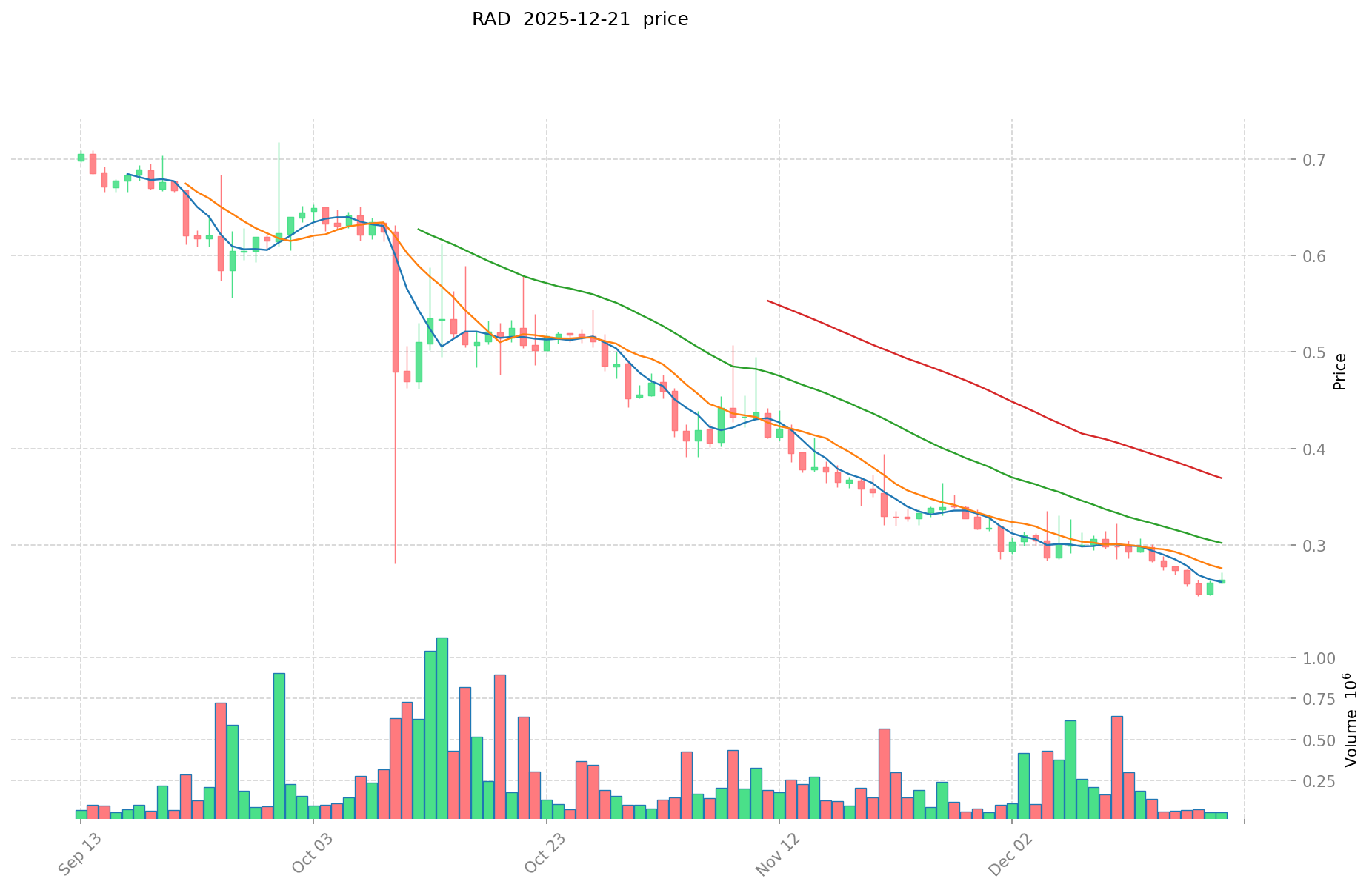
Based on available market data as of December 21, 2025:
Key Price Milestones:
- All-Time High (ATH): USD 27.61 (April 16, 2021)
- All-Time Low (ATL): USD 0.247899 (December 19, 2025)
- Current Price: USD 0.2648 (as of December 21, 2025, 14:21:25 UTC)
Significant Performance Indicators:
- 1-Hour Change: -0.41%
- 24-Hour Change: +1.49%
- 7-Day Change: -9.28%
- 30-Day Change: -24.099%
- 1-Year Change: -79.06%
The token has experienced substantial depreciation from its historical peak, declining approximately 99% from its ATH. This represents a significant erosion of value for early investors who acquired RAD near its peak in 2021.
Current RAD Market Status (December 21, 2025)
Price and Valuation Metrics:
- Current Price: USD 0.2648
- 24-Hour Trading Volume: USD 15,963.36
- Market Capitalization: USD 13,194,748.48
- Fully Diluted Valuation (FDV): USD 26,479,623.98
- Market Cap to FDV Ratio: 49.83%
Token Supply Structure:
- Circulating Supply: 49,829,110.57 RAD (49.83% of total)
- Total Supply: 99,998,580 RAD
- Maximum Supply: 100,000,000 RAD (fixed cap)
- Number of Token Holders: 7,709
Market Position:
- Global Ranking: #1,042
- Market Dominance: 0.00082%
- 24-Hour Price Range: USD 0.2599 – USD 0.2715
View real-time RAD market price on Gate
II. Project Overview and Tokenomics
Project Description
Radicle is a Web3-native network designed for software collaboration. The project provides GitHub-like functionality on truly decentralized infrastructure, enabling developers to fund, monetize, and manage software projects using NFTs, multi-signature wallets, and smart contracts.
RAD Token Function and Governance Model
RAD is designed as a governance token implementing several functions:
Primary Token Benefits:
- Governance Participation: Token holders have the right to participate in the governance of Radicle's smart contract system through voting and proposal mechanisms.
- Protocol Interaction Discounts: Members holding a certain quantity of RAD tokens receive discounts or free access when interacting with Radicle's Ethereum-based protocol.
- Network Ownership: RAD tokens represent public ownership stake in the Radicle network, enabling collective governance and supporting long-term sustainability.
Technical Specifications
Blockchain Architecture:
- Network: Ethereum (ETH)
- Contract Address: 0x31c8eacbffdd875c74b94b077895bd78cf1e64a3
- Token Standard: ERC-20 compatible
Supply Economics:
- Fixed maximum supply of 100 million tokens provides scarcity characteristics.
- Circulating supply at approximately 50% dilution suggests ongoing token distribution phase.
III. Market Analysis and Trading Activity
Liquidity and Trading Profile
Exchange Presence:
- Listed on 23 trading venues
- Adequate liquidity for retail trading at current volume levels
Recent Volume Trends: The 24-hour trading volume of USD 15,963.36 indicates moderate but limited liquidity. This liquidity profile suggests potential slippage on large orders and may constrain institutional participation.
Price Volatility Assessment
The token exhibits significant volatility:
- Recent 7-day decline of -9.28% indicates downward market pressure
- Monthly performance of -24.099% reflects sustained bearish sentiment
- Extended 1-year decline of -79.06% signals substantial long-term value destruction relative to peak valuations
IV. Ecosystem and Development
Project Resources and Community Engagement
Official Channels:
- Website: https://radicle.xyz/
- GitHub Repository: https://github.com/radicle-dev
- Community Forum: https://radicle.community/
- Social Media: Twitter presence at https://twitter.com/radicle
Integration Infrastructure:
- Blockchain Explorer: Verified on Etherscan
V. Risk Considerations
Market Concentration Risk: With 7,709 token holders and approximately 50% of total supply in circulation, the token concentration structure may present liquidity risks during periods of forced liquidation or coordinated exits.
Price Stability Concerns: The dramatic depreciation from ATH and recent continued decline suggest ongoing market skepticism regarding the project's current viability or competitive positioning relative to alternative code collaboration solutions.
Liquidity Constraints: Moderate daily trading volumes relative to market capitalization may result in significant price impact for institutional-scale transactions.
VI. Data Accuracy Notice
All market data presented in this report was current as of December 21, 2025, 14:21:25 UTC. Cryptocurrency markets operate continuously with real-time price fluctuations. Investors should verify current market conditions before making any investment decisions through authoritative price data sources.
This report presents factual market data and project information derived from available sources. No investment recommendations, price predictions, or financial advice are provided herein.
Radicle (RAD) Cryptocurrency Research Report
Report Date: December 21, 2025
I. Executive Summary
Radicle (RAD) is a governance token designed for the Radicle network, a Web3-native platform for software collaboration. As of December 21, 2025, RAD is trading at $0.2648, with a market capitalization of approximately $26.48 million and a circulating supply of 49.83 million tokens out of a maximum supply of 100 million tokens. The token has experienced significant depreciation, declining 79.06% over the past year and 24.10% over the past month.
II. Core Factors Influencing Whether Radicle (RAD) is a Good Investment
Supply Mechanism and Scarcity
RAD has a maximum supply of 100 million tokens with a current circulating supply of 49.83 million tokens (49.83% of total supply). The remaining 50.17% of tokens remain uncirculated, representing significant future dilution potential. This supply structure impacts long-term price sustainability and investor returns.
Market Position and Adoption
Radicle ranks 1,042 in global cryptocurrency market capitalization with a market share of 0.00082%. The project has 7,709 token holders and is listed on 23 exchanges. The platform aims to provide decentralized GitHub-like functionality, enabling developers to fund, monetize, and manage software projects using NFTs, multi-signature wallets, and smart contracts.
Governance and Utility Functions
RAD token holders receive governance rights within the Radicle smart contract system through voting and proposals. Token holders also enjoy discounts or free access when interacting with Radicle's Ethereum-based protocol. These utility functions provide fundamental value to token holders beyond speculative trading.
Development Activity
According to data from November 2025, RAD ranked second in development activity (behind mUSD), indicating ongoing technical work and ecosystem development supporting the project.
III. Price Performance and Technical Analysis
Historical Price Data
| Metric | Value |
|---|---|
| Current Price (Dec 21, 2025) | $0.2648 |
| 24-Hour High | $0.2715 |
| 24-Hour Low | $0.2599 |
| All-Time High | $27.61 (April 16, 2021) |
| All-Time Low | $0.247899 (December 19, 2025) |
| Initial Launch Price | $15.05 (February 18, 2021) |
Recent Price Movements
| Time Period | Change % | Absolute Change |
|---|---|---|
| 1 Hour | -0.41% | -$0.001090 |
| 24 Hours | +1.49% | +$0.003888 |
| 7 Days | -9.28% | -$0.027087 |
| 30 Days | -24.10% | -$0.084076 |
| 1 Year | -79.06% | -$0.999765 |
The token has declined from its all-time high of $27.61 by approximately 99.04%, indicating extreme volatility and substantial losses for early investors.
IV. Investment Sentiment and Market Outlook
Mixed Market Predictions
Available price forecasting sources present divergent views on RAD's investment potential:
- Some forecasters anticipate slight growth in 2025, with predictions ranging from modest increases to declines.
- Pessimistic forecasts predict further declines to $0.258 (WalletInvestor) and potentially lower levels.
- Longer-term speculative forecasts exist predicting substantial appreciation by 2030, though these lack consistent methodological support.
Technical Analysis Indicators
Technical analysis suggests bearish sentiment, with 12 sell signals and only 2 buy signals from 17 quantitative indicators. The token currently trades below exponential moving averages, indicating downward pressure.
Risk Assessment
Like all cryptocurrencies, RAD carries significant investment risk. Key risk factors include:
- Extreme price volatility and historical 99%+ drawdowns from all-time highs
- Relatively low market liquidity and capitalization
- Concentration of uncirculated supply (50.17% of maximum supply)
- Dependence on developer adoption and ecosystem growth
V. Project Fundamentals
Technology and Infrastructure
Radicle operates as an Ethereum-based protocol providing decentralized software collaboration infrastructure comparable to GitHub. The platform integrates NFT functionality, multi-signature wallets, and smart contract capabilities to enable developers to manage projects on decentralized infrastructure.
Token Contract Information
- Blockchain: Ethereum (ETH)
- Contract Address: 0x31c8eacbffdd875c74b94b077895bd78cf1e64a3
- Network: Listed on 23 exchanges with active trading volume
Community and Governance
The project maintains active community governance channels including a community forum (https://radicle.community/) and official social channels. Token holders participate in protocol governance through direct voting mechanisms.
VI. Conclusion
Radicle (RAD) represents a speculative investment opportunity with significant technical utility as a governance token for a decentralized software collaboration platform. However, investors should recognize that RAD carries substantial risks inherent to early-stage cryptocurrency projects, including extreme price volatility, low market capitalization, and dependence on ecosystem adoption.
The token's 79% annual depreciation and recent decline to near all-time lows reflect current market pessimism. While the project demonstrates ongoing development activity, investment decisions should be informed by individual risk tolerance and diversification strategies rather than reliance on price prediction forecasts.
Data Sources: Gate, CoinMarketCap, Ethereum blockchain, Santiment development metrics
Report Disclaimer: This report presents factual data and reference material regarding Radicle (RAD) and does not constitute investment advice or recommendations. Cryptocurrency investments carry substantial risk of total loss.
III. RAD Future Investment Predictions and Price Outlook (Is Radicle(RAD) worth investing in 2025-2030)
Short-term Investment Prediction (2025, short-term RAD investment outlook)
- Conservative forecast: $0.2142 - $0.2645
- Neutral forecast: $0.2645 - $0.3174
- Optimistic forecast: $0.3174 - $0.3500
Mid-term Investment Outlook (2026-2028, mid-term Radicle(RAD) investment forecast)
- Market phase expectation: Radicle is positioned in an early-stage recovery phase with gradual ecosystem expansion and increased institutional awareness of Web3 developer infrastructure solutions.
- Investment return prediction:
- 2026: $0.2706 - $0.3230
- 2027: $0.1842 - $0.3499
- Key catalysts: Enhanced governance participation, adoption by developer communities, integration with decentralized finance platforms, and ecosystem protocol upgrades.
Long-term Investment Outlook (Is Radicle a good long-term investment?)
- Base case scenario: $0.2824 - $0.4270 (assuming steady adoption of decentralized software collaboration tools and moderate market growth)
- Optimistic scenario: $0.3778 - $0.5625 (assuming breakthrough in enterprise adoption and favorable regulatory environment for Web3 infrastructure)
- Risk scenario: $0.1500 - $0.2000 (extreme market downturn, competitive pressure from centralized alternatives, governance challenges)
Click to view RAD long-term investment and price prediction: Price Prediction
2025-12-21 - 2030 Long-term Outlook
- Base case: $0.2824 - $0.4270 USD (corresponding to steady advancement and mainstream application development)
- Optimistic case: $0.3778 - $0.5625 USD (corresponding to large-scale adoption and favorable market conditions)
- Transformative case: $0.5625 USD and above (if ecosystem achieves breakthrough progress and mainstream adoption)
- 2030-12-31 forecast high: $0.5625 USD (based on optimistic development assumptions)
Disclaimer
The information and forecasts provided above are for reference purposes only and should not be construed as investment advice. Cryptocurrency markets are highly volatile and subject to regulatory, technological, and market risks. Past performance does not guarantee future results. Investors should conduct thorough research and consult with financial professionals before making investment decisions.
| 年份 | 预测最高价 | 预测平均价格 | 预测最低价 | 涨跌幅 |
|---|---|---|---|---|
| 2025 | 0.3174 | 0.2645 | 0.214245 | 0 |
| 2026 | 0.3229545 | 0.29095 | 0.2705835 | 9 |
| 2027 | 0.349925565 | 0.30695225 | 0.18417135 | 15 |
| 2028 | 0.42697057975 | 0.3284389075 | 0.28245746045 | 24 |
| 2029 | 0.44946864491375 | 0.377704743625 | 0.20773760899375 | 42 |
| 2030 | 0.56247790420635 | 0.413586694269375 | 0.335005222358193 | 56 |
Radicle (RAD) Investment Analysis Report
I. Project Overview
Basic Information
Radicle (RAD) is a governance token designed for the Radicle network, a Web3-native platform for software collaboration. The token was published on February 18, 2021, with an initial price of $15.05.
Current Market Data (as of December 21, 2025):
- Current Price: $0.2648
- Market Capitalization: $13,194,748.48
- Fully Diluted Valuation: $26,479,623.98
- Circulating Supply: 49,829,110.57 RAD
- Total Supply: 99,998,580 RAD
- 24-hour Volume: $15,963.36
- Market Ranking: #1042
Project Description
Radicle is a Web3-native network that provides GitHub-like functionality on truly decentralized infrastructure. The platform enables developers to fund, monetize, and manage software projects using NFTs, multi-signature wallets, and smart contracts.
Token Functionality
The RAD token serves as a governance token with the following utilities:
- Participation in governance decisions through voting and proposals
- Discounted or free interaction with Radicle's Ethereum-based protocol
- Public ownership and collective governance of the Radicle network
- Membership benefits for token holders
II. Market Performance Analysis
Price Performance
Historical Price Range:
- All-Time High: $27.61 (April 16, 2021)
- All-Time Low: $0.247899 (December 19, 2025)
- Current Price: $0.2648
Recent Price Trends:
| Timeframe | Change | Amount |
|---|---|---|
| 1 Hour | -0.41% | -$0.0011 |
| 24 Hours | +1.49% | +$0.0039 |
| 7 Days | -9.28% | -$0.0271 |
| 30 Days | -24.10% | -$0.0841 |
| 1 Year | -79.06% | -$0.9998 |
Market Indicators
- Market Dominance: 0.00082%
- Circulating Supply Ratio: 49.83%
- Token Holders: 7,709
- Active Exchanges: 23
- 24-hour High/Low: $0.2715 / $0.2599
III. Technical Information
Blockchain Details
- Chain: Ethereum (ETH)
- Contract Address: 0x31c8eacbffdd875c74b94b077895bd78cf1e64a3
- Official Website: https://radicle.xyz/
- GitHub: https://github.com/radicle-dev
- Community Forum: https://radicle.community/
- Social Media: Twitter - https://twitter.com/radicle
IV. Investment Strategy and Risk Management
Investment Methodology
- Long-term Holding (HODL RAD): Suitable for risk-averse investors focused on governance participation and ecosystem support
- Active Trading: Dependent on technical analysis given the token's high volatility and relatively illiquid market
Risk Management
-
Asset Allocation Proportions:
- Conservative investors: 0-2% of portfolio allocation
- Aggressive investors: 2-5% of portfolio allocation
- Institutional investors: Strategic allocation based on governance participation objectives
-
Risk Mitigation Strategies: Multi-asset portfolio diversification, inclusion of stablecoins and established cryptocurrencies
-
Secure Storage: Hardware wallets (Ledger, Trezor) for long-term holdings; reputable custodians for institutional quantities
V. Investment Risks and Challenges
Market Risks
- Extreme Volatility: RAD has experienced a 79% decline over the past year and trades at approximately 99% below its all-time high
- Liquidity Risk: Relatively low 24-hour trading volume ($15,963.36) compared to market capitalization suggests potential liquidity constraints
- Price Manipulation Risk: Small market cap and limited exchange availability may increase susceptibility to price volatility
Regulatory Risks
- Uncertainty regarding governance token classification across different jurisdictions
- Potential regulatory changes affecting decentralized governance mechanisms
- Compliance risks for developers using the platform in different regions
Technical Risks
- Smart contract vulnerabilities and potential security exploits
- Dependency on Ethereum network security and transaction costs
- Risk of protocol upgrades or changes affecting token utility
Adoption Risks
- Competition from established software collaboration platforms
- Dependency on developer adoption for platform viability
- Concentration risk with 7,709 token holders
VI. Conclusion: Is Radicle (RAD) a Good Investment?
Investment Value Summary
Radicle presents a specialized investment case within the decentralized developer tooling category. The token's fundamental value proposition relies on ecosystem adoption and governance participation rather than speculative appreciation. However, the 79% annual decline and current trading near all-time lows reflect significant market skepticism regarding near-term adoption prospects.
Investor Recommendations
✅ Beginners:
- Consider dollar-cost averaging with minimal portfolio allocation (0.5-1%)
- Prioritize secure hardware wallet storage
- Participate in governance only after thorough research
✅ Experienced Investors:
- Tactical position sizing based on development roadmap milestones
- Monitor developer adoption metrics and ecosystem growth
- Combine with other Web3 infrastructure investments
✅ Institutional Investors:
- Evaluate based on long-term developer ecosystem potential
- Participate in governance as part of infrastructure investment thesis
- Monitor competitive landscape and platform differentiation
⚠️ Risk Warning: Cryptocurrency investments carry substantial risk of loss, particularly for low-liquidity tokens with limited trading volume. This analysis is provided for informational purposes only and does not constitute investment advice. Investors should conduct independent research and consult with qualified financial advisors before making investment decisions.
Radicle (RAD) Frequently Asked Questions
I. FAQ
Q1: What is Radicle (RAD) and what is its primary function?
A: Radicle (RAD) is a governance token for the Radicle network, a Web3-native platform designed for decentralized software collaboration. RAD serves multiple functions including governance participation through voting and proposals, protocol interaction discounts for token holders, and representation of ownership stake in the Radicle network. The platform provides GitHub-like functionality on decentralized infrastructure, enabling developers to fund, monetize, and manage software projects using NFTs, multi-signature wallets, and smart contracts.
Q2: What is the current price and market capitalization of RAD as of December 2025?
A: As of December 21, 2025, RAD is trading at approximately USD 0.2648 with a market capitalization of USD 13.19 million and a fully diluted valuation of USD 26.48 million. The token has a circulating supply of 49.83 million out of a maximum supply of 100 million tokens. RAD ranks #1,042 in global cryptocurrency market capitalization with a 24-hour trading volume of USD 15,963.36.
Q3: How has RAD performed historically, and what are the key price milestones?
A: RAD has experienced significant depreciation since its launch in February 2021 at USD 15.05. The token reached an all-time high of USD 27.61 on April 16, 2021, but has since declined approximately 99% from that peak. The all-time low of USD 0.247899 was recorded on December 19, 2025, just two days before this report. Over the past year, RAD has declined 79.06%, with a 30-day decline of 24.10%, reflecting sustained bearish market sentiment.
Q4: What are the primary investment risks associated with RAD?
A: Key investment risks include extreme price volatility with historical 99%+ drawdowns from all-time highs; relatively low market liquidity with limited daily trading volume relative to market capitalization; significant supply dilution risk from the 50.17% of tokens not yet in circulation; concentration risk with only 7,709 token holders; and dependency on developer adoption for long-term ecosystem viability. Additionally, competition from established software collaboration platforms and regulatory uncertainty surrounding governance tokens present ongoing challenges.
Q5: What is the projected price outlook for RAD through 2030?
A: Price forecasts vary by scenario. For short-term 2025 outlook, conservative estimates range from USD 0.2142 to USD 0.2645, while optimistic forecasts reach USD 0.3500. Medium-term projections for 2026-2028 suggest ranges of USD 0.2706 to USD 0.3230 and USD 0.1842 to USD 0.3499 respectively. Long-term forecasts to 2030 project base case scenarios of USD 0.2824 to USD 0.4270, optimistic scenarios of USD 0.3778 to USD 0.5625, and risk scenarios of USD 0.1500 to USD 0.2000. However, these forecasts carry substantial uncertainty and should not be considered reliable predictions.
Q6: Is RAD suitable for beginner investors?
A: RAD is generally considered suitable only for risk-tolerant investors with specific interest in decentralized developer infrastructure. Beginner investors should consider dollar-cost averaging with minimal portfolio allocation (0.5%-1%), employ secure hardware wallet storage, and thoroughly research governance participation before investing. Conservative investors are advised to limit allocation to 0-2% of portfolio holdings, while aggressive investors may consider 2-5% allocation. Beginners should avoid allocating substantial capital to RAD given the token's extreme volatility and limited trading liquidity.
Q7: What factors could drive future RAD price appreciation?
A: Potential positive catalysts include enhanced governance participation by token holders, increased adoption by developer communities seeking decentralized collaboration infrastructure, successful integration with decentralized finance platforms, ecosystem protocol upgrades improving functionality, breakthrough progress toward enterprise adoption, and favorable regulatory developments supporting Web3 infrastructure. However, these catalysts remain uncertain and price appreciation is not guaranteed. Investors should monitor development activity, ecosystem growth metrics, and competitive positioning relative to alternative software collaboration solutions.
Q8: How does RAD's supply structure impact long-term investment potential?
A: RAD has a fixed maximum supply of 100 million tokens with approximately 49.83% currently in circulation. The remaining 50.17% of uncirculated tokens represents significant future dilution potential that may place downward pressure on long-term pricing. This supply structure means that investors face dilution risks as additional tokens enter circulation. The fixed cap provides scarcity characteristics beneficial for long-term value, but the substantial circulating supply ratio creates near-term dilution concerns that investors should carefully evaluate when considering long-term holding strategies.
This FAQ document presents factual information regarding Radicle (RAD) derived from available market data and project sources as of December 21, 2025. This material is provided for informational purposes only and does not constitute investment advice or recommendations. Cryptocurrency investments carry substantial risk of total loss.
Share
How to Buy Cryptocurrency


Trending Cryptocurrencies



2025 UNIPrice Prediction: Analyzing Key Factors That Will Shape Uniswap's Token Valuation in the Post-Bull Market Era

ENS vs HBAR: Comparing Two Innovative Blockchain Solutions for Digital Identity and Governance

RAD vs ETC: A Comparative Analysis of Two Trading Mechanisms in Modern Financial Markets
Is Radicle (RAD) a Good Investment?: Analyzing Growth Potential and Market Position in the Decentralized Development Space

Is Daolity (DAOLITY) a good investment?: Evaluating the potential and risks of this emerging cryptocurrency

MATR1X vs ETH: The Battle for Blockchain Supremacy in the Digital Age

How to Stake Chainlink: A Step-by-Step Guide to LINK Staking

AlphaArena Model Launch: How AI is Redefining Crypto Trading with Real-World Benchmarks

How to Participate in Chainlink Airdrop

SpaceX Transfers $105 Million in Bitcoin to Unmarked Wallets

Why Do We Celebrate Bitcoin Pizza Day?