Bearish candlestick patterns

2026-01-06 13:36:37
Crypto Trading
Crypto Tutorial
Investing In Crypto
K-line
Trading Bots
Article Rating : 4
83 ratings
Discover how to spot bearish candlestick patterns in the crypto market. Explore pattern types such as the Shooting Star, Evening Star, and Three Black Crows, along with trading strategies and risk management techniques. This comprehensive guide is designed for traders and analysts on Gate.
Bearish candlestick patterns
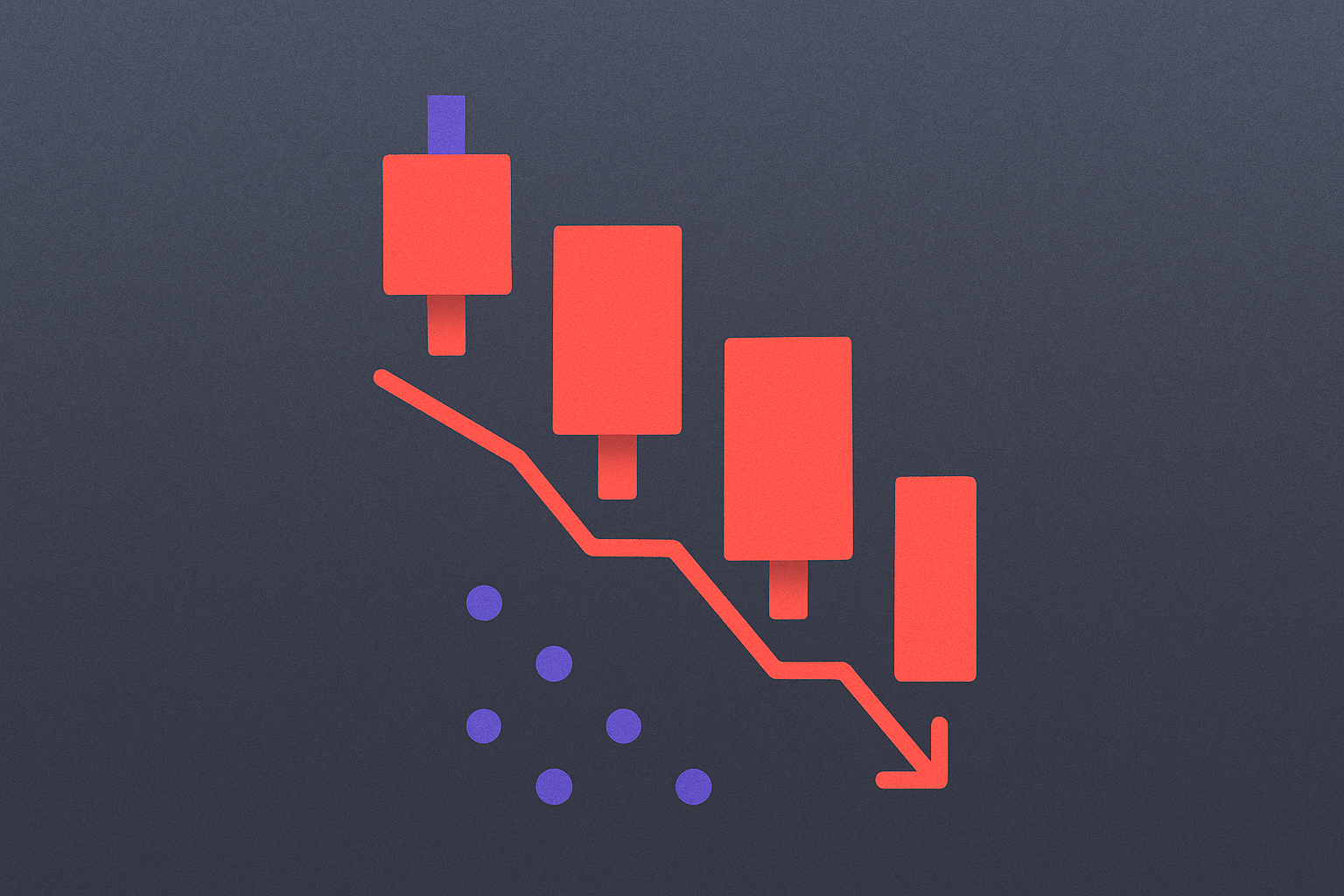
Introduction to Bearish Candlestick Patterns

Bearish candlestick patterns are the inverse of bullish patterns and typically emerge after an uptrend. These patterns are essential in technical analysis for financial markets, helping traders and investors pinpoint potential price reversal points. When bearish candlestick patterns appear, they may indicate a shift from an upward to a downward trend, signaling a possible change in market sentiment.

Traders should evaluate bearish candlestick patterns alongside market context, trading volume, and other technical indicators. Note that on both cryptocurrency and traditional candlestick charts, green generally represents a price increase (bullish candles), while red indicates a price decrease (bearish candles).

Main Types of Bearish Candlestick Patterns

Common bearish candlestick patterns include:

  1. Hanging Man Pattern
  2. Shooting Star Pattern
  3. Bearish Engulfing Pattern
  4. Evening Star Pattern
  5. Three Black Crows Pattern

Each pattern has unique characteristics and varying levels of reliability as a trend reversal indicator.

Hanging Man Pattern

The Hanging Man is one of the most recognizable bearish candlestick patterns. It forms when, after a price rally, a candle appears at the top with a long lower shadow and a small body. This candle may be either bearish or bullish, but its structure defines the pattern.

The Hanging Man serves as a strong bearish reversal signal. The candle following the Hanging Man is typically bearish—the longer this bearish candle, the higher the probability of a downtrend starting. Traders often use this pattern to signal entry into short positions.

Shooting Star Pattern

The Shooting Star pattern usually emerges at the peak of an uptrend and is a clear indicator of a possible reversal. It’s characterized by a short body and a much longer upper shadow. This candle can be a small bullish or bearish candle.

The Shooting Star shows that buyers attempted to drive the price higher, but sellers forced it back to or below the opening price. This price action often precedes a reversal from an uptrend to a downtrend.

Bearish Engulfing Pattern

The Bearish Engulfing pattern typically appears at the end of an uptrend and consists of two candles. The first is a small bullish candle, followed by a large bearish candle that completely engulfs the smaller one. This is known as an engulfing pattern and is a strong signal that the trend may reverse.

A Bearish Engulfing pattern suggests heightened price volatility and a shift in the balance between buyers and sellers. The market is likely to turn bearish. The larger the body of the second bearish candle, the stronger and more reliable the potential downtrend signal.

Evening Star Pattern

The Evening Star pattern forms during an uptrend and reliably signals that the market may have reached a top. This three-candle formation is considered one of the most trustworthy reversal indicators.

The Evening Star consists of three candles and is the opposite of the Morning Star pattern. The first candle is bullish, the second can be bearish, bullish, or a doji (a candle where the opening and closing prices are nearly equal). The third candle is bearish, and its low falls below the low of the first candle, confirming the trend reversal.

Three Black Crows Pattern

The Three Black Crows pattern features three consecutive bearish candles with little or no shadows. Each session opens near the previous session’s close, and as selling pressure intensifies, the closing price falls further each day.

This pattern typically signals the start of a downtrend and consistent selling pressure. It shows steady price weakening and is often accompanied by rising trading volume, confirming the strength of the bearish trend.

FAQ

What are bearish candlestick patterns? What are the most common types of bearish candlestick chart patterns?

Bearish candlestick patterns are chart formations that develop during downtrends. The most common types are the bearish flag, descending triangle, head and shoulders (top), and double top. These patterns point to a continuation or strengthening of the price decline.

How do you identify and trade bearish candlestick patterns (such as Shooting Star, Cloud Cover, Engulfing)?

To identify bearish patterns: The Shooting Star forms after a rally and has a long lower wick; Cloud Cover is made up of two red candles; Engulfing occurs when a small green candle is engulfed by a large red one. Trade the downward reversal in combination with support and resistance levels. These signals work best in downtrends.

When using bearish candlestick patterns in trading, how should you manage risk and set stop-loss orders?

Set your stop-loss above the upper boundary of the pattern to manage risk effectively. The size of your stop-loss should reflect your risk tolerance. Trade only during strong downtrends to maximize the probability of success.

How accurate are bearish candlestick patterns? Can you rely on them alone for trading decisions?

Bearish candlestick patterns have an average accuracy of about 60–70%. They are most effective when combined with other technical indicators and volume analysis. You should not rely solely on these patterns for trading decisions.

How do you use bearish candlestick patterns with other technical analysis tools (such as support and resistance levels, moving averages)?

Combine bearish patterns with support and resistance levels to identify sell points. Moving average crossovers reinforce these signals. Oscillators used alongside these tools improve trend prediction accuracy and increase signal reliability.

What are the differences between bearish candlestick patterns across different timeframes (daily, weekly, monthly)?

Bearish patterns on different timeframes reflect different levels of analysis: daily patterns show short-term moves and more detail, weekly patterns reveal medium-term trends, and monthly patterns indicate long-term direction. The same pattern can mean different things depending on the timeframe. Monthly patterns are generally more reliable as signals.

* The information is not intended to be and does not constitute financial advice or any other recommendation of any sort offered or endorsed by Gate.
Related Articles
How to Interpret MACD, RSI, and KDJ Indicators for Crypto Technical Analysis?

How to Interpret MACD, RSI, and KDJ Indicators for Crypto Technical Analysis?

This article explores the interpretation of MACD, RSI, and KDJ indicators in crypto technical analysis, providing essential insights for traders on Gate. It addresses challenges of volatile market conditions and offers a combined approach with price and volume analysis for greater accuracy in predicting market trends. Key problems solved include detecting trend strength, identifying overbought/oversold conditions, and signaling potential reversals. The structure focuses on understanding these indicators, moving average crossovers, and volume-price divergence, enhancing readability for quick scanning and efficient decision-making.
2025-11-19 09:42:23
How to Interpret Crypto Technical Indicators: Mastering MACD, RSI, and Volume Analysis

How to Interpret Crypto Technical Indicators: Mastering MACD, RSI, and Volume Analysis

This article explores how traders can leverage technical indicators like MACD, RSI, and KDJ for crypto trading signals, emphasizing their application in volatile markets such as Chainlink (LINK). It addresses the need for reliable analytical tools to identify market trends and reversals, benefiting both short-term and swing traders. The structured analysis covers interpreting moving average crossovers and analyzing volume-price divergences, offering practical insights for enhanced decision-making. Key topics include the synergy of indicator use, timeframe selection, and volume confirmation, making it essential for readers aiming to refine their trading strategies and risk management approaches.
2025-11-24 08:54:55
How to Interpret MACD, RSI, and Moving Averages for Crypto Trading Success?

How to Interpret MACD, RSI, and Moving Averages for Crypto Trading Success?

The article explores technical indicator analysis for crypto trading, focusing on MACD, RSI, and KDJ, providing traders with tools to identify market trends and entry/exit points. It addresses the need for reliable market analysis among crypto investors seeking consistent returns. The structure covers the function and application of each indicator, moving average crossovers, and volume-price divergences. Keywords include crypto trading, MACD, RSI, moving averages, and volume divergences, enhancing readability and searchability for quick understanding. The insights offered are invaluable for traders aiming to refine their strategy using comprehensive technical analysis.
2025-11-27 11:33:22
An Introduction to Candlestick Charts for Beginners

An Introduction to Candlestick Charts for Beginners

Discover how to read and interpret candlestick charts with our complete guide for beginners. Gain mastery over candlestick patterns, analyze cryptocurrency trends on Gate, and confidently make informed investment decisions.
2025-12-26 20:33:50
Demo Trading

Demo Trading

This article delves into cryptocurrency demo trading, showcasing its rise as an essential tool for risk-free practice. It covers what demo trading is, comparing top platforms like TradeSim Pro, CryptoLab, BlockchainX, FuturesTech, and Gate for their features and educational resources. The piece provides strategies on effectively using demo platforms, emphasizing skill development and disciplined practices. Lastly, it guides the transition from simulation to real trading, underscoring emotional preparedness and smart capital allocation. Designed for beginners and experienced traders alike, the content aids readers in navigating crypto markets with confidence.
2025-07-25 05:30:03
Trading Simulator: The Complete Guide to Paper, Backtests, and Live Drills

Trading Simulator: The Complete Guide to Paper, Backtests, and Live Drills

Before risking real funds, smart traders pressure-test their edge in a simulator. Here’s how to choose one, set it up properly, and use it to turn ideas into a repeatable, data-driven playbook.
2025-08-28 04:52:30
Recommended for You
How to Buy Crypto via iDEAL

How to Buy Crypto via iDEAL

This comprehensive guide walks you through purchasing Bitcoin and other cryptocurrencies using iDEAL, a secure Dutch payment method, on the Gate platform. iDEAL offers instant processing and bank-level security, making it ideal for users in the Netherlands seeking convenient crypto purchases. The article covers seven detailed steps: initiating your purchase, selecting currency and crypto, choosing iDEAL payment, completing first-time setup, reviewing orders, approving payments through your banking app, and receiving crypto instantly in your Spot Wallet. Security measures include two-factor authentication, strong passwords, and verified platform encryption. With zero deposit fees and daily limits of €1,000, iDEAL provides a reliable, efficient method for entering the cryptocurrency market on Gate.
2026-01-07 20:06:23
Avenir Group's Bitcoin ETF Holdings Reach $1.189 Billion, Setting New Record

Avenir Group's Bitcoin ETF Holdings Reach $1.189 Billion, Setting New Record

This article explores Bitcoin ETF investment trends through Avenir Group's strategic positioning as Asia's largest institutional holder of BlackRock's Bitcoin Trust with $1.189 billion in holdings. The piece examines how sustained five-quarter accumulation reflects institutional confidence in digital assets for portfolio diversification. Beyond direct Bitcoin ETF investments, the article details Avenir Group's comprehensive cryptocurrency ecosystem expansion, including $235.5 million investment in OSL Group and participation in cryptocurrency financial infrastructure platforms. Additionally, the organization launched a $500 million cooperative fund supporting blockchain ventures, demonstrating long-term commitment to digital asset adoption. The article provides practical insights for investors regarding Bitcoin ETF mechanics, institutional market implications, and investment considerations, positioning cryptocurrency as a legitimate alternative asset class in modern portfolio management.
2026-01-07 19:50:11
Ether.fi Card Launches Triple Rewards Campaign with 400,000 ETHFI Airdrop

Ether.fi Card Launches Triple Rewards Campaign with 400,000 ETHFI Airdrop

Discover how Ether.fi's triple rewards campaign distributes 400,000 ETHFI tokens through three distinct earning pathways: vault deposits for passive income, Cash Card spending for active rewards, and fiat on-ramps for seamless traditional finance integration. This article provides a comprehensive guide to maximizing your ETHFI airdrop earnings by exploring each mechanism's benefits and participation requirements. Learn the specific eligibility criteria, reward calculation factors, and strategies to optimize token accumulation across multiple engagement channels. Understand how to access the Ether.fi ecosystem with no entry thresholds while managing associated security considerations. Get answers to frequently asked questions about the campaign timeline, ETHFI token utility, and comparative advantages of Ether.fi Card. Act quickly during this limited-time promotion to secure your share of rewards before the campaign concludes.
2026-01-07 19:48:44
SHIB Price Climbs 6% Amid Burn Rate Soaring More Than 3,800% in a Week

SHIB Price Climbs 6% Amid Burn Rate Soaring More Than 3,800% in a Week

Explore how SHIB's coin burn strategy skyrocketed by 3,800%, fueling a 6% price jump in just one day. Get the latest insights on tokenomics, the MVRV ratio signaling an opportunity zone, and a price forecast of $0.000018. Start trading SHIB on Gate now.
2026-01-07 19:47:16
Ethereum staking holders show a higher MVRV than the circulating supply

Ethereum staking holders show a higher MVRV than the circulating supply

Explore an in-depth analysis of the MVRV ratio comparing Ethereum staking holders to the circulating supply. Gain insight into on-chain metrics, unrealized profits, and what these factors mean for crypto investors.
2026-01-07 19:43:42
Interview with Duan Yongping: 50 Key Points on Investment, Culture, and Education

Interview with Duan Yongping: 50 Key Points on Investment, Culture, and Education

This comprehensive interview presents 50 essential insights from renowned Chinese entrepreneur Duan Yongping on investment philosophy, corporate management, and education. The article explores his core investment principles emphasizing business fundamentals, cash flow analysis, and long-term thinking over short-term market fluctuations. It examines how corporate culture and trust-based relationships drive sustainable business success, while cautioning against emotional decision-making and hype-driven trends in emerging technologies. Additionally, the content covers his parenting philosophy centered on providing security and modeling positive behavior. Practical applications for investors include focusing on companies with durable competitive advantages, while business leaders can leverage his emphasis on values-based culture and transparent partnerships. The interview reinforces that consistent adherence to fundamental principles—applied across investment, business management, and personal development—yields
2026-01-07 19:32:42