

Bitcoin has had plenty of reasons to move lately. Strong headlines, solid fundamentals, and constant chatter about what comes next.
Yet the BTC price keeps doing nothing. Every push higher gets shut down. Every dip finds a weak bounce. To a lot of traders, it feels like the market is broken. According to NoLimit, there’s a very clear reason for that. And it has nothing to do with sentiment.
Source: X/@NoLimitGains
- Why Bitcoin Is Going Nowhere Right Now
- The Setup Behind the “Gamma Flush”
- What Changes After December 26
Why Bitcoin Is Going Nowhere Right Now
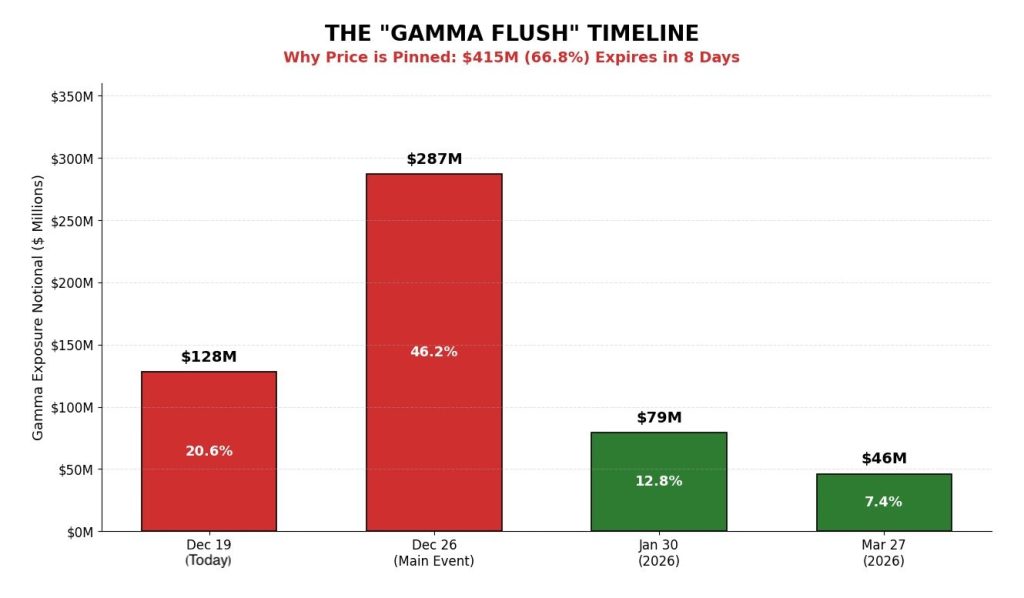
At the moment, the Bitcoin price is sitting under a heavy layer of short-term options pressure. Roughly $415 million in options exposure is set to expire over the next seven days. Even more important, most of that pressure is packed into a single date.
Today, about $128 million rolls off. But December 26 is the real focal point, with roughly $287 million expiring at once. That’s close to half of all the short-term exposure currently hanging over BTC.
When that much money is tied to options, the price movement becomes a problem for the people on the other side of those trades. If the Bitcoin price rips higher, they lose. If it dumps hard, they lose there too. So the easiest solution is to keep the price stuck right where it is.
That’s why every recent move feels fake. A small breakout shows up, then instantly fades. A sharp dip hits, then gets bought just enough to stop momentum. It’s not bullish. It’s not bearish. It’s controlled.
The Setup Behind the “Gamma Flush”
This kind of environment often leads to what traders call a gamma flush. As long as these options are active, the price is effectively pinned in place. But once that exposure expires, the pressure disappears quickly.
After December 26, the chart shows a steep drop in remaining exposure. January and March expiries are much smaller by comparison.
Replacing nearly $300 million in short-term options isn’t something that happens overnight, especially during a holiday period when liquidity is thin and traders are less active. That’s the key point. The restraint on price isn’t permanent.
Read Also: Japan’s Rate Move Puts Bitcoin at Risk of a Big Crash
What Changes After December 26
This doesn’t mean Bitcoin immediately pumps or crashes the moment those options expire. What it does mean is that the artificial pressure holding price in place starts to fade.
Once that happens, the BTC price can finally react to real buying and selling again. Moves should start to carry follow-through instead of getting slapped down instantly. Volatility won’t feel forced anymore. It’ll feel real.
For now, the takeaway is simple. Bitcoin isn’t weak, and it isn’t broken. It’s temporarily pinned.
And the next seven days are what decide when that pin finally gets pulled.
Disclaimer: The information on this page may come from third parties and does not represent the views or opinions of Gate. The content displayed on this page is for reference only and does not constitute any financial, investment, or legal advice. Gate does not guarantee the accuracy or completeness of the information and shall not be liable for any losses arising from the use of this information. Virtual asset investments carry high risks and are subject to significant price volatility. You may lose all of your invested principal. Please fully understand the relevant risks and make prudent decisions based on your own financial situation and risk tolerance. For details, please refer to
Disclaimer.
Related Articles
Willy Woo: Energy is the only path to forging hard currency, and Bitcoin is built on that.
Gate News message, April 7, a well-known Bitcoin analyst Willy Woo recently responded to a post questioning that “Bitcoin consumes too much energy.” He said there are only three ways to ensure the safety of a currency’s ledger: relying on physical atoms (like gold), depending on energy consumption (like Bitcoin), and building on social/political consensus (like fiat currency). Willy Woo emphasized that energy is the only path to forging an absolute hard currency, and physical atoms are not scarce.
GateNews2m ago
BTC 15-minute rise of 0.45%: driven by routine trading, with moderately resonating macro hedging sentiment
From 2026-04-07 15:15 to 15:30 (UTC), Bitcoin (BTC) recorded a +0.45% return. The price moved slightly upward within the USDT range of 67,886.0 to 68,199.5, with an amplitude of 0.46%. During this period, market attention increased somewhat, but overall volatility remained within the normal range, and no unusual market fluctuations appeared.
The main driving force behind this anomaly was routine trading activity in the spot market. On-chain data shows that the number of active addresses in the 15-minute window was about 66,000, slightly higher than the previous period. In the same period, spot trading volume increased by about 0.5 from the previous period over period
GateNews13m ago
Charles Schwab Wealth Management Warning: Allocating 1%-3% of an investment portfolio to BTC/ETH can significantly alter the risk profile.
Gate News message: On April 7, the U.S. financial giant Charles Schwab released a research bulletin warning that even if only 1%-3% of funds are allocated to Bitcoin or Ethereum within an investment portfolio, it may significantly change the portfolio’s overall risk characteristics. The research report notes that Bitcoin and Ethereum have both historically experienced drawdowns of more than 70%, far higher than the volatility levels of stocks or bonds; therefore, even small allocations can have a noticeable impact during periods of market volatility. Charles Schwab proposed two cryptocurrency allocation approaches: one is the traditional portfolio theory method, which allocates based on expected returns, volatility, and correlation; the other is a risk-based method, which determines the share of crypto assets according to the level of risk one is willing to take, shifting the focus from returns to risk tolerance.
GateNews28m ago


