🔥 Gate Square Event: #PostToWinNIGHT 🔥
Post anything related to NIGHT to join!
Market outlook, project thoughts, research takeaways, user experience — all count.
📅 Event Duration: Dec 10 08:00 - Dec 21 16:00 UTC
📌 How to Participate
1️⃣ Post on Gate Square (text, analysis, opinions, or image posts are all valid)
2️⃣ Add the hashtag #PostToWinNIGHT or #发帖赢代币NIGHT
🏆 Rewards (Total: 1,000 NIGHT)
🥇 Top 1: 200 NIGHT
🥈 Top 4: 100 NIGHT each
🥉 Top 10: 40 NIGHT each
📄 Notes
Content must be original (no plagiarism or repetitive spam)
Winners must complete Gate Square identity verification
Gat
The True Holy Grail of DeAI: Talus's "Fully On-Chain" Solution
The practicality of a product is the gold standard for measuring the potential of crypto AI projects, but true decentralization is its holy grail.
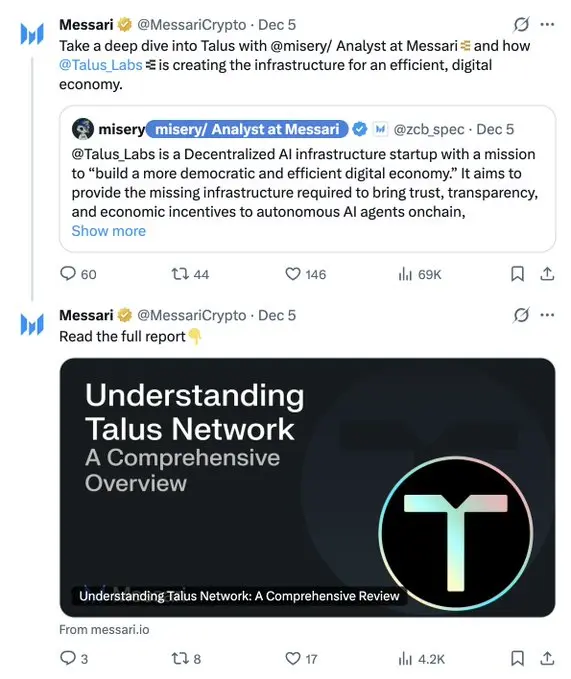
A few days ago, a report on Talus released by top crypto research firm Messari sparked deeper thoughts for me.
Core product implementation in the crypto AI sector is not a rarity; mature projects like Fetch and Olas are already on the market. However, most of them adopt a hybrid model of “off-chain computation + on-chain settlement.” Since the logic behind AI decisions is not fully on-chain, the entire decision process is a “black box,” making it impossible for outsiders to verify whether the decision-making follows the preset logic.
This is not true decentralization, nor is it true DeAI.
True DeAI: Fully On-Chain AI
Talus fills the gap in the DeAI infrastructure sector, transforming AI agents from black-box tools into fully decentralized, on-chain verifiable, and on-chain accountability-based independent economies.
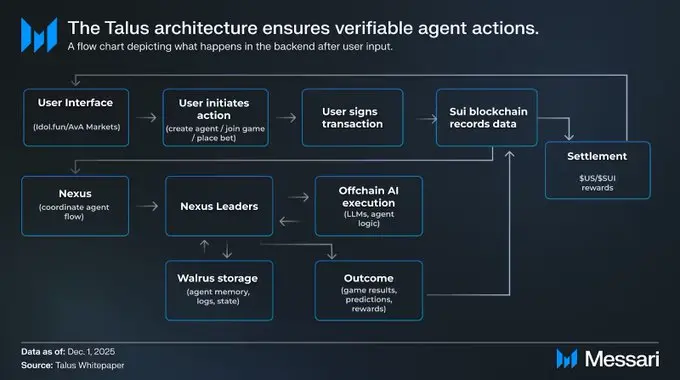
The core concept of Talus is “fully on-chain AI,” meaning that everything from the AI agent’s logic, state, to decision steps is written into smart contracts and executed directly on-chain. With this architecture, anyone can verify the historical behavior and decision paths of AI agents without the need to trust a third party.
The Trilemma of DeAI
Similar to the blockchain trilemma, the DeAI sector also faces a trilemma: balancing decentralization, performance, and cost. Talus cannot eliminate this trilemma, but its Nexus core framework skillfully balances all three.
Decentralization requires that all AI agent logic/state/decisions are fully on-chain. Purely on-chain execution of computation-intensive tasks can easily cause performance bottlenecks, especially in multi-agent concurrent scenarios.
Talus, based on its self-developed and first fully on-chain AI agent framework Nexus, anchors key AI agent behaviors (decision logic, workflow state, settlement results) entirely on-chain, executing and recording them through smart contracts on Sui to ensure verifiability and no black box.
This is also why Talus chose Sui as its underlying chain: Sui’s MoveVM supports parallel transaction processing, enabling scenarios with multiple AI agents running concurrently.
Talus has found a viable path within the DeAI trilemma, to some extent filling the gap in decentralized AI infrastructure, but the road to truly decentralized AI agents remains long and challenging.