イーサリアムの「退化」騒動を突き抜ける:なぜ「イーサリアムの価値観」が最も広い堀なのか?

ETH-2.55%
SOL-2.34%
SUI-3.17%

Written by: imToken

Over the past period, if you’ve been continuously following the Ethereum ecosystem, you may have experienced a sense of fragmentation.

  • On one side, there are intensive discussions about technical topics like scaling routes, Rollup architecture, Interop, ZK, PBS, Slot shortening, etc.;
  • On the other side, there are debates about “whether the Ethereum Foundation is arrogant,” “why not be more aggressive,” “why the coin price is sluggish,” and so on, even escalating into emotionalized confrontations;

These discussions actually repeatedly point to the same deeper question: What kind of system does Ethereum want to become?

In fact, many controversies don’t stem from technical disagreements, but rather from different understandings of Ethereum’s “value premises.” Therefore, only by returning to these premises themselves can we truly understand why Ethereum has made choices that many now consider “untimely.”

1. Ethereum’s “Seven-Year Itch”: Is Ethereum Degrading?

The recent Ethereum community has not been peaceful.

From reflections on the Rollup-centric route, to debates over the concept of “Ethereum Alignment,” and comparisons with various high-performance public chains, a subtle yet continuously fermenting “Ethereum anxiety” is spreading.

This anxiety is not hard to understand.

As other public chains continuously refresh TPS, TVL, popular narratives, latency, and user experience metrics, Ethereum is repeatedly discussing architecture decomposition, execution outsourcing, interoperability, and finality problems—which appears neither intuitive nor pragmatic.

This has also surfaced a more pointed question: Is Ethereum in “degradation”?

To answer this question, we cannot only look at the technical roadmap of the past one or two years, but must extend our perspective to a longer time dimension—back to what Ethereum has truly persisted in over this decade.

In fact, many emerging high-performance public chains in recent years have chosen a more direct path: exchanging extreme performance and user experience for reduced node counts, raised hardware thresholds, and centralized sequencing and execution.

However, from the Ethereum community’s perspective, such speed often comes at the cost of fragility resistance.

A frequently overlooked but remarkably indicative fact is that in nearly a decade of operation, Ethereum has never experienced a network-wide outage or rollback event, maintaining uninterrupted 7×24×365 operation.

This is not because Ethereum was “luckier” than Solana, Sui, and others, but because from its inception, it chose to prioritize whether the system could continue functioning under worst-case scenarios over performance metrics.

In other words, Ethereum appears slow today not because it cannot go faster, but because it has always asked a harder question—when the network scales larger, more participants join, and the environment becomes less friendly, can this system continue to operate?

From this perspective, the so-called “seven-year itch” is not Ethereum degrading, but rather it actively enduring short-term discomfort and doubt for survival across a longer cycle.

2. Understanding “Ethereum Alignment”: Not Taking Sides, But Drawing Boundaries

Precisely because of this, the first step to understanding Ethereum is accepting a fact that is unpopular yet extremely crucial: Ethereum is not a system with “maximum efficiency” as its sole objective; its core goal is not to run fastest, but to be “trustworthy even in worst cases.”

Therefore, in Ethereum’s context, many seemingly technical issues are essentially value choices: Should we sacrifice decentralization for speed? Should we introduce permissionless nodes for throughput? Should we entrust security assumptions to a few for better user experience?

Ethereum’s answer is often no.

This also explains why the Ethereum community maintains an almost instinctive wariness toward shortcuts, where “can we do it” always yields to “should we do it.”

It is precisely in this context that “Alignment” has become one of the most controversial concepts recently, with some worried it might evolve into moral blackmail or even become a tool for rent-seeking.

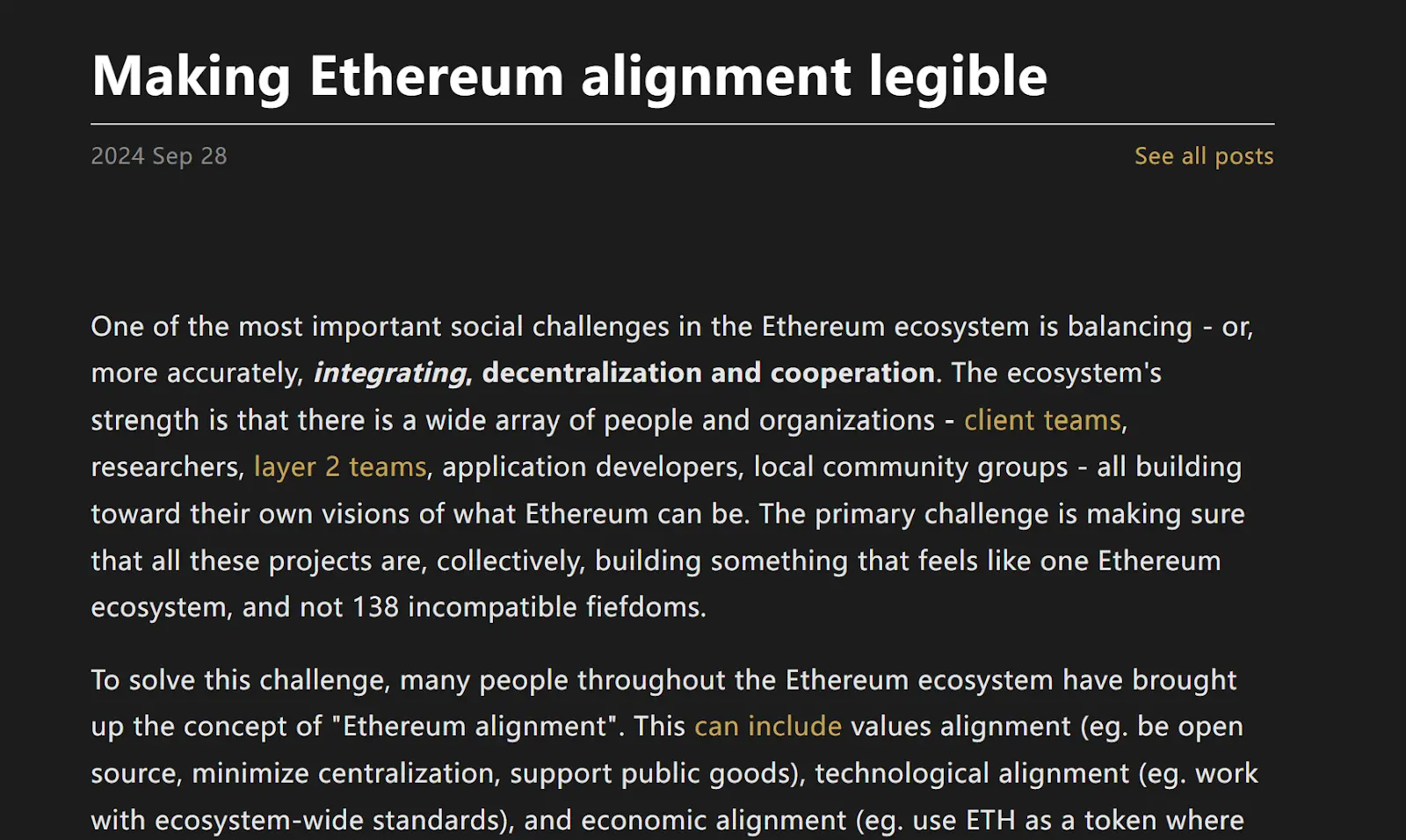
In fact, this concern is not unfounded. As early as September 2024, Vitalik Buterin directly pointed out this risk in “Making Ethereum alignment legible”:

If “Alignment” means whether you have the right friends, then the concept itself has already failed.

Vitalik’s solution is not to abandon alignment, but to make it legible, decomposable, and discussable. In his view, alignment should not be a vague political stance, but should be broken down into a set of auditable attributes:

  • Technical Alignment: Do you use Ethereum’s secure consensus? Do you champion open-source and open standards?
  • Economic Alignment: Do you promote ETH value capture long-term, rather than unilateral extraction?
  • Spiritual Alignment: Are you pursuing public good rather than merely predatory growth?

From this perspective, alignment is not a loyalty test, but a form of reciprocal symbiotic social contract.

The Ethereum ecosystem allows chaos, competition, and even fierce competition between L2s; but ultimately, these activities should give back to the mother chain that provides them security, consensus, and settlement guarantees.

3. The Dialectic of “Decentralization” and “Censorship Resistance”

If “Alignment” defines value boundaries, then truly supporting this boundary are the two pillars Ethereum has long upheld: decentralization and censorship resistance.

First, in Ethereum’s context, “decentralization” doesn’t mean having more nodes, nor does it mean everyone must run nodes. Rather, it means the system can function normally without trusting any single participant.

This means the protocol should not depend on a single sequencer, coordinator, or company; it also means node operation costs shouldn’t be so high that only professional institutions remain, ensuring ordinary people can still verify whether the system is operating according to the rules.

Precisely because of this, Ethereum maintains long-term restraint on hardware thresholds, bandwidth requirements, and state bloat, even if this slows certain short-term performance metrics (related reading: “ZK Route ‘Dawn Moment’: Is Ethereum’s Final Roadmap Accelerating Across the Board?”).

In Ethereum’s view, a system running at lightning speed but unable to be verified by ordinary people has essentially lost its “permissionless” significance.

Another frequently misunderstood value is censorship resistance.

Ethereum does not assume the world is benign. Instead, it defaults from inception that participants might pursue profit, power might concentrate, and external pressure will certainly emerge. Therefore, censorship resistance is not about ensuring “no one censors,” but ensuring that even if someone tries to censor, the system won’t fail.

This is also why Ethereum places such emphasis on proposer/builder separation, decentralized construction, and economic game design mechanisms—not because they’re elegant, but because they can continue functioning in worst-case scenarios.

In many discussions, people ask: “Would such extreme situations really happen in practice?”

But frankly, if a system is only secure in an ideal world, then it’s not worth entrusting value in the real world.

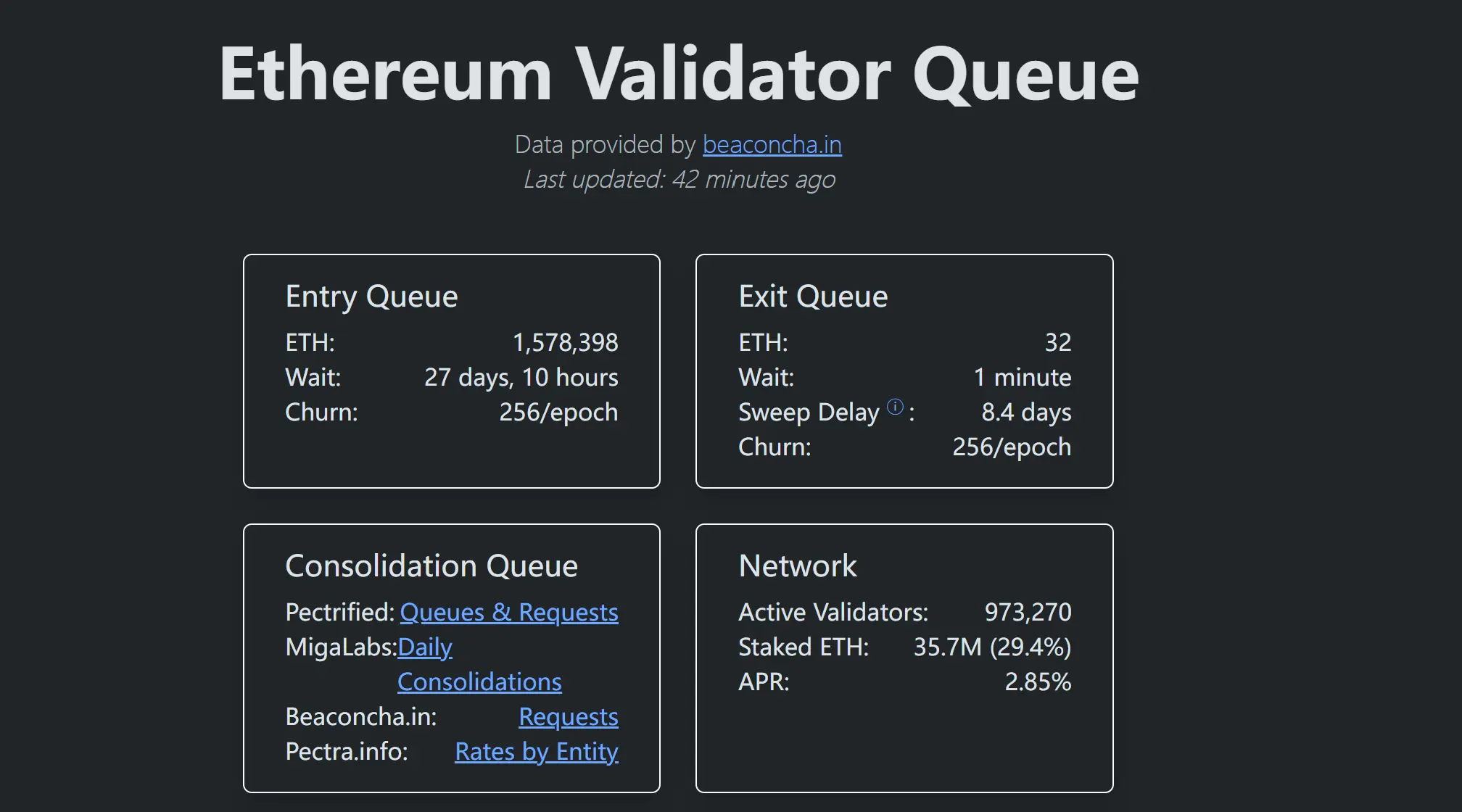
Finally, let me end with an interesting data point: currently Ethereum PoS’s staking exit queue has nearly cleared, while the queue for entering staking continues to grow (exceeding 1.57 million ETH).

Amid criticism and doubt, substantial amounts of ETH still choose to be locked long-term into this system.

This perhaps says more than any manifesto could.

In Closing

Many critics say Ethereum is always “discussing philosophy even after others have already started running.”

But from another angle, it’s precisely these discussions that have kept Ethereum from repeatedly tearing down and rebuilding. Whether it’s the Rollup-centric roadmap, the gradual introduction of ZK, or routes like Interop, fast confirmation, and Slot shortening, they all unfold under a premise:

All performance improvements must be capable of being incorporated into existing security and value assumptions.

This also explains why Ethereum’s evolution often presents the characteristic of “appearing conservative yet actually robust.” Ultimately, it’s not that Ethereum doesn’t pursue efficiency, but that it refuses to exchange future systemic risks for current short-term advantages.

And this is precisely the underlying spirit that has sustained the Ethereum ecosystem through a decade—and in an era of “efficiency / TVL supremacy,” the scarcest and most worth protecting thing in Web3.

原文表示
免責事項:このページの情報は第三者から提供される場合があり、Gateの見解または意見を代表するものではありません。このページに表示される内容は参考情報のみであり、いかなる金融、投資、または法律上の助言を構成するものではありません。Gateは情報の正確性または完全性を保証せず、当該情報の利用に起因するいかなる損失についても責任を負いません。仮想資産への投資は高いリスクを伴い、大きな価格変動の影響を受けます。投資元本の全額を失う可能性があります。関連するリスクを十分に理解したうえで、ご自身の財務状況およびリスク許容度に基づき慎重に判断してください。詳細は免責事項をご参照ください。

関連記事

Vitalik が AI モデル Qwen 35B を称賛:3分未満で Willans 公式を解析

イーサリアム共同創始者のVitalik Buterinは、AIモデルQwen 35Bの数学解析能力を賞賛し、特にWillans公式の解析における性能に感銘を受けています。彼は、このモデルが短時間で複雑な計算を完了したことに驚き、模演算と初等関数を組み合わせるそのアイデアを非常にクールだと述べています。

GateNews2時間前

イーサリアム現物ETFは昨日、純流出額が4197.15万ドルで、3日連続で資金流出が続いています

On March 22, Ethereum spot ETF experienced net outflows of $41.9715 million on March 20, marking three consecutive days of capital outflows. Among these, BlackRock's Staked ETH ETF saw net inflows of $5.4658 million, while BlackRock's ETF ETHA experienced net outflows of $31.4508 million. The current total net asset value of Ethereum spot ETFs stands at $1.2328 billion, with cumulative historical net inflows of $1.1729 billion.

GateNews3時間前

あるクジラが1時間前にあるCEXから1979枚のETHを引き出し、価値416万ドル

Gate Newsの報道によると、3月22日にOnchain Lensの監視で、あるクジラが1時間前にあるCEXから1979枚のETHを引き出し、価値は416万ドルです。過去1ヶ月間にこのクジラはこの取引所を通じて合計8662枚のETHを引き出しており、総額は1823万ドルに上ります。

GateNews4時間前

Resolv Attack: Attacker Spent 200,000 USDC to Mint 80 Million USR, Already Purchased 9,111 ETH

Onchain Lensは、Resolvの攻撃者が20万枚のUSDCを費やして8000万枚のUSRを鋳造し、その後これを使って9111枚のETHを購入したことを検知しました。攻撃者は引き続きUSRを他の暗号通貨に変換しており、今後もETHを追加で保有し続ける可能性があります。

GateNews4時間前

攻撃者は455万ドル相当のETHを購入済み

Gate News Alert: On March 22, on-chain analyst Ai Yi posted an analysis on the X platform regarding the Resolve attacker's operations: 1. Minted 50 million USR with 100,000 USDC; 2. Converted 35 million USR to wstUSR; 3. Continuously exchanged wstUSR for USDC and USDT; 4. Used USDT to purchase

GateNews4時間前

CFTC、暗号資産の証拠金規則を明確化:BTC、ETHの資本控除率20%、デリバティブ市場への参入を許可

米国商品先物取引委員会(CFTC)は最近、FAQを公開し、暗号通貨がデリバティブ市場で保証金として使用される際の詳細を明らかにしました。ビットコインとイーサリアムの資本控除率は20%、ステーブルコインは2%と定められています。試行計画は最初の3ヶ月間、3種類の暗号資産のみを対象とし、その後、対象通貨の種類を拡大し、申告要件を緩和します。条件を満たす暗号資産は保証金として利用可能となり、米国の金融システムがブロックチェーン資産を段階的に受け入れつつあることを示しています。

動區BlockTempo4時間前
コメント
0/400
コメントなし