As blockchain evolves from a simple value transfer tool into a multi-dimensional digital infrastructure, identity authentication and data trust have emerged as critical challenges. In the traditional internet model, user identities are typically controlled by centralized platforms, while data usage and transfer lack transparency and verifiability. This structure presents clear limitations in cross-platform collaboration, privacy protection, and trust building.
Ontology was introduced as a solution within this context. Its core objective is to build a “decentralized trust infrastructure.” Unlike public blockchains that focus primarily on financial applications, Ontology emphasizes identity and data layers. Through decentralized identity (DID) and verifiable credential mechanisms, it enables users to establish trust relationships that are verifiable and reusable across multiple parties, positioning itself as a key component in the Web3 and data economy landscape.
What Is Ontology (ONT)? Origins and Background
As a combination of a high-performance public blockchain and a distributed trust framework, Ontology is designed to provide foundational support for digital identity, data exchange, and cross-organizational collaboration. Its original intent goes beyond simple crypto asset transfers, aiming instead to create an infrastructure layer that supports trust establishment.
From a historical perspective, Ontology emerged during a period of growing demand for enterprise blockchain solutions. As traditional industries began exploring blockchain applications, challenges around identity verification, data ownership, and regulatory compliance became increasingly important. In this context, Ontology introduced a set of solutions centered on identity and data, enabling blockchain technology to better serve real-world use cases.
What Is Ontology’s Core Architecture?
Ontology adopts modular architecture that separates identity, data, and trust mechanisms, improving both flexibility and scalability. Its core structure can be understood across three layers:
First, the decentralized identity layer, where ONT ID provides a unique identifier for users and entities.
Second, the data layer, which manages data ownership and credential issuance.
Third, the trust layer, which establishes trusted relationships through on-chain verification and consensus mechanisms.
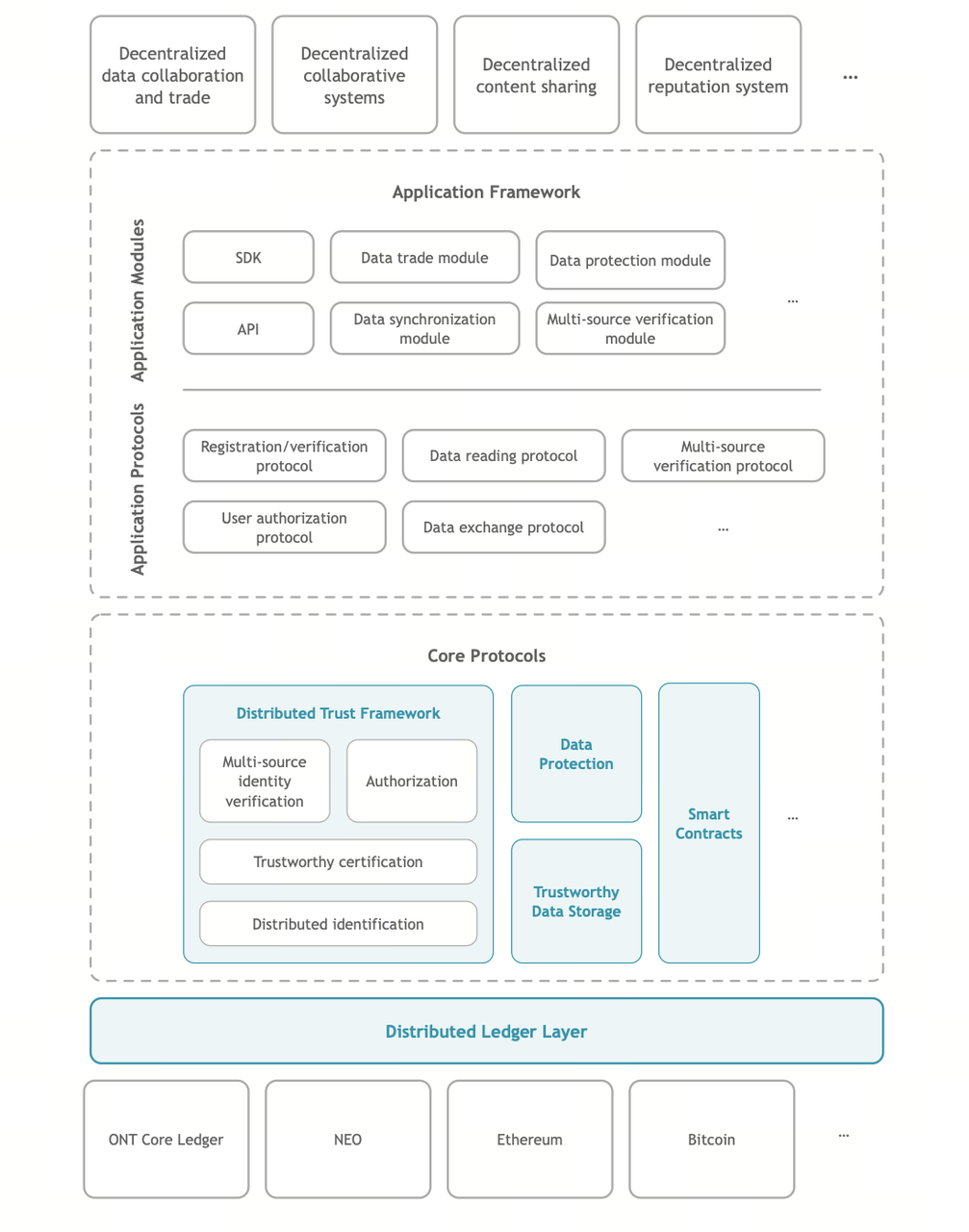 Source: Ontology White Paper
This architecture allows Ontology not only to support applications on a single chain but also to act as a “trust intermediary layer” in multi-chain environments, connecting identity and data across different systems.
How Does Ontology Work?
Ontology’s operating logic can be summarized as a process of identity, data, verification, and trust. Users first create a decentralized identity (ONT ID) and bind relevant data or credentials to it. When identity authentication or data verification is required, the system validates the information through cryptographic signatures and on-chain records to confirm its authenticity.
During this process, network nodes verify transactions and data through a consensus mechanism and record the results on the blockchain, ensuring immutability. At the same time, a token-based incentive system encourages nodes to maintain the network, allowing the trust framework to function continuously in a decentralized environment.
Ontology’s Decentralized Identity (ONT ID) Mechanism
ONT ID is one of Ontology’s core components, representing the decentralized identity of users or entities. Unlike traditional account systems, ONT ID is fully controlled by the user, eliminating reliance on centralized platforms.
In practice, ONT ID can be linked to various types of data, including identity information, certificates, and behavioral records. Through verifiable credentials, third-party institutions can issue trusted attestations, while users retain control over what information they disclose. This enables identity verification while preserving privacy.
This mechanism allows Ontology to achieve trusted authentication without exposing raw data, making it a key foundation in the digital identity space.
Ontology’s Token Economy and Use Cases
Ontology adopts a dual-token model consisting of ONT and ONG, each serving distinct roles within the system.
ONT is primarily used for governance and staking, functioning as the core value token of the network. ONG, on the other hand, is used to pay transaction fees and operational costs, acting as the “fuel” for network activity. Users who hold ONT can earn ONG through staking, creating an incentive structure that supports network participation.
This design helps balance network security with usability, ensuring stable operation while maintaining economic incentives.
Ontology vs Ethereum: A Comparative Analysis
Ontology and Ethereum are both blockchain infrastructures, but they differ significantly in design goals. Ontology focuses on identity and data layers, while Ethereum serves as a general-purpose smart contract platform.
At the architectural level, Ethereum emphasizes decentralized computing power and supports a wide range of decentralized applications. In contrast, Ontology provides foundational support for cross-system collaboration through decentralized identity and trust mechanisms.
In terms of applications, Ethereum is widely used in DeFi and NFTs, whereas Ontology is better suited for digital identity, data sharing, and enterprise-level use cases. These differences highlight the diverse roles that various infrastructures play within the broader blockchain ecosystem.
Ontology Use Cases
Ontology’s applications are primarily concentrated in identity and data-related domains. In digital identity, ONT ID can be used for KYC, credential management, and Web3 login systems. In the data space, Ontology supports data ownership and privacy protection, enabling secure data exchange between different parties.
In enterprise settings, Ontology can be applied to supply chain management, data sharing, and compliance scenarios, enhancing transparency and verifiability through on-chain trust mechanisms. In multi-chain environments, its identity and trust capabilities can also serve as a bridge connecting different blockchain systems.
Conclusion
Ontology is a blockchain infrastructure centered on decentralized identity and data collaboration. Its core value lies in building verifiable trust. Through ONT ID, a modular architecture, and a dual-token model, Ontology provides a practical framework for identity authentication and trusted data exchange in decentralized environments.
Compared to finance-focused public blockchains, Ontology is positioned more as a trust-layer infrastructure, playing an important role in the evolution of digital identity and the data economy.
FAQs
Is Ontology (ONT) a public blockchain?
Yes, Ontology is a public blockchain network as well as a distributed trust framework that supports identity and data-related applications.
What is the difference between ONT and ONG?
ONT is mainly used for governance and staking, while ONG is used to pay transaction fees and on-chain operation costs.
What is ONT ID?
ONT ID is Ontology’s decentralized identity system, used to represent users or entities and support identity verification and data binding.
Does Ontology support smart contracts?
Yes, Ontology supports smart contracts, although its primary focus is on identity and data layers rather than general-purpose computation.
What are the main use cases of Ontology?
They include digital identity verification, data ownership and exchange, enterprise blockchain applications, and cross-chain trust mechanisms.







