What is Sign?

(Source: ethsign)
Sign Protocol is an omnichain verification protocol that empowers users to freely attest and verify data on-chain, building a verifiable trust layer for Web3. Sign Protocol transitions trust from subjective belief to objective verification, ensuring transparency, standardization, and full traceability.
Core Concepts
Traditionally, trust depended on assuming that certain parties acted honestly. In Web3, information is decentralized and flows across chains—anyone can publish, share, or modify data. Sign Protocol introduces a new trust model: using on-chain proofs and cryptographic signatures, all information can be verified, referenced, and tracked. This approach goes beyond identity verification, extending to governance, points systems, rewards, reputation networks, and more.
How the Protocol Works
Sign Protocol is structured around three key functions: Write, Read, and Query. Each step is designed for maximum verifiability and composability.
1. Writing Data
Sign Protocol classifies data into two main types:
- Schema: Defines the format and validation rules for data.
- Attestation: Represents actual verification information.
Users can create or submit data via three methods:
- Fully On-chain: Deployed on public blockchains such as EVM, Starknet, Solana, TON.
- Fully on Arweave: Ideal for large datasets or files.
- Hybrid: Combines on-chain records with off-chain storage to balance cost and usability.
All data is ultimately recorded by Sign Protocol smart contracts, guaranteeing each attestation is both verifiable and tamper-resistant.
2. Reading Data
Developers and users can access data in two ways:
- Directly from smart contracts or Arweave.
- Through the SignScan API for efficient querying and filtering.
SignScan serves as Sign Protocol’s indexing and aggregation engine—integrating multi-chain data into a unified interface so developers avoid cross-chain synchronization complexity.
3. Querying and Interacting with Data
SignScan also acts as the protocol’s data explorer, providing no-code tools for users to create or verify attestations:
- Search existing schemas and related data.
- Generate new schemas or attestations on demand.
- Review trending attestation categories.
- Query historical attestations and activity for any address.
This approach makes attestation accessible to all users, not just developers, as a participatory trust-building mechanism.
Sign Protocol Technical Foundation
Sign Protocol is more than a single protocol—it’s a comprehensive verifiable trust framework with four distinct layers:
- Attestation Layer: Manages attestation and verification, forming the system’s backbone.
- Infrastructure Layer: Preserves data integrity via on-chain and decentralized storage (IPFS, Arweave).
- Application Layer: Supports diverse use cases like DAO governance, user points systems, reputation mechanisms, and more.
- Trust Layer: Enables end users to independently verify information without relying on third-party intermediaries.
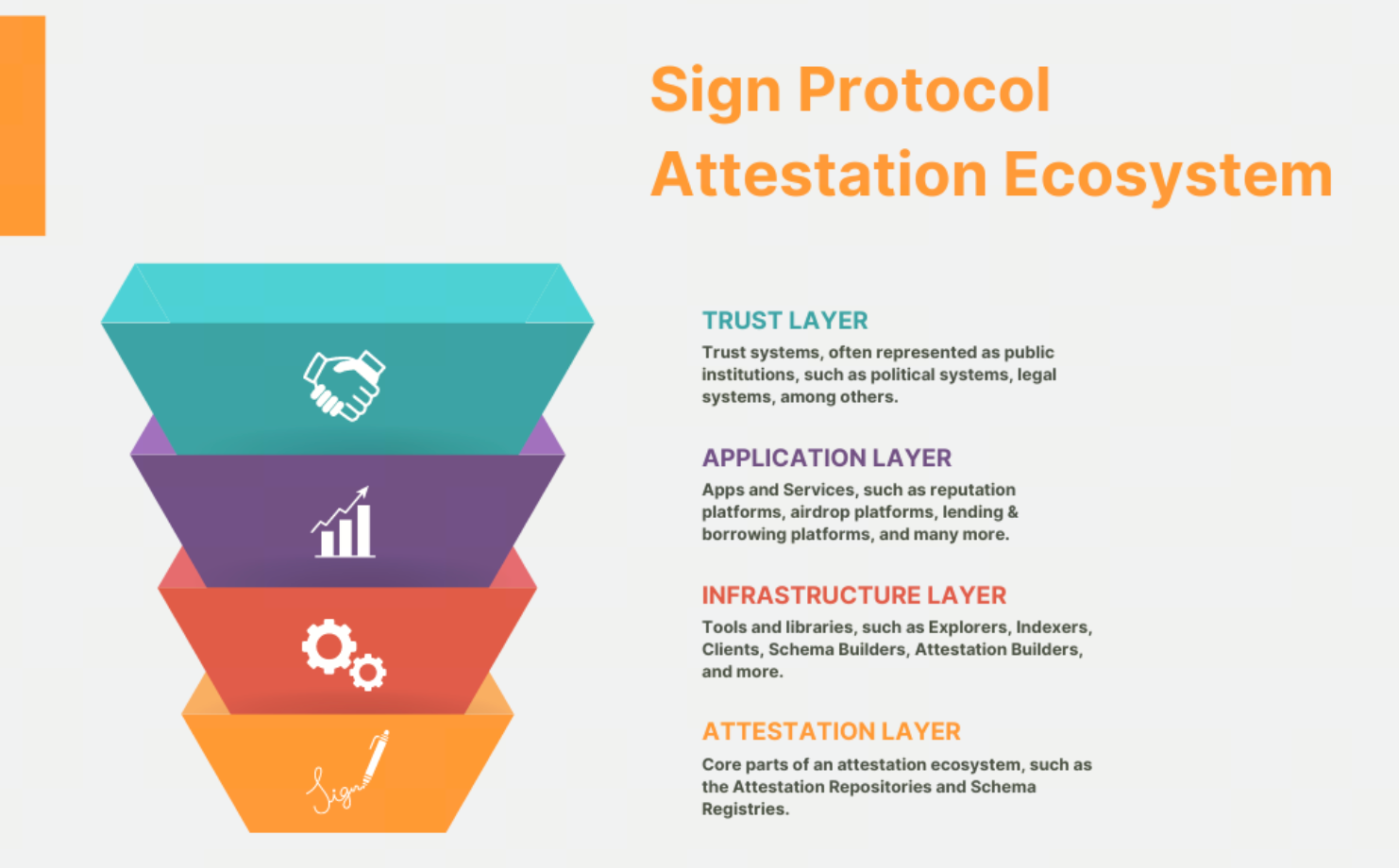
(Source: docs.sign.global)
This architecture aims to replace traditional trust models that depend on institutional endorsement, transforming trust into a verifiable cryptographic fact.
Effective Attestations (e/att)
Sign Protocol introduces Effective Attestations (e/att) to improve the performance and value of on-chain attestations. The four key features are:
- Verifiability: All attestations can be independently verified and standardized by schema labeling.
- Relevancy: Attestations must have practical use—such as DAO voting, NFT ownership, credit history, and more.
- Insightfulness: Structured data enables developers to analyze and extract meaningful insights.
- Universality: Cross-chain compatibility allows free interaction and referencing across different ecosystems.
Therefore, Sign Protocol serves as more than a data system; it is a composable trust infrastructure.
Multi-chain & Storage Integration
Sign Protocol’s omnichain capability lets it operate across multiple blockchains, including Ethereum, BNB Chain, Base, Solana, Starknet, and more. The protocol supports large-scale data storage via IPFS and Arweave, allowing attestations to include both structured and unstructured data (documents, images, token records, etc.). This integrated design delivers high scalability and availability, making Sign Protocol the core engine for cross-chain trust data flow.
Real-world use cases
Sign Protocol’s potential applications span the following areas:
- DAO governance: Verifies voting rights and participation, ensuring transparent decision-making.
- User reputation systems: Builds credit models based on on-chain behavior.
- Points & rewards distribution: Implements verifiable Proof of Participation mechanisms.
- Digital signatures & credentials: Integrates EthSign to support cryptographic signatures as replacements for traditional electronic contracts.
- Decentralized identity (DID): Establishes a cross-chain identity authentication base layer.
Together, these applications lay the foundation for an emerging on-chain trust economy.
Tokenomics
Sign Protocol’s token model balances governance, incentives, and long-term ecosystem growth, with a total supply of 10,000,000,000 SIGN tokens.
Token Allocation
- Community Incentives — 40%: Encourages user participation and developer contributions; 10% will be airdropped to early supporters and testers during the Token Generation Event (TGE).
- Supporters — 20%: Allocated to early strategic investors and long-term partners to strengthen the ecosystem’s foundation.
- Core Team — 10%: Rewards protocol core developers and researchers, released through locked vesting to ensure long-term commitment.
- Ecosystem Growth — 10%: Funds ecosystem collaboration, cross-chain integration, developer grants, and infrastructure maintenance.
- Foundation — 20%: Managed by the Sign Foundation for governance, R&D, and global community outreach.
The protocol will mint tokens first on Ethereum mainnet and then distribute them in parallel via BNB Chain and Base, ensuring immediate support for multi-chain use cases.
Token Utility
$SIGN is both a governance token and the fuel and trust credential for protocol operations:
- Governance Voting: Token holders can participate in proposals for protocol parameters, schema standards, and fee allocation.
- Incentive Rewards: Compensates contributors, validators, and developers.
- Data Verification Fees: Covers on-chain transaction costs for attestation and verification.
- Cross-chain Universality: Serves as a cross-chain trust token across multiple blockchains.
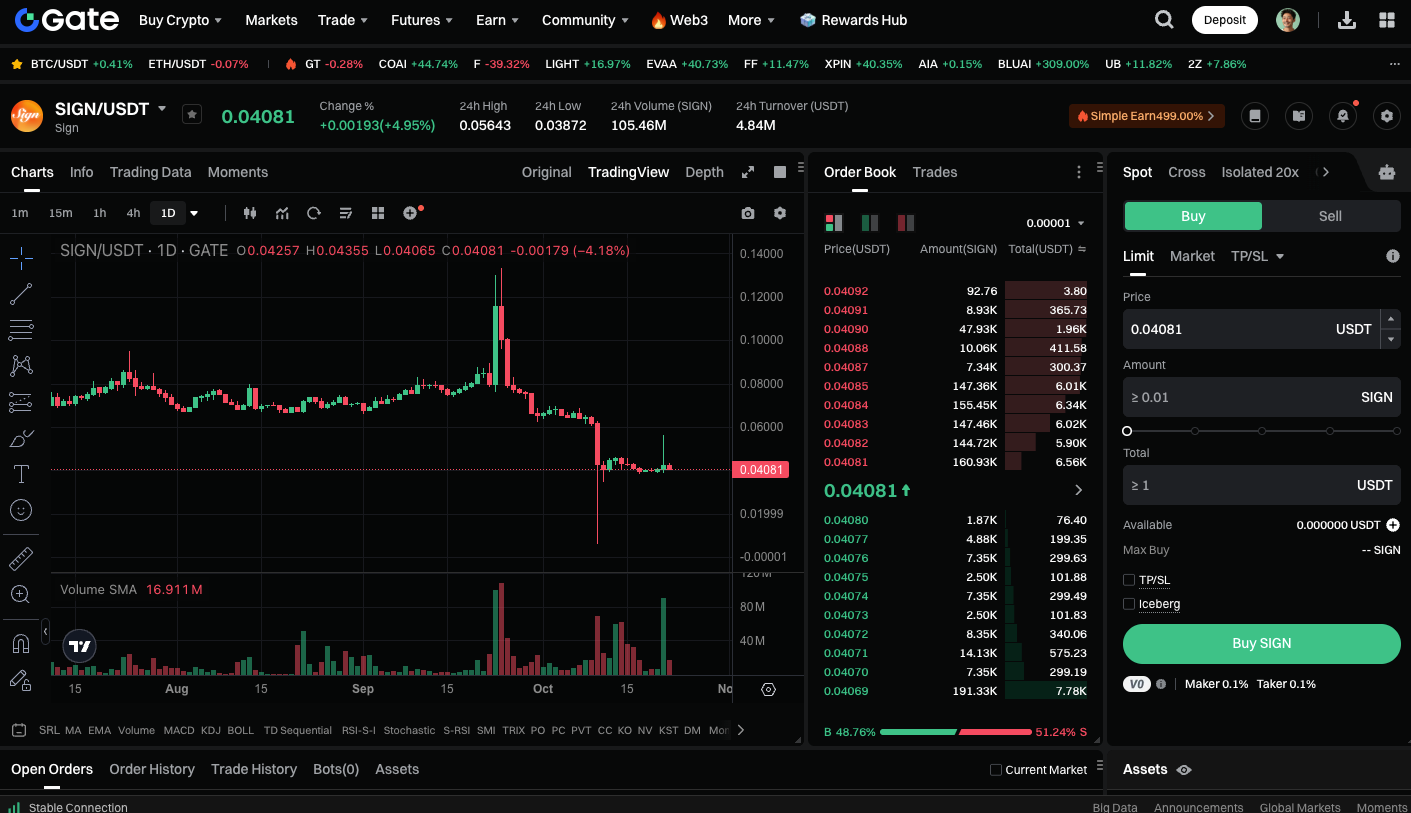
SIGN spot trading is now available: https://www.gate.com/trade/SIGN_USDT
Conclusion
In Web3, trust isn’t built on centralized authority—it’s anchored in transparency, cryptography, and consensus. Sign Protocol (SIGN) is establishing an infrastructure that turns trust into a verifiable fact, revolutionizing how information is authenticated and reshaping the very logic of trust across networks. As multi-chain integration and attestation ecosystems expand, Sign Protocol aims to be the foundation for genuine, transparent, and verifiable applications—ushering in the Verifiable Trust Era for Web3.







