ZRO vs HBAR: A Comparison of Two Emerging Cryptocurrencies in the Digital Asset Space

Introduction: ZRO vs HBAR Investment Comparison
In the cryptocurrency market, LayerZero vs Hedera has always been a topic that investors can't ignore. The two not only have significant differences in market cap ranking, application scenarios, and price performance, but also represent different cryptocurrency asset positioning.
LayerZero (ZRO): Since its launch, it has gained market recognition for its omnichain interoperability protocol designed for lightweight message passing across chains.
Hedera (HBAR): Since its inception in 2019, it has been hailed as a fast, secure, and fair public ledger network using hashgraph consensus, and is one of the cryptocurrencies with the highest global trading volume and market capitalization.
This article will comprehensively analyze the investment value comparison between LayerZero and Hedera in terms of historical price trends, supply mechanisms, institutional adoption, technological ecosystems, and future predictions, and attempt to answer the question that investors are most concerned about:
"Which is the better buy right now?"
I. Price History Comparison and Current Market Status
LayerZero (ZRO) and Hedera (HBAR) Historical Price Trends
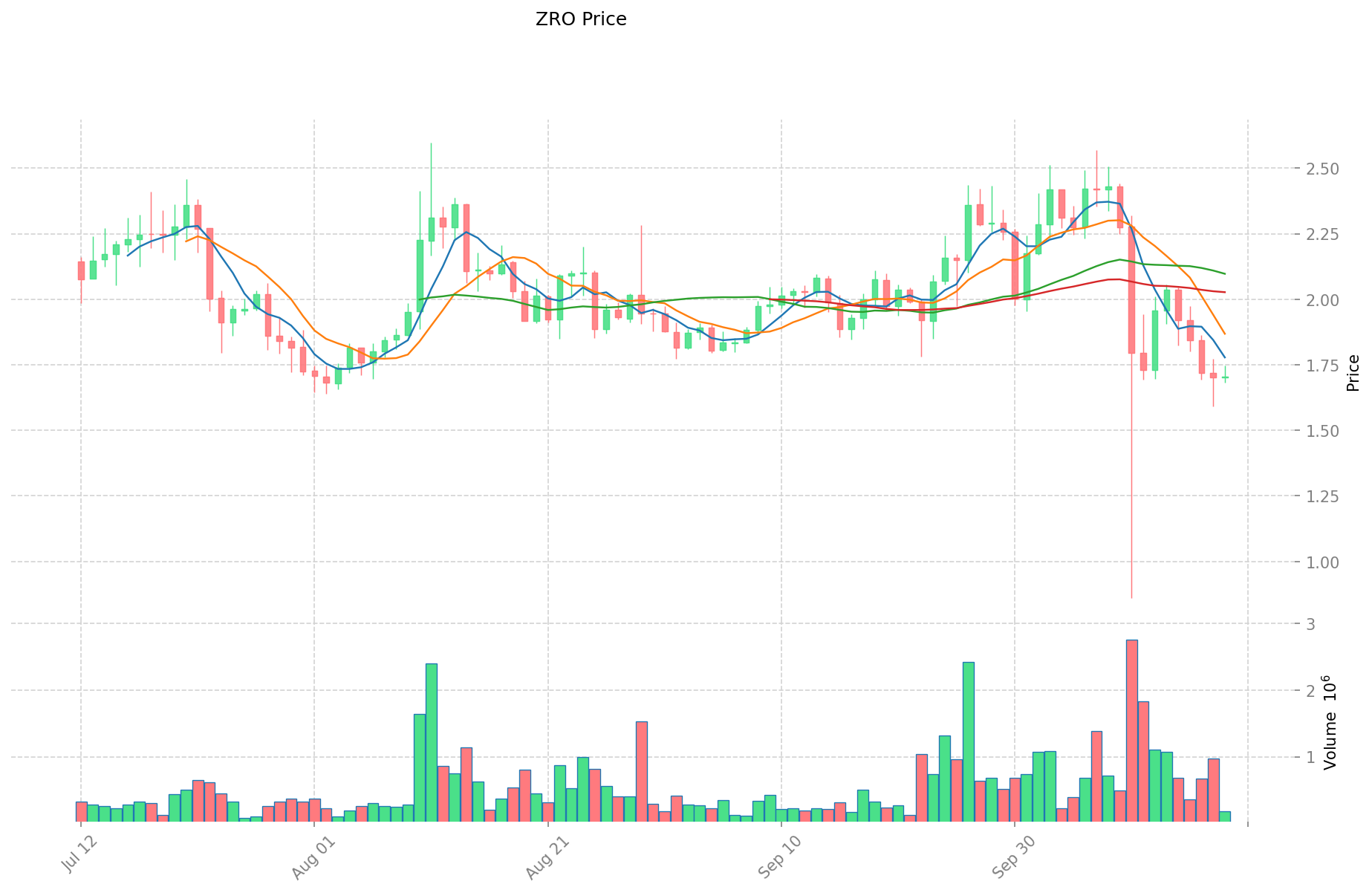
- 2024: ZRO reached its all-time high of $7.557 on December 6, 2024.
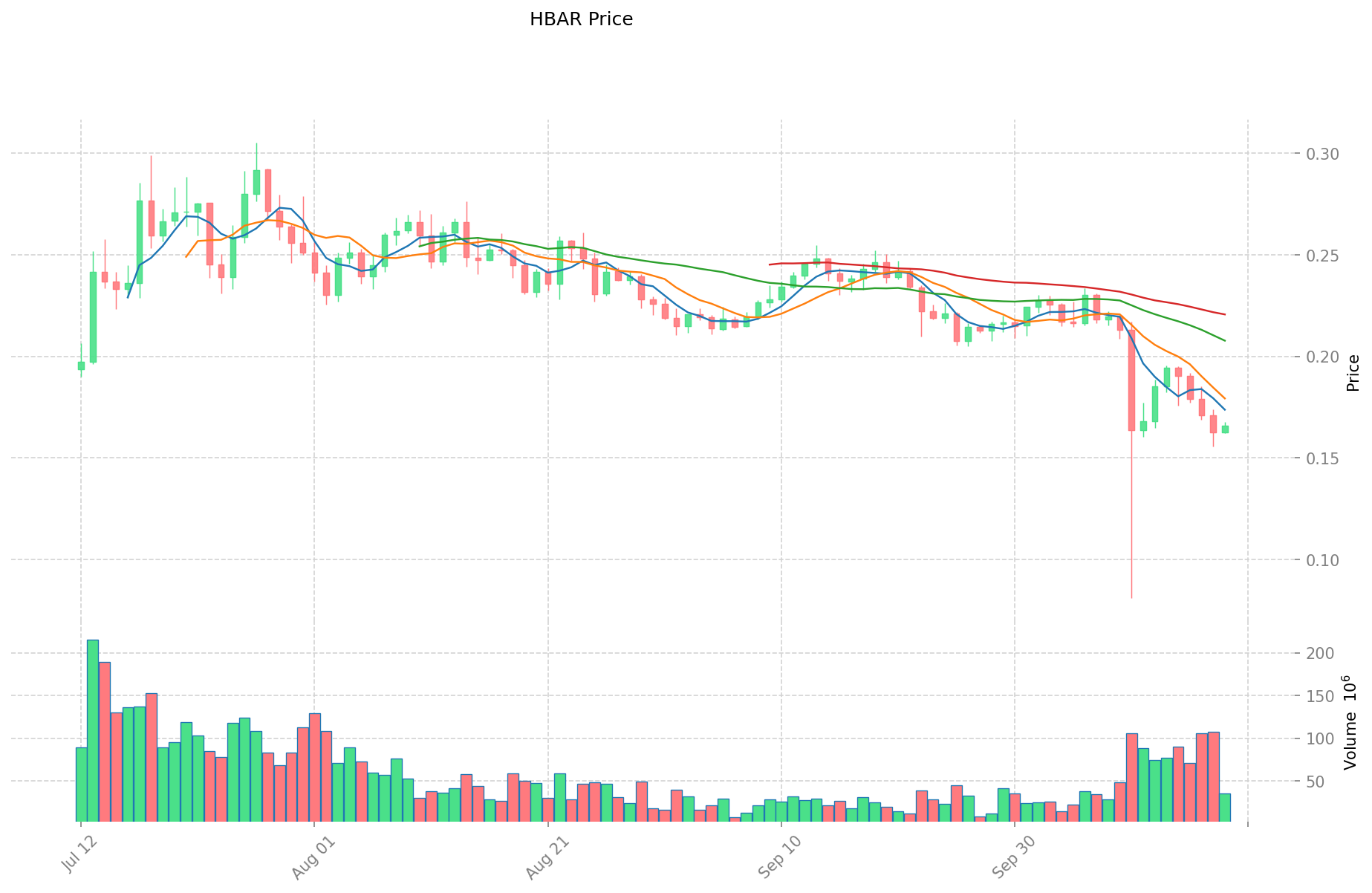
- 2025: HBAR experienced significant growth, with a 224.54% price increase over the past year.
- Comparative analysis: In the recent market cycle, ZRO dropped from its high of $7.557 to a current price of $1.703, while HBAR has shown strong performance with a substantial yearly gain.
Current Market Situation (2025-10-19)
- ZRO current price: $1.703
- HBAR current price: $0.16576
- 24-hour trading volume: ZRO $304,461.93 vs HBAR $5,776,527.74
- Market Sentiment Index (Fear & Greed Index): 23 (Extreme Fear)
Click to view real-time prices:
- Check ZRO current price Market Price
- Check HBAR current price Market Price
II. Core Factors Affecting Investment Value of ZRO vs HBAR
Supply Mechanism Comparison (Tokenomics)
- ZRO: Fixed supply model with a maximum cap of 10 billion tokens. Features a deflationary mechanism where 100% of fees from the platform are used to buy back and burn ZRO tokens.
- HBAR: Maximum supply of 50 billion tokens with a gradual release schedule. Distribution includes allocations to SAFT investors, team members, and the Hedera treasury.
- 📌 Historical Pattern: Fixed cap and deflationary mechanisms (like ZRO's) tend to create upward price pressure over time, while larger supplies with gradual releases (like HBAR) often provide more price stability but potentially slower appreciation.
Institutional Adoption and Market Applications
- Institutional Holdings: HBAR has established partnerships with major corporations on its governing council including Google, IBM, Boeing, and LG. ZRO has backing from noted VC firms like Delphi Digital and Framework Ventures.
- Enterprise Adoption: HBAR has real-world implementations in supply chain tracking, document verification, and cross-border payments through the Hedera network. ZRO's applications focus on zero-knowledge technology implementation in privacy-preserving transactions.
- Regulatory Attitudes: HBAR benefits from its compliance-focused approach and enterprise governance model, potentially facing fewer regulatory hurdles. ZRO's privacy-focused technology may face additional scrutiny in jurisdictions concerned with transaction transparency.
Technical Development and Ecosystem Building
- ZRO Technical Upgrades: Focuses on advancing zero-knowledge proof technology for privacy-preserving transactions and cross-chain interoperability.
- HBAR Technical Development: Continues to enhance its hashgraph consensus mechanism for higher throughput and lower latency. Recently implemented staking capabilities.
- Ecosystem Comparison: HBAR has more established enterprise applications and greater transaction volume, while ZRO is building in the emerging privacy and cross-chain interoperability segments with fewer but potentially high-growth applications.
Macroeconomic Factors and Market Cycles
- Inflation Performance: Both position themselves as digital assets with controlled supply mechanisms, potentially serving as inflation hedges. HBAR's enterprise backing may provide stability, while ZRO's deflationary mechanism could theoretically provide stronger price support during inflationary periods.
- Monetary Policy Impact: Interest rate changes affect risk appetite for emerging technologies like those underlying both tokens, with enterprise-backed HBAR potentially showing more resilience during risk-off periods.
- Geopolitical Factors: Increasing global privacy concerns could boost demand for ZRO's zero-knowledge applications, while HBAR's enterprise network may benefit from increasing corporate digital transformation initiatives.
III. 2025-2030 Price Prediction: ZRO vs HBAR
Short-term Prediction (2025)
- ZRO: Conservative $1.05 - $1.70 | Optimistic $1.70 - $1.91
- HBAR: Conservative $0.11 - $0.17 | Optimistic $0.17 - $0.19
Mid-term Prediction (2027)
- ZRO may enter a growth phase, with prices expected in the range of $1.38 - $2.60
- HBAR may enter a consolidation phase, with prices expected in the range of $0.13 - $0.24
- Key drivers: Institutional capital inflow, ETFs, ecosystem development
Long-term Prediction (2030)
- ZRO: Base scenario $2.53 - $3.16 | Optimistic scenario $3.16 - $3.92
- HBAR: Base scenario $0.29 - $0.30 | Optimistic scenario $0.30 - $0.37
Disclaimer
ZRO:
| 年份 | 预测最高价 | 预测平均价格 | 预测最低价 | 涨跌幅 |
|---|---|---|---|---|
| 2025 | 1.90624 | 1.702 | 1.05524 | 0 |
| 2026 | 1.9664908 | 1.80412 | 1.0283484 | 5 |
| 2027 | 2.601721452 | 1.8853054 | 1.376272942 | 10 |
| 2028 | 2.84926205102 | 2.243513426 | 1.48071886116 | 31 |
| 2029 | 3.7686538529948 | 2.54638773851 | 2.1389657003484 | 49 |
| 2030 | 3.915325786732976 | 3.1575207957524 | 2.52601663660192 | 85 |
HBAR:
| 年份 | 预测最高价 | 预测平均价格 | 预测最低价 | 涨跌幅 |
|---|---|---|---|---|
| 2025 | 0.1873088 | 0.16576 | 0.1143744 | 0 |
| 2026 | 0.248913504 | 0.1765344 | 0.118278048 | 6 |
| 2027 | 0.24250530528 | 0.212723952 | 0.13401608976 | 28 |
| 2028 | 0.3163843338096 | 0.22761462864 | 0.193472434344 | 37 |
| 2029 | 0.331839367094256 | 0.2719994812248 | 0.182239652420616 | 64 |
| 2030 | 0.374380085957814 | 0.301919424159528 | 0.292861841434742 | 82 |
IV. Investment Strategy Comparison: ZRO vs HBAR
Long-term vs Short-term Investment Strategies
- ZRO: Suitable for investors focused on privacy technologies and cross-chain interoperability
- HBAR: Suitable for investors seeking enterprise adoption and stable network growth
Risk Management and Asset Allocation
- Conservative investors: ZRO: 20% vs HBAR: 80%
- Aggressive investors: ZRO: 60% vs HBAR: 40%
- Hedging tools: Stablecoin allocation, options, cross-currency portfolios
V. Potential Risk Comparison
Market Risks
- ZRO: Higher volatility due to smaller market cap and emerging technology focus
- HBAR: Potential for slower price appreciation due to larger token supply
Technical Risks
- ZRO: Scalability, network stability
- HBAR: Hashgraph consensus reliability, potential centralization concerns
Regulatory Risks
- Global regulatory policies may have differing impacts on privacy-focused ZRO versus enterprise-oriented HBAR
VI. Conclusion: Which Is the Better Buy?
📌 Investment Value Summary:
- ZRO advantages: Deflationary mechanism, focus on emerging privacy and interoperability technologies
- HBAR advantages: Strong enterprise partnerships, established use cases, compliance-focused approach
✅ Investment Advice:
- New investors: Consider a larger allocation to HBAR for its enterprise backing and stability
- Experienced investors: Balanced portfolio with both ZRO and HBAR to capture potential growth in privacy tech and enterprise adoption
- Institutional investors: Evaluate HBAR for its established partnerships and ZRO for exposure to emerging blockchain technologies
⚠️ Risk Warning: The cryptocurrency market is highly volatile. This article does not constitute investment advice. None
VII. FAQ
Q1: What are the main differences between LayerZero (ZRO) and Hedera (HBAR)? A: LayerZero (ZRO) focuses on omnichain interoperability and privacy-preserving transactions, while Hedera (HBAR) is known for its enterprise-grade public ledger using hashgraph consensus. ZRO has a fixed supply with a deflationary mechanism, whereas HBAR has a larger supply with gradual release. ZRO is more volatile and potentially higher growth, while HBAR offers more stability due to its enterprise partnerships.
Q2: Which token has shown better price performance recently? A: As of 2025-10-19, HBAR has shown stronger recent performance with a 224.54% price increase over the past year. ZRO, on the other hand, has dropped from its all-time high of $7.557 in December 2024 to a current price of $1.703.
Q3: How do the supply mechanisms of ZRO and HBAR differ? A: ZRO has a fixed supply model with a maximum cap of 10 billion tokens and a deflationary mechanism where 100% of platform fees are used to buy back and burn tokens. HBAR has a maximum supply of 50 billion tokens with a gradual release schedule, including allocations to investors, team members, and the Hedera treasury.
Q4: What are the key factors affecting the investment value of ZRO and HBAR? A: Key factors include supply mechanisms, institutional adoption, market applications, technical development, ecosystem building, and macroeconomic factors such as inflation and monetary policy. ZRO's value is influenced by advancements in privacy technology and cross-chain interoperability, while HBAR's value is tied to enterprise adoption and its established use cases.
Q5: How do the long-term price predictions for ZRO and HBAR compare? A: For 2030, ZRO's base scenario predicts a range of $2.53 - $3.16, with an optimistic scenario of $3.16 - $3.92. HBAR's base scenario for 2030 is $0.29 - $0.30, with an optimistic scenario of $0.30 - $0.37. These predictions suggest potentially higher growth for ZRO, but with likely higher volatility compared to HBAR.
Q6: What are the main risks associated with investing in ZRO and HBAR? A: ZRO faces higher volatility due to its smaller market cap and emerging technology focus, as well as potential scalability and network stability issues. HBAR risks include slower price appreciation due to larger token supply, potential centralization concerns, and reliability of its hashgraph consensus. Both face regulatory risks, with ZRO potentially facing more scrutiny due to its privacy focus.
Q7: How might different types of investors approach ZRO and HBAR? A: New investors might consider a larger allocation to HBAR for its enterprise backing and stability. Experienced investors could balance their portfolio with both ZRO and HBAR to capture potential growth in privacy tech and enterprise adoption. Institutional investors may evaluate HBAR for its established partnerships and ZRO for exposure to emerging blockchain technologies.
Share
Content
Introduction: ZRO vs HBAR Investment Comparison
I. Price History Comparison and Current Market Status
II. Core Factors Affecting Investment Value of ZRO vs HBAR
III. 2025-2030 Price Prediction: ZRO vs HBAR
IV. Investment Strategy Comparison: ZRO vs HBAR
V. Potential Risk Comparison
VI. Conclusion: Which Is the Better Buy?
VII. FAQ
How to Buy Cryptocurrency


Trending Cryptocurrencies


Is Humanity (H) a good investment?: Exploring the potential of a new cryptocurrency in the digital age

IAG vs AVAX: Comparing Two Blockchain Platforms for Enterprise Solutions

2025 OKB Price Prediction: Analyzing Market Trends and Future Potential of OKB Token in the Crypto Ecosystem

pi price prediction
2025 SUI价格预测:区块链新贵的未来发展与投资价值分析
2025 PI Price Prediction: Analyzing Market Trends and Future Value Potential of PI Network's Digital Currency
Xenea Daily Quiz Answer December 13, 2025

Guide to Bridging Assets to the Polygon Network

Guide to Integrating Polygon Network with Your Crypto Wallet

Beginner's Guide to Secure Digital Asset Storage with BEP2

Guide to Bridging Assets to Polygon PoS Network