Is Gitcoin (GITCOIN) a good investment? Analyzing tokenomics, community impact, and future potential in the web3 funding ecosystem

Introduction: The Investment Position and Market Prospects of Gitcoin (GITCOIN)
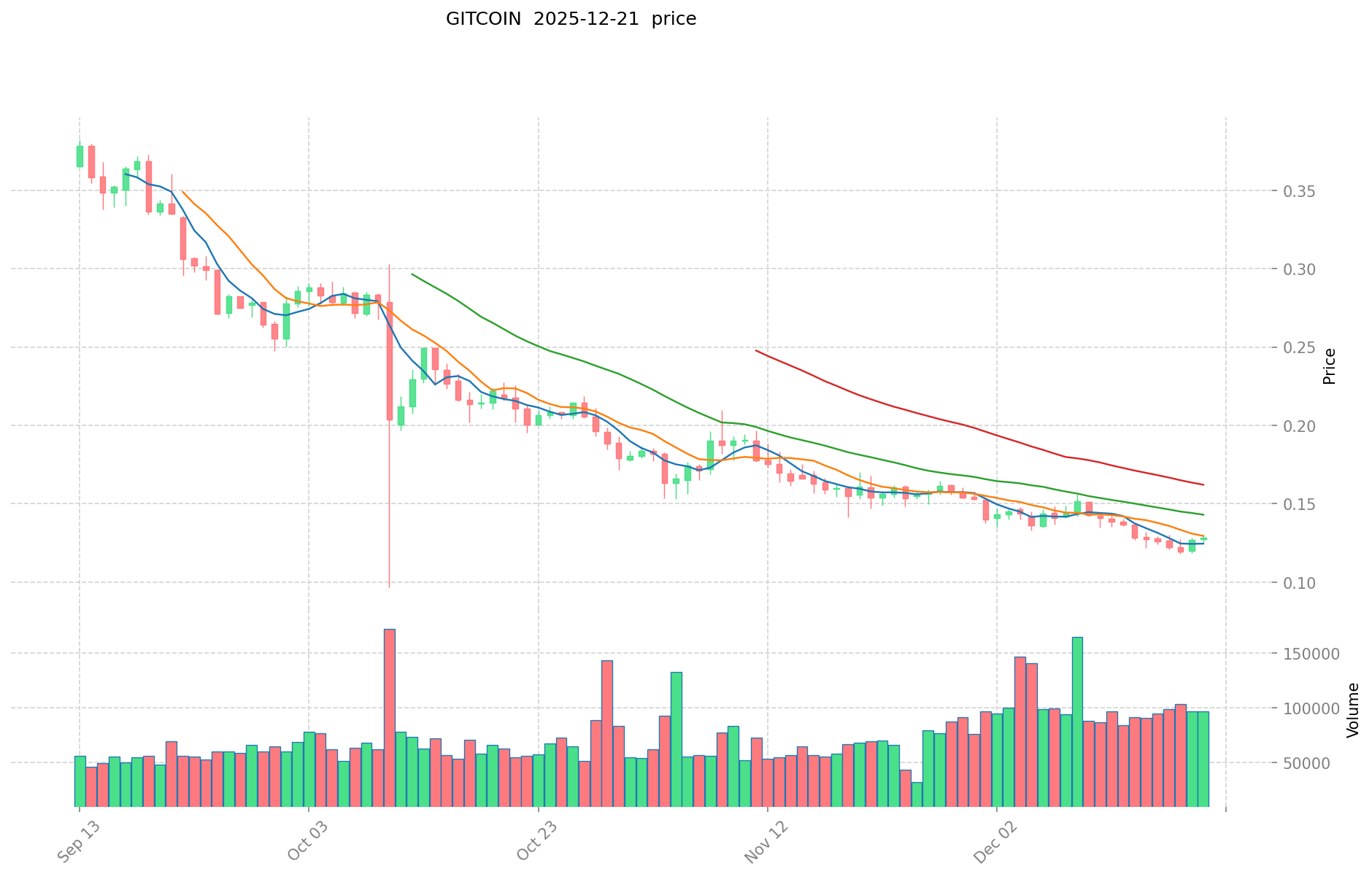
Gitcoin is an important asset in the cryptocurrency field. Since its launch in May 2021, it has achieved notable progress in open-source software development and decentralized governance. As of December 2025, Gitcoin's market capitalization stands at approximately $12.81 million, with a circulating supply of around 96.38 million GTC tokens, trading at $0.1281 per token. As a governance token designed to allocate resources within the GitcoinDAO ecosystem for funding public goods, Gitcoin has gradually become a focal point when investors discuss the investment prospects of decentralized public funding platforms. This article provides a comprehensive analysis of Gitcoin's investment value, historical price trends, future price forecasts, and associated investment risks to serve as a reference for investors.
Gitcoin (GITCOIN) Cryptocurrency Asset Research Report
I. Gitcoin Price History Review and Current Investment Value Assessment
Gitcoin Historical Price Performance and Investment Returns
Based on available data, Gitcoin has experienced significant price volatility since its launch:
- All-Time High (ATH): USD 22.37 reached on November 27, 2021
- All-Time Low (ATL): USD 0.118188 recorded on December 19, 2025
- Maximum Drawdown: Approximately 99.47% from ATH to ATL
- Launch Price: USD 3.5281 (May 25, 2021)
Current Gitcoin Market Status (December 21, 2025)
Price Metrics:
- Current Price: USD 0.1281
- 24-Hour Price Change: -0.07%
- 1-Hour Change: +0.79%
- 7-Day Change: -4.97%
- 30-Day Change: -16.93%
- 1-Year Change: -82.34%
Market Capitalization and Supply:
- Market Cap: USD 12,346,883.62
- Fully Diluted Valuation: USD 12,810,000.00
- Circulating Supply: 96,384,727.71 GITCOIN
- Total Supply: 100,000,000 GITCOIN
- Circulating Supply Ratio: 96.38%
- Market Dominance: 0.00039%
Trading Data:
- 24-Hour Trading Volume: USD 12,264.98
- Market Cap to FDV Ratio: 96.38%
- Number of Exchange Listings: 21
- Token Holders: 91,778
Market Sentiment:
- Market Emotion Index: 1 (indicating subdued sentiment)
View real-time GITCOIN market price at Gate Gitcoin Price
II. Project Overview and Token Economics
Platform Description
Gitcoin is an open-source platform enabling developers to build open-source software using programming languages including Python, Rust, Ruby, JavaScript, Solidity, HTML, and CSS, while earning compensation for their contributions.
GTC Token Function
GTC serves as the governance token for the GitcoinDAO ecosystem, facilitating decentralized governance and funding mechanisms for public goods in the Web3 space. The token is designed to support open-source project development and promote decentralized infrastructure advancement.
Token Supply Structure
- Maximum Supply: 100,000,000 GITCOIN
- Total Supply: 100,000,000 GITCOIN
- Circulating Supply: 96,384,727.71 GITCOIN
- Supply Inflation: 3.61% of total supply not yet in circulation
III. Trading and Accessibility
- Blockchain Network: Ethereum (ETH)
- Smart Contract Address: 0xde30da39c46104798bb5aa3fe8b9e0e1f348163f
- Available Trading Pairs: 21+ exchange listings
- Price Stability: Significant volatility observed across multiple timeframes
Report Generated: December 21, 2025
Data Source: Gate Cryptocurrency Data Platform
Disclaimer: This report provides factual market data and project information for research purposes only and does not constitute investment advice.
Gitcoin (GTC) Investment Analysis Report
Report Date: December 21, 2025
I. Executive Summary
Gitcoin (GTC) is a governance token for the GitcoinDAO ecosystem, designed to facilitate funding for public goods through decentralized mechanisms. As of December 21, 2025, GTC is trading at $0.1281, representing a significant decline from its all-time high of $22.37 reached on November 27, 2021. The token has experienced a -82.34% decline over the past year, with a market capitalization of approximately $12.81 million and a fully diluted valuation matching this figure, indicating 96.38% of the total supply is in circulation.
II. Core Factors Affecting Whether Gitcoin is a Good Investment
Supply Mechanism and Scarcity
Gitcoin operates with a fixed maximum supply of 100,000,000 GTC tokens, with 96,384,727.71 tokens currently in circulation (96.38% of total supply). The high circulating supply ratio indicates limited scarcity relative to the total cap. The supply mechanism directly impacts price stability and investment value, as the near-complete circulation of available tokens leaves minimal room for supply-driven price appreciation through gradual token releases.
Market Performance and Price Dynamics
Historical Price Performance:
- All-Time High (ATH): $22.37 (November 27, 2021)
- All-Time Low (ATL): $0.118188 (December 19, 2025)
- Current Price: $0.1281
- 24-Hour Range: $0.1254 - $0.1302
Price Trends:
- 1-Hour Change: +0.79%
- 24-Hour Change: -0.07%
- 7-Day Change: -4.97%
- 30-Day Change: -16.93%
- 1-Year Change: -82.34%
The token has experienced sustained downward pressure, with only marginal short-term recovery signals over the past hour. The 82.34% annual decline reflects significant investor loss from peak valuations.
Market Liquidity and Exchange Availability
GTC trades on 21 different exchanges with a 24-hour trading volume of $12,264.98. The token maintains 91,778 holders, indicating moderate market participation. Market dominance stands at 0.00039%, reflecting minimal influence on overall cryptocurrency market movements.
Valuation Metrics
- Market Capitalization: $12,346,883.62
- Fully Diluted Valuation: $12,810,000.00
- Market Cap to FDV Ratio: 96.38%
- Market Share: 0.00039%
The near-equivalence between market cap and fully diluted valuation demonstrates that valuation expansion cannot occur through additional token circulation, as the supply is nearly complete.
III. Price Prediction Perspectives
Various market analysts provide divergent forecasts for GTC pricing:
Conservative Forecasts:
- CoinCodex projects trading within $0.1061 - $0.1269 range for 2025, with average price of $0.1133
- A 5% annual growth projection suggests $0.13 by 2026, $0.16 by 2030, and $0.27 by 2040
- CoinCheckup forecasts a -12.85% decline to $0.1111 by January 18, 2026, with bearish technical outlook
Optimistic Forecasts:
- StealthEx suggests potential highs of $3.54 (+264%) at peak, with minimums near $2.86 by end of 2025
- CryptoTicker projects trading range of $0.69124 - $1.0445 by year-end 2025
The wide divergence between forecasts (ranging from $0.10 to $3.54) indicates high uncertainty regarding future price direction and the speculative nature of such projections.
IV. Key Considerations for Investment Assessment
Platform Function and Use Case
Gitcoin operates as an open-source platform enabling developers to earn compensation by contributing to open-source software projects. GTC serves as the governance token for GitcoinDAO, distributing funding for public goods. The platform's value depends on sustained developer participation and funding availability for ecosystem projects.
Risk Factors
- Significant Drawdown: The 82.34% annual decline and proximity to all-time lows indicate substantial downside risk recently experienced
- Market Sentiment: Current trading near recent low prices reflects weak market sentiment
- Regulatory Exposure: Binance's May 2025 collateral ratio reduction to 25% for GTC suggests increased margin trading risks and potential exchange-level concerns
- Market Position: Ranking of 1,078 among cryptocurrencies indicates limited market prominence
Technical Market Indicators
Recent data shows bearish technical indicators, with multiple analysts noting negative short-term outlook despite minimal 24-hour price movements.
V. Conclusion
Gitcoin presents a highly speculative investment profile characterized by:
- Severe valuation decline from historical peaks
- Limited near-term upside from supply expansion
- Divided market forecasts reflecting uncertainty
- Governance-focused utility dependent on ecosystem adoption
- Regulatory and margin trading concerns
Investment decisions should be based on individual risk tolerance, investment timeline, and fundamental belief in the GitcoinDAO ecosystem's ability to sustain and grow its public goods funding mission.
III. GITCOIN Future Investment Predictions and Price Outlook
Short-term Investment Prediction (2025, Short-term GITCOIN Investment Outlook)
- Conservative Forecast: $0.0976 - $0.1285
- Neutral Forecast: $0.1285 - $0.1489
- Optimistic Forecast: $0.1489 - $0.1650
Mid-term Investment Outlook (2026-2027, Mid-term Gitcoin(GITCOIN) Investment Forecast)
-
Market Stage Expectations: Recovery phase with gradual ecosystem expansion; Gitcoin DAO governance maturation and increased protocol adoption among Web3 developers and open-source contributors.
-
Investment Return Projections:
- 2026: $0.1220 - $0.2066
- 2027: $0.1001 - $0.2538
-
Key Catalysts: Enhanced DAO governance mechanisms, expanded quadratic funding deployment, increased developer platform adoption, strategic partnerships within Web3 infrastructure ecosystem.
Long-term Investment Outlook (Is Gitcoin a Good Long-term Investment?)
-
Base Case: $0.2785 - $0.4363 USD (assumes steady ecosystem growth with stable developer participation and moderate market expansion by 2030)
-
Optimistic Case: $0.4363 - $0.6500 USD (assumes breakthrough adoption in public goods funding, significant increase in active developers on platform, and favorable crypto market conditions)
-
Risk Case: $0.1000 - $0.1800 USD (extreme conditions: regulatory headwinds, reduced developer participation, market contraction, or protocol adoption slowdown)
For detailed GITCOIN long-term investment and price predictions, visit: Price Prediction
2025-12-31 Long-term Outlook
-
Base Scenario: $0.1220 - $0.2066 USD (corresponding to steady ecosystem development and moderate protocol adoption growth)
-
Optimistic Scenario: $0.2207 - $0.3683 USD (corresponding to accelerated developer onboarding and expanded quadratic funding initiatives)
-
Transformative Scenario: $0.4363 USD and above (breakthrough in mainstream Web3 developer adoption and significant expansion of public goods funding mechanisms)
-
2030-12-31 Predicted Peak: $0.4363 USD (based on optimistic development assumptions)
Disclaimer
This analysis is for informational purposes only and does not constitute investment advice. Cryptocurrency markets are highly volatile and unpredictable. Past performance does not guarantee future results. Actual price movements may deviate substantially from these forecasts due to regulatory changes, market sentiment shifts, technological developments, or macroeconomic factors. Investors should conduct thorough due diligence and consult qualified financial advisors before making investment decisions.
| 年份 | 预测最高价 | 预测平均价格 | 预测最低价 | 涨跌幅 |
|---|---|---|---|---|
| 2025 | 0.148944 | 0.1284 | 0.097584 | 0 |
| 2026 | 0.20662128 | 0.138672 | 0.12203136 | 8 |
| 2027 | 0.2537905608 | 0.17264664 | 0.1001350512 | 34 |
| 2028 | 0.28784511054 | 0.2132186004 | 0.144988648272 | 66 |
| 2029 | 0.3682818275409 | 0.25053185547 | 0.1778776173837 | 95 |
| 2030 | 0.436263646522684 | 0.30940684150545 | 0.278466157354905 | 141 |
Gitcoin (GTC) Comprehensive Research Report
I. Project Overview
Basic Information
Gitcoin is an open source platform that enables developers to create open source software using various programming languages and technologies—including Python, Rust, Ruby, JavaScript, Solidity, HTML, CSS, and Design—while earning compensation for their contributions.
Token Details:
- Token Name: Gitcoin (GTC)
- Token Type: Governance Token
- Total Supply: 100,000,000 GTC
- Circulating Supply: 96,384,727.71 GTC (96.38% of total supply)
- Current Price: $0.1281 (as of December 21, 2025)
- Market Capitalization: $12,346,883.62
- Fully Diluted Valuation: $12,810,000.00
- Market Ranking: #1078
- Number of Holders: 91,778
Project Mission
GTC serves as a governance token for GitcoinDAO, facilitating the distribution and decentralization of Gitcoin throughout the DAO ecosystem. The token's primary purpose is to enable collective funding of next-generation public goods through community governance mechanisms.
Launch Details:
- Publishing Date: May 26, 2021
- Publishing Price: $3.5281
II. Token Economics & Market Performance
Price Performance Analysis
Current Market Status (December 21, 2025):
- Current Price: $0.1281
- 24-Hour Price Range: $0.1254 - $0.1302
- 24-Hour Trading Volume: $12,264.98
- Market Share: 0.0039%
Historical Price Milestones:
- All-Time High (ATH): $22.37 (November 27, 2021)
- All-Time Low (ATL): $0.118188 (December 19, 2025)
- Distance from ATH: -99.43%
Price Trend Analysis
| Time Period | Price Change | Change Amount |
|---|---|---|
| 1 Hour | +0.79% | +$0.001004 |
| 24 Hours | -0.07% | -$0.000090 |
| 7 Days | -4.97% | -$0.006700 |
| 30 Days | -16.93% | -$0.026107 |
| 1 Year | -82.34% | -$0.597268 |
Key Observations:
- GTC has experienced severe long-term depreciation, declining 82.34% over the past year.
- Short-term volatility shows mixed signals, with a marginal 24-hour decline offset by 1-hour gains.
- Recent price action indicates weakness, with the token reaching ATL levels in mid-December 2025.
Market Liquidity & Distribution
- Number of Exchanges Listed: 21
- Token Distribution Ratio: 96.38% circulating vs. total supply indicates a highly distributed token
- Dominance: 0.0039% of total cryptocurrency market
III. Gitcoin Ecosystem & Governance Structure
Core Ecosystem Functions
GitcoinDAO operates as a decentralized autonomous organization where GTC token holders exercise governance authority over protocol decisions, funding allocation, and platform development priorities. The ecosystem aims to democratize public goods funding through community participation.
Governance Mechanisms
Token holders utilize GTC for:
- Voting on protocol upgrades and parameter changes
- Directing capital allocation toward public goods initiatives
- Participating in DAO treasury management decisions
Network & Integration
Blockchain Network: Ethereum (ETH)
- Contract Address: 0xde30da39c46104798bb5aa3fe8b9e0e1f348163f
- Token Standard: ERC-20 compliant
IV. Investment Strategy & Risk Management
Investment Methodologies
Long-Term Holding (HODL GTC):
- Suitable for investors with conviction in Gitcoin's mission of decentralized public goods funding
- Requires tolerance for extended downturns and price volatility
- Appropriate for those believing in the project's long-term ecosystem development
Active Trading:
- Relies on technical analysis and identification of support/resistance levels
- Suitable for experienced traders comfortable with high-volatility assets
- Requires monitoring of market sentiment indicators and trading volume patterns
Risk Management Framework
Asset Allocation Guidelines:
- Conservative Investors: 1-3% portfolio allocation maximum
- Balanced/Professional Investors: 3-5% portfolio allocation
- Aggressive Investors: 5-10% portfolio allocation (for experienced traders only)
Diversification Strategies:
- Multi-asset portfolio composition to reduce concentration risk
- Hedging mechanisms through stablecoin allocation
- Correlation-independent asset combinations
Secure Storage Solutions:
- Hot wallet: For active trading (Metamask, Trust Wallet for Ethereum-based access)
- Cold Wallet: For long-term holdings (hardware wallets or paper wallets)
- Recommended Security Practices: Enable multi-signature wallets where possible, utilize hardware wallet solutions like Ledger or Trezor
V. Investment Risks & Challenges
Market Risks
- High Price Volatility: GTC exhibits significant price swings, with 82.34% annual decline demonstrating extreme downside risk
- Low Liquidity Depth: Trading volume of $12,264.98 in 24 hours indicates limited market depth, increasing price impact for large transactions
- Extended Downtrend: Consistent decline across all measured timeframes suggests ongoing bearish market sentiment
Regulatory Risks
- Governance Token Classification: Regulatory bodies in various jurisdictions may classify GTC differently, potentially impacting trading and holding regulations
- DAO Regulatory Uncertainty: Legal framework surrounding DAOs remains unclear in many jurisdictions, creating compliance risks
- Jurisdictional Variations: Different countries maintain inconsistent approaches to cryptocurrency governance and token regulations
Operational & Technical Risks
- Smart Contract Risk: As an ERC-20 token dependent on Ethereum's infrastructure, GTC is exposed to potential vulnerabilities in both its own contract code and the underlying Layer 1 blockchain
- Network Security: Ethereum network upgrades or security incidents could impact token functionality
- Ecosystem Dependency: Gitcoin platform's viability directly affects GTC's utility and value proposition
VI. Conclusion: Is Gitcoin (GTC) a Good Investment?
Investment Value Summary
Gitcoin operates within a compelling ecosystem focused on funding public goods through decentralized governance. However, current market conditions present significant challenges:
- Long-Term Potential: Gitcoin's mission aligns with growing interest in decentralized funding mechanisms and public goods contribution, suggesting long-term relevance
- Short-Term Challenges: Severe price depreciation (-82.34% annually) and proximity to all-time lows indicate substantial short-term headwinds
- Valuation Context: Current price represents a 99.43% decline from peak levels, though this may reflect broader market cycles rather than fundamental project failures
Investor Recommendations
⚠️ Disclaimer: Cryptocurrency investments carry substantial risk. This analysis is provided for informational purposes only and does not constitute investment advice. Conduct independent due diligence before making investment decisions.
For Beginner Investors:
- ✅ Consider dollar-cost averaging (DCA) strategy with small allocation sizes
- ✅ Utilize secure wallet infrastructure (hardware wallets or reputable custodial services)
- ✅ Allocate only capital you can afford to lose entirely
For Experienced Traders:
- ✅ Identify support/resistance levels through technical analysis
- ✅ Implement structured position sizing with strict stop-loss parameters
- ✅ Consider GTC as potential contrarian position given extreme depreciation
For Institutional Investors:
- ✅ Evaluate GitcoinDAO governance structure and token economics thoroughly
- ✅ Consider strategic allocation aligned with broader public goods funding thesis
- ✅ Monitor regulatory developments affecting DAO governance tokens
Final Assessment
GTC represents a governance token in a niche ecosystem focused on decentralized public goods funding. Current price levels reflect significant bearish sentiment. Investment decisions should be based on individual risk tolerance, investment horizon, and conviction regarding Gitcoin's long-term mission rather than short-term price appreciation expectations.
Gitcoin (GTC) Frequently Asked Questions
I. FAQ
Q1: What is Gitcoin (GTC) and what is its primary function?
A: Gitcoin is an open-source platform that enables developers to earn compensation by contributing to open-source software projects using various programming languages including Python, Rust, Ruby, JavaScript, and Solidity. GTC serves as the governance token for GitcoinDAO, facilitating decentralized decision-making and resource allocation for funding public goods within the Web3 ecosystem. The token allows holders to participate in protocol upgrades, funding allocation decisions, and DAO treasury management through community governance mechanisms.
Q2: What is the current price and market capitalization of Gitcoin as of December 21, 2025?
A: As of December 21, 2025, Gitcoin is trading at $0.1281 per token with a market capitalization of approximately $12.35 million. The fully diluted valuation stands at $12.81 million, with 96,384,727.71 GTC tokens in circulation out of a total supply of 100 million tokens (96.38% circulating supply ratio). The token maintains a market dominance of 0.00039% and ranks #1,078 among all cryptocurrencies.
Q3: What has been Gitcoin's historical price performance and what are the key price milestones?
A: Gitcoin reached its all-time high of $22.37 on November 27, 2021, and its all-time low of $0.118188 on December 19, 2025. The token launched at $3.5281 in May 2021. Currently, GTC is trading approximately 99.43% below its all-time high and has experienced an 82.34% decline over the past year. The token shows continued weakness across all measured timeframes (7-day change: -4.97%, 30-day change: -16.93%), indicating sustained bearish market sentiment.
Q4: What price forecasts exist for Gitcoin in the short, medium, and long term?
A: Price forecasts vary widely depending on analyst and methodology. Short-term projections (2025) range from $0.0976 to $0.1650. Medium-term forecasts for 2026-2027 suggest ranges of $0.1220-$0.2066 (2026) and $0.1001-$0.2538 (2027). Long-term predictions for 2030 range from $0.1000-$0.6500 USD depending on scenario assumptions: base case projects $0.2785-$0.4363, the optimistic case suggests $0.4363-$0.6500, and the risk case estimates $0.1000-$0.1800. These divergent forecasts reflect high uncertainty regarding future price direction.
Q5: What are the primary investment risks associated with holding Gitcoin?
A: Key investment risks include: (1) Extreme price volatility with an 82.34% annual decline and proximity to all-time lows; (2) Limited market liquidity with only $12,264.98 in 24-hour trading volume across 21 exchanges; (3) Regulatory uncertainty surrounding governance tokens and DAO legal frameworks; (4) Smart contract and Ethereum network dependency risks; (5) Operational risk tied to Gitcoin platform adoption and ecosystem viability; (6) Margin trading concerns evidenced by Binance reducing GTC collateral ratios to 25% in May 2025. The token's niche market position (#1,078 ranking) further compounds these risks.
Q6: What is the recommended investment allocation and strategy for Gitcoin?
A: Investment allocation recommendations depend on risk profile: Conservative investors should limit GTC to 1-3% of portfolio; Balanced/Professional investors may allocate 3-5%; Aggressive investors with experience in volatile assets might consider 5-10% allocation. Recommended strategies include dollar-cost averaging (DCA) for beginners, technical analysis-based trading for experienced traders, and long-term holding (HODL) only for those with conviction in the project's public goods funding mission. Secure storage should utilize hardware wallets for long-term holdings and reputable hot wallets like Metamask or Trust Wallet for active trading. All investors should only allocate capital they can afford to lose entirely.
Q7: How does Gitcoin's token supply structure impact its investment potential?
A: Gitcoin operates with a fixed maximum supply of 100 million tokens, with 96.38% already in circulation. This near-complete token distribution limits price appreciation potential from supply scarcity mechanics or future token release events. The high circulating supply ratio means valuations cannot expand through additional token circulation, and valuation growth would require increased demand from market participants rather than supply constraints. This structural factor represents a key limitation for long-term price appreciation compared to cryptocurrencies with lower circulating supply ratios.
Q8: Is Gitcoin a suitable investment for long-term holding despite current market conditions?
A: Gitcoin presents a speculative long-term investment profile suitable only for investors with strong conviction in decentralized public goods funding mechanisms and GitcoinDAO ecosystem development. The project's mission aligns with growing interest in Web3 infrastructure and community-driven funding models, suggesting long-term relevance. However, current 99.43% decline from peak prices and -82.34% annual performance indicate severe short-term headwinds. Long-term investment viability depends on sustained developer participation, expanded platform adoption, and favorable cryptocurrency market cycles. Investment decisions should prioritize mission alignment and risk tolerance over short-term price appreciation expectations. Beginners should consider minimal DCA allocations, while institutional investors should conduct thorough governance evaluation before committing capital.
Share
How to Buy Cryptocurrency


Trending Cryptocurrencies



Is Daolity (DAOLITY) a good investment?: Evaluating the potential and risks of this emerging cryptocurrency

Is Plian (PLIAN) a good investment?: Analyzing the potential and risks of this emerging cryptocurrency

2025 ID Price Prediction: Expert Analysis and Market Forecast for the Digital Identity Token

Hedera (HBAR) 2025 Price Analysis and Investment Prospects

Sui Price Market Analysis and Long-term Investment Potential in 2025

Analysis of GT coin price and investment prospects in 2025
Pi Network Launch Date: Discover Listing Insights, Future Price Forecast, and Purchase Guide

Bobo The Bear NFT Meme Token Achieves $150 Million Market Cap Milestone

Understanding the Simple Moving Average Formula
Ethereum Approaches $4000: Will It Surpass Resistance or Face Reversal?

The Ultimate Guide to Selecting a Top Crypto Wallet for Beginners in 2025