FORM vs ARB: A Comprehensive Comparison of Two Powerful Financial Analysis Tools


Introduction: FORM vs ARB Investment Comparison
In the cryptocurrency market, the comparison between FORM and ARB has always been a topic investors cannot ignore. The two not only show significant differences in market capitalization ranking, application scenarios, and price performance, but also represent different positioning of crypto assets.
Four (FORM): As a rebranded version of the former BinaryX token launched in 2024, it has gained market recognition through its role as an integral part of the Four.meme fair launch platform and its contributions to GameFi, IGO Launchpads, and decentralized finance solutions within the BNB Chain DeFi ecosystem.
Arbitrum (ARB): Since its launch as the governance token for the Arbitrum ecosystem, it has been recognized as a key utility token enabling high-throughput, low-cost smart contracts while maintaining trustless security through its Ethereum scaling solutions.
This article will comprehensively analyze the investment value comparison between FORM and ARB from the perspectives of historical price trends, supply mechanisms, market positioning, and ecosystem development, while attempting to answer the most critical question investors are asking:
"Which is the better buy right now?"
Comparative Market Analysis: Four (FORM) and Arbitrum (ARB)
I. Historical Price Comparison and Current Market Status
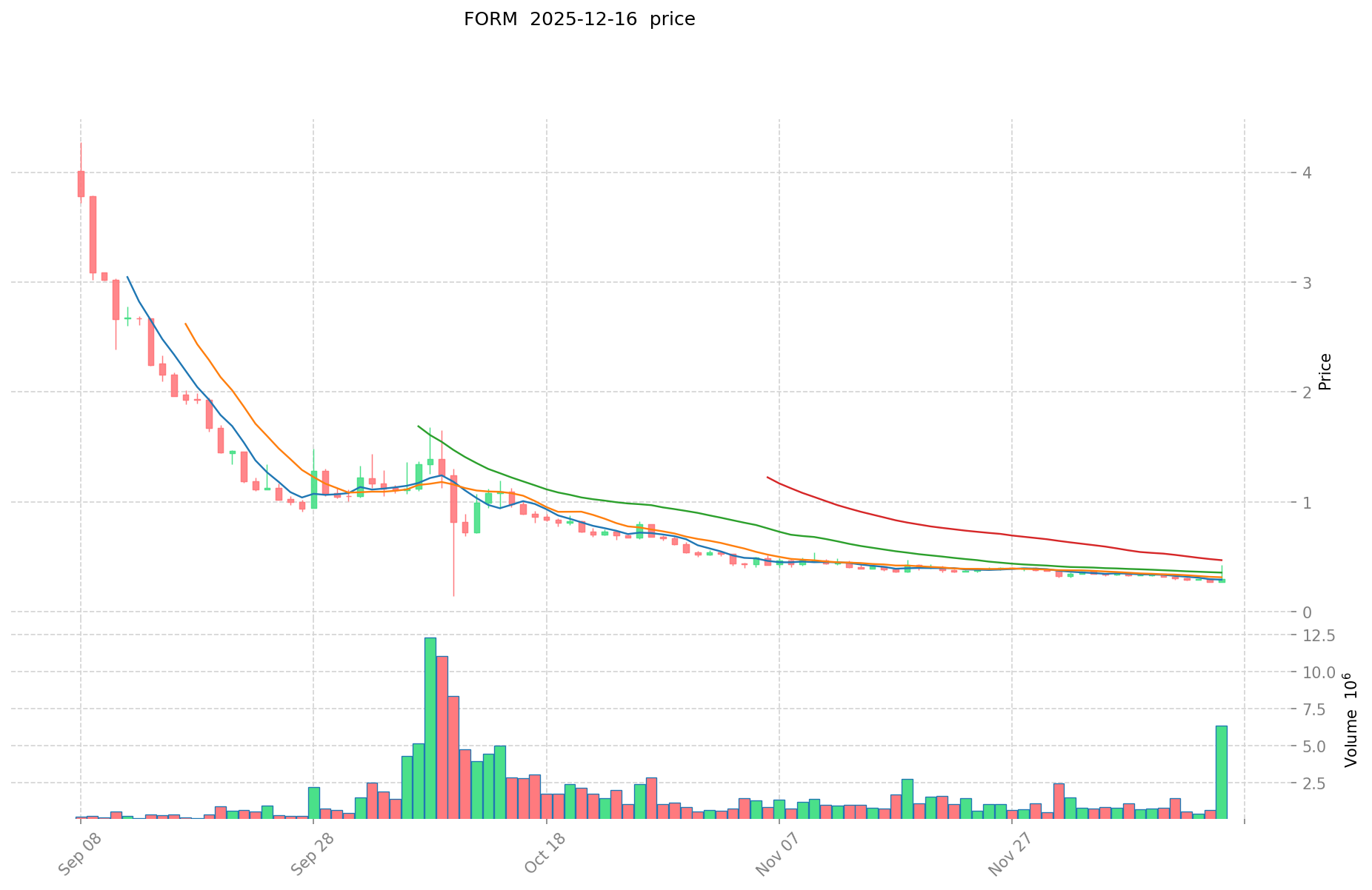
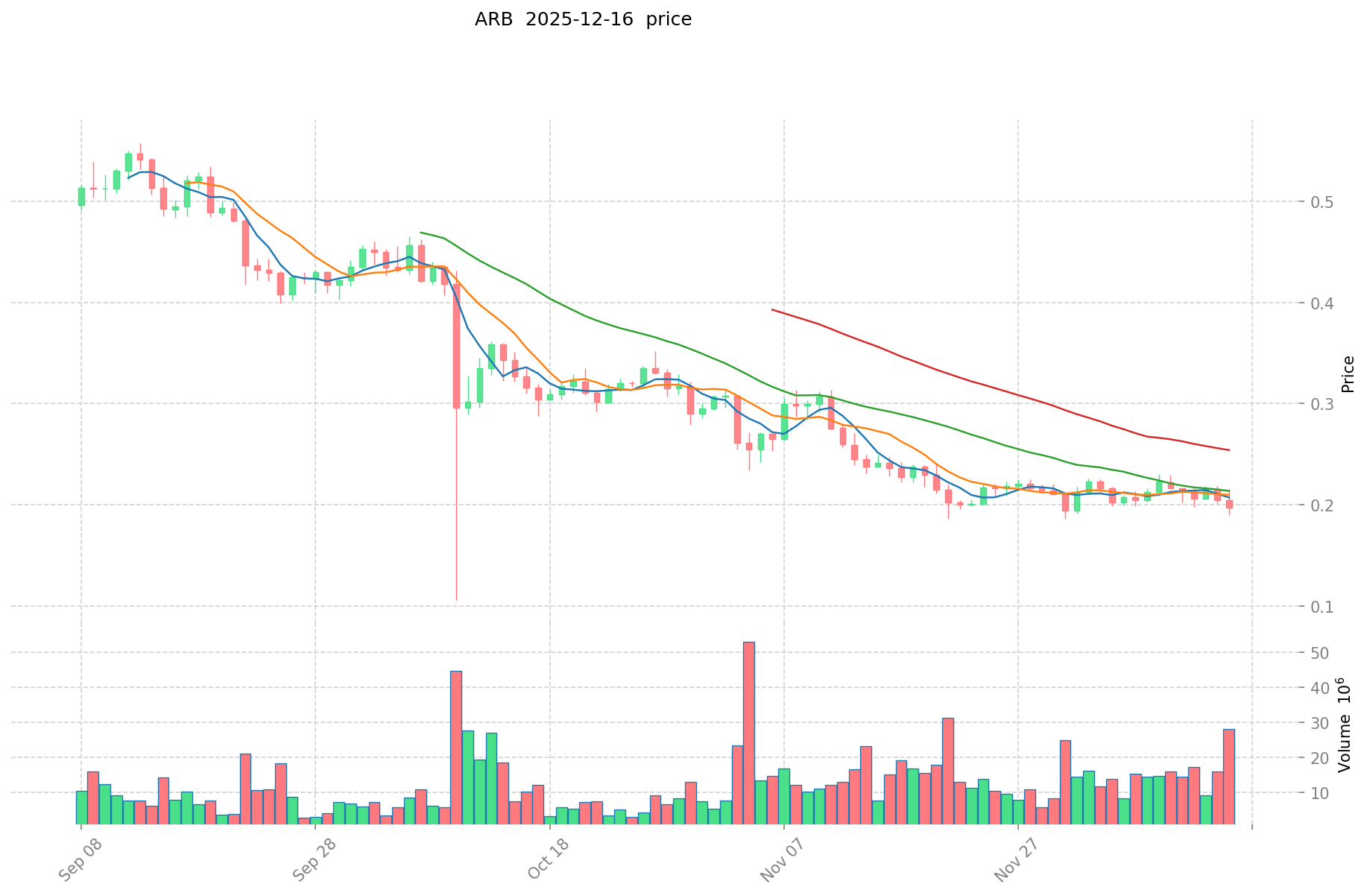
Four (FORM) and Arbitrum (ARB) Historical Price Trends
Four (FORM):
- Historical high: $4.19 (August 10, 2025)
- Historical low: $0.143 (February 3, 2025)
- Price range: Experienced significant volatility with approximately 29x movement from low to high
Arbitrum (ARB):
- Historical high: $2.39 (January 12, 2024)
- Historical low: $0.187 (December 2, 2025)
- Price range: Significant decline from peak, with approximately 12.8x downside movement from historical high
Comparative Analysis: Four (FORM) demonstrates more recent price volatility within 2025, having achieved its peak in August before moderating. Arbitrum (ARB), conversely, has been in a prolonged downtrend since its January 2024 peak, reflecting sustained pressure on the Layer 2 scaling solution token over the past two years.
Current Market Status (December 17, 2025)
Price Metrics:
- Four (FORM): $0.4237
- Arbitrum (ARB): $0.2003
24-Hour Performance:
- Four (FORM): +42.64% in 24 hours; 24-hour volume: $3,669,609.96
- Arbitrum (ARB): +2.87% in 24 hours; 24-hour volume: $3,113,733.77
Market Capitalization:
- Four (FORM): $161,797,156.00 (circulating); $242,484,324.35 (fully diluted valuation)
- Arbitrum (ARB): $1,125,315,211.25 (circulating); $2,003,000,000.00 (fully diluted valuation)
Market Sentiment: Cryptocurrency Fear & Greed Index: 11 (Extreme Fear)
Check Real-Time Prices:
- View FORM current price: https://www.gate.com/price/four-form
- View ARB current price: https://www.gate.com/price/arbitrum-arb
II. Seven-Day and Extended Timeframe Performance
Four (FORM) - Multi-Period Returns:
- 1 hour: +2.12%
- 24 hours: +42.64%
- 7 days: +23.65%
- 30 days: +11.68%
- 1 year: -18.00%
Arbitrum (ARB) - Multi-Period Returns:
- 1 hour: -0.35%
- 24 hours: +2.87%
- 7 days: -9.73%
- 30 days: -13.51%
- 1 year: -80.33%
Key Observations: Four (FORM) exhibits positive momentum across most timeframes except the year-to-date period, suggesting recent recovery from oversold conditions. Arbitrum (ARB) shows significant weakness across weekly, monthly, and annual metrics, indicating sustained bearish sentiment and substantial value erosion over the past year.
III. Project Overview and Utility
Four (FORM)
Project Description: Four (FORM) is a rebranded version of the former BinaryX (BNX) token, representing a significant evolution in the project's strategic vision. The token serves as an integral component of the Four.meme fair launch platform, which was incubated and launched on July 3, 2024.
Ecosystem Focus:
- GameFi applications
- IGO (Initial Game Offering) Launchpads
- Decentralized Finance (DeFi) solutions
- Part of the broader BNB Chain DeFi ecosystem
Token Metrics:
- Circulating supply: 381,867,255.14 tokens (66.72% of total)
- Total supply: 572,301,922 tokens
- Maximum supply: 580,000,000 tokens
- Market ranking: #255
Arbitrum (ARB)
Project Description: Arbitrum is an Ethereum Layer 2 scaling solution enabling high-throughput, low-cost smart contracts while maintaining trustless security. The protocol operates through optimistic rollup technology, consolidating multiple transactions into a single on-chain transaction to reduce costs and improve scalability.
Technical Architecture:
- Three operational modes: AnyTrust Channels, AnyTrust Sidechains, and Arbitrum Rollup
- Achieves up to 40,000 transactions per second throughput
- ARB serves as the governance token for the Arbitrum ecosystem
Token Metrics:
- Circulating supply: 5,618,148,833 tokens (56.18% of total)
- Total supply: 10,000,000,000 tokens
- Maximum supply: 10,000,000,000 tokens
- Market ranking: #75
IV. Ecosystem Activity and Market Positioning
Four (FORM):
- Exchange listings: 28 platforms
- Token holders: 14,383
- Blockchain: BSC (Binance Smart Chain)
- Market share: 0.0076%
Arbitrum (ARB):
- Exchange listings: 61 platforms
- Token holders: 60,160
- Multi-chain presence: Ethereum and Arbitrum networks
- Market share: 0.063%
Comparative Scale: Arbitrum maintains significantly broader market adoption with 4.2x more holders and 2.2x greater exchange listing coverage. The market capitalization differential reflects Arbitrum's established position as a major Layer 2 scaling solution, while Four (FORM) remains substantially smaller in market valuation despite recent percentage gains.
V. Risk Considerations
Market Sentiment Context: The current Fear & Greed Index reading of 11 (Extreme Fear) indicates heightened market anxiety and potential capitulation. This sentiment environment affects all cryptocurrencies, particularly those with recent volatility or longer-term downtrends.
Volatility Profile:
- Four (FORM): Recent 24-hour gain of 42.64% demonstrates high volatility and potential for sharp reversals
- Arbitrum (ARB): Sustained year-long decline of 80.33% reflects extended bearish pressure
VI. Data Sources and References
- Primary data source: GateData market data as of December 17, 2025, 06:12-06:16 UTC
- Cryptocurrency Fear & Greed Index: December 16, 2025
- Contract addresses: BSC (Four) and Ethereum/Arbitrum networks (Arbitrum)
- Official resources:
- Four: https://www.binaryx.pro
- Arbitrum: https://arbitrum.io, https://arbitrum.foundation
Arbitrum (ARB) Investment Value Analysis Report
I. Executive Summary
ARB serves as the governance token for Arbitrum, a Layer 2 scaling solution built on Ethereum. Its investment value derives from its role in enabling lower transaction fees, faster transaction processing, and incentivizing network participation compared to Ethereum's mainnet.
II. Core Factors Influencing ARB Investment Value
Supply Mechanism and Tokenomics
-
ARB Token Structure: ARB operates as a governance and utility token within the Arbitrum ecosystem. The token's value proposition is fundamentally tied to the network's transaction activity and the extraction of value from maximal extractable value (MEV) profits.
-
📌 Historical Pattern: The sustainability of ARB's value depends on maintaining current activity levels on Arbitrum. As MEV profits accumulate within the network, the value capture mechanisms for ARB token holders strengthen accordingly.
Institutional Adoption and Market Application
-
Network Utility: ARB's primary function centers on incentivizing network participation and transaction processing within the Arbitrum Layer 2 solution.
-
Ecosystem Development: Layer 2 solutions like Arbitrum are critical infrastructure for scaling Ethereum's network, which enhances the practical utility of the underlying token.
Macroeconomic and Market Cycle Factors
- Layer 2 Ecosystem Maturation: The Layer 2 sector represents an evolving segment within crypto markets, with tokenomics increasingly focused on capturing sustainable utility value rather than relying solely on transaction fee mechanisms.
III. Investment Considerations
Technology Foundation
- ARB's value is anchored to Ethereum's smart contract technology, which ensures transaction transparency and security within the Layer 2 framework.
Network Activity Dependency
The token's valuation demonstrates direct correlation with on-chain activity levels. Sustained or growing transaction volumes on Arbitrum directly strengthen ARB's value proposition as a claim on future value accumulation sources within the network.
Market Dynamics
ARB represents exposure to the Layer 2 scaling narrative. Investors in Layer 2 tokens focus more specifically on the utility and adoption of that particular Layer 2 solution, as opposed to broader Ethereum ecosystem exposure.
IV. Conclusion
ARB's investment value is fundamentally defined by Arbitrum's network adoption, transaction volume sustainability, and the protocol's ability to capture and distribute MEV-derived value. The token functions as a direct claim on future value accumulation mechanisms within the Arbitrum ecosystem rather than serving as a general-purpose currency or store of value.
III. 2025-2030 Year Price Prediction: FORM vs ARB
Short-term Prediction (2025)
- FORM: Conservative $0.333138-$0.4271 | Optimistic $0.478352
- ARB: Conservative $0.115884-$0.1998 | Optimistic $0.23976
Mid-term Prediction (2027-2028)
- FORM may enter consolidation phase with price range $0.443362-$0.6030989409, supported by ecosystem maturation and growing adoption
- ARB may enter steady growth phase with price range $0.152406441-$0.30476738754, driven by protocol upgrades and developer activity
- Key drivers: institutional capital inflow, spot/futures ETF approvals, layer-2 scaling solutions, and DeFi ecosystem expansion
Long-term Prediction (2030)
- FORM: Base case $0.809173475129098-$0.86082284588202 | Optimistic scenario $1.067420328893704
- ARB: Base case $0.28496674272528-$0.2999649923424 | Optimistic scenario $0.347959391117184
Disclaimer: Price predictions are based on historical data analysis and market models. Actual prices may deviate significantly from forecasts due to regulatory changes, market sentiment shifts, technological developments, and macroeconomic factors. This analysis is for informational purposes only and does not constitute investment advice. Investors should conduct independent research and consult financial advisors before making investment decisions.
FORM:
| 年份 | 预测最高价 | 预测平均价格 | 预测最低价 | 涨跌幅 |
|---|---|---|---|---|
| 2025 | 0.478352 | 0.4271 | 0.333138 | 0 |
| 2026 | 0.67456174 | 0.452726 | 0.4300897 | 6 |
| 2027 | 0.6030989409 | 0.56364387 | 0.5467345539 | 33 |
| 2028 | 0.863389680066 | 0.58337140545 | 0.443362268142 | 37 |
| 2029 | 0.99826514900604 | 0.723380542758 | 0.49189876907544 | 70 |
| 2030 | 1.067420328893704 | 0.86082284588202 | 0.809173475129098 | 103 |
ARB:
| 年份 | 预测最高价 | 预测平均价格 | 预测最低价 | 涨跌幅 |
|---|---|---|---|---|
| 2025 | 0.23976 | 0.1998 | 0.115884 | 0 |
| 2026 | 0.2351646 | 0.21978 | 0.1230768 | 9 |
| 2027 | 0.234296469 | 0.2274723 | 0.152406441 | 13 |
| 2028 | 0.30476738754 | 0.2308843845 | 0.19394288298 | 15 |
| 2029 | 0.3321040986648 | 0.26782588602 | 0.2517563328588 | 33 |
| 2030 | 0.347959391117184 | 0.2999649923424 | 0.28496674272528 | 49 |
Comparative Investment Analysis: FORM vs ARB
I. Investment Strategy Comparison: FORM vs ARB
Long-term vs Short-term Investment Strategies
Four (FORM):
- Suitable for investors focused on emerging GameFi ecosystem participation and fair launch platform adoption within the BNB Chain DeFi ecosystem
- Short-term traders may capitalize on high volatility patterns (recent 24-hour gains of 42.64%)
- Medium-term positioning aligns with ecosystem maturation and institutional capital inflow timelines
Arbitrum (ARB):
- Suitable for investors seeking exposure to established Layer 2 scaling infrastructure with foundational utility anchored to Ethereum's network
- Long-term positioning targets sustained transaction volume growth and MEV value capture mechanisms
- Conservative investors may view current depressed valuation (80.33% decline from January 2024 peak) as potential accumulation opportunity
Risk Management and Asset Allocation
Conservative Investor Profile:
- FORM: 20-30% allocation (higher growth potential offset by smaller market cap and recent emergence)
- ARB: 70-80% allocation (established infrastructure, larger market cap of $1.13B, institutional adoption)
Aggressive Investor Profile:
- FORM: 50-70% allocation (targeting volatility capture and early-stage ecosystem gains)
- ARB: 30-50% allocation (Layer 2 scaling thesis exposure with reduced downside risk relative to current valuations)
Hedging Instruments:
- Stablecoin allocation (15-25% of portfolio) for volatility buffer given Fear & Greed Index reading of 11
- Cross-asset diversification across Layer 2 ecosystem tokens to reduce single-protocol risk
- Consider options strategies during extreme volatility periods to manage downside exposure
II. Comparative Risk Analysis
Market Risk
Four (FORM):
- Extreme intraday volatility: 42.64% 24-hour movement creates significant liquidation risk for leveraged positions
- Limited market liquidity relative to position size: 14,383 token holders concentrate holder distribution
- Rebranding risk: Transition from BinaryX (BNX) may carry uncertain market perception and adoption challenges
Arbitrum (ARB):
- Sustained bearish pressure: 80.33% year-to-date decline reflects prolonged value erosion and potential loss of investor confidence
- Layer 2 competition risk: Alternative scaling solutions (Optimism, Polygon, zkSync) compete for transaction volume and developer adoption
- Ethereum dependency: ARB's utility directly correlates with Ethereum network conditions and L2 demand cycles
Technology Risk
Four (FORM):
- Smart contract audit status and security framework not specified in available documentation
- Platform dependency: Fair launch mechanism requires sustained operational reliability of Four.meme infrastructure
- GameFi sector-specific risks: Game development timelines, player adoption, and token utility within gaming applications remain nascent
Arbitrum (ARB):
- Optimistic rollup architecture: Assumes honest validator participation; potential vulnerability if majority validator collusion occurs
- Bridge security: Cross-chain messaging between Layer 2 and Ethereum mainnet represents potential attack surface
- Network scalability: While designed for 40,000 transactions per second, actual sustained throughput under stress conditions requires ongoing monitoring
Regulatory Risk
- Global Regulatory Environment: Both tokens face potential restrictions from jurisdictions implementing stricter crypto asset classification requirements
- Governance Token Classification: ARB's explicit governance function may attract heightened regulatory scrutiny compared to utility-focused FORM
- DeFi Compliance: Four.meme's IGO launchpad activities may face evolving regulatory requirements around token offerings and investor protection
- Layer 2 Infrastructure: Arbitrum's positioning as critical Ethereum scaling infrastructure may receive different regulatory treatment than speculative gaming tokens
III. 2025-2030 Price Projection Analysis
FORM Price Forecasts
| Year | High Projection | Average Projection | Low Projection | Expected Change |
|---|---|---|---|---|
| 2025 | $0.478352 | $0.4271 | $0.333138 | Baseline |
| 2026 | $0.67456174 | $0.452726 | $0.4300897 | 6% |
| 2027 | $0.6030989409 | $0.56364387 | $0.5467345539 | 33% |
| 2028 | $0.863389680066 | $0.58337140545 | $0.443362268142 | 37% |
| 2029 | $0.99826514900604 | $0.723380542758 | $0.49189876907544 | 70% |
| 2030 | $1.067420328893704 | $0.86082284588202 | $0.809173475129098 | 103% |
ARB Price Forecasts
| Year | High Projection | Average Projection | Low Projection | Expected Change |
|---|---|---|---|---|
| 2025 | $0.23976 | $0.1998 | $0.115884 | Baseline |
| 2026 | $0.2351646 | $0.21978 | $0.1230768 | 9% |
| 2027 | $0.234296469 | $0.2274723 | $0.152406441 | 13% |
| 2028 | $0.30476738754 | $0.2308843845 | $0.19394288298 | 15% |
| 2029 | $0.3321040986648 | $0.26782588602 | $0.2517563328588 | 33% |
| 2030 | $0.347959391117184 | $0.2999649923424 | $0.28496674272528 | 49% |
Key Drivers for Mid-term Growth (2027-2028)
- Institutional capital inflow through spot and futures ETF approvals
- Layer 2 scaling solutions expansion and Ethereum ecosystem development
- DeFi ecosystem maturation and total value locked (TVL) growth
- GameFi adoption cycles and mainstream gaming integration (FORM-specific)
IV. Investment Value Summary and Recommendations
📌 Investment Value Summary
Four (FORM) Advantages:
- Recent strong momentum with 42.64% 24-hour performance and positive 7-day/30-day returns
- Emerging ecosystem positioned in high-growth GameFi and fair launch sectors
- Projected 103% growth potential by 2030 from current base case
- Lower market capitalization allows for substantial percentage gains with capital influx
- Integration within BNB Chain DeFi ecosystem provides infrastructure support
Arbitrum (ARB) Advantages:
- Established Layer 2 scaling infrastructure with proven transaction throughput (40,000 TPS capacity)
- Significantly larger market capitalization ($1.13B) and broader adoption (60,160 token holders)
- Critical infrastructure positioning within Ethereum ecosystem reduces obsolescence risk
- 61 exchange listings provide superior liquidity and accessibility
- Potential recovery from 80.33% decline offers asymmetric risk-reward opportunity
✅ Investment Recommendations
Beginner Investors:
- Prioritize Arbitrum (ARB) for foundational exposure to established Layer 2 infrastructure
- Allocate 70-80% to ARB given lower volatility relative to FORM and proven ecosystem utility
- Use remaining 20-30% for speculative FORM positioning to capture early-stage ecosystem growth
- Implement dollar-cost averaging strategy to mitigate entry timing risk in current extreme fear environment (Fear & Greed Index: 11)
Experienced Investors:
- Consider tactical FORM accumulation during volatility pullbacks, targeting high-probability support levels
- Implement paired trading strategy: Long ARB for infrastructure exposure, short-term FORM momentum plays for portfolio alpha generation
- Utilize options strategies on FORM to capture realized volatility while managing downside exposure through protective puts
- Monitor Layer 2 competitive dynamics; rotate between ARB and alternative L2 solutions based on developer activity and TVL trends
Institutional Investors:
- ARB represents primary allocation target due to liquidity depth (61 exchange listings) and alignment with infrastructure investment thesis
- Establish positions across multiple Layer 2 protocols (including ARB) rather than single-solution concentration
- Integrate FORM exposure as emerging ecosystem play within diversified GameFi allocation framework (maximum 15-20% of gaming token exposure)
- Establish governance participation in ARB through token delegation to influence protocol development roadmap
- Conduct quarterly rebalancing based on Layer 2 ecosystem share (ARB's percentage of Layer 2 TVL relative to peers)
V. Critical Disclaimers and Risk Warnings
⚠️ Risk Notice: Cryptocurrency markets demonstrate extreme volatility. Price predictions presented are based on historical data modeling and do not constitute guarantees. Actual prices may deviate substantially from forecasts due to:
- Regulatory policy shifts and enforcement actions
- Macroeconomic market sentiment reversals
- Technological developments and security incidents
- Protocol upgrades affecting token utility functions
This analysis is provided for informational purposes only and does not constitute investment advice, financial recommendations, or solicitation to purchase cryptocurrency assets. Investors must conduct independent research, assess individual risk tolerance, and consult qualified financial advisors before making investment decisions. Cryptocurrency investments carry substantial risk of total loss. None
FAQ: Four (FORM) vs Arbitrum (ARB) Investment Comparison
I. Which token offers better short-term investment potential: FORM or ARB?
Answer: Four (FORM) demonstrates superior short-term momentum, having gained 42.64% in the past 24 hours and 23.65% over 7 days as of December 17, 2025. However, this volatility presents both opportunity and risk. Arbitrum (ARB) shows minimal short-term momentum at +2.87% (24-hour) but represents a more stable entry point for risk-averse traders. Short-term traders seeking high volatility should consider FORM, while conservative investors should prioritize ARB's established infrastructure and lower intraday volatility profile.
II. What are the fundamental differences in token utility between FORM and ARB?
Answer: Four (FORM) functions as a governance and utility token within the Four.meme fair launch platform, serving the GameFi, IGO launchpad, and BNB Chain DeFi ecosystem. Arbitrum (ARB) serves as the governance token for Arbitrum Layer 2 scaling solution, enabling high-throughput transactions and MEV value capture. ARB's utility is anchored to Ethereum infrastructure and transaction volume, while FORM's utility depends on GameFi ecosystem adoption and platform activity. This represents a fundamental difference: ARB represents scaling infrastructure exposure, while FORM represents emerging gaming economy participation.
III. How significant is the market capitalization difference between these two tokens?
Answer: The disparity is substantial. Arbitrum (ARB) maintains a circulating market capitalization of $1.125 billion compared to Four (FORM) at $161.8 million—approximately 6.95x larger. ARB's fully diluted valuation reaches $2.003 billion versus FORM's $242.5 million. This capitalization gap reflects ARB's established position as critical Layer 2 infrastructure with 60,160 token holders versus FORM's 14,383 holders. Larger market capitalization provides ARB with superior liquidity (61 exchange listings vs. FORM's 28) and reduced slippage risk during large position entry or exit.
IV. What does the 80.33% year-to-date decline in ARB suggest about future recovery potential?
Answer: Arbitrum's sustained bearish pressure since January 2024 indicates prolonged loss of investor confidence, yet creates potential asymmetric recovery opportunity. The extreme decline may reflect sector rotation from Layer 2 solutions or macro market headwinds rather than fundamental protocol failure—Arbitrum maintains robust technical infrastructure with 40,000 transactions-per-second capacity and strong developer adoption. The 2030 price projection suggests 49% potential upside from current levels under base-case scenarios. However, recovery is not guaranteed; the token faces competition from alternative L2 solutions (Optimism, Polygon, zkSync) that may capture developer and user activity share.
V. What is the significance of FORM's recent rebranding from BinaryX (BNX)?
Answer: The rebranding to Four (FORM) represents strategic repositioning toward the GameFi and fair launch platform narrative. The transition from BinaryX introduced the Four.meme platform launched July 3, 2024, expanding beyond its original positioning. While rebrandings can enhance market perception and attract new investor cohorts, they introduce adoption uncertainty. Current price momentum suggests positive market reception, but investors should monitor whether the rebranding translates into sustained platform adoption, growing total value locked (TVL), and increasing transaction volume within the Four.meme ecosystem to validate the strategic pivot's success.
VI. Given the extreme fear market sentiment (Fear & Greed Index: 11), which token offers better downside protection?
Answer: Arbitrum (ARB) provides superior downside protection despite its 80.33% decline. Its larger market capitalization ($1.125B), broader adoption (60,160 holders across 61 exchanges), and infrastructure utility create structural support. FORM's extreme 42.64% 24-hour volatility in a fear-driven market increases liquidation risk and potential sharp reversals. For capital preservation in extreme fear environments, ARB's established infrastructure and institutional adoption provide psychological and technical support. Consider allocating 70-80% to ARB and 20-30% to FORM for conservative investors seeking downside protection while maintaining exposure to higher-growth opportunities.
VII. What investment time horizon should I consider based on the 2025-2030 price projections?
Answer: The projections suggest different optimal holding periods: FORM projects 103% potential growth by 2030 (base case) with meaningful gains materializing from 2027-2030 as ecosystem maturation occurs; this requires 3-5 year holding capacity. Arbitrum projects 49% growth by 2030, indicating a longer consolidation and recovery pattern aligned with Layer 2 infrastructure development cycles. For short-term traders (< 3 months), FORM's volatility offers tactical opportunities. For medium-term investors (1-3 years), position-weighted averaging into both tokens captures potential ecosystem expansion. For long-term investors (5+ years), ARB represents more conservative infrastructure exposure while FORM represents speculative emerging ecosystem participation. Current extreme fear environment (Index: 11) may provide favorable accumulation timing across both assets regardless of time horizon.
VIII. How should macroeconomic and regulatory developments affect my allocation between FORM and ARB?
Answer: Macroeconomic factors differentially impact both tokens. Institutional capital inflow through spot/futures ETF approvals would disproportionately benefit ARB given its established infrastructure status and larger market accessibility. Conversely, gaming industry growth cycles and mainstream GameFi adoption would support FORM's expansion. Regulatory developments present asymmetric risks: ARB's explicit governance function may attract heightened regulatory scrutiny as a voting mechanism, while FORM's IGO launchpad activities face evolving token offering regulations. Recommend maintaining quarterly rebalancing based on regulatory announcements, Layer 2 ecosystem developments (ARB's TVL share among L2 solutions), and macroeconomic conditions. A 70% ARB / 30% FORM allocation provides infrastructure exposure while allowing tactical rebalancing toward speculative gaming exposure during favorable regulatory or economic conditions.
Share
How to Buy Cryptocurrency


Trending Cryptocurrencies



XZXX: A Comprehensive Guide to the BRC-20 Meme Token in 2025

Bitcoin Fear and Greed Index: Market Sentiment Analysis for 2025

Top Crypto ETFs to Watch in 2025: Navigating the Digital Asset Boom

5 ways to get Bitcoin for free in 2025: Newbie Guide

Bitcoin Market Cap in 2025: Analysis and Trends for Investors
2025 Bitcoin Price Prediction: Trump's Tariffs' Impact on BTC
Elon Musk's Cryptocurrency Portfolio: A 2025 Insight

Exploring Covalent's Blockchain Data Platform: An In-Depth Look at CXT Token
Paxful Review 2023: Features, Security, and User Experience
Mastering Web3 Wallet Management: A Guide for Using Tezos Platforms

Understanding Circulating Supply: A Key Metric in Crypto Economy