Breaking the Market Cycle? Tom Lee Says the Crypto “Supercycle” Has Arrived, With Ethereum Potentially Targeting $62,000
Tom Lee: Crypto Market Breaks the “Four-Year Cycle” as Ethereum Advances Toward Financial Infrastructure Leadership
At Binance Blockchain Week in December 2025, prominent Wall Street strategist and Fundstrat founder Tom Lee declared that the cryptocurrency market has moved beyond the traditional “four-year cycle.” The previous model—driven by halving events, retail sentiment, and alternating bull and bear phases—is now giving way to new structural forces.
Lee believes the market has already bottomed out, and a new growth cycle that will shape the next decade is just beginning.
He points out that the market’s current momentum is fueled not by short-term speculation or rotating themes, but by three decisive, long-term drivers: sustained institutional capital inflows, larger-scale portfolio allocations, and the rapid tokenization of real-world assets. These forces are fundamentally reshaping the way the crypto market operates.
Why Ethereum Is Considered “Next-Generation Financial Infrastructure”
In Lee’s view, Ethereum’s significance goes far beyond its identity as a crypto asset. It is the foundational layer powering the next wave of financial infrastructure, including smart contracts, DeFi, stablecoin settlement, and real-world asset tokenization (RWA).
As traditional assets—such as securities, real estate, fund shares, bonds, and various financial rights—are increasingly represented and managed on-chain, demand for ETH is shifting from speculative trading to essential settlement needs. Lee also highlights a critical but often overlooked fact: most traditional institutions currently have zero exposure to crypto assets. If their allocation rises from 0 to 1% or 2%, the influx of new capital would be transformative for the entire market.
ETH’s Path to $62,000: What Must Happen First?
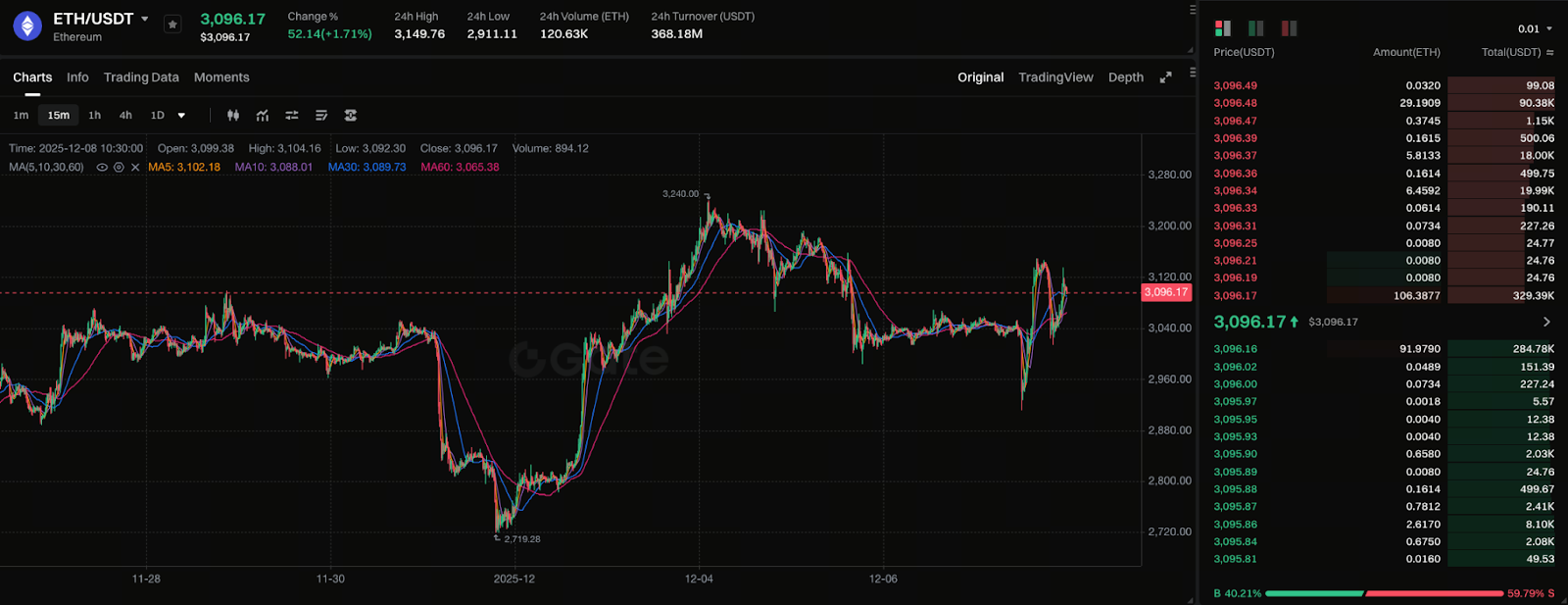
Chart: https://www.gate.com/trade/ETH_USDT
Regarding the much-anticipated ETH price target of $62,000, Lee lays out specific prerequisites. This isn’t a speculative guess; it’s a projection founded on several critical variables coming together:
First, the market must enter a genuine “supercycle.” This involves not only continuous institutional inflows but potentially sovereign wealth participation, making crypto assets a core part of global investment portfolios.
Second, Ethereum’s network fundamentals need to show sustained improvement. Factors such as on-chain transaction volume, DeFi application growth, stablecoin settlement activity, and the pace of real-world asset tokenization must all rise in tandem to drive ETH’s intrinsic value.
Third, this rally should not hinge on a single catalyst. Unlike past cycles driven by halving events or retail sentiment, the current cycle is rooted in institutional reform, asset structure transformation, and upgrades to financial infrastructure.
Lee believes ETH could move from its current multi-thousand-dollar range toward the ambitious $62,000 mark only if all these conditions are met.
Market Skepticism and Real Risks That Can’t Be Ignored
Of course, not everyone is convinced. Many analysts argue that the $62,000 target is more of an ideal scenario, contingent on:
- Large-scale adoption of real-world asset tokenization
- Widespread institutional integration of crypto assets
- Structural migration within the global financial system
If any of these elements fall behind, the target could be delayed or even rendered unattainable.
Macro conditions also play a crucial role. Interest rate shifts, liquidity constraints, regulatory policy changes, and geopolitical risks can all have systemic effects on the crypto market. Even Tom Lee repeatedly stresses that crypto assets never operate in isolation—they are always subject to the broader global macro cycle.
In reality, the current scale of ETH’s on-chain transactions, application activity, and progress with RWA adoption remains far from the vision of a “global financial infrastructure.” Achieving multi-trillion-dollar valuations in the short term is still limited by practical constraints.
How Should Investors Approach This Forecast Rationally?
For most investors, Tom Lee’s perspective should be treated as an extremely optimistic long-term framework, not as a short-term price guarantee.
The real focus for long-term tracking isn’t a single price target, but whether these key trends continue to unfold:
- Is real-world asset tokenization entering a phase of meaningful scale?
- Are institutional and traditional capital flows consistently increasing?
- Is genuine demand for Ethereum network usage growing in step?
If you’re considering ETH, the prudent approach is to view it as one of several high-volatility, high-potential long-term allocations—not as an all-in bet.
Maintaining a diversified portfolio, managing positions wisely, setting clear profit-taking and stop-loss levels, and closely monitoring macro policy and liquidity developments remain essential for successfully navigating market cycles.
Share
Content
Tom Lee: Crypto Market Breaks the “Four-Year Cycle” as Ethereum Advances Toward Financial Infrastructure Leadership
Why Ethereum Is Considered “Next-Generation Financial Infrastructure”
ETH’s Path to $62,000: What Must Happen First?
Market Skepticism and Real Risks That Can’t Be Ignored
How Should Investors Approach This Forecast Rationally?


Related Articles

2025 BTC Price Prediction: BTC Trend Forecast Based on Technical and Macroeconomic Data

Pi Coin Transaction Guide: How to Transfer to Gate.com

Flare Crypto Explained: What Is Flare Network and Why It Matters in 2025

How to Use a Crypto Whale Tracker: Top Tool Recommendation for 2025 to Follow Whale Moves

What is N2: An AI-Driven Layer 2 Solution